
Unlocking Innovation: Business Analyst’s Role

Business Analyst innovation role

Introduction:

Ever wonder why some companies keep coming up with amazing ideas while others just stay the same? The key often lies in a powerful hidden force within the organization: the Business Analyst. These people aren’t just recorders of what others sayβ€”they are the builders of new ideas, driving forwardthinking plans and finding great solutions.

People often think Business Analysts just write down what users want.
But the truth is, they do much more. They ask why things are done a certain way. This helps uncover deeper needs that lead to big changes instead of small fixes.

Take a mobile banking company that wanted to add another step to log in because many customers were giving up halfway.
Instead of just noting that need, the Business Analyst talked to customers and studied how they used the app. They found that the real problem wasn’t securityβ€”it was slow page loads. So they switched to a biometric login instead of multiple screens.

Result: 43% more successful logins.

This shows that Business Analysts aren’t just writers of requirementsβ€”they are the ones who trigger real change.

Innovation by itself isn’t enough.
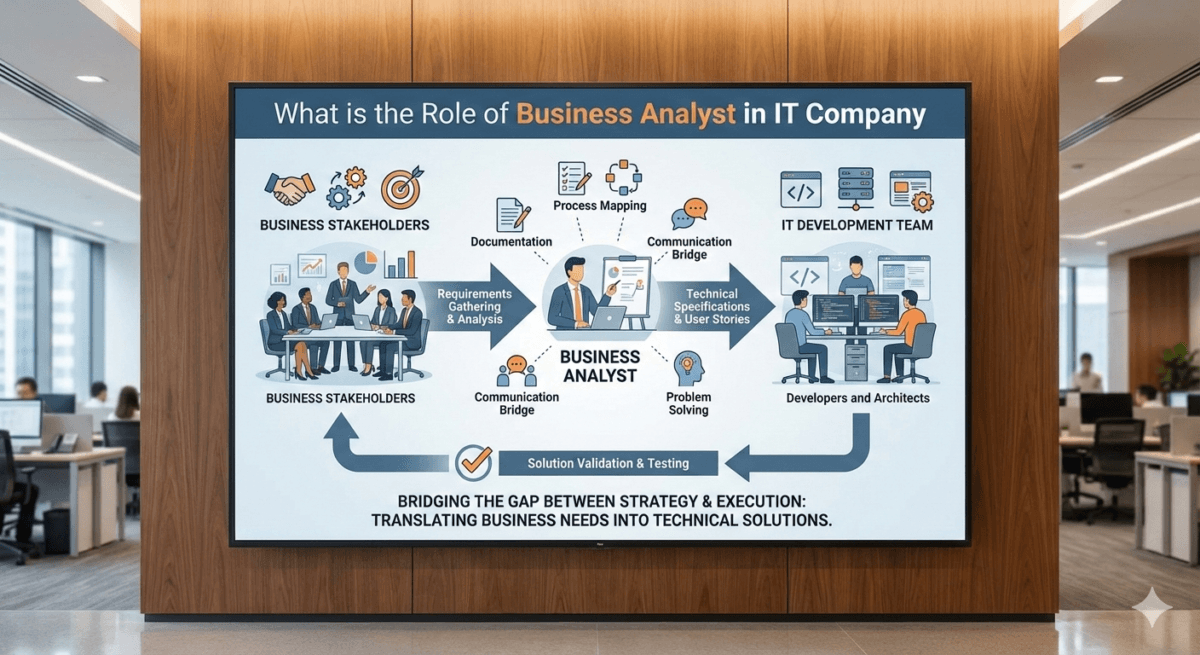
To make it work, you need to turn ideas into action. That’s where the Business Analyst steps in as a bridge between what’s imagined and what gets built.

They help teams break big ideas into:

Clear business goals
Specific scope
Measurable success
Feasible paths to follow

Also, they make sure all voices are heard.
In meetings, they create a safe space for people to share ideas, even if they are shy or unsure.

To know if an idea works, they use data.
They look at:

Customer behavior
What competitors are doing
Trends in the market

This helps decide which ideas are worth pursuing.

For example, a retail chain wanted to offer a virtual try-on experience.
The Business Analyst checked browsing data and trend reports to find which products would be most popular. They found beauty and eyewear would sell more quickly than clothes.
Result: The company launched in those areas and got 6 times faster returns on investment.

Using Design Thinking is becoming a big part of what modern Business Analysts do.
It helps find new ideas that are both creative and practical.

Here’s how they use it:

– **Empathize**: Talk to customers and map out their experiences
– **Define**: Find the real problem and understand what needs fixing
– **Ideate**: Help think of new ideas and options
– **Prototype**: Make simple models or demos to test ideas
– **Test**: Get real feedback and choose what works best

They run workshops to brainstorm new ideas, map out user journeys to find problems, and test prototypes quickly.
Instead of waiting for the β€œperfect” plan, they try things out fast, learn from what works, and make changes often.

AI and automation are not taking the place of Business Analystsβ€”they are helping them do better work.
They use tools like:

Predictive analytics to find what customers might need next
Machine learning to discover patterns and trends
Automation to handle repetitive tasks, freeing up time for strategic thinking

A logistics company once had late deliveries.
Instead of hiring more people, the Business Analyst used AI to improve delivery routes.
Result: Fewer late deliveries without hiring more workers.

To stay ahead, modern Business Analysts need skills in:

– Data analysis
Tools like Power BI and Tableau
Basics of automation
Using AI to gather requirements and create quick prototypes

Here’s a path to becoming an innovative Business Analyst:
Start asking β€œwhy” instead of just β€œwhat.”
Be part of innovation projects and workshops.
Learn and use Design Thinking.
Build skills in analysis, automation, and AI.
Think about customers more than just what they need.
Follow innovation and Business Analyst communities for ongoing learning.

Business Analysts who focus on innovation move up to roles like Product Manager, Innovation Strategist, Digital Transformation Consultant, or Business Architect.
Companies look for these kinds of BAs because they bring real value to the business.

Conclusion

Innovation isn’t born from creativity alone β€” it comes from analytically decoding real-world problems and turning insights into impactful solutions.
That makes the Business Analyst not just a participant but a driver of innovation, a strategic change leader, and a future-shaper of organizations.

The companies that dominate the future will be the ones where Business Analysts are empowered to innovate β€” not just document.

Related Articles

Β 

πŸ”— External Links

The Art of Prioritizing Product Backlogs

Product backlog prioritization

Introduction:

Are you tired of endless product backlogs that never seem to shrink?
Do your development teams feel overwhelmed and your stakeholders frustrated?

This article reveals the strategic secrets to taming your product backlogβ€”ensuring your most valuable features finally see the light of day.
Discover actionable techniques that transform chaos into clarity and boost your product development workflow efficiency.

BenefitOriented Hook

Imagine a world where your product development is always focused on highimpact features.

Where your teams are aligned.

Where every release delivers undeniable value.

That’s the power of mastering product backlog prioritization.

This guide equips Business Analysts with the tools, frameworks, and realworld strategies to optimize workflows and drive measurable organizational results.

1.The Prioritization Paradox: Why Your Backlog Is a Bottleneck

BAs Drowning in Unprioritized Backlogs
Most Business Analysts know this nightmare:
Hundreds of backlog items
No clear priorities
Stakeholders pushing their own agendas
Teams constantly asking, β€œWhat should we do first?”

A backlog is supposed to be a strategic assetβ€”but without prioritization, it becomes a dumping ground.

The Hidden Costs of β€œEverything Is Important”

When every feature is labeled as a β€œhigh priority,” nothing truly is.

This creates:

Wasted development effort
Missed deadlines
Low morale among developers
Frequent scope creep
Delayed releases
Real Scenario (BA Perspective):

A telecom BA had 230 items in the backlog.
Every departmentβ€”sales, marketing, customer serviceβ€”claimed their requests were β€œcritical.”
Result: The team built features that didn’t move the revenue needle, while highvalue capabilities were postponed for months.

Once prioritization frameworks were introduced, delivery time improved by 35%, and stakeholder conflicts decreased significantly.

Setting the Stage: How Effective Prioritization Unlocks Agile Superpowers

Prioritization leads to:

Better sprint planning
Faster releases
Improved team focus
Businessvaluedriven development
Reduced rework

For BAs, prioritization is not just a taskβ€”it’s a strategic capability that influences product success.

2.Beyond Gut Feel: Data-Driven Prioritization Frameworks

Most backlog problems happen because decisions are based on:

Emotions
Stakeholder power
Opinions
β€œQuick wins” that deliver little value

A Business Analyst must champion datadriven decisionmaking.

Let’s explore three practical frameworks.

2.1 MoSCoW Prioritization (Must, Should, Could, Won’t)
How It Works

MUST β†’ Essential features for MVP
SHOULD β†’ Important but not critical
COULD β†’ Nice-to-have
WON’T β†’ Not included now

Real BA Example:

A Healthcare BA used MoSCoW to prioritize EHR system enhancements.

Stakeholders wanted everything ASAP β€” MoSCoW helped clearly classify compliancedriven items as MUST and UX improvements as COULD.

Result:
Release planning became predictable and conflicts reduced.

2.2 RICE Framework (Reach, Impact, Confidence, Effort)
Formula:

RICE Score = (Reach Γ— Impact Γ— Confidence) / Effort

Example:

A BA evaluating two features:

Feature | Reach | Impact | Confidence | Effort | RICE Score
Promo Engine | 600 users | High | 80% | 20 days | 24
Dark Mode | 900 users | Low | 90% | 25 days | 12.96

Promo Engine wins despite lower reach.

2.3 WSJF (Weighted Shortest Job First)

Used widely in SAFe Agile environments.

Formula:

WSJF = Cost of Delay / Job Size

BA Scenario:

A BA at an insurance company used WSJF to prioritize:

A claimstatus tracker
A chatbot
A policy renewal automation tool

WSJF revealed the renewal automation had the highest business impact per unit of effort β€” helping secure stakeholder buyin.

Decision Matrix: Scoring Items Objectively

A BA can create a matrix based on:

Customer value
Revenue potential
Risk reduction
Technical feasibility
Compliance urgency

Matrix scores are then used to rank backlog items objectively.

This eliminates β€œhighest paid person’s opinion (HiPPO) decisions”.

3.Stakeholder Harmony: Aligning on Value and Vision

Prioritization is not about tools β€” it’s about people.
3.1 Mastering Stakeholder Interviews

BAs must ask questions that reveal:

True business value
Actual pain points
Cost of not implementing
Urgency vs perceived importance

Effective BA Questions:

β€œWhat will happen if we don’t build this now?”

β€œWho benefits the most from this feature?”

β€œWhat problem are we solving?”

3.2 Conflict Resolution Strategies

BAs often mediate conflicts among:

Sales
Marketing
Operations
Product
Customers

Techniques BAs Use:

Valuebased negotiation
Databacked justification
Impact analysis
Roadmap transparency
Neutral facilitation

Scenario Example:

Sales wants rapid onboarding.
Support wants fewer customer calls.
BA uses RICE scoring β†’ onboarding impacts more users β†’ gets higher priority.

3.3 Building Shared Understanding with Visual Roadmaps

Roadmaps help stakeholders see:

What’s coming
Why it’s coming
How decisions are made

Tools like:

Miro
Productboard
Aha!

Jira Roadmaps

Help align vision and reduce conflicts.

4.The Prioritization Playbook: Tips, Tools & Continuous Improvement

BA Tips for Smarter Prioritization

Reprioritize every sprint
Challenge every β€œurgent” request
Facilitate valuedriven discussions
Say β€œnot now” instead of β€œno”
Use actual data, not assumptions
Regular backlog grooming

Managing Urgent Requests

Teach stakeholders:

β€œUrgent” β‰  Immediate
Importance must be justified
Effort must be estimated
Value must be proven

Tools Every BA Should Master
Jira
Backlog ranking
Sprint planning
Epics & story linking
Roadmaps
Azure DevOps
Work item tagging
Prioritization dashboards

Dedicated Prioritization Tools
Productboard
Airfocus
Aha!

These tools offer scoring models, impact tracking, and stakeholder collaboration.

Iterative Refinement

Prioritization isn’t a one-time exerciseβ€”it evolves.

BAs should:

Review new data
Evaluate team capacity
Assess dependency changes
Rescore backlog items monthly

5.Your Prioritization Power-Up: Actionable Steps for Today

Quick Wins for BAs

Pick one framework (MoSCoW, RICE, or WSJF)
Apply it to a small part of your backlog
Share results with your Product Owner
Facilitate a 15-minute prioritization workshop

NextLevel Strategies

Become a proactive backlog manager
Use analytics for value forecasting
Build stakeholder prioritization dashboards
Run monthly backlog β€œclean-up” sessions

The Future: BAs as Strategic Navigators

Modern Business Analysts are not notetakers.

They are strategists who shape product direction.

Backlog prioritization is one of the most powerful skills a BA can use to influence:

Roadmaps
Release planning
Value delivery
Customer satisfaction

Related Articles:

Future of BA: Beyond Technical Skills in 2030

Future of Business Analyst 2030

Intoduction

Are you a Business Analyst worried that AI might take your job by 2030? Let’s be honestβ€”your technical skills alone might not be enough. The real question is, can you adapt? This article takes a closer look at the unexpected human qualities that will become the key to success for Business Analysts in the years to come, and how you can make sure your career not only survives but thrives.

Imagine it’s 2030

What if the most valuable traits for a Business Analyst aren’t what you think? Beyond coding, tools, and data models, the role is shifting toward qualities like empathy, strategy, and adaptability. Let‘s explore how the BA role is changing β€” and what you can do to stay ahead.

The Great Tech Shift: BA’s New Role

By 2030, automation and AI will have changed the way organizations work.
But contrary to what many believe, this doesn’t mean that Business Analysts will become irrelevant β€” it means their real value will finally be recognized.

Automation Takes Care of Repetitive Tasks

Routine work like gathering data, creating reports, and documenting processes is already being handled by AI tools such as ChatGPT, Power BI Copilot, and Jira automation.

Instead of being afraid of these technologies, BAs can use them to free up time and focus on strategic decisionmaking.

Example:
In a financial services firm, AI may automatically spot trends in transactions.
The BA’s role then switches from collecting that data to interpreting what it means β€” such as identifying customer behavior patterns or potential compliance risks.

AI Insights Improve Strategic Thinking

While AI can generate reports, BAs are still needed to turn those insights into real business value.
Understanding why a trend is important is something that remains uniquely human.

BAs Become Solution Architects

The Business Analyst in 2030 won’t just hand off requirements β€” they’ll help design the solutions.

They’ll act as a bridge between business goals and technical execution, collaborating with developers, product owners, and data scientists as solution architects.

Beyond the Code: Human-Centric Skills

As AI takes over the technical work, human skills will define a successful Business Analyst.

Empathy and Active Listening

Understanding user pain points goes beyond just asking questions.
BAs will need to truly listen β€” not just to what is said, but to what is meant.

Example:
When a healthcare BA interviews doctors about patient record systems, they might notice frustration with the time spent on data entry β€” uncovering a workflow problem rather than just a system bug.

Navigating Stakeholder Dynamics

By 2030, businesses will involve a wide range of teams β€” data scientists, AI engineers, UX designers, and business sponsors.

The BA’s role is to be the translator and diplomat who balances different priorities and brings the team together around a shared vision.

Persuasive Communication and Storytelling

Data alone can’t inspire change β€” stories can.

Future BAs will master the art of using data to create compelling narratives that drive decisionmaking at the highest level.

Strategic Visionaries: The BA as a Consultant

In 2030, Business Analysts will move from being taskoriented to being trusted advisors.

Identifying Opportunities, Not Just Problems

Instead of just reacting to issues, BAs will proactively spot trends and suggest new business models or digital solutions before stakeholders even ask.

Example:
A BA in the retail sector might analyze customer data and suggest using AI to offer personalized recommendations β€” directly increasing sales and customer loyalty.

Leveraging Data for Strategy

While data scientists provide analytics, the BA interprets them in terms of business goals β€” aligning insights with growth, efficiency, or customer experience.

Driving Innovation and Transformation

Business Analysts will become catalysts for change, helping organizations adopt technologies like AI, blockchain, and quantum computing.

The Agile Advantage: Adaptability is Key

Agile will continue to be the foundation of modern business analysis, but its meaning will evolve.

Thriving in FastPaced Environments

With continuous delivery models and short iteration cycles, BAs must stay agile β€” ready to pivot strategies when priorities change overnight.

Example:
In an ecommerce project, sudden regulatory changes could mean updating compliance features midsprint.
The BA ensures that the impact is assessed and priorities are reevaluated without disrupting the team‘s momentum.

Continuous Learning & Emerging Tech

The BA of 2030 will be a lifelong learner β€” from AI ethics to design thinking.
Upskilling won’t be optional β€” it’ll be essential for staying relevant.

Leading Change with Resilience

Change fatigue will be common in fast transformation projects.
BAs will act as change leaders, ensuring support and keeping team morale high through effective communication.

FutureProofing Your BA Career

To stay relevant beyond 2030, Business Analysts must embrace a growth mindset and actively contribute to the BA community.

Cultivating Lifelong Learning

Invest in ongoing certifications (like IIBA CBAP, PMI-PBA) and platforms like Coursera or LinkedIn Learning to stay ahead of emerging trends.

Networking and Community Engagement

Connect with online BA forums, LinkedIn communities, and local IIBA chapters.
These realworld connections offer exposure to different practices and open up new opportunities.

Mentoring the Next Generation

Senior BAs can futureproof their influence by mentoring junior analysts β€” sharing realworld insight that no AI can replicate.

Conclusion: The Human Edge Defines the Future

By 2030, the most successful Business Analysts won’t be those who know every tool β€” but those who connect technology with people, and data with decisions.

The future belongs to empathetic communicators, strategic thinkers, and adaptable leaders.

So don’t fear AI β€” use it.
Build the human skills machines can’t replicate, and you’ll remain indispensable in the next decade of business evolution.

These help with SEO and reader navigation within your own website:

Related Articles

BA’s Guide to Enterprise Architecture

Enterprise Architecture for Business Analysts

Introduction:

What if learning just one key idea could help you move your Business Analyst career from just collecting requirements to actually helping shape an organization‘s future? Enterprise Architecture isn’t just for “tech experts” β€” it’s a powerful strategy tool that Business Analysts need now more than ever. Discover why this knowledge is your secret weapon for unlocking new chances and becoming a real visionary.

1.Unmasking Enterprise Architecture: Why BAs Need to Know
Demystifying the “EA” Buzzword

Enterprise Architecture (EA) often sounds like complicated tech jargon with lots of diagrams and frameworks.
But in reality, EA is about connecting business strategy with technology implementation.
In simple terms, EA shows how a company‘s processes, systems, and technology match its big goals.

For example, imagine a retail company moving into ecommerce.
The Business Analyst (BA) needs to make sure that customer experience, payment systems, and logistics tools all support the same main idea. This link is what EA ensures, and the BA is right at the center of it.

The Evolving Enterprise Landscape

Today‘s businesses are always changing β€” with AI, datadriven decision making, and global competition.
Old BA skills like gathering requirements aren’t enough anymore.
Now, BAs need to understand the big picture, work with architects, and make sure every requirement supports the company‘s vision

Example:Β BA working in a healthcare project ensures that a new patient data system does more than meet user needs β€” it also follows companywide data privacy and sharing rules.

Your Career Superpower: Understanding EA

Knowing EA makes you more than just someone who gathers requirements β€” it turns you into a strategic thinker.

You become the person who turns “what the business wants” into “how technology can make it happen.”

This mindset is what separates a junior BA from a senior BA or enterprise BA.

2.The BA’s Strategic Lens: Bridging Business and Blueprints

Translating Business Strategy into Architectural Requirements

Business Analysts have a special role in turning business goals into architectural ideas.
You might not draw system designs, but you help define the main points, connections, and success measures that architects use to build solutions.

Scenario:

A financial services company wants to update its loan processing system.

The BA works with the Enterprise Architect to find out:

Which old systems need to be connected

What rules drive automation

How data moves between systems

This ensures everything fits together from the start, making costly changes later much less likely.

Identifying Architectural Drivers from Stakeholder Needs

Every request from a stakeholder has hiddenarchitectural drivers” β€” things like scalability, security, or how systems connect.
BAs find these drivers through good requirement gathering.

For example, when a marketing manager asks for “realtime customer insights,” the BA changes that into an architectural need: a data analytics system with live dashboards.

Why BAs Are Unsung Heroes

Many architectural problems aren’t due to poor design, but because business needs weren’t properly translated.
BAs prevent these costly mixups by making sure every architecture decision supports business goals.

3.Navigating the EA Frameworks: A BA’s Practical Toolkit

Key EA Frameworks Decoded

Understanding tools like TOGAF, Zachman, and ArchiMate helps BAs communicate better with architects.

TOGAF (The Open Group Architecture Framework) β€” Gives a clear way to match IT with business goals.

Zachman Framework β€” Organizes architectural parts by different perspectives (Planner, Owner, Designer).

ArchiMate β€” A way to show how business, data, and technology parts relate.

You don’t have to know all the details β€” but knowing how they fit together gives you a better chance in strategic discussions.

From Concept to Reality

BAs contribute directly to EA by:

Writing about business abilities and processes

Creating use cases and value streams

Linking requirements with architecture parts

These inputs help architects build models that match the company‘s goals.

Collaboration Tips for BAs

To work well with Enterprise Architects:

Talk about strategy and capabilities, not just features.

Think about why first, then how.

Use tools like BPMN and Capability Maps to explain complex ideas.

4.Impact & Influence: Showcasing BA Value in EA Initiatives
Quantifying the BA’s Impact

BAs ensure EA ideas lead to real results.

Example: In a telecom project, a BA matched business goals (like reducing customer loss) with architecture parts (like data analytics and customer systems).
The result was a 15% improvement in customer retention.

Elevating Your Influence

To be heard in EA discussions:

Link your business cases to key goals.

Show how new designs improve returns.

Use simple language to explain tech stuff.

This makes you a strategic partner, not just a requirements person.

Real-World Case Study

In a government digital transformation project, BAs found duplicate systems across different departments.

By working with architects, they suggested a new data platform, cutting operational costs by 20%.

This example shows how BAs bring real business value through EA.

5.Your EA Journey: Next Steps for the Ambitious BA
Actionable Steps

Join a TOGAF Foundation or IIBA Enterprise Analysis course.

Take part in architecture workshops or crossfunctional teams.

Start small β€” align one project with company goals and show the results.

Essential Resources

Books: Enterprise Architecture as Strategy by Jeanne Ross

Online Communities: LinkedIn EA groups, BA Times Forums

Certifications: TOGAF, IIBA-CCA, CBAP

FutureProofing Your Career

The line between Business Analyst and Enterprise Architect is getting thinner.

Understanding EA helps futureproof your BA career, letting you influence big decisions, digital changes, and company transformations.

Conclusion

Enterprise Architecture is no longer something optional for Business Analysts β€” it’s a way to speed up your career.

By learning EA principles, you become the link between vision and action, helping companies change effectively while growing your role as a strategic leader.

πŸ”— Related Articles:

  1. Advanced Business Analysis Techniques

  2. Effective Requirement Elicitation Techniques

  3. Business Process Modeling Techniques

  4. Digital Transformation for Business Analysts


🌐 External Links (Authoritative References)

  1. The Open Group – TOGAF Overview

  2. Zachman International Framework

  3. IIBA – Business Analysis and Enterprise Architecture

Future Proof Your BA Career 2026

Future proof your BA career 2026

Imagine confidently moving through the world of business analysis in 2026, knowing you have the right skills and ideas to stay at the top of your game. This guide is your key to not just getting by, but really excelling in the coming year. It shows you how to prepare your career for the future and keep your job secure.

The 2026 Business Analyst Reality

What’s Really New for Business Analysts in 2026 – Beyond the Hype?

The world of business analysis is changing fast.
By 2026, AI will be part of every decision, and companies will be run more by data.
But the main change isn’t just about technology – it’s about what businesses expect from their analysts.
Organizations now look for partners, not just people who collect requirements.

Reallife example:

A BA in banking used to focus on writing down the needs for a new loan system.
In 2026, that same BA is expected to look at AI models for lending, understand risk data, and suggest ways to improve processes – still making sure everything stays legal and clients are happy.

So, in short: 2026 favors analysts who think about more than just requirements and act as real problem solvers.

The Rise of AI-Enhanced Business Analysis – Why You Can’t Ignore It

AI is no longer something for the future – it’s already here.
BAs are expected to use AI tools to get insights, automate tasks, and speed up requirement checks.

Here are some examples:

Using AI chat tools like ChatGPT to create drafts for requirements.

Using Power BI with AI features for instant insights.

Applying predictive tools to understand how customers might behave.

Tip for BAs: Instead of worrying about AI, see yourself as the person who explains what AI finds in terms the business can understand.

Client Expectations Are Changing – Less Data, More Strategy

Clients don’t want BAs who just repeat what they say.
They want people who challenge ideas and help reach goals.

Example:
A retail client says, β€œWe need an app for managing inventory.”

A ready-for-2026 BA asks, β€œWhat problems are costing you money?”
and then suggests using AI to forecast demand instead of building another app.

This shift from just taking orders to being a real advisor is the main way BAs stand out in 2026.

Skillset Upgrade: Your 2026 Toolbox

From Collecting Requirements to Designing Strategic Solutions – A Must-Do Shift

Traditional methods like interviews and workshops will still be important, but in 2026, BAs need to take that information and build strategies.

This means creating solution plans, mapping value streams, and using data to make smart decisions.

Example:

A healthcare BA finds delays in patient signups by analyzing processes.
Instead of just reporting issues, they suggest an AI chatbot to help with triage, linking technology directly to faster service.

Mastering AI Tools for Data Work, Automation, and Smart Predictions

Top AI tools BAs should try in 2026 include:

– Microsoft Power Automate – for automating workflows.

– ChatGPT and Gemini AI – to summarize information or write up requirements.

– Tableau or Power BI with AI features – for making smart data dashboards.

Processmining tools like Celonis or UiPath – to spot realtime bottlenecks.

The Key to Influencing Decisions with Data and Stories

BAs need to move from showing charts to telling stories that move people.

You need to mix data visuals with storytelling skills – showing why things matter to leaders.

Example:
Instead of just showing a chart about costs going up, tell the story of how automation could save $2 million and boost customer happiness.

How BAs Become the Link Between AI and Business Needs

In 2026, BAs act as the bridge between AI experts and business leaders.

You’ll define:
– The business problems AI can fix.

– The data needed and how to avoid bias.

– What success looks like when using AI.

Example:

A BA in the insurance industry turns the vague goal of β€œreducing claim time” into measurable goals using AI tools that scan and understand documents.

Spotting Ethical Issues and Bias in AI Systems

AI can make unfair decisions if the data it uses is flawed.

BAs now have to check for fairness, transparency, and responsibility in projects.

Example:

In a hiring tool, a BA finds that the AI model is making unfair choices based on location data and brings this up early in the project.

Working Well with Data Scientists and Machine Learning Engineers

Teamwork is more important than ever.
The BA’s job is to connect business goals with what the AI models need and test if the results work in real situations.

Example:

A telecom BA works with AI engineers to finetune a model that predicts customer loss – making sure it aligns with real service goals, not just technical accuracy.

Going Beyond the Classic BA Role

Looking Into New BA-Related Positions: AI Product Owner, Digital Transformation Analyst

2026 brings new roles like:

– AI Product Owner – focuses on creating AI-driven features and product goals.

– Digital Transformation Analyst – helps bridge business and IT during big changes.

These roles need a deep understanding of the business and the ability to use AI tools and interpret data.

The Value of Specializing in a Specific Area or Technology

General BAs are not in high demand anymore.
Specialists in areas like finance, health, logistics, or security are more wanted.
Pick a niche you’re interested in and build deep knowledge of its tools, rules, and ways of working.

Example:
A BA who specializes in healthcare learns the FHIR standards and the HIPAA rules to stand out.

Creating a Personal Brand That Shows Your Forward-Thinking Skills

In 2026, how you share your knowledge online is as important as your resume.

Write posts, share case studies, and create short articles that show your skills.

Your Step-by-Step Plan for a Future-Ready Career
Staying Ahead with Certifications, Online Learning, and Hands-On Projects

Stay ahead with certifications like:

– IIBA CBAP / CCBA / ECBA
– Agile Analysis Certification (AAC)
– AI for Business Professionals (Coursera, IBM, Google)

Also, work on side projects – help automate tasks at your job or analyze reports using Power BI.

Smart Networking: Connecting With Trend-Setting Leaders

Join groups like IIBA, LinkedIn BA communities, and local BA groups.

Participate in webinars, attend panel discussions, and work on opensource projects.

Thinking Ahead: Building a Mindset That Helps You Grow

The most important skill in 2026 isn’t about coding – it’s about being adaptable.

Embrace new tools, test them out, and keep track of what you learn.

Conclusion: Your BA Future Starts Now

2026 isn’t about AI taking over – it’s about AI helping you do better.

The analysts who succeed will be those who combine smart thinking, AI knowledge, and understanding of people to create real value.

Related Articles:

https://www.bacareers.in/how-to-become-a-business-analyst/
https://www.bacareers.in/soft-skills-for-business-analyst/
https://www.bacareers.in/how-to-become-a-business-analyst/

External Links:

https://www.coursera.org/
https://www.edx.org/
https://www.iiba.org/

BA’s Guide to AI Prompt Engineering

BA’s guide to AI prompt engineering
Tired of going through huge piles of data or having trouble explaining complicated needs?
What if you could just talk to an AI and get clear answers, wellwritten reports, or even draft user stories in a matter of minutes?

This guide will show you how AI prompt engineering can change how you work as a Business Analyst (BA) β€” making you faster, more skilled, and really valuable in today’s world where data is everything.

Imagine a future where your AI assistant writes user stories, finds stakeholders, and even creates solution ideas with just a few wellthought-out prompts.

That future isn’t far away β€” it’s already here.

And for a Business Analyst, understanding prompt engineering is the key to moving from being a regular BA to a nextlevel AI-powered BA.

AI’s New Language: Why BAs Need to Be Good at It

In a world where generative AI is taking over, the role of a Business Analyst has changed a lot.

Today, BAs are expected to turn business problems into prompts that AI can understand and act on.

1.
The Changing Job of the BA

Modern BAs need more than just understanding data and processes.
They also have to be able to talk to AI tools like ChatGPT, Claude, or Gemini.
They use these tools to:

Create process documents
Find out what depends on what
Summarize requirements

For example:

A BA in a retail company might use a prompt like:

β€œSummarize customer feedback from this dataset and list the top three issues that affect online checkout.”

The AI gives the BA useful insights that they can share with others β€” saving hours of work that would otherwise take a long time to do manually.

2.
Breaking the Myth

Prompt engineering isn’t only for developers or data scientists.

For BAs, it’s about learning how to ask questions that result in useful and aligned business insights.

Think of prompt engineering like requirement gathering β€” but for AI.

Your prompts are like the requirements, and the AI’s answers are the solutions.

3.
Quick Results

By learning prompt engineering, BAs can:

Write draft BRDs and FRDs faster
Do repetitive documentation automatically
Get datadriven insights for decisionmaking

The BA’s Prompt Power-Up: Key Ideas


1.
Clarity Over Length

When you ask an AI something, less is more.

You want to be clear, not complicated.

Example:
β€œCan you maybe try to summarize this document in a way that makes sense to stakeholders?”

β€œSummarize the document in bullet points, highlighting key requirements and dependencies for stakeholders.”

BAs love clear communication, and AI responds best when it’s clear.

2.
Context Is Everything

Every good prompt starts with some background.

BAs already do this naturally when they talk about the project and business goals β€” now they apply it to AI.

Example Prompt:

β€œYou are a senior Business Analyst in a banking project.
Summarize these meeting notes and extract key regulatory compliance requirements.”

Adding a role and background makes the AI’s answer much more relevant.

3.
Going Through It Step by Step

Prompting isn’t just one thing you do once.
It’s like refining requirements during stakeholder meetings.

Example:

First Prompt: β€œGenerate acceptance criteria for a login page.”
Refined Prompt: β€œGenerate acceptance criteria for a login page in a banking app with two-factor authentication and password recovery.”

Each time you refine, the answer becomes more accurate and helpful.

From Theory to Real Work: How BAs Use AI Prompt Engineering

Let’s look at how AI prompt engineering helps BAs with everyday tasks.

1.
Creating User Stories and Acceptance Criteria

BAs can create user stories and acceptance criteria in minutes.

Example Prompt:

β€œGenerate 5 user stories and acceptance criteria for an ecommerce checkout feature, using the β€˜Given-When-Then’ format.”

Result: The BA gets draft versions ready for review, saving hours of manual writing.

2.
Summarizing Stakeholder Interviews and Meetings

Instead of manually going through long conversations, use AI prompts to get clear summaries.

Example Prompt:

β€œSummarize key pain points and action items from these stakeholder meeting notes.”

This ensures nothing is missed and communication stays clear.

3.
Creating Process Flows and Spotting Bottlenecks

AI can help visualize workflows or find potential problems.

Example:

β€œBased on this text, identify the main steps in the loan approval process and highlight bottlenecks.”

This lets BAs quickly move from unstructured text to clear insights.

Advanced Prompting Tips for BAs


1.
Using Step-by-Step Reasoning

Ask the AI to explain its thinking.

This helps BAs check the logic and follow the reasoning process.

Example Prompt:

β€œExplain step-by-step how you would prioritize these project requirements based on business value and risk.”

2.
Telling AI What Not to Do

Tell the AI what to avoid.

This is especially important for projects with strict rules or compliance issues.

Example Prompt:

β€œGenerate a summary of customer data usage policies, excluding any personally identifiable information (PII).”

3.
Using AI Feedback

Treat AI like a junior analyst β€” review its output and improve it.

Example:
Ask the AI:

β€œCan this BRD section be made clearer for technical teams?”

Then use its feedback to improve the documentation.

This continuous feedback loop helps both the prompt and the document get better over time.

The FutureProof BA: Staying One Step Ahead


1.
Looking Ahead

AI tools are changing fast.
Tomorrow’s BAs must:

Be ready for AI-driven requirement management tools
Know how to handle AI ethics and bias
Work smoothly with AI-powered development teams

2.
Keeping Up with Learning Resources

To stay ahead, BAs should explore:

IIBA.org β€” for global standards in business analysis
OpenAI Learning β€” for AI prompt guidelines
Coursera: Generative AI for Everyone β€” for basics of AI

3.
Your Next Step

Start today.

Try writing prompts every day.

Whether it’s about summarizing requirements, making test cases, or planning a project β€” the more you practice, the more comfortable you become with AI’s new language.

Conclusion

Prompt engineering isn’t taking over the role of a Business Analyst β€” it’s making them more powerful.

A BA who understands AI prompt engineering can turn complex data into clear insights, automate routine tasks, and deliver results faster than ever before.

Best Practices for Writing User Story: A Comprehensive Guide
The future belongs to those who know how to ask the right questions β€” not just to humans, but to machines as well.πŸš€ Future of Business Analysis in AI

Related Articles:

Decoding Stakeholder Politics as a Business Analyst

stakeholder politics in business analysis

What if I told you the biggest problem for your next business analysis project isn’t the data β€” it’s the hidden rules of power in the company? Forget what you’ve learned in school. Truly knowing and using stakeholder politics is the secret power every Business Analyst needs.

Think being a great BA is just about collecting requirements and drawing diagrams?
Think again. Without getting good at stakeholder politics, even your smartest analysis might not get used.

Introduction

As Business Analysts, we often focus on tools, methods, and writing reports.
But behind every successful project is something less obvious β€” yet more important β€” which is stakeholder politics.

Projects are driven by people, and people act based on relationships, power, goals, and fear.
Knowing these things helps an average BA become someone really influential.

Let’s uncover the hidden world of stakeholder politics and see how Business Analysts can use this knowledge to make projects succeed.

1.
The Hidden Dynamics: Beyond the Requirements

Understand the reasons behind what people say.
Their requests may not always be what they truly want. They might be influenced by their own goals, fear of change, or pressure from higherups.

For example, a manager might be against automation not because it’s not useful, but because it could take away control from their team.

As a BA, your job is not just to record needs β€” it’s to get the real reason behind those needs.

Example:

In a finance system upgrade, a BA noticed the CFO’s assistant was not happy with any changes.
By listening closely, the BA found out the assistant was worried about losing their job. Addressing this early helped in smoothly implementing the new system later.

Identify the β€œSilent Power Brokers”

Not everyone who has influence has a big title.
Some people, even without formal positions, have a lot of power β€” maybe because they are experienced, trusted, or have strong connections.

Knowing these invisible influencers early can help the BA plan decisions more wisely.

Realworld Tip:

During stakeholder analysis, ask project sponsors questions like, β€œWho else should I talk to about this?”
Often, this will reveal hidden power players.

Practice Active Listening

Every meeting has more than what is spoken.
Pay attention to tone, hesitation, and how the group reacts.

A skilled BA listens closely to understand what is really happening β€” spotting unspoken tensions, alliances, and resistance.


Mapping the Minefield: Unveiling the Stakeholder Landscape
Create a Visual Stakeholder Map

Use tools like the Power/Interest Grid to group stakeholders by how much power they have and how interested they are.

This map helps the BA focus on the right people to talk to and how to communicate with them.

Example:


In an HR transformation project, mapping showed that HR managers cared a lot but didn’t have much power, while the CIO had a lot of power but wasn’t very interested.
Tailoring communication for both groups made sure everyone supported the project.

Recognize Departmental Silos and Conflicts

Different departments often have different goals β€” what’s good for one might be bad for another.

The BA acts as a bridge, turning competing goals into common objectives.

Scenario:

In a retail project, the marketing team wanted fast campaign launches while IT focused on data security.
The BA negotiated a step-by-step release that pleased both teams.

Spot Alliances and Rivalries

Stakeholders often form groups β€” some helpful, some not.
Being aware of these groups early can make a big difference.

If two departments are fighting for budget or recognition, the BA should know how that affects the project’s support.


Mastering the Art of Influence: Navigating Power Plays

Use Empathetic Communication

Empathy means understanding people’s viewpoints, not agreeing with them.

By showing concern, you can turn resistance into teamwork.

Example:

A BA working on a CRM project addressed sales managers’ worries by showing how automation could improve customer interactions, not replace human effort.

Manage Strong Personalities Tactfully

Some stakeholders speak a lot, others stay quiet.
The BA needs to give everyone a chance to be heard.

Techniques like discussing in rounds or collecting anonymous feedback help deal with dominating voices.

Negotiate Win-Win Outcomes

Negotiation is a key skill for a BA.
When goals clash, look for common ground.

Offer solutions that help everyone move forward without stopping the project.

The BA’s Strategic Toolkit: Proactive Political Acumen

Develop a β€œPolitical Radar”

Predict problems before they happen.
Use one-on-one checkins to spot tensions early.

Think of this as managing risks in relationships.

Leverage Data to Counter Bias

When people have different opinions, data becomes your tool.

Use dashboards, performance metrics, and case studies to support your arguments with facts.

Example:

A BA used customer support data to back up a UX redesign β€” turning a personal complaint into a measurable need.

Build Allies and Trusted Advisors

Create informal connections across departments.
These relationships give insights into the company’s hidden politics and help the project move forward smoothly.

FutureProofing Your Projects: Sustaining Stakeholder Harmony

Keep Communication Transparent

Set up regular updates, dashboards, and open feedback channels.

Transparency stops rumors and builds trust β€” the foundation of a good working relationship.

Reevaluate Stakeholder Dynamics

As projects change, new stakeholders might show up.
Keep checking the influence map to stay up to date with new interests and shifting priorities.

LongTerm Benefits

Knowing stakeholder politics not only helps your projects succeed, but it also helps your career grow.

Political awareness makes you a better leader, negotiator, and communicator β€” all important skills for moving into senior BA or product owner roles.

Conclusion

In the world of business analysis, success is not just about processes β€” it’s about people.

By understanding stakeholder politics, you turn uncertainty into opportunities and resistance into teamwork.

A Business Analyst who gets both requirements and relationships doesn’t just deliver projects β€” they deliver real lasting change.

Related Articles:

Storytelling for BAs: Presenting Complex Solutions

Storytelling for Business Analysts

Are your presentations often met with blank looks or just polite nods? You’ve done the workβ€”analyzed data, designed processes, and come up with smart ideasβ€”but when it’s time to present, the group seems lost.

That’s because numbers and facts alone don’t grab people‘s attentionβ€”stories do.

In today‘s busy business world, Business Analysts need to do more than just show results.
They need to connect with people, build trust, and make others want to take action.
Let’s see how using stories can turn your presentations from boring to engaging.

The Power of Storytelling in Business

People love stories.

From ancient drawings on cave walls to today‘s popular talks, we remember stories, not just lists of numbers.

For a Business Analyst, storytelling helps make complex data easier to understand and connect with business goals.

Why stories work:

They help people understand complicated data better.

They build trust by showing real feelings and connections.

They make your message stick and show what action to take.

Example:

Imagine a BA talking about a new automation tool.
Instead of saying:

Using this tool cuts manual work by 40%.”

Try this:

“Meet Priya, our operations manager, who spends half her day checking invoices.
With our new tool, she’ll finally have time to focus on solving problems, not just entering data.

Suddenly, people care.
They can see the real difference.

Reallife Example:

In a bank, a BA used a storybased approach to get support for a compliance project.
By focusing on “keeping customers safeinstead of “upgrading systems,” leadership approved the project quicklyβ€”within one meeting.

1.
Identify the Hero and the Villain

Hero: Your customer, user, or stakeholder
Villain: The problem, inefficiency, or risk

Example:

Finance managers (the hero) get stuck with manual work (the villain).
Our new tool (the solution) helps them escape the mess of data entry.

2.
Structure Your Story

Beginning: The current situationβ€”what’s wrong or inefficient
Middle: The journeyβ€”your solution and how it changes things
End: The futureβ€”how much better things get, how efficient, or how happy customers are

3.
Highlight ‘Aha!’ Moments

Show key ideas that make your audience say, “Oh, I get it now!”

For example, show how dashboards save time and help people make better decisions.

Tip:
If you’re presenting in a workshop or sprint review, use visualsβ€”flow diagrams, before-and-after charts, or short user stories can make your message more real.Effective Requirement Elicitation Techniques
β€” Learn how to get the details that help build your story.

Practical Storytelling Tips for BAs

Here‘s how to use storytelling in your everyday presentations.

1.
Use Analogies and Metaphors

Make complex ideas simple by comparing them to something familiar.

Example:

Think of this workflow like a GPSβ€”it shows the way and warns about traffic ahead.”

2.
Use Real Stories

Client stories: Show the human side of success.

Case studies: Share real outcomes, not just features.

Personal stories: Share lessons from past projects.

3.
Simplify Jargon

Use simple business language instead of technical terms.

Example:

Instead of sayingAPI integration reduces latency,” say, “Our systems will finally work together in realtime.”

4.
Use Visual Storytelling

Use picturesβ€”process maps, storyboards, or mockupsβ€”to help your audiencesee” the story.
Tools like Miro, Lucidchart, or Figma can help.

Your Call to Action: Be a Storytelling BA

Key Points:

Facts help, but stories move people.

A clear story turns complex ideas into easy-to-understand messages.

Storytelling makes you a better communicator and changemaker.

Try This:

In your next presentation, replace one data slide with a storyβ€”someone real, a problem they face, and how your solution helps them.

You’ll notice the difference right awayβ€”more interest, more questions, and more support.

Conclusion

Storytelling isn’t just a “soft skill”β€”it’s a powerful way to communicate that sets good BAs apart from great ones.

When you tell a story, you don’t just show dataβ€”you inspire people to act, build trust, and create real change.

So, the next time you’re making a BRD, an executive presentation, or a sprint demo, remember:
Don’t just show the data.
Tell the story behind it.

PMI – The Importance of Communication in Project Success.

πŸ”— Related Articles:

  1. Agile Methodology for Business Analysts

  2. Stakeholder Engagement Strategies

  3. Effective Requirement Elicitation Techniques

  4. Business Analyst Interview Tips

  5. Change Management for Business Analysts

🌐 External Links

  1. Harvard Business Review – Why Your Brain Loves Good Storytelling

  2. International Institute of Business Analysis (IIBA)

  3. PMI – The Importance of Communication in Project Success

From BA to Product Owner: Career Transition

From Business Analyst to Product Owner

Introduction:

Imagine having a career where you combine bigpicture thinking with realworld results, where your choices directly affect how products are made. That’s the power of the Product Owner (PO) role.
If you’re a Business Analyst (BA), you’re already close to making this change.

Many BAs reach a point where they want to influence what a product should be, not just write down what it should do.
This article will take you step by step through how to make that move β€” giving you clear understanding, confidence, and real skills to go from Business Analyst to Product Owner.

1.
Understanding the Shift from BA to PO
Knowing the Key Differences: Strategy vs. Execution

At first, both roles seem similar β€” like gathering needs, talking to stakeholders, and making sure business goals are met.
But the main difference is in what they focus on:

Business Analysts focus on making sure the solution fits the needs and works well.

Product Owners focus on deciding what to build and why it’s important for users and the business.

Γ°ΒŸΒ”ΒΉ Example:
A BA might write the details for a new loan feature in a banking app.

A PO would decide if such a feature fits the company‘s longterm plan and helps customers.

Why BAs Are WellPlaced for This Change

BAs already have important skills like analysis, talking to people, and managing different opinions β€” all essential for being a PO.

They understand how users work and what problems they face, which makes them naturally good at thinking about products.

Real-World Example:
Priya, a senior BA in a fintech company, often suggested product improvements based on customer feedback.
Her way of linking user problems to business goals caught the attention of her team, and she was later promoted to Product Owner for a digital payments team.

Recognizing the Desire for Product Ownership

If you often ask yourself:

Γ’Β€ΒœWhy are we building this feature?Ҁ
Γ’Β€ΒœHow can we make customers happier?Ҁ
Γ’Β€ΒœIs this in line with our business goals?Ҁ
Then you’re already thinking like a Product Owner.

2.
Closing the Knowledge Gap
Important Certifications and Training

To make your move more official, getting certifications can help:

PSPO (Professional Scrum Product Owner) from Scrum.org
CSPO (Certified Scrum Product Owner) from Scrum Alliance
SAFe POPM (Product Owner/Product Manager) if you work in bigger, more complex teams
You can also take the Agile Methodology for Business Analysts course for basic Agile knowledge.

Learning Product Discovery and Roadmap Planning

Unlike a BA, who focuses on collecting requirements from people, a PO finds out what users really need and picks the most valuable options.

Start by learning:

Techniques for finding user needs (like interviews, A/B tests, and MVPs)
Tools for creating roadmaps like Aha!
, Productboard, or Jira Roadmaps

Going Deeper into Agile Frameworks Beyond Scrum

While many BAs know Scrum, POs need to understand how multiple teams work together, like with SAFe, LeSS, or Nexus.

This helps in planning features that work across teams and aligning delivery with overall business goals.

3.
Gaining Real Experience
Learning by Watching Existing POs

One of the best ways to learn is by observing an existing PO.
See how they:

Choose what to build
Work with different people
Say no to things that aren’t important

Tip: Ask to join backlog refinement or sprint planning meetings to learn how decisions are made.

Leading Smaller Projects as a StandIn PO

Offer to lead a small product feature or a pilot project as a stand-in PO.

This shows initiative and gives you hands-on experience with choosing priorities, dealing with stakeholders, and getting feedback.

Real-Life Example:
Ravi, a BA in an insurance company, offered to lead a new feature for tracking claims.
His active involvement helped him land an internal Product Owner role.

Building a Product Thinking Portfolio

Start creating a personal product portfolio that shows your thinking:

Case studies of problems you solved
User journey maps you made
Metrics showing the value you delivered

You can learn how to structure your case studies from this guide: Business Analysis Case Studies with Solutions.

4.
Networking and Building Your Brand
Connecting with Product Owners

Networking is key.

Connect with Product Owners on LinkedIn, join Agile groups, or attend Scrum and Product events.

These connections can lead to mentoring or even job recommendations.

Writing a Resume That Shows Product Thinking

When updating your Business Analyst resume, focus on results, not just what you did.

Highlight things like:

Γ’Β€ΒœReduced onboarding time by 30% through process redesign.Ҁ

Check out this guide for more: Business Analyst Career Paths and Salary.

Using Your BA Experience as a Strength

Don’t forget your BA background β€” it’s your starting point.

Your understanding of business needs, your ability to get requirements, and your teamwork make you wellsuited for thinking like a Product Owner.

5.
Launching Your Product Owner Career
Preparing for Interviews: Focus on Value and Empathy

When applying for PO roles, recruiters look for people who can turn customer problems into value.

Use real stories from your BA job to show how you influenced product direction or changed how customers felt.

Understanding Salary and Growth Opportunities

PO roles usually pay 20–40% more than BA roles, depending on where you live and your industry.

In India, entrylevel POs might earn between ҂¹12–18 LPA, while senior POs can earn ҂¹25 LPA or more.

Continuing to Learn and Stay Ahead

The product world changes fast.
Keep up with:

Product management podcasts and blogs (like Mind the Product or Roman Pichler’s blog)
Communities like Product School or Product Coalition

Never stop learning β€” consider advanced BA certifications like CBAP if you want to be even more versatile.

Conclusion

Moving from Business Analyst to Product Owner isn’t about leaving your analytical skills behind β€” it’s about expanding your influence to shape product direction.

With the right learning, experience, and mindset, you can go from collecting requirements to defining the vision that drives successful products.

Related Articles:

  1. https://www.bacareers.in/business-analyst-career-paths-and-salary/

  2. https://www.bacareers.in/change-management-for-business-analysts/

  3. https://www.bacareers.in/agile-methodology-for-business-analysts/

  4. https://www.bacareers.in/becoming-a-certified-business-analysis-professional-cbap/

  5. https://www.bacareers.in/business-analysis-case-studies/

  6. https://www.bacareers.in/effective-requirement-elicitation-techniques-in-software-engineering/

  7. https://www.bacareers.in/soft-skills-for-business-analysts/

  8. https://www.bacareers.in/business-analyst-interview-tips/

  9. https://www.bacareers.in/user-story-writing-best-practices/

  10. https://www.bacareers.in/risk-management-in-business-analysis/

  11. https://www.bacareers.in/business-analysis-in-startups/

  12. https://www.bacareers.in/data-analysis-for-business-analysts/

Negotiation Skills for Agile Product Owners

Negotiation skills for Agile Product Owners

Negotiation skills for Agile Product Owners

Benefit-Driven Hook

What if mastering a few simple negotiation techniques could completely transform your effectiveness as an Agile Product Owner?
This article isn’t just about theory β€” it’s about giving you concrete, real-world strategies to consistently achieve consensus, drive product success, and elevate your influence within your organization. Get ready to unlock the power of persuasive communication and see your projects thrive like never before.


Curiosity Hook

There’s one crucial skill that separates good Agile Product Owners from truly exceptional ones β€” and it’s not what you might think. The secret lies in mastering negotiation. Let’s uncover how the best POs secure buy-in, manage expectations, and navigate complex demands while keeping their products on track.


The PO’s Negotiation Battlefield

In 2025, Product Owners (POs) face a unique challenge β€” balancing team capacity, stakeholder wishlists, and evolving market demands. Unlike traditional project managers, Agile POs live in a fast-paced, iterative environment where priorities can shift weekly.

A typical day might involve:

  • A stakeholder requesting a high-priority feature last minute.

  • The development team warning about sprint overload.

  • The business analyst highlighting dependencies that could impact delivery.

Here, negotiation isn’t optional β€” it’s survival.

Why Traditional β€œWin-Lose” Negotiation Fails in Agile

In traditional corporate environments, negotiation often means one side wins while the other concedes. However, Agile thrives on collaboration, trust, and shared ownership. A β€œwin-lose” mindset leads to:

  • Long-term friction between teams.

  • Reduced trust among stakeholders.

  • Misalignment with the product vision.

When Product Owners fail to negotiate effectively, the result is clear β€” delayed features, frustrated teams, and stakeholder dissatisfaction.

Example:
Imagine a retail PO pushing a marketing-driven feature that the development team lacks capacity for. Without negotiation, this leads to burnout and missed deadlines. With negotiation, the PO might align with the BA to reprioritize backlog items based on customer value and feasibility β€” turning conflict into consensus.


Beyond β€œNo”: Building Collaborative Bridges

The best negotiators don’t just say β€œno” β€” they find ways to say β€œlet’s explore how.”

Shift from Defending to Understanding

Effective Product Owners shift their mindset from defending features to understanding underlying needs. A stakeholder’s demand for β€œreal-time analytics,” for example, might stem from their goal to make faster business decisions β€” not necessarily the feature itself.

This is where Business Analysts play a key role. BAs can help POs uncover the β€œwhy” behind requests through elicitation techniques, making it easier to design win-win solutions.
πŸ‘‰ Learn more: Effective Requirement Elicitation Techniques in Software Engineering

Active Listening Techniques

Agile POs must master active listening:

  • Summarize what you’ve heard (β€œSo your main concern is…”)

  • Validate the emotion behind the request.

  • Ask probing questions to identify true priorities.

Even when faced with aggressive requests, this approach helps calm tensions and reveal the real issue.

Framing Proposals

Once you understand the motivation, frame your proposals around shared goals.
For instance:

β€œI understand your urgency for this feature. If we delay feature X, we can deliver your request in this sprint β€” but it might impact our release plan. How would you like to proceed?”

This collaborative framing builds respect and strengthens relationships.


The Art of the Strategic β€œYes, And…”

In Agile, a simple β€œno” can block collaboration. Instead, POs can adopt the β€œYes, and…” technique to maintain momentum.

Use Data to Strengthen Your Position

POs backed by data are far more persuasive. Use velocity charts, customer feedback, or product analytics to explain trade-offs.
Example:

β€œYes, we can add that feature, and according to our analytics, it might delay a higher-impact item that affects 70% of users. Let’s discuss how to balance both.”

This transforms discussions from emotional to logical.

Propose Creative Alternatives

Great negotiators find win-win solutions. Perhaps a stakeholder’s desired functionality can be delivered through an MVP version or in a phased release.

Scenario:
A Business Analyst can support by mapping dependencies and showing how iterative delivery meets the same goal without jeopardizing sprint stability.

Pre-Negotiation Preparation

Before entering discussions, define:

  • Non-negotiables: What aspects of the product vision are fixed.

  • Ideal outcomes: What success looks like.

  • Acceptable concessions: What can be compromised.

Prepared POs appear confident, logical, and collaborative.


De-escalating Tensions and Finding Common Ground

Conflict is inevitable β€” but escalation is optional.

Tactics for Handling Emotional Stakeholders

  • Stay calm and avoid reacting to emotion with emotion.

  • Use neutral language (β€œLet’s revisit our objectives”) rather than defensive phrasing.

  • Employ the pause principle β€” take a moment to think before responding.

Focus on Shared Objectives

Remind everyone of the bigger picture β€” customer value and product success. Agile encourages a β€œwe’re in this together” mindset.

β€œOur goal is to deliver maximum customer impact this quarter. Let’s see which feature helps us achieve that first.”

Follow-Up Mechanisms

After negotiation, clarity is key. Summarize agreements in sprint reviews or backlog refinement notes. This ensures accountability and prevents misunderstandings.


Your Negotiation Toolkit for Agile Success

Here are actionable tools Product Owners can immediately apply:

1. Common PO Scenarios and Frameworks

ScenarioNegotiation StrategyExample
Scope CreepUse MoSCoW prioritizationβ€œThis is a β€˜Could Have’ β€” can we schedule it for the next sprint?”
Resource ConstraintsPresent trade-off dataβ€œIf we add this feature, we’ll need to drop another. Which is more valuable?”
Conflicting PrioritiesAlign with BA’s impact analysisβ€œLet’s review how each item aligns with our business goals.”

2. Continuous Improvement

After each negotiation, conduct a retrospective. What worked? What didn’t? Agile encourages learning from every sprint β€” and that includes communication.

3. Empowering Your Team

Transparency builds trust. When appropriate, involve your Scrum team or BA in negotiation discussions. This fosters ownership and shared understanding.
πŸ‘‰ Related read: Stakeholder Engagement Strategies for Business Analysts


Conclusion: Negotiation as a Core Leadership Skill

Negotiation isn’t just a communication skill β€” it’s a strategic leadership capability. For Agile Product Owners, mastering negotiation means balancing empathy with assertiveness, data with intuition, and flexibility with focus.

And with the partnership of Business Analysts β€” who bring clarity, data, and structure to discussions β€” Product Owners can turn every negotiation from a potential conflict into a collaborative win.


Future-Proof Your BA Career Now

Β 

Introduction

Future-Proof business analyst career – Your Business Analyst (BA) career, as you know it, is about to change. Don’t be caught unprepared. This isn’t just about learning new software β€” it’s about rethinking how you deliver business value in an age defined by automation, artificial intelligence (AI), and data-driven decisions.

The future belongs to Business Analysts who can adapt, innovate, and evolve beyond traditional requirements gathering. This article explores practical strategies, real-world examples, and actionable insights to help you stay ahead of the curve and future-proof your BA career.


The Shifting Sands of BA: Why Now Matters More Than Ever

Automation and AI Impact

Automation and AI are transforming traditional BA tasks like documentation, data collection, and requirement analysis. Tools such as ChatGPT, Power Automate, and UiPath are already handling repetitive work, freeing BAs to focus on strategic thinking and value creation.

Example:
In a banking project, a Business Analyst who once manually gathered transaction data can now use an AI-powered dashboard to auto-generate insights. Instead of spending hours collecting data, the BA focuses on interpreting patterns and recommending customer-centric strategies.

The β€œWhy” Behind the Urgency

The BA role is evolving fast. Those who don’t adapt risk career stagnation. Businesses now expect BAs to be innovation partners, not just requirement documenters.

According to IIBA’s Future of Business Analysis Report, 70% of organizations are integrating AI-driven analysis tools, demanding higher-level analytical and digital fluency from Business Analysts.

Opportunity in Disruption

Disruption creates opportunity. BAs who understand emerging technologies and align business goals with digital initiatives are moving into leadership and product strategy roles.

Scenario:
A BA in a logistics company who upskilled in data visualization and AI-driven route optimization transitioned into a Product Owner role. Instead of reacting to change, they led the transformation.


Beyond Requirements: The Core Skills of the Future-Proof BA

1. Data Storytelling and Analytics

Future BAs must go beyond presenting numbers. They need to translate data into stories that drive decisions. Tools like Power BI and Tableau enable BAs to craft visual narratives that connect business users with data insights.

Example:
A BA in retail used Power BI dashboards to illustrate seasonal buying patterns, helping marketing teams design more effective campaigns.

➑️ Learn more: Data Analysis for Business Analysts


2. Strategic Thinking and Business Acumen

The next-gen BA must think beyond projects β€” they must understand how the business operates. Strategic BAs align solutions with long-term goals and measurable outcomes.

Real-World Tip:
During requirement workshops, ask questions like:

  • β€œHow will this feature impact customer retention?”

  • β€œWhat’s the ROI of automating this process?”

This mindset shifts you from a task executor to a strategic partner.


3. Agile and Product Ownership Mastery

The agile era has redefined how BAs operate. Future-ready BAs embed themselves within Agile and DevOps teams, contributing continuously instead of delivering requirements once.

Example:
A BA working on a SaaS product adopted a Product Owner mindset, participating in sprint planning, backlog prioritization, and release reviews β€” ensuring faster delivery and stronger stakeholder alignment.

➑️ Related article: Agile Methodology for Business Analysts


Tech Stack & Toolbelt: Your Digital Edge

1. Low-Code/No-Code Platforms

Platforms like Mendix, Power Apps, and OutSystems empower BAs to prototype solutions quickly without deep coding knowledge. This accelerates delivery and enhances collaboration with development teams.

Example:
A BA in healthcare used Power Apps to build a claims submission prototype within days β€” saving weeks of development effort.


2. AI/ML Literacy for BAs

Understanding AI and machine learning concepts helps BAs identify opportunities for automation and predictive analytics. You don’t need to be a data scientist β€” just understand how AI supports business processes.

Scenario:
In an insurance project, a BA who understood machine learning helped design a predictive model that identified high-risk claims β€” reducing fraud by 20%.


3. Cloud-Native Environments

Modern BAs must understand how cloud systems (AWS, Azure, Google Cloud) affect business scalability, data privacy, and system integration.

Tip:
When documenting requirements, include β€œcloud implications” such as data residency, security, and integration layers to ensure long-term scalability.


Cultivating a Growth Mindset: Continuous Learning & Networking

1. Identifying Future Trends

Stay proactive. Follow emerging technologies, industry reports, and business models. Sites like Gartner, IIBA, and Harvard Business Review regularly publish insights on the future of business analysis.


2. Strategic Networking

Connect with innovators, thought leaders, and communities. Join IIBA chapters, attend BA webinars, and engage in LinkedIn BA groups. Networking exposes you to trends before they become mainstream.


3. Upskilling and Reskilling Pathways

Continuous learning is your best insurance policy.
Popular certifications include:

  • CBAP (Certified Business Analysis Professional) – for experienced BAs

  • ECBA – for beginners entering the BA field

  • Agile Analysis Certification (AAC) – for BAs in agile environments

➑️ Read: Becoming a Certified Business Analysis Professional (CBAP)


Your Action Plan: From Vision to Execution

1. Personalized Skills Gap Analysis

List your current skills vs. future needs. Identify gaps in areas like data analytics, cloud, or AI literacy. Free tools like LinkedIn Skills Assessment can guide your self-evaluation.


2. Building a 6-Month Learning Roadmap

Break your learning goals into achievable milestones.
Example Plan:

  • Month 1–2: Complete Power BI or Tableau basics

  • Month 3–4: Learn fundamentals of AI & automation

  • Month 5–6: Earn an Agile or Product Ownership certification


3. Showcasing Your Evolution

Update your LinkedIn profile, resume, and portfolio to reflect your new competencies. Share case studies, dashboards, and agile project outcomes that demonstrate your adaptability and digital fluency.

Real-Time Scenario:
A BA who posted a case study on LinkedIn about using ChatGPT for stakeholder communication received multiple job offers from innovative startups.


Conclusion: The Future Belongs to Adaptable BAs

The landscape of business analysis is evolving β€” fast. But it’s not about fearing change; it’s about embracing it. By enhancing your technical literacy, business acumen, and strategic mindset, you’ll not only stay relevant β€” you’ll lead the transformation.

Start today. Future-proof your BA career β€” because tomorrow’s opportunities belong to those who prepare now.

Β 

Β 

Business Analysis in Digital Marketing: A Comprehensive Guide

Business Analysis in Digital Marketing: A Comprehensive Guide

In today’s digital environment, businesses are increasingly turning to digital marketing to reach audiences, build brand awareness and drive sales. However, digital marketing requires a strong foundation of analysis and strategic planning to be fully effective. This is where business research comes into play in digital marketing. By combining business analytics with digital marketing strategies, companies can make data-driven decisions that lead to higher ROI and better customer engagement. , and sustainable growth.

Continue reading “Business Analysis in Digital Marketing: A Comprehensive Guide”

Business Analysis Life Cycle – How It Works

The Business Analysis Life Cycle is an important part of any project management process. It helps you plan for the future by identifying all the steps that need to happen in order to complete a project successfully.

Business Analysis Life Cycle

Introduction

A business analysis life cycle (BALLC) is a structured approach to planning, executing, monitoring, and controlling a project. It provides a framework for managing projects and ensures that each phase of the project is completed according to plan.

The Business Analysis Process

The BALLC consists of four phases: Planning, Execution, Monitoring, and Control. Each phase has its own set of activities that must be performed in order to complete the process successfully.

The Business Analyst Role

A business analyst plays an integral role in the development of software solutions by providing guidance and direction to other members of the team. They also ensure that the solution meets the needs of the organization.

The Business Analyst Toolkit

The Business Analyst ToolKit provides a framework for understanding the process of business analysis. This includes the following sections:

  • Introduction
  • What Is Business Analysis?
  • Why Do We Need Business Analysis?
  • Who Needs To Know About Business Analysis?
  • What Are The Different Types Of Business Analysis?
  • How Does Business Analysis Work?
  • How Should I Start My Career As A Business Analyst?
  • Where Can I Find More Information On Business Analysis?
  • Resources
  1. Business analysis is a process that helps business owners understand their businesses and how they work. It involves gathering information about the business, analyzing it, and then making recommendations based on what was learned.
  1. There are four major steps involved in business analysis:
  • Understand the problem
  • Identify potential solutions
  • Evaluate each solution
  • Implement the best solution
  1. Each step in the business analysis process should be completed before moving onto the next step. However, some steps may need to be repeated if additional information is discovered later.
  1. The first step in the business analysis is understanding the problem. This includes identifying the current situation and determining whether the problem exists.
  1. Once the problem is identified, the second step is to identify potential solutions. Potential solutions could be internal (within the company), external (outside the company), or both.
  1. After potential solutions have been identified, the third step is evaluating each solution. Solutions are evaluated based on three criteria: cost, risk, and benefit.
  1. Finally, after each solution has been evaluated, the final step is implementing the best solution. This means choosing the solution that offers the highest level of benefit at the lowest possible cost.
  1. In order to complete the business analysis process, it is necessary to gather information about the business. Information can be gathered through interviews, surveys, observations, and document reviews.
  1. Interviewing employees is a great way to gather information about the problems and potential solutions. Employees who are knowledgeable about the business can provide valuable insight into the issues facing the company.
  1. Surveys are useful tools for gathering information about the problems and solutions. These surveys can be conducted online or via paper questionnaires.

Summary

In this section, we will discuss what Business Analysis is, why do we need it, who needs to know about it, different types of business analysis, how does business analysis work, how should I start my career as a business analyst, where can I find more information on business analysis, and resources.

  1. Β Top 15 Business Analysis Blogs and Websites To Follow
  2. What is business process Modelling?
  3. Why Is Requirements Elicitation A Difficult Task?
  4. What Is The First Step Of Requirement Elicitation?

Business Analyst Roles and Responsibilities , job description and duties

Business Analyst Roles and Responsibilities, job description and duties, Salary and benefits

Let us discuss Business Analyst Roles and Responsibilities, job description and duties, Salary and benefits about With growing competition and hunger to be the best in industry there is a need for consistent performance and perseverance to achieve the success in business.

Continue reading “Business Analyst Roles and Responsibilities , job description and duties”

What is Data Mapping?

Data Mapping

Data beats feelings. Still, data also causes feelings. Especially negative feelings if your data does not give any practicable perceptivity on the subject. Data mapping and its indecorous perpetration are the most significant reasons behind point less insights. The lack of unified criteria and naming conventions across different data sources makes it hard for judges to see a holistic picture of business conditioning and make data- driven opinions. Without formalized perceptivity and multitudinous data disagreement all the time spent on data aggregation may be wasted in vain. This problem most explosively manifests itself in digital advertising, where different marketing tools have different names for the same metric. Ultimately, companies can’t find an operation to their data.

A recent study by Inc plant that over to 73 of company data goes unused for analytics. In this post, you’ll learn what data mapping is, how it solves data analytics issues, and what data mapping tools help non-technical judges gain demitasse clear insights.

As a Business Analyst, what is data and what are the fields in old system and New System for migration projects.

Data Mapping

What is data mapping?

Data mapping is a process of matching fields from different datasets into a schema. The data mapping process identifies the target (for illustration, data storehouse table) data element for each source element (for illustration, transactional system).

Data mapping is the first step for a variety of different tasks, similar as Data migration Data transformation Data ingestion Merging of multiple datasets or databases into a single database.Β  While moving information from one source to another, data specialists have to ensure that the meaning of information remains the same and applicable for the final destination.

In other words, data mapping helps databases talk to each other. Let’s consider the illustration of marketing metrics. Marketers frequently need to gather information from Google Analytics and Google Search Console in one place. These tools keep information about new druggies coming from Google in their own database. However, you’ll have to count the same caller doubly, If you just combine data from both sources. That’s why you need to produce a data chart that connects Google sessions in Google Analytics and clicks from Google Search Console. In this way, you can avoid duplications and fill your new database with precise data.

How to do data mapping?

To understand how data mapping works, we first have to figure out what data models are. A data model is an abstract model that describes data rudiments are arranged and how they relate to each other and other entities. Here are some of the most common data models Since there is no unified way to organize data in different models, data fields in two separate datasets might have distinct structures. But why do we need to know the way data is arranged in databases and how different datasets relate to each other?

Imagine that your company used a particular CRM system for a long time, but now it can’t manage with your requirements, and the company migrates to another solution. Likely, your new system habit have the same data format as your old bone. The new system might contain new data fields, naming conventions, and fields order.

While the former result stored data in the following format Client_First_Name, Client_Last_Name, Client_Email, Client_Cell_Phone, Client_Company,Client_Work_Address,Client_BirhdateAnd your new result might have the following data formatting Last Name, First Name, Company, Work Address, Cell Phone, Birthdate, Email.

As you can see, these results have different data structures and naming conventions. In this case, copy pasting information would do no good. That’s where data mapping comes to help. With the help of a data chart, you can produce a set of rules which will make the data migration smooth and successful.

Here’s how data mapping between two CRMs works.Β  These rules govern the data migration workflow in the following way.

Take the data from the first field of the old CRMs database and put it into the alternate field of the new CRM’s database.

Take the data from the alternate field of the old CRMs database and put it into the first field of the new CRM’s database. And so on Of course, these rules should also consider variables data types, the size of the data field, Γ‚ data fields names, and other details. But this illustration gives a high- position understanding of how data mapping works in mortal terms.

Data mapping advantages

The major advantage of data mapping is egregious judges get well-structured, analysis-ready data in the asked destination by mapping out your data. But what it gives you on a grander scale, and how it benefits your business? Let’s find out.

Three crucial benefits of data mapping tools Common data language. With data mapping, businesses achieve a grainy of their performance. Let’s take marketing platforms as an illustration. Every marketing platform has its own picking conventions for the same metric. Hence, every platform calls the same metric in different ways. Impressions, views, imps, imp are different names for the same criteria used by different tools.

Analysts can unify criteria from colorful sources to aggregate them in a single marketing report with data mapping. That’s how marketers can get a holistic view of the crusade performance and make the right opinions faster. This use case also applies to deals brigades, reclamation brigades, and other departments that use numerous data sources in their day-to- daywork. Recommendation systems Data mapping is one of the crucial factors behind behavior are targeting.

Γ‚ Businesses similar as Amazon excerpt precious perceptivity from druggies browsing habits, purchase history, time spent on a runner, viewing history, and other data.Β  Then, data specialists connect these perceptivities with other stats similar as demographic information or druggies purchase power.

By combining data from these sources, Amazon can target druggies with certain products and epitomize shopping gests grounded on a number of factors (e.g., challenges guests may be facing, their position, age, interests, education, occupation, and numerous further).

Still, to get the real value out of plain information, data experts must invest considerable sweats in data mapping because of data heterogeneity. Lead attribution Companies can track where their prospects come from and what marketing channels are the most effective by making your perceptivity talk to each other. With data mapping, marketers align criteria from different sources and combine them together. With data from analytics platforms similar as Google Analytics or Mixpanel and data from CRM systems similar as Hubspot or Shopify advertisers identify which data should be credited for each conversion. This data- driven criterion model gives a more accurate view of marketing performance and allows for better allocation of advertising budget.

Let us discuss the tools in next article.

How to Become a Business Analyst in IT field

How to Become a Business Analyst

Here whatever I mentioned is based on my own experience; I feel it may help to someone who are preparing for BA and trying to get job as a Business Analyst.

A BA is in charge of understanding a business’s changing needs, and providing technological solutions to improve its processes and systems. Thus, a business analyst is often thought of as the link between the business and IT departments.

Let us discuss in-detail below to understand how to become a BA and what are the skills needed to prove as a BA.Β 

How to Become a Business Analyst

How to become a Business Analyst

Once we got information from our friends or colleagues related to BA career and if we decided to become a Business Analyst, then first question in our mind is how to become a Business Analyst.

Then we start discussing or inquiring more about BA and start thinking about “How to become a Business Analyst and what skills needed to become a BA. Here I am trying to give some inputs which may answer to your question “How to become a Business Analyst”Β 

Identify Skills:

Before deciding to become BA first identify what are the skills needed to become a BA and what BA will do on daily basis.Β  Most of the people may think communication is very important to become BA that is partially true. Communication means not only speaking in English, as s BAΒ we should know what to speak and what not to speak and how to convince the stakeholders. Once you identify the skills, analyze yourself whether you are suitable for this position or not. Once you decided that you are suitable for this position then start improving skills to become BA.

How to identify Skills :

Now a days we can get more BA blogs and videos online, we can get to know by reading BA blogs and watching some videos on YouTube.

What are the skills needed to become a Business Analyst

Develop Your Knowledge as a Business Analyst:Β 

Once you decided that you are suitable for this position then start improving skills to become a Business Analyst by reading Business Analyst related blogs and by watching videos. And you can discuss with your seniors who can help you to build your career as a BA Start understand,Β  how software application will be developed and what challenges team faced during the development of the Project. And start thinking as a BA, if you are in that situation as a BA then how you will react and you will resolve the issues are problems.

What BA does on his/her day to day life
Role of BA in a Project

Develop your Domain Knowledge:

Domain knowledge is very important for BA Example for Domain Knowledge: Banking, Insurance, Finance, Healthcare, Telecom etc… Domain knowledge will help you to understand client requirements easily. You may think that as a fresher how I can get Domain Knowledge. Start discussing with your friends and seniors who are working on multiple domains and multiple organizations. Try to understanding by them how bank will work and how IT Company will work. Most of the companies will not expect Domain knowledge if you are attending interview as a Fresher, but it is good to have some knowledge.

What is Domain Knowledge

What is domain knowledge and why domain knowledge is important for BA

Practice BA Tools:Β 

BA will use some prototyping tools to capture the requirements.Β  Stake holders can understand by seeing the prototypes what is the requirement and what client is expecting by this requirement.

What are the tools used by BA
Documents prepared by the BA during the SDLC

Prepare Resume:

Once you are confident then start preparing the resume and start attending to interviews. And ensure your resume should not be a template; change the resume as per the job description and company requirement.Β  Before attending to any interview read the job description carefully and prepares yourself what interviewer is expecting from you and how to answer to him.

Don’t worry and don’t disappoint if you not answered any question, note down the questions which you not answered and prepare well for those. Don’t lose your confidence and keep attending the interviews.

Read Job Description of BA

Start Attending the Interviews:

Note down the questions:

I feel it helps you to understand how to become a BA/Β 

Once you understand how to become a BA, then you can start prepare your resume and start attending interview.

Business Analyst Certification

FAQS:

What qualifications do you need to be a business analyst?

Desirable qualifications
Undergraduate degree in subjects such as computer science, business information systems, computing and systems development, and business management.
Postgraduate qualification

How do I start a business analyst career?

To start a career as a business analyst, initially educate yourself as a business analyst person by undergoing some business analyst training. Get certified: There are a number of BA certifications widely recognized in the industry today.

Is it hard to become a business analyst?

Business analysis is hard.
It’s an extremely creative activity – occasionally frustrating but generally very satisfying. I used to come home most days feeling like I’d done a good day’s work and would still have plenty of energy to apply myself to extra-curricular activities in the evening.

Is business analyst a good career?

good business analyst can move from industry to industry with ease. You can move to where the work is needed. You are a very flexible resource. It is also a well paid career.

How do I become a business analyst with no experience?

Learn From Other Business Analysts.
Do Some Research On BA Work Deliverables.
Seek Out Training Opportunities.
Master Soft Skills.
Participate in Business Analysis Tasks.

How is business analyst as a career?

After eight to 10 years in various business analysis positions, you can advance to chief technology officer or work as a consultant. You can take the business analyst career path as far as you would like, progressing through management levels as far as your expertise, talents and desires take you.

Does business analyst need MBA?

MBA degree is not necessary for an individual to take up a Business Analyst (IT Business Analyst) role. Those who start their IT business analyst careers , most of the times do not have good skills in all the three areas. … So an MBA is not necessary to take up an IT business analyst role.

How is business analyst career path?

After eight to 10 years in various business analysis positions, you can advance to chief technology officer or work as a consultant. You can take the business analyst career path as far as you would like, progressing through management levels as far as your expertise, talents and desires take you.

Is business analyst a technical job?

No, it is not. It is more of a techno-functional role but doesn’t require technical skills. Here are some extracts from Adaptive US’ blog on Business Analyst Job Description : … Managing requirements both at the project level and organization level are vital in fulfilling business needs.

What is Business Analyst Role in Testing / BA in testing

Business Analyst Role in Testing / BAΒ in testing

Let us discuss here what is Business Analyst Role in Testing

Business Analyst Role in Testing

Business Analyst Role in Testing / BAΒ in testing

As I mentioned in the main page, in a software company there will be Testing team. In industry terms we call it as Quality Assurance (QA) team or Quality Control (QC) team. Most popular terminology is QA or testing. Let us try to understand whatΒ  is Business Analyst role in Testing.

My intention of putting β€˜testing’ knowledge here is to make Business Analyst aspirants to know about testing not intended for Developers and testers. As a Business Analyst it is important to know how testing is done and how testers perform in real life scenarios. Let’s see now, how and what a β€˜tester’ will do in real time projects;

First let us understand why testing team is needed in Software Company or software project or why team needs to test the software application or product?

β€œTesting” will not applicable only for software product or application. β€œTesting” is applicable everywhere in our day to day life also. For example, before buying clothes we will test whether these clothes will suit to us or not.

Another example: Before buying two wheeler or four wheeler we will test the vehicle whether it will suit to us or not and all the functionalities are working or not.

Similarly testing team will test the software product/ application before releasing to client or market. Without proper testing we will not find quality product. If testing not done properly then software will have so many problems or issues. It leads to project failure, because no one will accept application with issues or problems.

So testing is very important during the project execution.

In β€˜Testing’ there are 2 major types

a) Black-box testing
B) White-box testingΒ 

Sample BA Document Templates

FREE DOWNLOAD

Send download link to:

I confirm that I have read and agree to the Privacy Policy.

Subscribe to get exclusive content and recommendations every month. You can unsubscribe anytime.

Black-box testing: Let me put in simple words, black-box testing deals mainly with the functionality testing. Here we test – if β€˜x’ is input, are we getting β€˜y’ as output.

White-box testing:

here also tester will test if β€˜x’ is input β€˜y’ is the output or not but this type of testing deals with technical things. How program logic is written? Based on the code is the input and output are proper or not? How input is interacting with backend database and how results are fetched.

In simple words you can say, black-box testing needs functional knowledge and white-box needs technical knowledge.
As you know, Business Analyst will do Business requirements gathering and prepare SRS/FSD/FRS and share the documents with Development and testing team. Testers will read the SRS /FSD/FRS and if any doubts are there then they will ask Business Analyst for clarifications. Then Business Analyst will clarify all the doubts and arrange meetings if needed.Β  After all the clarifications are made as first step; β€˜Testing Lead’ will create high level Test Scenarios. In the test Scenario it will be mentioned – what to be tested? What all modules are to be tested and what all are the high-level expected results?

Testers will write Test-cases which will be based on the SRS /FSD/ FRS document provided by Business Analyst. Test cases will be written in detail for each field and each function.

For entire application and including all the modules β€˜test cases’ will be written. Usually MS-Excel will be used to write test-cases. Once test cases are ready then a senior tester or any of the other testers will review the test-cases.

Once Developers code the functionality build will be passed to testing team. (What is Build? – Build is the terminology used. Build means – Developed code.) Build will be tested in phase wise and accordingly to test plan prepared by Testing team leader. Testing will be done based on the test cases written. Usually it is called β€œtest-case” execution. Before testing team start testing there are some tests.

Before build is passed to testers there are some testing done. Yes!! Developers themselves do a round of testing before passing build to testing team. We call it as β€œUnit Testing”. Developers will write Unit Test- cases and execute unit test cases.Β 

After unit testing is done, there is one more testing called BVT (build Verification testing). This testing is done by developers or testers or deployment engineer. The main purpose of this test is to ensure the Build is stable or not. (note: there will be different servers like development or lab server, test server, production server) when build is deployed in different server all the path and connections need to be changed and build should be ensured working. If not working Testers will not be able to test build. Also if any major bugs (what is Bug: it is terminology again. Bug means mistake or error) testing team will reject the build form testing.

After BVT is done testers will start testing the build as per test-cases written. Any bugs found will be logged into central repository. There are some tools specifically for testing team which will act as repository and as well as tracking purpose. Any bugs can be logged into tool and assign to development team. An email will be triggered to developer on that bug. Developer will check and if it is a bug he will fix that bug. If not bug developer will write his comments for that bug and close the bugs]

When testers log bugs and it will be fixed by developers, again it will be tested. The fixed functionality will be tested – this is called β€œPatch testing”. Usually any patch or fixes done by developers will have impact on different functionality so again from start application need to be tested. This type of testing is called β€œRegression Testing”

The other testing types are;

Smoke testing: This is a sort of high level testing done on all the major functionality to ensure all the main parts of software are working. This does not do in-depth testing minute level.

Sample BA Document Templates

FREE DOWNLOAD

Send download link to:

I confirm that I have read and agree to the Privacy Policy.

Subscribe to get exclusive content and recommendations every month. You can unsubscribe anytime.

Sanity testing:

This is to ensure all parts of software are working but this testing focuses on minute level of functionality.

Integration Testing:

Software will be developed in phases or modules. Each module developed will be tested separately and at the end all the modules will be clubbed and tested. This is called Integration testing.

System testing:

This is to ensure entire software is working properly. In this test not only testers but business analysts, consultants and other people will test. This is something like preparatory exam before main exam. After system testing is done build will be deployed for UAT.

UAT:

User Acceptance testing – this is done by clients.

Beta Testing: This is done by both client and testing team or business analyst. Once UAT is passed and application is deployed for usability for some period application will be on Beta.

Now lets see bug classification:

  • Blocker bugsΒ 
  • Major bugs
  • Critical bugsΒ 
  • Normal bugsΒ 
  • Trivial bugs

Defect or Bug Life Cycle

Blocker Bugs are those which blocks testers from further testing, say for example if application is having Login function and after login testers are supposed test some functions BUT if they are not able to login. i,e. some problem in development with respect to login function we call it as Blocker bug.Β 
other important bugs which are critical will be categorized into major and critical.
Some small bugs like not accepting numbers, telephone number is accepting alphabets are considered as normal and trival bugs.

Once bugs are raised testers will pass it to developers, once developers fix those bugs it will be passed back to testers for verification of fixed bugs. if again there is some problem withΒ  fixed bugs testers will pass it back to developers. This cycle repeats and once bug is fixed, testers will verify and close the bugs.
There are some open source tools like Bugzilla which are used to keep track of bug status. i.e. opened, closed, verified etc..

Also there are 2 more types of bugs called Invalid bugs and duplicate bugs. If testers raise some bugs which have no problems then developers will mark it as Invalid bugs. If same bugs are repeated then developers will mark it as Duplicate bugs.

(Note Again: this article is for Business Analysts and not for testers because for testers testing document need to be in depth. This is just for understanding QA or testing cycle).

Business Analyst involves in Testing phase, so it is good to have knowledge on testing.

Depends on the organization Business Analyst participates in all the phases of SDLC except Development.

It does not mean that Business Analyst will not participate in development phase, Business analystΒ  explains the requirements to development team if team needs more clarity on the requirements.Β 

I hope this articleΒ  helped you to understand whatΒ  isΒ  Business Analyst role inΒ  testing

Sample BA Document Templates

FREE DOWNLOAD

Send download link to:

I confirm that I have read and agree to the Privacy Policy.

Subscribe to get exclusive content and recommendations every month. You can unsubscribe anytime.

FAQS: Testing and UAT

What is the business analyst role in UAT?

The Business Analyst Role is central to achieving success in UAT sessions. … UAT helps stakeholders to determine whether the system can be put to use in real-life business scenarios or not. 2. The UAT session is an opportunity for users to see the solution in action and confirm that it meets their needs.

Who writes UAT test cases?

When it comes to UAT, often the UAT is composed of Business Analysts and selected end-users who will perform the actual UA testing. But QA, who have an overall responsibility to ensure the application/product works as required, should be part of the process for test definition

Who is responsible for UAT?

In summary, quality assurance is the responsibility of the business user and it therefore Party R responsible for executing the UAT. While a project manager (Party D) can help facilitate the time line and sign off process, and should support and be accountable for getting it done with Party R responsible for UAT.

Who runs UAT?

For many, UAT belongs in the hands of business analysts and corresponding business owners. These individuals collaborate to create the test plans and test cases and then determine how to implement and track their progress, all the while integrating the skills of technical experts and a quality assurance team.

Is UAT functional testing?

User Acceptance Testing (UAT) is a type of testing performed by the end user or the client to verify/accept the software system before moving the software application to the production environment. UAT is done in the final phase of testing after functional, integration and system testing is done.

Why is UAT important?

UAT is important because it helps demonstrate that required business functions are operating in a manner suited to real-world circumstances and usage. Verified and tested by the people who are going to be working with it on a daily basis. Basically you and your team are getting a better piece of software

What is UAT sign off?

UAT Signoff: When all defects are resolved, the UAT team formally accepts (or recommends acceptance to the project manager) the software application as developed. The approval shows that the application meets user requirements and is deployable.

What is Business Analyst Role in Agile Project.

Business Analyst Role in Agile Project.

Business Analyst Role in Agile Project

Here I want to share Business Analyst role in Agile project, now a days most of the companies are looking for Agile methodology because software will be delivered frequently so that client will happy.

I observed people are thinking Business Analyst is needed in Waterfall methodology and not needed for Agile Methodology as it is team work and scrum team will handle everything. Business analyst title is not present in scrum roles; however someone needs to analyze the requirements and should be decision maker. Business Analyst job is not only to prepare the documents.

I can say Business Analyst is needed when we are working on Agile Methodology too, because even if we are following Agile methodology below things needs to be followed.

  • ElicitateΒ  the requirements
  • Analyze the Requirements
  • And prepare the documents, (here need not to maintain the documentation as we maintained in Waterfall methodology, however BA needs to document the requirements in the form of User Stories.
  • BA needs to track the requirements.
  • Communicate with internal and external stakeholder to deliver the requirements on time without bugs.

Can read below to understand the Business Analyst Role:

I feel it helps you to understand the overview of Business Analyst Role in Agile Project.

If you want to do certification, then you can visit IIBA

FAQs

What are the roles and responsibilities of business analyst?

Business analysts (BAs) are responsible for bridging the gap between IT and the business using data analytics to assess processes, determine requirements and deliver data-driven recommendations and reports to executives and stakeholders.

Are there business analysts in agile?

There is an opportunity for Business Analysts to become effective members of an agile team but they need to be prepared to rethink the way they approach their jobs. … Additionally, while Business Analysts provide significant value to an Agile team, all team members have a responsibility to do β€œbusiness impact analysis”

Can a business analyst become a scrum master?

No, You Cannot Be The Business Analyst and ScrumMaster.
The ScrumMaster focuses on the team and how to continuously improve. The Business Analyst focuses on product backlog, stakeholders, and customer needs. Despite these shared skills, it is difficult for one person to assume both roles successfully . It depends on organization to organization. In some companies Business Analyst act as a Scrum Master.

What does a business analyst do agile?

What is an Agile Business Analyst? The main goal of an Agile Business Analyst is to solve business problems as and when they occur. While the rest of the Agile team is focused on producing new pieces of working software in every iteration or sprint, they are focused on the main goal of the entire project.

Is business analyst part of agile team?

Even though the role of business analyst is rarely mentioned in descriptions of agile it does not mean that business analysis does not occur. In fact, agile’s focus on delivering value to customers requires the entire team to collaboratively perform business analysis on a frequent basis.

What is a BA called in agile?

Agile Business Analyst Summary: The business analyst (BA) has played a key role in software development. But within a modern agile context, the role of the BA is less clear, and there is some confusion as to whether the product owner role subsumes that of the traditional BA.

What is the role of business analyst in sprint planning?

The business analyst’s role in Sprint planning is to mentor, coach and support the PO in ensuring the product backlog items (PBIs) for a particular Sprint are β€œready” (refined) as possible.

Does business analyst write user stories?

User stories are written throughout the agile project, however, the Business Analyst assigned to the project should produce user stories in the discovery phase. After the discovery phase, everyone on the team will then participate to create a product backlog of user stories

Is a scrum master a business analyst?

No, You Cannot Be The Business Analyst and ScrumMaster.

The Scrum Master focuses on the team and how to continuously improve. The Business Analyst focuses on product backlog, stakeholders, and customer needs. Despite these shared skills, it is difficult for one person to assume both roles successfully.

Where does a BA fit in Scrum?

The Business Analyst, also known as BA, plays a crucial and drastic role in the Scrum Team, though a BA role is not formally defined in the Scrum Framework. They act as the link between the Product Owner/customer and the technical IT team

What are the essential qualities of an agile BA?

Key Characteristics of a Good Agile Business Analyst

  • Communication Expert. Effective communication is the key to the success of any business. …
  • Problem-Solving Ability. …
  • Critical Thinking. …
  • Analytical Bend of Mind. …
  • Process Modelling. …
  • Relationship Building Skill.

Which is a better role Scrum Master or business analyst?

The scrum master ensures the team’s efficiency, consistency, and continuous development. On the other hand, a business analyst is more objective, focusing on the business operations or requirements and tackling concerns such as product backlogs, customer needs, marketing strategies, etc

What is the Role of Business Analyst in IT Company

What is the Role of Business Analyst

What is the role of Business Analyst and what Business Analyst does on his day to day life, this is the first question in our mind when we are learning about Business Analyst.

What is the Role of Business Analyst

Who is BusinessAnalyst/ Role of the BusinessAnalyst in Project:

Business Analyst is a communicator between internal and external stakeholders. Business Analyst needs to understand the Business requirement and analyze the same and provide suitable solution to Client.

Business Analyst can be able to understand the requirement from client and he should be able to explain the same to Technology team to deliver proper requirement.

Customer explains in functional way what is his need and what he is expecting from the system.

Basic Responsibilities of Business Analyst/ Role of BusinessAnalyst in Project:

  • Understand the project
  • Gathering the Requirements
  • Analyze and validate the Requirements
  • Understand the Requirement
  • Feasibility study.
  • Managing the stakeholders and identify the stakeholders.
  • Identify the (SME) Subject matter experts.
  • Track the requirements till delivery.
  • Write Test Cases (Whenever needed)
  • Test the Application Functionality and match with the Customer requirement.
  • Arrange multiple meetings with internal and external stake holders to understand the requirements (Workshops, Brainstorming sessions and Walkthroughs.
  • Ensure to deliver the requirements on time with less bugs.
  • Support to client to understand the application functionality.
  • Prepare User Manuals (Where ever Needed)
  • Prepare the Documents (FSD,FRD and BRD)
  • Should have Domain Knowledge (Ex : Banking, Insurance, Healthcare)
  • Understand the SDLC(Software Development Life Cycle)

What is the main objective of the BusinessAnalyst

Business Analyst or Project Management main objective is to collect the problems and issues from the different users in the form of client requirements or need of a Customer, and to solve the problems with the help of Subject Matter Experts, by keeping stake holder expectations.

Before scheduling the meeting as a Business Analyst we should have proper Agenda to meet customer needs(Requirements).

  • Please ensure to participate Associated Stake holders.
  • Decision Makers and SME’s should be participated in meeting sessions to clarify the doubts and to take necessary decisions where ever needed.
  • Should ask all the relevant questions related to requirement and ensure meeting should be on track, if it goes to off track then time will be wasted, and they may confuse with different requirement.
  • And ensure everyone should participate in the meeting.
  • Take minutes of the meeting once meeting completed, and please share with all the participants who are involved in the meeting.

Role of Business Analyst in Testing

Scrum Master Role in a Project

Business Analyst Role in AML/Kyc Project

Business Analyst Role in Product based Company

Can I become a Business Analyst:

Business Analyst Skills

Business Analyst Daily Tasks

Business Analyst Role in Agile Project.

Tell me About Your self as a Business Analyst.

For Business Analyst Certification you can visit IIBA.Β 

Business Analyst FAQ

What skills are needed for a business analyst?

Nine Key Skills That Every Good Business Analyst Needs
Understand your objectives. Being able to interpret direction is important. …
Good verbal communication skills. …
The ability to run stakeholder meetings. …
Be a good listener. …
Hone your presentation skills. …
Be excellent at time management. …
Documentation and writing skills. …
Stakeholder management.

Does business analyst require coding?

To perform BA work on an IT project does not require a technical background or the ability to write code. … As a business analyst on an IT project, it is important to have a general understanding of software systems.

What industry is business analyst in?

Developing technical solutions to business problems, or to advance a company’s sales efforts, begins with defining, analyzing and documenting requirements. Managing requirements at the project level can help fulfill business needs. Business analysts typically take the lead role in: Assisting with the business case

error

Enjoy this blog? Please spread the word :)