


FREE DOWNLOAD: Business Analyst Documentation Toolkit
Get instant access to real-world BRD, FRD, and project story templates used by senior BAs.
Download Free Templates PDF📌 Quick Summary for Aspiring Business Analysts
Aspiration Business Analyst – Summed up! You need to be competent in 3 Main P’s to transform into a Business Analyst.
1) Functional BA skills – Requirement Gathering, Documentation, Process Modeling etc.)
2) Agile methodologies – Scrum, JIRA, User Stories, Acceptances Criteria.
3) Tools – SQL, Wireframing tools, Excel, etc. You do not need to be a computer science engineer or have any technical & coding skills! People from non-IT background – Sales, Ops, Finance, Customer Service, and so on – step into BA’s shoe by leveraging their domain skills, problem solving skills and applying industry standard BA skills as described below.
📑 Complete Business Analyst Career Roadmap
Follow this step-by-step career navigation matrix to build your BA skillset from scratch:
| Career Step | Focus Area | Core Knowledge & Guides (Click to Read) | Key Deliverables / Milestones |
Step 1: Understand the BA Role |
Responsibilities & Mindset | • How to Become a Business Analyst | Clear understanding of day-to-day BA tasks, stakeholder interactions, and software development lifecycle (SDLC) roles. |
Step 2: Master Core BA Skills |
Elicitation & Documentation |
| Ability to author BRDs, FRDs, System Requirements Specifications (SRS), and construct process flow diagrams (BPMN). |
Step 3: Master Agile & Tools |
Agile Framework & Software |
| Proficiency in Jira, Confluence, drafting User Stories with Gherkin Acceptance Criteria, and managing backlog grooming. |
Step 4: Build Domain Expertise |
Industry Verticals |
| Specialized understanding of Banking, E-Commerce, Healthcare, or Insurance operational processes and compliance rules. |
Step 5: Resume & Portfolio |
Job Application Prep | • Requirements Traceability Matrix (RTM) | Creating a BA sample project portfolio (BRD samples, process maps, user story logs) and optimizing your LinkedIn profile. |
6 Steps to Becoming a Business Analyst
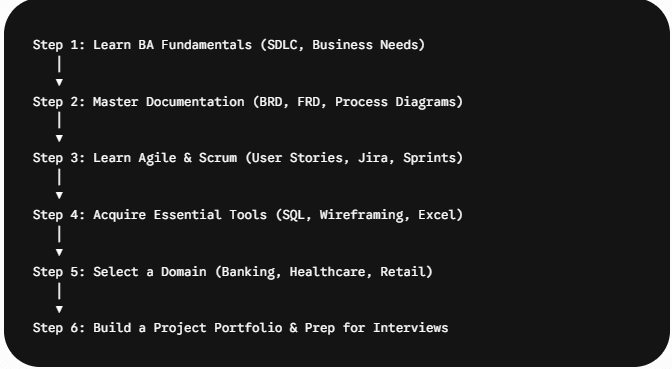
Step 1: Identify & understand – What does BA do?
Business Analyst works as an intermediary, between people in the business world who wants to solve problems with our software and those in IT world who work as engineers build that software solution.
Software Development lifecycle- waterfall vs agile Role of a BA in different phases – the ideation phase, execution phase, ideation phase and signature stage Identifying Difference – Business, Functionality, and non-functionality requirements
Step 2: Requirements Gathering and Documentation.
Requirements Elicitation will a be significant and will serve the purpose of clearly communicating between business and the engineering team. – Business Requirements Document (BRD), Functional Requirements Document (FRD) and a Business Process Model – like a process flow chart (using Draw.io, lucidchart etc). Step
3: Learn Agile & Scrum Methodologies. – Basic understanding of Agile terms and methods.
You should be able to write a UserStory, document theAcceptance Criteria in a given-when-then/Gherkinformat, and be part of the Scrum events like sprintplanning, Daily SCRUM, and sprint retros & reviews. Step
4: Learn how to Use a BA Tools. – – – – – – – – – –
JIRA, Azure, Trello etc for Agile methods – Microsoft Excel (VLookUp, Pivot Tables) – Lucidchart, Draw.io or Microsoft Visio for a process flowchart – Balsamiq, Figma or Sketch to draw mockups or wireframes – basic sql (SQL select & where command + a bonus of a join clause). Step
5: Gain Knowledge of a Specific Domain. –
Banking, E-commerce, Retail, Healthcare etc., Leverage from your prior experience from any industry if applicable.
Step 6: Develop a BA portfolio. –
a few sample documents such as – BRD of a dummy project, Sample process Flowchart for a specific task, – Create 5 use-stories with acceptance criteria. – Upload these to your resume or LinkedIn.
Step 7: Get ready for interviews (FAQ)
Q – What if I don’t have a Technical / Coding Background? –
No. BAs don’t need any of the technical skills to become successful Business Analysts; their function is limited to ensuring they deliver the correct specifications. They communicate the business need and the team addresses the development effort. Basic sql knowledge for confirming information within the tests being executed comes handy, but Coding and software engineering skills are not needed.
Q – How long will it take me to transition to a Business Analyst role?
If you spend 5 to 10 hours per week, learning for 3 to 6 months should provide a strong understanding of all the essential skills you need to develop as a business analyst to find a successful BA Role.
What qualifications do you need to be a business analyst?
Desirable qualifications
Undergraduate degree in subjects such as computer science, business information systems, computing and systems development, and business management.
Postgraduate qualification
How do I start a business analyst career?
To start a career as a business analyst, initially educate yourself as a business analyst person by undergoing some business analyst training. Get certified: There are a number of BA certifications widely recognized in the industry today.
Is it hard to become a business analyst?
Business analysis is hard.
It’s an extremely creative activity – occasionally frustrating but generally very satisfying. I used to come home most days feeling like I’d done a good day’s work and would still have plenty of energy to apply myself to extra-curricular activities in the evening.
Is business analyst a good career?
A good business analyst can move from industry to industry with ease. You can move to where the work is needed. You are a very flexible resource. It is also a well paid career.
How do I become a business analyst with no experience?
Learn From Other Business Analysts.
Do Some Research On BA Work Deliverables.
Seek Out Training Opportunities.
Master Soft Skills.
Participate in Business Analysis Tasks.
How is business analyst as a career?
After eight to 10 years in various business analysis positions, you can advance to chief technology officer or work as a consultant. You can take the business analyst career path as far as you would like, progressing through management levels as far as your expertise, talents and desires take you.
Does business analyst need MBA?
MBA degree is not necessary for an individual to take up a Business Analyst (IT Business Analyst) role. Those who start their IT business analyst careers , most of the times do not have good skills in all the three areas. … So an MBA is not necessary to take up an IT business analyst role.
How is business analyst career path?
After eight to 10 years in various business analysis positions, you can advance to chief technology officer or work as a consultant. You can take the business analyst career path as far as you would like, progressing through management levels as far as your expertise, talents and desires take you.
Is business analyst a technical job?
No, it is not. It is more of a techno-functional role but doesn’t require technical skills. Here are some extracts from Adaptive US’ blog on Business Analyst Job Description : … Managing requirements both at the project level and organization level are vital in fulfilling business needs.

FAQS:
What qualifications do you need to be a business analyst?
Desirable qualifications
Undergraduate degree in subjects such as computer science, business information systems, computing and systems development, and business management.
Postgraduate qualification
How do I start a business analyst career?
To start a career as a business analyst, initially educate yourself as a business analyst person by undergoing some business analyst training. Get certified: There are a number of BA certifications widely recognized in the industry today.
Is it hard to become a business analyst?
Business analysis is hard.
It’s an extremely creative activity – occasionally frustrating but generally very satisfying. I used to come home most days feeling like I’d done a good day’s work and would still have plenty of energy to apply myself to extra-curricular activities in the evening.
Is business analyst a good career?
A good business analyst can move from industry to industry with ease. You can move to where the work is needed. You are a very flexible resource. It is also a well paid career.
How do I become a business analyst with no experience?
Learn From Other Business Analysts.
Do Some Research On BA Work Deliverables.
Seek Out Training Opportunities.
Master Soft Skills.
Participate in Business Analysis Tasks.
How is business analyst as a career?
After eight to 10 years in various business analysis positions, you can advance to chief technology officer or work as a consultant. You can take the business analyst career path as far as you would like, progressing through management levels as far as your expertise, talents and desires take you.
Does business analyst need MBA?
MBA degree is not necessary for an individual to take up a Business Analyst (IT Business Analyst) role. Those who start their IT business analyst careers , most of the times do not have good skills in all the three areas. … So an MBA is not necessary to take up an IT business analyst role.
How is business analyst career path?
After eight to 10 years in various business analysis positions, you can advance to chief technology officer or work as a consultant. You can take the business analyst career path as far as you would like, progressing through management levels as far as your expertise, talents and desires take you.
Is business analyst a technical job?
No, it is not. It is more of a techno-functional role but doesn’t require technical skills. Here are some extracts from Adaptive US’ blog on Business Analyst Job Description : … Managing requirements both at the project level and organization level are vital in fulfilling business needs.
🎁 Become a Better Business Analyst
Join 1,200+ Business Analysts learning every week.
Get instant access to:
📘 FREE Business Analyst Templates
🎯 Interview Preparation Guides
🚀 Agile & Scrum Tutorials
🤖 AI for Business Analysts
📈 Career Growth Tips
100% Free • No Spam • Unsubscribe Anytime
