

FREE DOWNLOAD: Business Analyst Documentation Toolkit
Get instant access to real-world BRD, FRD, and project story templates used by senior BAs.
Download Free Templates PDF📌 Quick Summary for Business Analysts & Project Teams
A quick look at software requirement engineering for business analysts and project teams A quick glimpse at software requirements, what they are, types and examples
Software requirements are the “services” that a system provides as well as the “constraints” that the system imposes. There are typically two basic categories of requirements: Functional Requirements (i.e., what the system does, the functionality that is should possess) and NonFunctional Requirements (i.e., those quality attributes and constraints that the system must have or operate under such as performance, security and scalability). Forgetting one class of requirements will put your project on the road to delays, creeps and project failure.

📑 Requirements Engineering Navigation Hub
To help you navigate requirements elicitation, analysis, and management, use this interactive cluster guide:
| Requirements Core Pillars | Deep-Dive Knowledge Areas (Click to Read) | Why It Matters for a Business Analyst |
1. Requirements Elicitation | • Top 10 Elicitation Techniques • Conducting Stakeholder Interviews |
Helps BAs gather comprehensive business needs and ask the right questions without missing critical details. |
2. Requirements Analysis & Types | • Functional vs. Non-Functional Requirements • Business Requirements vs Functional Requirements |
Enables BAs to classify requirements accurately so developers and QA teams understand system behavior. |
3. Requirements Documentation | • How to Write a BRD (With Template) • Writing Functional Specifications (FRD) |
Ensures clear baseline documentation so business stakeholders and developers share 100% alignment. |
4. Requirements Traceability & Management | • Building a Requirements Traceability Matrix (RTM) • Managing Scope Creep & Change Requests |
Protects the project scope, ensures every requirement is tested, and verifies end-to-end delivery success. |
Because of this, it’s important to allot sufficient time on requirements work for everyone in a project (including business analysts and product owners) to gain a good understanding of system’s requirements before it starts getting developed.
When you build a software system and fail to consider something crucial, like a lack of appropriate authentication or a speed bottleneck in transaction speeds, you can wind up with a product that’s completely unusable even with perfect functionality. Here’s a closer inspection of each requirement type with some real world software examples.
What are Requirements in software?
A software requirement or requirements engineering is basically definition of the system. It includes all features, attributes, operations and functionality. The requirement definition represents some aspect of business logic, contract/specification, a stakeholder requirement.
The Requirement Engineering may have three hierarchy of level:
- Business requirements :- goals set by executives to achieve certain targets.
- User Requirements :- detailed account of what Users want from the system.
- System requirements :- sets out in detail all functional specifications and the required qualities in order to make the requirements achievable to the developers.
Key Types of Requirements in Software Engineering
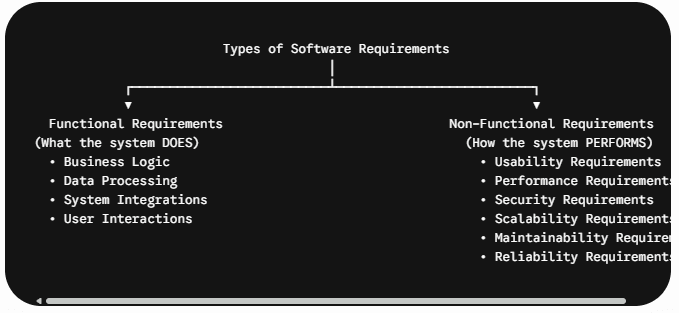
Functional Requirements
Functional requirements can be stated by user goals, tasks and procedures, and for which no alternate exists that meet user requirements.
These requirements directly guide the development of system interfaces, database workflows, and features that end users interact with every day.
Real-World Examples:
Authentication: The system must allow users to log in using an email address and password or Single Sign-On (SSO).
Payment Processing: When a user clicks “Checkout,” the payment gateway must process credit card transactions within 3 seconds and generate an email receipt.
Data Validation: The user registration form must validate that phone numbers contain exactly 10 digits before form submission.
Non-Functional Requirements (NFRs)
NonFunctional requirements are those qualities which systems will offer to useability, efficiency, security, standards etc. It’s always considered more crucial as if we forgot a non functional requirement like a system must not fail under load; the system’s output may be 100% ok, or it might be crashed all the time so it’s still an useless system. It is critical that each one business/project role clearly understands what are being requested or committed for, so that these are clear and specific enough to avoid misinterpretation by developers as well as testers.
Functional Requirements Vs Non-Functional Requirements:
Summary Comparison: Functional vs. Non-Functional Requirements
| Feature / Metric | Functional Requirements | Non-Functional Requirements |
| Primary Question | What does the system do? | How well does the system perform it? |
| Focus Area | Features, business logic, inputs/outputs | Quality, speed, security, user experience |
| Testing Approach | Functional Testing, System Testing, UAT | Load Testing, Penetration Testing, Usability Testing |
| Documentation Format | User Stories, Use Case Diagrams, FRD | Quality Attribute Scenarios, SLA Metrics |
| Example | “Send an order confirmation email.” | “Deliver confirmation email within 5 seconds.” |
Here are some Key TYPES of REQUIREMENTS in Software Engineering With Examples Key TYPES of REQUIREMENTS in SOFTWARE ENGINEERING 1.
Functional Requirements What are Functional requirements?
Requirements detailing what a system should do.
Functional requirements specify how the system responds to input or specific conditions, often related to business logic, processes, operations, and services that are of interest to the end user.
They describe the behaviors of a software product by stating how it would react to various conditions and actions from users.
Example: These types of specifications clearly define the input of the function, its operations or service offered to it and the output. The type of specification covers the main input/ output behaviors:
Data validation : The user registration page shall have checks to ensure the email and mobile number formats are valid . Process requirements , input/output requirements and output data to user and console.
2. Non-Functional Requirements (NFRs) What are Non-Functional Requirements?
NFRs defines a system’s qualities or attribute and describes constraints or quality that a system will possess. They specify how the system should perform while executing its functionalities. While functional requirements define what the system does, NFRs define how the system does it.
Importance :- Non-functional requirements are crucial to the success of a system because a poorly implemented system in terms of non-functional attributes can still render a functionality almost useless.
For example , A system that meets 100% functional requirement and also very bad performance will render the functionally useless to.
KEY SUBTYPES OF NON-FUNCTIONAL REQUIREMENTS INCLUDE:-
1.Usability requirements : Specify how easily users will be able to learn and use your system and define metrics related to how user’s interact with a system.
Reduces learning curve , user effort and user error. Example : Users will be able to register an account by following these simple steps in under a minute. 2. Performance requirements Details the requirements on performance for both workload and load performance. Set quantitative thresholds for throughput , resource requirements ,response time.
Example : ” The search results pages must return a result set within 1.5 seconds after 5,000 concurrent users have clicked search”
3.Security requirements Describe what defenses are used to protects the data from an organization. Also set forth other aspects like authentication and encryption.
Example: Personal data, health-care information and customer financial information to be secured utilizing data-at-rest and data-in-transit encryption methods( AES-256 ) while ensuring compliance with PCI / SSAE standards.
4. Scalability Requirements Describes the system’sability to cope with an increase in work load. In simple terms to adjust its scale when the needs are too high or too low.
Examples : A database design shall support 300% increase in the load during holiday season , and will accommodate as the company grows .
Expandability requirement :- The system architecture should be easily extendable or scalable and this shouldn’t be costly either.
5. Maintainability Requirements Specifies requirements regarding how easily the system be updated , modified or Debugged and repaired when required .
Example : At least 80% of automated test coverage with comprehensive line-documentation detailing api endpoint usage and function signatures.
6. Reliability & Availability Requirements Specifies system’s level of reliability with respect to when they should provide correct outputs or service outputs in a specified time or operate at a given conditions for specific duration etc.
Example ,“The system availability will not exceed four 9’s (99.99% of the time ), and it will maintain a target RTO of less than 15 minutes.
Frequently Asked Questions (FAQs)
What is the main difference between functional and non-functional requirements?
Functional requirements specify specific actions or features the software must perform (e.g., adding an item to a cart). Non-Functional requirements define quality attributes and performance constraints (e.g., cart response time under load).
Who is responsible for gathering requirements in software development?
In Agile and traditional environments, Business Analysts, Product Owners, and System Architects work directly with business stakeholders, technical leads, and end users to gather, analyze, and document requirements.
Why are non-functional requirements often overlooked?
Teams often focus primarily on visible features (functional logic) to show quick progress to stakeholders. However, neglecting NFRs like security or scalability early on often leads to costly re-architecting later in the development cycle.
Related Guides & Deep Dives
To expand your knowledge on software requirement gathering and documentation techniques, check out these related guides:
📄 What Are Non-Functional Requirements in Software Development?
🔍 How Business Analysts Gather Requirements (Elicitation Guide)
“
🎁 Become a Better Business Analyst
Join 1,200+ Business Analysts learning every week.
Get instant access to:
📘 FREE Business Analyst Templates
🎯 Interview Preparation Guides
🚀 Agile & Scrum Tutorials
🤖 AI for Business Analysts
📈 Career Growth Tips
100% Free • No Spam • Unsubscribe Anytime

2 thoughts on “Types of Requirements in Software Engineering: Complete Guide for BAs”