

FREE DOWNLOAD: Business Analyst Documentation Toolkit
Get instant access to real-world BRD, FRD, and project story templates used by senior BAs.
Download Free Templates PDFWhat is the Waterfall Life Cycle Model in SDLC?
The Waterfall Life Cycle Model is a classic, linear-sequential Software Development Life Cycle (SDLC) methodology where software development progresses strictly downhill through predefined phases like a natural waterfall.
In a pure Waterfall SDLC, each phase—ranging from Requirement Gathering to Maintenance—must be 100% completed, reviewed, and formally signed off before the next phase can begin.
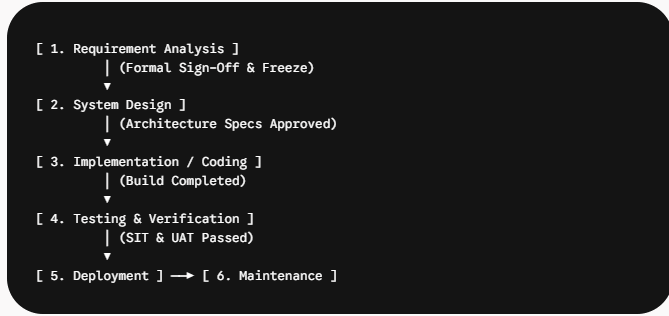

6 Sequential Phases of the Waterfall SDLC Model
| Phase # | Phase Name | Primary Development Goal | Business Analyst (BA) Deliverables |
| 1 | Requirement Gathering & Analysis | Elicit and document all business, technical, and compliance needs upfront. | Business Requirements Document (BRD), Functional Requirements Document (FRD), Traceability Matrix. |
| 2 | System & Architectural Design | Translate functional requirements into system architectures, database schemas, and interface designs. | High-Level Design (HLD), Low-Level Design (LLD), System Architecture Blueprints. |
| 3 | Implementation & Coding | Software developers write source code based on approved design documentation. | Source Code Modules, Code Review Logs, Unit Test Case Reports. |
| 4 | Testing & Verification | QA teams and business users validate code against functional specifications. | System Integration Testing (SIT) Reports, User Acceptance Testing (UAT) Sign-Offs. |
| 5 | Deployment & Release | Install software onto live production servers or user hardware environments. | Deployment Checklist, Release Notes, End-User Training Manuals. |
| 6 | Maintenance & Operations | Perform bug fixes, patch upgrades, and operational updates in production. | Change Request (CR) Logs, Post-Implementation Audit Reports. |
Entry and Exit Sign-Off Criteria in Waterfall SDLC
A defining feature of the Waterfall life cycle model is strict phase gating through Entry and Exit Criteria:
Phase Entry Criteria: Prerequisites that must be met before starting a phase (e.g., Coding cannot begin until the HLD/LLD design documents are approved).
Phase Exit Criteria (Quality Gate): Final deliverables and formal approvals needed to freeze the phase (e.g., Requirements Phase cannot close without a signed BRD from executive sponsors).
🏦 Real-Time Scenario: Waterfall SDLC in a Core Banking Migration Project
Context & Objective
A national bank is migrating its Core Ledger & Accounts System to a secure private cloud. Due to legal compliance, strict auditing rules, and static requirements, the bank chooses the Waterfall SDLC model over Agile.
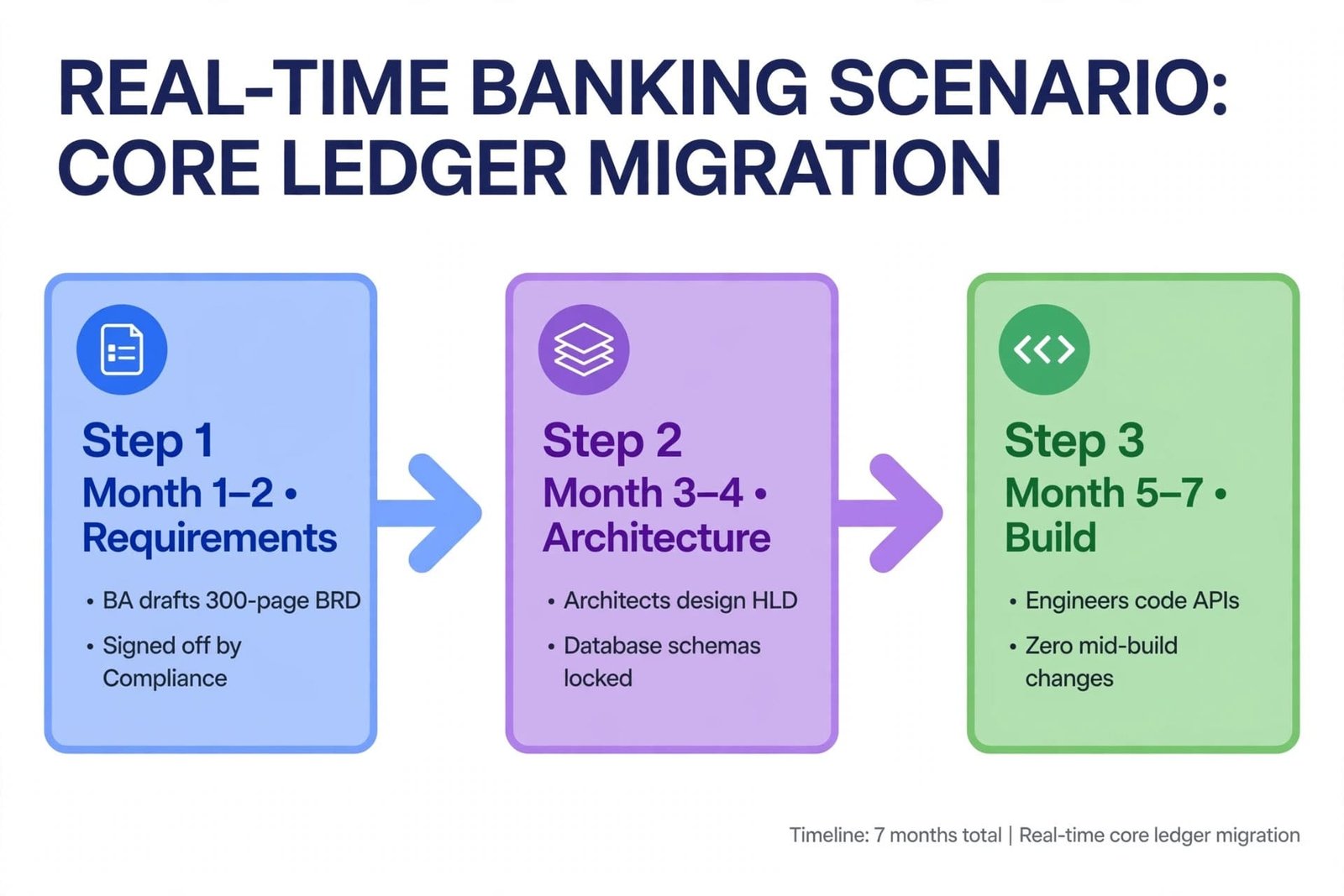
How the BA Managed the Waterfall Life Cycle
Requirements Baseline (Months 1–2): The BA conducted 15 JAD workshops across finance, compliance, and risk teams, producing a 300-page BRD. Once signed, requirements were formally frozen.
Design & Traceability (Months 3–4): The BA built a Requirements Traceability Matrix (RTM) to ensure all 150 regulatory rules were explicitly mapped to system design components.
Formal Change Control: When a regulatory team requested a minor change in Month 6 (during coding), the BA did not change the code directly. Instead, they raised a formal Change Request (CR) evaluating cost and timeline impacts for post-release approval.
Waterfall vs. Agile SDLC: Quick Comparison
| Evaluation Metric | Waterfall Life Cycle Model | Agile Model |
| Process Flow | Linear and sequential. | Iterative and incremental (Sprints). |
| Requirement Flexibility | Rigid; locked upfront. | Flexible; welcomes evolving backlogs. |
| Stakeholder Involvement | High at start (Requirements) and end (UAT). | Continuous engagement at every sprint demo. |
| Risk Management | High risk late in testing if defects are found. | Low risk; tested continuously in iterations. |
| Best Used For | Banking, healthcare, defense, static scope. | Web apps, startups, evolving FinTech apps. |
Business Analysis Resource Hub
📘 Documentation Guide: BRD vs FRD Differences & Real-World Examples — Learn how to draft core Waterfall requirements deliverables.
🧪 Testing Lifecycle: User Acceptance Testing (UAT) Guide for Business Analysts — Master the final phase before Waterfall production deployment.
🔄 Alternative Models: The Agile Model in Software Engineering: Lifecycle & Principles — Compare traditional Waterfall to modern Agile frameworks.
Frequently Asked Questions (FAQ)
The main advantage is predictability and clear documentation. Because all requirements, budgets, and timelines are agreed upon upfront, project scope is well-defined and easy to manage for fixed-scope projects.
Use Waterfall when project requirements are fully understood, technologies are stable, regulatory compliance demands strict documentation, or working on critical infrastructure (e.g., core banking, healthcare, or defense platforms).
A Quality Gate is a formal review checkpoint at the end of each phase where stakeholders verify that all exit criteria deliverables (such as signed BRDs or UAT sign-offs) are completed before approving movement to the next phase.
🎁 Become a Better Business Analyst
Join 1,200+ Business Analysts learning every week.
Get instant access to:
📘 FREE Business Analyst Templates
🎯 Interview Preparation Guides
🚀 Agile & Scrum Tutorials
🤖 AI for Business Analysts
📈 Career Growth Tips
100% Free • No Spam • Unsubscribe Anytime

Thank You