

FREE DOWNLOAD: Business Analyst Documentation Toolkit
Get instant access to real-world BRD, FRD, and project story templates used by senior BAs.
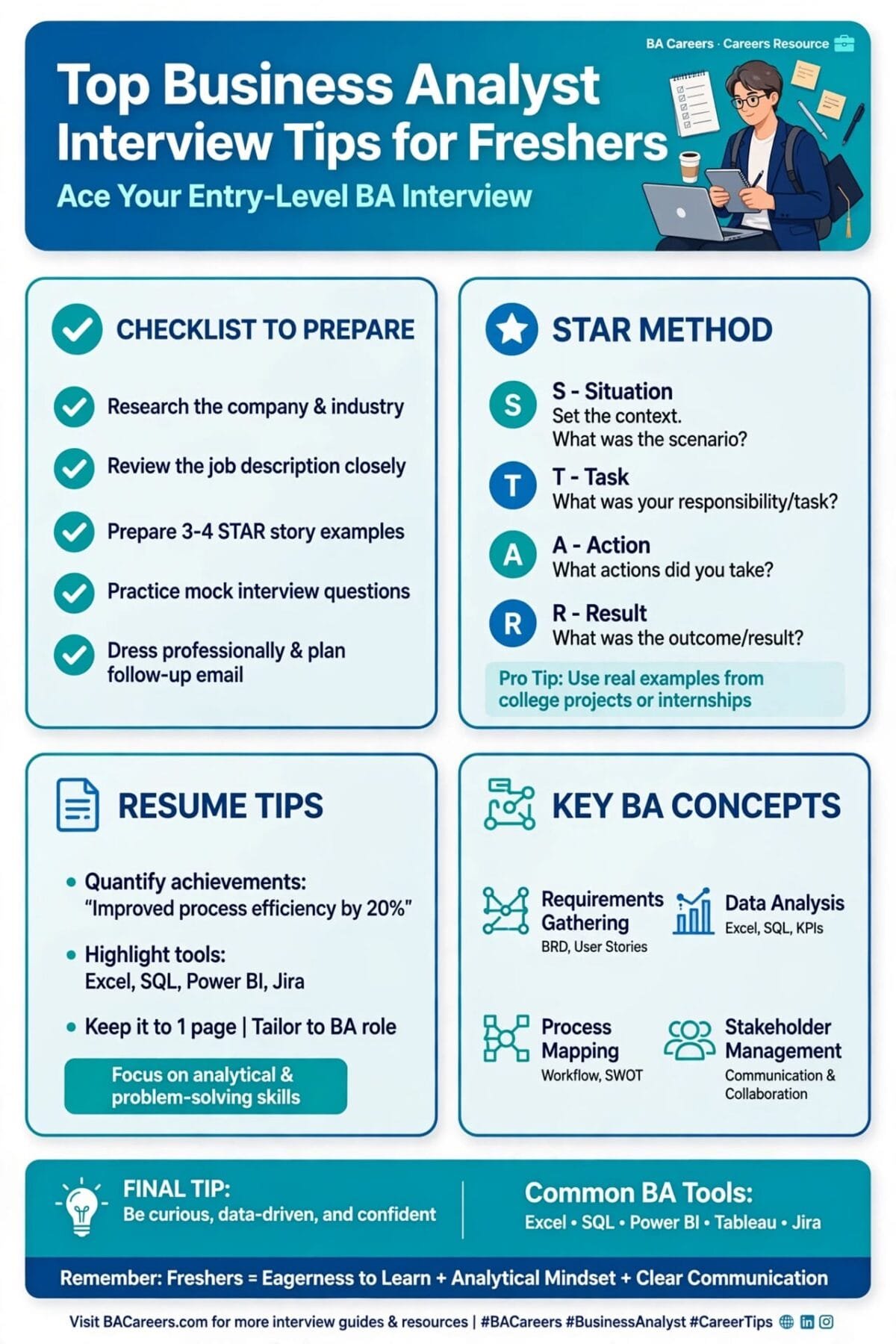
Download Free Templates PDFBreaking into the Business Analysis field as a fresher can be challenging, but structured preparation can set you apart. Understanding core Business Analyst interview tips, key documentation standards, and basic SDLC concepts allows candidates to showcase strong analytical capabilities even without extensive hands-on corporate experience.
5 Essential Interview Tips for Entry-Level BAs.
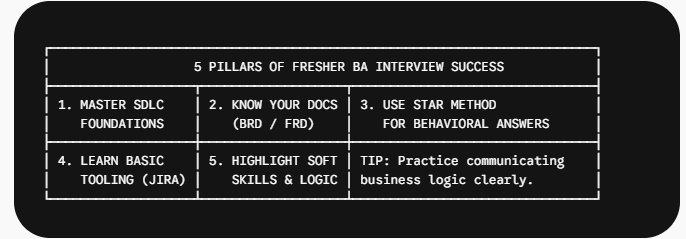
1. Master Core Business Analysis Concepts
Be prepared to explain foundational terms clearly:
Differences between Functional and Non-Functional Requirements.
Differences between Agile (Scrum) and Waterfall methodologies.
Key phases of the Software Development Life Cycle (SDLC).
2. Understand Key BA Documentation
Even without workplace experience, know the structure and purpose of core project artifacts:
BRD (Business Requirements Document): Outlines high-level business goals.
FRD / SRS (Functional Requirements Document): Details technical implementation logic and workflows.
User Stories: Standard Agile requirements format (
As a [user], I want [feature], so that [benefit]) along with Acceptance Criteria.
3. Apply the STAR Method for Behavioral Questions
Structure scenario-based responses using STAR:
Situation: Set the context of a academic or internship project.
Task: Explain the analytical challenge or problem to solve.
Action: Detail the specific steps you took (e.g., mapped process flow, interviewed users).
Result: Highlight the positive outcome or key metric achieved.
4. Familiarize Yourself with Industry Tools
Demonstrate baseline knowledge in common BA tools:
Documentation & Tracking: JIRA, Confluence, Trello.
Process Mapping & Wireframing: Lucidchart, Microsoft Visio, Figma, Balsamiq.
Data Analysis: Basic SQL queries and Excel functions (VLOOKUP, Pivot Tables).
5. Emphasize Problem-Solving and Soft Skills
Interviews for entry-level positions heavily evaluate critical thinking, communication, active listening, and conflict-resolution abilities. Show how you manage ambiguous situations and bridge gaps between technical and non-technical teams.
Quick Reference: What Interviewers Look For
| Evaluation Area | What Freshers Usually Say | What Makes You Stand Out |
| Role Definition | “A BA gathers requirements from clients.” | “A BA analyzes business problems, identifies root causes, and bridges business needs with technical solutions.” |
| Requirements Handling | “I write down what the user wants.” | “I validate underlying user needs, use the 5 Whys technique, and write structured user stories with acceptance criteria.” |
| Handling Misalignment | “I ask the manager what to do.” | “I facilitate alignment workshops, use process flows to highlight gaps, and present trade-off analysis to decision-makers.” |
Real-World BA Scenario: Answering “How Would You Handle Vague Requirements?”
The Answer Strategy:
“If presented with ambiguous requirements, I would schedule an elicitation session with key stakeholders to ask open-ended questions and uncover the underlying ‘Why’. I would draw an As-Is process flow to visualize current bottlenecks, draft proposed To-Be workflows, and confirm acceptance criteria with subject matter experts before sharing with the development team.”
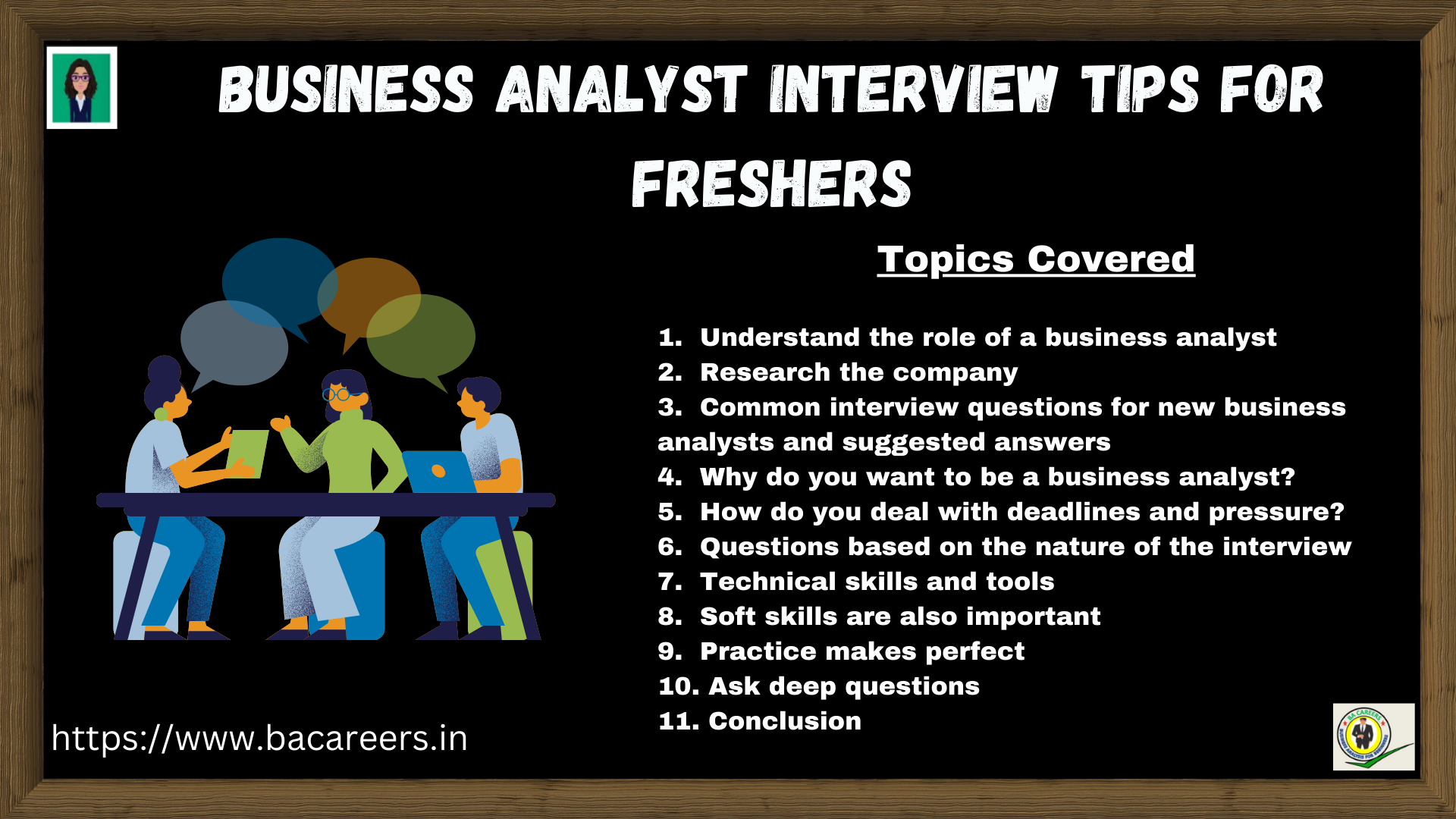
1. Understand the role of a business analyst
Before you start preparing for the interview, you need to know exactly what a business analyst does. The BA’s primary role is to bridge the gap between IT and the business, ensuring that business requirements are clear and understood by all stakeholders.
2. Research the company
Please research the company you are applying to. Learn about their products, services, target market and industry trends. This knowledge will help you tailor your answers to show how you can meet their needs. 3. Prepare for common interview questions
Here are some common interview questions for new business analysts and suggested answers:
Tell me about yourself.
A: “I just graduated from [your university] with [your degree]. While I was studying, I became interested in business analysis, especially how to use data to drive decisions strategy. I worked at the following companies. At [Company Name] I honed my skills in [Special Skills]. I appreciate the opportunity to bring my background and passion for analytics to your team.
Why do you want to be a business analyst?
Answer: “I like to solve problems and bridge the gaps between departments. Working as a Business Analyst allows me to use analytical and communication skills to make projects meet needs. business. I would be very interested in your company for [company specific reasons].”
How do you deal with deadlines and pressure?
Answer: “I rate tasks based on their speed and importance. I also break larger tasks down into more manageable tasks to make progress. Communication is important, so I keep stakeholders informed of progress and possible issues.
4. Questions based on the nature of the interview
Interviewers often use situational questions to determine how you handle real life situations. Here are some examples of possible answers:
Scenario: “You are presented with a project with incomplete requirements. How do you solve this problem?”
A: “I started by gathering a lot of information from existing literature. Next, I meet with key stakeholders to fill in the blanks and make sure all requirements are clear and documented. This will help prevent misunderstandings and ensure that the project stays on track.
Scenario: “Stakeholders are not satisfied with the delivered solution. What will you do?”
Answer: “First I listen to the concerns of the stakeholders and understand their perspectives. Then, I review the requirements and solutions to identify gaps and misconceptions. Based on this analysis, I recommend adjustments or negotiations to ensure that the solution meets the needs of the stakeholders and maintains the integrity of the project.
5. Technical skills and tools
Highlight any technical skills or tools you know. Common tools used by business consultants include:
Microsoft Excel: used for data analysis and reporting.
SQL: used for database queries.
JIRA or Trello: for project management.
Tableau or Power BI: for data visualization.
6. Soft skills are also important
Don’t underestimate the importance of soft skills. Communication, problem solving, and critical thinking are important for business analysts. Be prepared to demonstrate these skills with examples from your past experiences.
7. Practice makes perfect
Conduct mock interviews with a friend or mentor to practice your answers and master the interview format. This will help you build your confidence and improve your delivery.
8. Ask deep questions
At the end of the interview, you may have an opportunity to ask questions. Use this time to show your true interest in the position and the company. Questions may include:
“Can you describe a career path for someone in this position?”
“What is the biggest challenge facing your team right now?”
“How does the company support continuing professional development?”
Conclusion
Preparing for a business analyst interview involves getting to know the job, researching the company, and practicing answers to common questions and answers. Highlight your technical skills and flexibility and demonstrate your enthusiasm for the position. With the right preparation, you’ll be on your way to landing your first business analyst job.
Related Articles :
- Business Analysis Certifications Beyond CBAP: A Comprehensive Guide
- Soft Skills for Business Analysts: A Comprehensive Guide
- Business Analyst Software Reviews: A Comprehensive Guide
- The Future of Business Analysis: Trends, Career Paths, and Opportunities
- Industry-specific Business Analysis: Healthcare and Finance
- Remote Business Analyst Jobs: A Comprehensive Guide for Freshers
Frequently Asked Questions (FAQs)
Yes. Employers look for strong analytical reasoning, problem-solving skills, business acumen, and domain knowledge. Formal technical degrees are not strictly required for many entry-level BA roles.
Common entry-level questions include:
What is the difference between a BRD and an FRD?
How do you write a good User Story?
What is User Acceptance Testing (UAT), and what is the BA’s role in it?
How do you handle scope creep?
Preparing with practical Business Analyst interview tips is essential for freshers looking to break into the BA field and impress prospective employers.
By mastering foundational BA interview preparation topics—such as requirements documentation, Agile user stories, and SDLC workflows—freshers can confidently demonstrate job readiness.
📄 Business Analysis Career & Interview Knowledge Hub
Explore how interview preparation links with core BA duties, best practices, and career progression:
| Knowledge Area | Deep-Dive Guide | Why It Matters for an Entry-Level BA |
|---|---|---|
| Interview Strategy | BA Interview Tips for Freshers | Master entry-level questions, behavioral frameworks, and core candidate evaluation points. |
| BA Principles | Dos and Don’ts for Business Analysts | Understand essential operational best practices and common pitfalls to avoid. |
| Roles & Responsibilities | BA Roles & Responsibilities Guide | Learn foundational job duties across project initiation, discovery, and testing. |
| Agile Delivery Roles | Scrum BA Role Guide | Prepare for Agile interviews by mastering backlog refinement and sprint planning workflows. |
| Overcoming Challenges | BA Challenges & Solutions Guide | Answer scenario questions on handling scope creep, vague requirements, and stakeholder friction. |
🎁 Become a Better Business Analyst
Join 1,200+ Business Analysts learning every week.
Get instant access to:
📘 FREE Business Analyst Templates
🎯 Interview Preparation Guides
🚀 Agile & Scrum Tutorials
🤖 AI for Business Analysts
📈 Career Growth Tips
100% Free • No Spam • Unsubscribe Anytime
