

FREE DOWNLOAD: Business Analyst Documentation Toolkit
Get instant access to real-world BRD, FRD, and project story templates used by senior BAs.
Download Free Templates PDFAlthough the official Scrum Guide explicitly defines only three roles—Product Owner, Scrum Master, and Developers—the modern enterprise software landscape heavily relies on a Scrum BA (Scrum Business Analyst).
A Scrum BA bridges the gap between high-level business strategy and technical sprint execution, supporting the Product Owner in product backlog refinement and ensuring engineering teams have crystal-clear, buildable requirements.

What Does a Scrum BA Do?
A Scrum Business Analyst operates as a core team member who translates business goals, stakeholder inputs, and complex user journeys into structured user stories, acceptance criteria, and process flows.
Key Responsibilities of a Scrum BA Across Ceremonies
| Scrum Ceremony | Core Scrum BA Responsibilities | Artifacts Produced |
| Backlog Refinement | Slices large epics into INVEST-compliant user stories, adds Acceptance Criteria (Given-When-Then), and clarifies edge cases. | Refined Product Backlog, User Stories |
| Sprint Planning | Clarifies requirement scope, business logic, and acceptance boundaries for engineers estimating story points. | Sprint Backlog Scope, Scenario Notes |
| Daily Standup | Addresses immediate requirement blockers, clarifies functional ambiguity, and aligns with developers during active sprints. | Updated Ticket Notes, Impediment Log |
| Sprint Review / Demo | Assists in demonstrating completed user stories to stakeholders and capturing feedback for future backlog iterations. | Demo Feedback Notes, New User Stories |
| Sprint Retrospective | Participates in team process optimization to refine requirement handoffs and definition of ready (DoR) standards. | Process Improvement Actions |
Product Owner vs. Scrum BA: Understanding the Division
While both roles focus on delivering maximum value, their day-to-day operational scope is distinct:
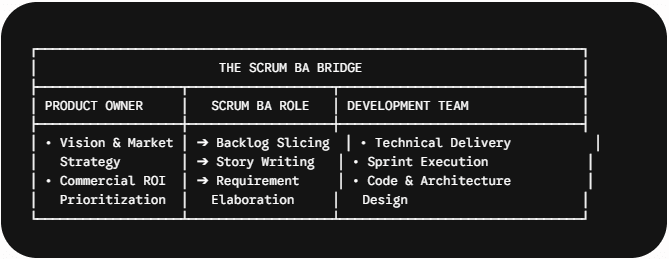
Product Owner (The “WHAT” & “WHY”): Owns the overall product vision, secures funding, manages commercial ROI, sets release roadmap priorities, and engages external business leaders.
Scrum BA (The “HOW IT WORKS”): Digs deep into operational details, maps process workflows, details acceptance criteria scenarios, and collaborates continuously with developers and QA testers during sprint execution.
Real-World Scenario: A Scrum BA in Sprint Refinement
Context: A fintech team is building a peer-to-peer (P2P) fund transfer module.
Execution:
Product Owner Direction: “We need to allow users to send money via mobile numbers.”
Scrum BA Action: The Scrum BA breaks this epic down into functional user stories, defines daily transfer limits ($2,500/day max), details currency conversion logic, and drafts Given-When-Then acceptance criteria for insufficient fund errors.
What is ScrumBA?
ScrumBA is a term used to describe a Business Analyst who works within a Scrum team. These BAs adapt to Agile values and practices and collaborate with Product Owners, Scrum Masters, and Development Teams to deliver high-value increments in each sprint.
While not an official Scrum role, ScrumBAs are crucial in bridging the gap between business and technology.
Scrum Roles Recap
Before understanding ScrumBA, let’s quickly review the standard Scrum roles:
Product Owner (PO): Owns the product backlog and defines what to build.
Scrum Master (SM): Facilitates the Scrum process and removes impediments.
Development Team: Builds the product increment.
To read more about Scrum roles, visit:
👉 Scrum Roles Explained with Real Examples
Where Does the BA Fit in Scrum?
Although the Scrum Guide doesn’t list BA as a formal role, the Business Analyst can play a supportive and collaborative role, particularly in:
Backlog refinement
Writing user stories and acceptance criteria
Understanding and communicating business needs
Supporting the Product Owner
Ensuring stakeholder alignment
Responsibilities of a ScrumBA
1. Support Product Owner in Backlog Management
ScrumBAs help refine backlog items, split epics into stories, and ensure clear acceptance criteria are defined.
✅ Example:
In a digital banking project, the PO provides an epic: “Enable Mobile Loan Applications.”
The ScrumBA works with stakeholders to split it into clear stories:
“Submit KYC through mobile”
“Track loan approval status”
“Upload income documents”
2. Gather & Clarify Requirements
ScrumBAs bridge communication between business stakeholders and the Scrum Team, helping to avoid misinterpretations.
✅ Real-Time Scenario:
In an e-commerce app, users report confusion about coupon codes. The ScrumBA interviews users and discovers the need for a clearer UX flow and success messages. These insights are translated into actionable stories.
3. Define Acceptance Criteria
They write clear and testable acceptance criteria to ensure deliverables match expectations.
✅ Example:
For the story “Apply Coupon at Checkout,” a ScrumBA writes:
Given the user is on the checkout page
When they enter a valid coupon
Then a discount should be applied to the total price
4. Facilitate Communication Between Stakeholders & Team
ScrumBAs ensure that feedback loops are quick and aligned with sprint goals.
✅ Real-Time Scenario:
In a healthcare app, a BA collects feedback from doctors and translates it into user stories for the development team, improving usability for the “Appointment Scheduling” feature.
5. Support Sprint Planning and Reviews
ScrumBAs provide business context during sprint planning and help demonstrate user stories during sprint reviews.
✅ Example:
During Sprint Review for a loyalty program, the ScrumBA walks through how a new reward points system aligns with customer retention goals.
ScrumBA vs Traditional BA
| Aspect | Traditional BA | ScrumBA |
|---|---|---|
| Documentation | Detailed upfront BRD/FRD | Lean documentation, evolving stories |
| Communication Style | Formal and structured | Collaborative and iterative |
| Engagement with Team | Works with business separately | Part of the Scrum Team |
| Tools | Excel, Word, Visio | JIRA, Confluence, Miro |
To explore more differences, read:
👉 BRD vs FRD – What’s the Difference?
Tools That ScrumBAs Use
JIRA / Azure DevOps – For user story tracking and backlog management
Confluence – For knowledge sharing and documentation
Miro / Lucidchart – For visual workflows, process diagrams
SQL / Excel – For data analysis when needed
Common Challenges Faced by ScrumBAs
| Challenge | How ScrumBA Helps |
|---|---|
| Vague requirements | Clarifies scope through story mapping sessions |
| Frequent changes in priorities | Works with PO to re-prioritize based on value |
| Miscommunication with dev team | Clarifies business context and acceptance criteria |
Benefits of Having a ScrumBA in Agile Teams
✅ Improved requirement clarity
✅ Faster feedback loop
✅ Better stakeholder collaboration
✅ Increased sprint success rate
✅ Smooth UAT planning and sign-off
Conclusion
While not officially defined, the ScrumBA is a powerful enabler in Agile environments. They ensure business goals are clearly translated into actionable, testable, and valuable stories for the Scrum team.
As Agile adoption grows, ScrumBAs are becoming an essential part of modern product teams, especially in industries like banking, healthcare, retail, and fintech.
Related Articles on BACareers:
External Resources
Frequently Asked Questions (FAQs)
Yes. While the official Scrum Guide groups all hands-on creators under the term “Developers,” a Scrum BA is fully integrated into cross-functional Scrum teams to handle requirements engineering and backlog management.
Absoluting. Because Scrum BAs already possess strong domain knowledge, stakeholder management skills, and backlog experience, transitioning into a Product Owner role is one of the most common career progression paths for BAs.
Understanding the vital role of a Scrum BA is essential for delivering successful software in Agile environments.
By partnering with Product Owners and technical teams, a Scrum Business Analyst ensures that user stories are refined, estimable, and aligned with enterprise strategic goals.
📄 Scrum Framework & Business Analysis Hub
Explore how Scrum BAs manage requirements, user stories, and quality assurance across sprint lifecycles:
| Knowledge Area | Deep-Dive Guide | Why It Matters for a Business Analyst |
|---|---|---|
| Scrum Roles | Scrum BA Comprehensive Guide | Master Scrum ceremonies, backlog refinement workflows, and Product Owner collaboration. |
| Agile Requirements | Agile User Stories Comprehensive Guide | Learn how Scrum BAs write INVEST-compliant user stories and acceptance criteria. |
| Agile Mindset | Agile Mindset & Transformation Guide | Adopt adaptability and iterative thinking principles required in fast-paced Scrum teams. |
| UAT & Quality Assurance | Effective UAT Execution Guide | Validate completed sprint stories against business scenarios during User Acceptance Testing. |
| Agile Tooling | JIRA & Confluence Setup Guide | Organize sprint backlogs, user story boards, and release documentation effectively. |
🎁 Become a Better Business Analyst
Join 1,200+ Business Analysts learning every week.
Get instant access to:
📘 FREE Business Analyst Templates
🎯 Interview Preparation Guides
🚀 Agile & Scrum Tutorials
🤖 AI for Business Analysts
📈 Career Growth Tips
100% Free • No Spam • Unsubscribe Anytime
