

FREE DOWNLOAD: Business Analyst Documentation Toolkit
Get instant access to real-world BRD, FRD, and project story templates used by senior BAs.
Download Free Templates PDFAn Agile mindset is the set of attitudes, beliefs, and behaviors that prioritize adaptability, continuous learning, customer-centricity, and cross-functional collaboration over rigid planning and hierarchical control.
For a Business Analyst, cultivating an agile mindset in business analysis is the single most important factor in driving a successful organizational Agile transformation. Tools like JIRA or frameworks like Scrum are merely mechanics; the mindset is what delivers true agility.
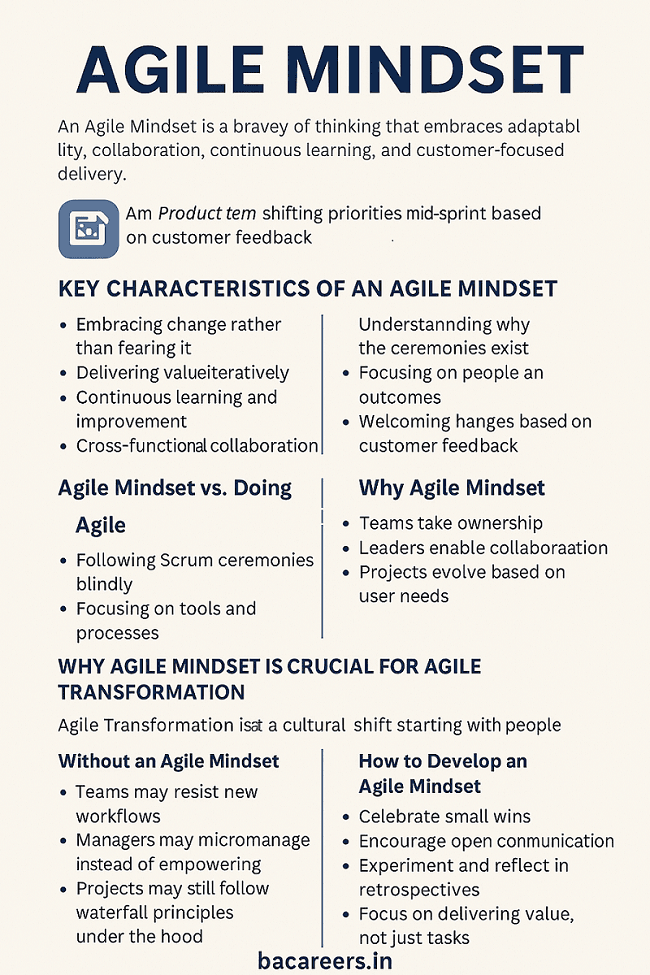
✅ Example: A product team shifting priorities mid-sprint based on customer feedback—rather than sticking to an outdated plan—is demonstrating an Agile Mindset.
The 4 Pillars of an Agile Mindset
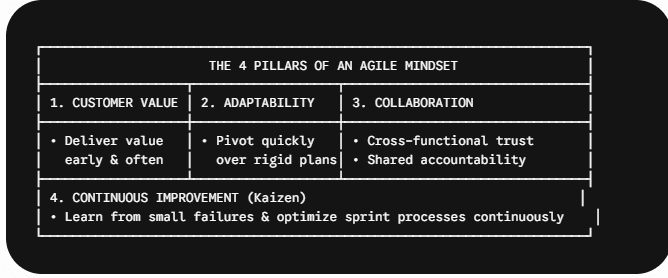
Customer Value First: Prioritize business outcomes and customer delight over rigid process compliance.
Adaptability Over Fixed Plans: View scope changes as opportunities to optimize products rather than disruptions.
Cross-Functional Collaboration: Break down departmental silos between business leaders, BAs, developers, and QA testers.
Relentless Improvement (Kaizen): Embrace rapid feedback loops, small experiments, and continuous learning from retrospectives.
Fixed Mindset vs. Agile Mindset in Business Analysis
| Operational Focus | Traditional (Fixed) BA Mindset | Agile (Growth) BA Mindset |
| Requirements | Rigid, signed-off BRD upfront before coding begins. | Iterative user stories refined progressively in backlog sessions. |
| Handling Change | Change requests viewed as scope creep and project risk. | Scope change welcomed if it adds verifiable customer value. |
| Problem Solving | Seeks complete certainty and exhaustive detailed specs. | Embraces ambiguity, tests hypotheses via MVPs (Minimum Viable Products). |
| Success Metric | Delivered 100% of agreed scope on time and budget. | Delivered measurable business ROI and customer satisfaction. |
Real-World BA Scenario: Transitioning from Waterfall BRD to Agile Discovery
Context: A Senior Business Analyst at an insurance enterprise is leading a digital portal overhaul during an organizational Agile transformation.
Execution:
Old Approach (Fixed): Spending 3 months writing a 120-page specification document detailing every possible claim scenario before developers write a line of code.
Agile Mindset Approach: Partnering with product owners to deliver a simple claim submission feature in Sprint 1. Gathering immediate user feedback, identifying real user friction points, and iteratively refining backend integrations in subsequent sprints.
Key Characteristics of an Agile Mindset
An Agile Mindset is rooted in four core values from the Agile Manifesto:
Individuals and interactions over processes and tool.
Working software over comprehensive documentation
Customer collaboration over contract negotiation
Responding to change over following a plan
🔑 Additional Traits Include:
Embracing change rather than fearing it
Delivering value iteratively
Continuous learning and improvement
Cross-functional collaboration
Failing fast and adapting quickly
Agile Mindset vs. Doing Agile
| Doing Agile | Being Agile (Agile Mindset) |
|---|---|
| Following Scrum ceremonies blindly | Understanding why the ceremonies exist |
| Focusing on tools and processes | Focusing on people and outcomes |
| Sticking to plans even when needs change | Welcoming changes based on customer feedback |
💡 Real-time Scenario:
A software development team was using Scrum but missed all deadlines. Upon inspection, they were doing Agile—daily standups, sprint planning, and retrospectives—but lacked ownership, adaptability, and customer focus. Once they adopted an Agile Mindset, including real customer feedback loops and flexible sprint goals, delivery improved dramatically.
Why Agile Mindset is Crucial for Agile Transformation
Agile Transformation is more than adopting new tools or processes—it’s a cultural shift that begins with people.
Without an Agile Mindset:
Teams may resist new workflows.
Managers may micromanage instead of empowering.
Projects may still follow waterfall principles under the hood.
With an Agile Mindset:
Teams take ownership.
Leaders enable collaboration.
Projects evolve based on user needs.
🧠 Learn more about Agile Transformation.
Role of Business Analyst in Agile Mindset and Transformation
Business Analysts (BAs) are critical in facilitating Agile Mindset within teams and stakeholders.
🎯 Responsibilities of a BA in Agile Transformation:
Championing Agile Values:
Helping teams understand customer needs and shift from documentation-heavy to interaction-based workflows.Continuous Communication:
Ensuring Product Owners, Developers, and stakeholders stay aligned through constant feedback.Eliciting Flexible Requirements:
Writing user stories that allow change and promote incremental delivery.Driving Customer-Centric Thinking:
Shifting focus from “What do we want to build?” to “What does the customer need?”Facilitating Agile Ceremonies:
Participating in or even moderating standups, retrospectives, backlog grooming sessions.
✅ Real-World Example:
In a banking project, the BA helped transform the waterfall-based product design into short Agile iterations. Instead of collecting all requirements upfront, they broke them into features and delivered them sprint-by-sprint. This reduced risk and improved product-market fit.
How to Develop an Agile Mindset
Here are ways both individuals and teams can foster an Agile Mindset:
🧩 For Individuals:
Practice active listening
Welcome feedback instead of defending your stance
Be comfortable with uncertainty
Learn continuously—attend Agile meetups, read case studies
🧩 For Teams:
Celebrate small wins
Encourage open communication
Experiment and reflect in retrospectives
Focus on delivering value, not just tasks
Tools and Techniques That Support Agile Mindset
While mindset is about how you think, tools can support the journey:
| Tool / Technique | Purpose |
|---|---|
| JIRA / Azure DevOps | Sprint tracking and backlog management |
| User Story Mapping | Visualize user journey and prioritize value |
| Kanban Boards | Promote transparency and flow |
| Retrospectives | Encourage continuous improvement |
🔗 Check out: Business Analysis Techniques and Tools
Agile Mindset in Action: Real-Time Scenarios
📌 Scenario 1: Marketing Campaign Pivot
A marketing team launches a campaign but sees poor engagement. With an Agile Mindset, they quickly run a user survey, analyze feedback, and redesign the messaging—all within one sprint.
📌 Scenario 2: Software Release Delay
A Dev team finds a critical bug near release. Instead of hiding it, they alert stakeholders, delay the launch, fix the issue, and win long-term trust.
📌 Scenario 3: BA Aligning Product Vision
A BA collaborates with end-users, discovers they prefer mobile-first design, and shifts the product roadmap to reflect this insight, resulting in 30% more usage.
Challenges in Adopting an Agile Mindset
While the benefits are clear, there are some common hurdles:
Resistance to change from leadership or senior stakeholders
Lack of training or awareness
Misunderstanding Agile as just a set of ceremonies
Fear of accountability in transparent environments
✅ Solution:
Conduct mindset workshops, include real-time feedback mechanisms, and engage BAs as transformation facilitators.
Benefits of Agile Mindset for Business Analysts
Stronger collaboration with cross-functional teams
Faster delivery of customer value
Increased stakeholder trust
Enhanced adaptability and career growth
📖 Related: How to Become a Business Analyst
Conclusion: Think Agile, Act Agile
An Agile Mindset is not a destination but a continuous journey. Whether you’re a developer, tester, manager, or business analyst, embracing agility can transform the way you work and the value you deliver.
In today’s rapidly changing business landscape, adopting an Agile Mindset is no longer optional—it’s a necessity.
🔗 Internal Links (from bacareers.in):
🌐 External Links:
Frequently Asked Questions (FAQs)
Doing Agile refers to following ceremonies, using JIRA boards, or running sprints mechanically without shifting cultural habits.
Being Agile means embodying an Agile mindset—embracing flexibility, empowering teams, and focusing continuously on customer value delivery.
Start by encouraging iterative feedback, writing flexible user stories focused on outcomes rather than rigid technical tasks, and facilitating blameless retrospectives.
Developing an Agile mindset is the cornerstone of any successful organizational Agile transformation.
For Business Analysts, shifting from rigid, specification-heavy documentation to an adaptable, customer-focused Agile mindset in business analysis enables faster value delivery and stronger stakeholder trust.
📄 Agile Mindset & Leadership Knowledge Hub
Explore how an Agile mindset links with framework practices, user story mapping, and career progression:
| Knowledge Area | Deep-Dive Guide | Why It Matters for a Business Analyst |
|---|---|---|
| Agile Transformation | Agile Mindset & Transformation Guide | Master adaptability, customer value principles, and growth mindsets in software teams. |
| Agile Methodology | 12 Agile Principles Guide | Understand the foundational values powering iterative development and self-organizing teams. |
| Agile Requirements | Agile User Stories Comprehensive Guide | Apply an Agile mindset to write small, value-driven user stories and acceptance criteria. |
| BA Soft Skills | Business Analyst Storytelling Guide | Use storytelling techniques to pitch Agile mindsets and business value to stakeholders. |
| Career Strategy 2026 | Future-Proof Your BA Career in 2026 | Combine AI tooling and Agile mindsets to elevate your strategic business analysis impact. |
🎁 Become a Better Business Analyst
Join 1,200+ Business Analysts learning every week.
Get instant access to:
📘 FREE Business Analyst Templates
🎯 Interview Preparation Guides
🚀 Agile & Scrum Tutorials
🤖 AI for Business Analysts
📈 Career Growth Tips
100% Free • No Spam • Unsubscribe Anytime
