

FREE DOWNLOAD: Business Analyst Documentation Toolkit
Get instant access to real-world BRD, FRD, and project story templates used by senior BAs.
Download Free Templates PDF
In modern software delivery and enterprise transformation, technical specifications and raw data dashboards are rarely enough to drive organizational change. Business Analyst storytelling is the strategic art of translating complex data metrics, system workflows, and user pain points into compelling narrative frameworks that inspire action from stakeholders.
For a Business Analyst, mastering data storytelling bridges the gap between high-level executive vision and technical execution.
The 3-Part BA Storytelling Framework
Every persuasive Business Analyst story follows a structured narrative
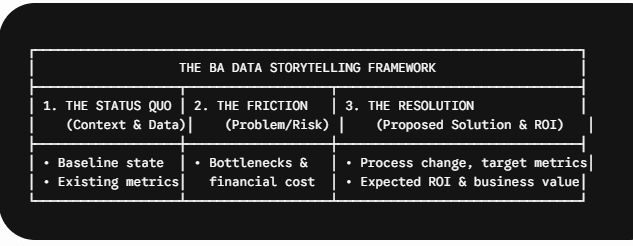
1. Set the Context (The Baseline)
Establish current operational conditions using empirical data points (e.g., “Customer onboarding takes an average of 4.5 days across core branch operations”).
2. Introduce the Friction (The Problem)
Highlight operational risks, revenue loss, or inefficiency costs (e.g., “Because 35% of applicants abandon manual document verification, the bank loses an estimated $120,000 monthly in potential account balances”).
3. Deliver the Resolution (The Proposed Future State)
Present the technical or process solution accompanied by clear financial and performance projections (e.g., “Implementing an automated REST API integration for digital ID verification reduces onboarding time to 3 minutes, recovering 80% of lost conversions”).
Essential Storytelling Techniques for Business Analysts
| Technique | Application | Stakeholder Impact |
| User Personas | Frame requirements around real human scenarios rather than system IDs. | Builds empathy and clarifies product vision for development teams. |
| Data Visualization | Pair numbers with clean visual charts (Power BI, Tableau) instead of dense spreadsheets. | Speeds up executive decision-making during steerco meetings. |
| Process Mapping | Use BPMN diagrams to visually contrast “As-Is” versus “To-Be” states. | Highlights bottleneck risks clearly to non-technical operational leaders. |
| Impact-First Hook | Lead presentations with the business outcome before diving into technical details. | Retains executive engagement throughout project updates. |
Real-World BA Scenario: Presenting a FinTech System Migration
Context: A Senior BA must convince non-technical banking executives to approve a $200,000 backend API migration project.
The Story Pitch:
The Hook: “We are currently losing 1,200 digital loan applications every month due to legacy processing timeouts.”
The Narrative: “Meet Sarah, a first-time homebuyer applying for a mortgage on her phone. On Step 3, our legacy mainframe takes 45 seconds to fetch her credit score via SOAP services. Frustrated, Sarah closes our app and opens a competitor’s.”
The Resolution: “By migrating to modern microservices and REST APIs, response times drop from 45 seconds to 200 milliseconds, boosting completion rates by 22% and delivering an ROI within 90 days.”
Related Articles:
Soft Skills & Communication
Soft Skills for Business Analysts
👉 https://www.bacareers.in/soft-skills-for-business-analysts/
Requirement Elicitation
Effective Requirement Elicitation Techniques
👉 https://www.bacareers.in/effective-requirement-elicitation-techniques/
Process Modeling & Visualization
Business Process Modeling Techniques
👉 https://www.bacareers.in/business-process-modeling-techniques/
External Links:
Storytelling & Influence (Authority)
Why Your Brain Loves Good Storytelling – Harvard Business Review
👉 https://hbr.org/2014/03/why-your-brain-loves-good-storytelling
Best place to use:
The Hidden Power of Storytelling in Business
2️⃣ Change Management & Human Behavior
Organizational Change and Human Behavior – McKinsey Insights
👉 https://www.mckinsey.com/capabilities/people-and-organizational-performance/our-insights
Best place to use:
The Psychology of Influence: Leading Stakeholders to Action
Frequently Asked Questions (FAQs)
Data storytelling combines qualitative business context, quantitative analytics, and effective data visualizations to communicate key insights clearly to decision-makers.
Executive Storytelling: Focuses on high-level outcomes, return on investment (ROI), strategic alignment, and risk mitigation.
Developer Storytelling: Focuses on user context, acceptance criteria scenarios, functional boundary limits, and technical edge cases.
Mastering Business Analyst storytelling is essential for driving stakeholder alignment and turning complex requirements into actionable business value.
By blending structured narrative arcs with data storytelling for Business Analysts, BAs can influence executive decisions, refine product backlogs, and lead successful digital transformations.
📄 Business Analysis & Leadership Hub
Explore how BA storytelling connects with Agile frameworks, technical documentation, and career advancement:
| Knowledge Area | Deep-Dive Guide | Why It Matters for a Business Analyst |
|---|---|---|
| BA Leadership & Soft Skills | Business Analyst Storytelling Guide | Influence executives, present business cases, and communicate complex data insights clearly. |
| Career Growth 2026 | Future-Proof Your BA Career in 2026 | Combine AI automation, product management mindsets, and strategic narrative skills. |
| Agile Requirements | Agile User Stories Comprehensive Guide | Use user-centric narratives to draft clear user story descriptions and acceptance criteria. |
| Agile Tooling | JIRA & Confluence Setup Guide | Structure epic backlogs and Confluence product vision docs to support team alignment. |
| Technical BA Skills | API Requirement Documentation Guide | Translate backend API data architectures into clear business impact stories for stakeholders. |
🎁 Become a Better Business Analyst
Join 1,200+ Business Analysts learning every week.
Get instant access to:
📘 FREE Business Analyst Templates
🎯 Interview Preparation Guides
🚀 Agile & Scrum Tutorials
🤖 AI for Business Analysts
📈 Career Growth Tips
100% Free • No Spam • Unsubscribe Anytime
