

FREE DOWNLOAD: Business Analyst Documentation Toolkit
Get instant access to real-world BRD, FRD, and project story templates used by senior BAs.
Download Free Templates PDF
In 2026, the traditional role of the Business Analyst (BA) as a passive requirements documenter has fundamentally shifted. With the rapid adoption of Generative AI, low-code automation, and data-driven product strategies, modern enterprise organizations expect BAs to act as strategic partners, product growth enablers, and data storytellers.
1. The Core Drivers Changing the BA Role in 2026
Generative AI & Automation Integration: Routine tasks like initial BRD drafts, user story creation, and basic process flow diagrams are now assisted by AI tools. BAs must focus on business value alignment and risk validation.
Data-Driven Decision Making: BAs are required to interpret analytics dashboards (e.g., Power BI, Tableau) and turn raw metrics into actionable business strategies.
Transition from Project Mindset to Product Thinking: Organizations are moving away from temporary project deliverables toward continuous product lifecycles, requiring BAs to understand user retention, customer churn, and value streams.
2. Four Essential Pillars to Future-Proof Your BA Career
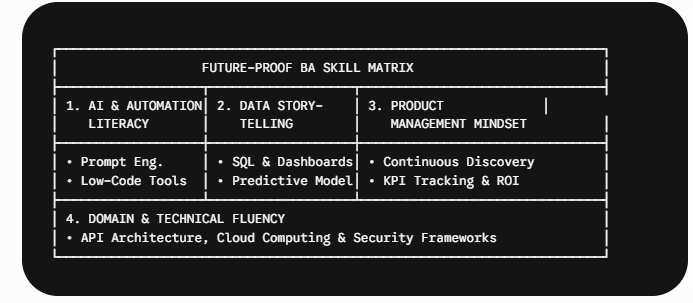
Pillar 1: AI & Automation Literacy
Use AI tools (ChatGPT, Claude, Power Automate) to automate manual requirements gathering and initial test case generation.
Understand predictive model requirements and ethics when working on machine learning initiatives.
Pillar 2: Data Storytelling & Analytics
Master tools like SQL, Power BI, and Tableau to back up business cases with empirical data.
Move beyond reporting numbers—explain why a metric dropped and present three validated solutions.
Pillar 3: Product Management & Agile Strategy
Embrace Product Owner competencies: backlog prioritization, discovery workshops, and hypothesis-driven development.
Measure post-launch adoption rates rather than stopping effort at deployment.
Pillar 4: Modern Technical Architecture
Understand how REST APIs, Core Banking/FinTech workflows, and Cloud Infrastructure (AWS, Azure) connect across modern enterprise ecosystems.
3. Real-World BA Scenarios for 2026
Scenario 1: Replacing Legacy Document Gathering with AI-Assisted Discovery
The Situation: A senior BA is assigned to refactor a complex legacy claim processing system with over 200 undocumented business rules.
The Modern BA Approach: Instead of spending weeks manually reading old code or interviewing stakeholders from scratch, the BA utilizes AI prompts to parse legacy specification logs and generate a preliminary decision tree. The BA then hosts targeted, 30-minute validation sessions with key business stakeholders to verify edge cases, saving over 40 hours of manual elicitation.
Scenario 2: Data-Driven Feature Prioritization in Digital Banking
The Situation: Stakeholders insist on building an elaborate multi-currency wallet feature for a mobile banking application.
The Modern BA Approach: Rather than writing functional specifications immediately, the BA writes SQL queries against event tracking logs to analyze user transaction history. Upon discovering that only 1.2% of active users make international transfers, the BA presents a data dashboard showing that automating local real-time account opening yields a 4x higher return on investment (ROI).
4. Actionable 6-Month Upskilling Plan
| Phase | Duration | Core Focus Area | Deliverable / Milestone |
| Phase 1 | Months 1–2 | Advanced Data & Analytics | Build 2 interactive Power BI/Tableau dashboards with sample business datasets. |
| Phase 2 | Months 3–4 | AI & API Literacy | Write full API data mapping specs and utilize AI tools for backlog generation. |
| Phase 3 | Months 5–6 | Agile & Product Credentials | Earn an IIBA credential (ECBA, CCBA, CBAP) or Product Ownership certification. |
What’s Really New for Business Analysts in 2026 – Beyond the Hype?
The world of business analysis is changing fast.
By 2026, AI will be part of every decision, and companies will be run more by data.
But the main change isn’t just about technology – it’s about what businesses expect from their analysts.
Organizations now look for partners, not just people who collect requirements.
Real–life example:
A BA in banking used to focus on writing down the needs for a new loan system.
In 2026, that same BA is expected to look at AI models for lending, understand risk data, and suggest ways to improve processes – still making sure everything stays legal and clients are happy.
So, in short: 2026 favors analysts who think about more than just requirements and act as real problem solvers.
The Rise of AI-Enhanced Business Analysis – Why You Can’t Ignore It
AI is no longer something for the future – it’s already here.
BAs are expected to use AI tools to get insights, automate tasks, and speed up requirement checks.
Here are some examples:
– Using AI chat tools like ChatGPT to create drafts for requirements.
– Using Power BI with AI features for instant insights.
– Applying predictive tools to understand how customers might behave.
Tip for BAs:
Instead of worrying about AI, see yourself as the person who explains what AI finds in terms the business can understand.
Client Expectations Are Changing – Less Data, More Strategy
Clients don’t want BAs who just repeat what they say.
They want people who challenge ideas and help reach goals.
Example:
A retail client says, “We need an app for managing inventory.”
A ready-for-2026 BA asks, “What problems are costing you money?”
and then suggests using AI to forecast demand instead of building another app.
This shift from just taking orders to being a real advisor is the main way BAs stand out in 2026.
Skillset Upgrade: Your 2026 Toolbox
From Collecting Requirements to Designing Strategic Solutions – A Must-Do Shift
Traditional methods like interviews and workshops will still be important, but in 2026, BAs need to take that information and build strategies.
This means creating solution plans, mapping value streams, and using data to make smart decisions.
Example:
A healthcare BA finds delays in patient sign–ups by analyzing processes.
Instead of just reporting issues, they suggest an AI chatbot to help with triage, linking technology directly to faster service.
Mastering AI Tools for Data Work, Automation, and Smart Predictions
Top AI tools BAs should try in 2026 include:
– Microsoft Power Automate – for automating workflows.
– ChatGPT and Gemini AI – to summarize information or write up requirements.
– Tableau or Power BI with AI features – for making smart data dashboards.
– Process–mining tools like Celonis or UiPath – to spot real–time bottlenecks.
The Key to Influencing Decisions with Data and Stories
BAs need to move from showing charts to telling stories that move people.
You need to mix data visuals with storytelling skills – showing why things matter to leaders.
Example:
Instead of just showing a chart about costs going up, tell the story of how automation could save $2 million and boost customer happiness.
How BAs Become the Link Between AI and Business Needs
In 2026, BAs act as the bridge between AI experts and business leaders.
You’ll define:
– The business problems AI can fix.
– The data needed and how to avoid bias.
– What success looks like when using AI.
Example:
A BA in the insurance industry turns the vague goal of “reducing claim time” into measurable goals using AI tools that scan and understand documents.
Spotting Ethical Issues and Bias in AI Systems
AI can make unfair decisions if the data it uses is flawed.
BAs now have to check for fairness, transparency, and responsibility in projects.
Example:
In a hiring tool, a BA finds that the AI model is making unfair choices based on location data and brings this up early in the project.
Working Well with Data Scientists and Machine Learning Engineers
Teamwork is more important than ever.
The BA’s job is to connect business goals with what the AI models need and test if the results work in real situations.
Example:
A telecom BA works with AI engineers to fine–tune a model that predicts customer loss – making sure it aligns with real service goals, not just technical accuracy.
Going Beyond the Classic BA Role
Looking Into New BA-Related Positions: AI Product Owner, Digital Transformation Analyst 2026 brings new roles like:
– AI Product Owner – focuses on creating AI-driven features and product goals.
– Digital Transformation Analyst – helps bridge business and IT during big changes.
These roles need a deep understanding of the business and the ability to use AI tools and interpret data.
The Value of Specializing in a Specific Area or Technology
General BAs are not in high demand anymore.
Specialists in areas like finance, health, logistics, or security are more wanted.
Pick a niche you’re interested in and build deep knowledge of its tools, rules, and ways of working.
Example:
A BA who specializes in healthcare learns the FHIR standards and the HIPAA rules to stand out.
Creating a Personal Brand That Shows Your Forward-Thinking Skills
In 2026, how you share your knowledge online is as important as your resume.
Write posts, share case studies, and create short articles that show your skills.
Your Step-by-Step Plan for a Future-Ready Career.
Staying Ahead with Certifications, Online Learning, and Hands-On Projects
Stay ahead with certifications like:
– IIBA CBAP / CCBA / ECBA
– Agile Analysis Certification (AAC)
– AI for Business Professionals (Coursera, IBM, Google)
Also, work on side projects – help automate tasks at your job or analyze reports using Power BI.
Smart Networking: Connecting With Trend-Setting Leaders
Join groups like IIBA, LinkedIn BA communities, and local BA groups.
Participate in webinars, attend panel discussions, and work on open–source projects.
Thinking Ahead: Building a Mindset That Helps You Grow
The most important skill in 2026 isn’t about coding – it’s about being adaptable.
Embrace new tools, test them out, and keep track of what you learn.
Related Articles:
https://www.bacareers.in/how-to-become-a-business-analyst/
https://www.bacareers.in/soft-skills-for-business-analyst/
https://www.bacareers.in/how-to-become-a-business-analyst/
External Links:
https://www.coursera.org/
https://www.edx.org/
https://www.iiba.org/
To future-proof your BA career in 2026, professionals must expand beyond traditional requirements gathering and embrace data storytelling, AI-driven automation, and modern technical architectures.
📄 Business Analysis Career & Skill Development Hub
Explore strategic topics to level up your technical business analysis skills and advance your career:
| Focus Area | Deep-Dive Guide | Career Impact |
|---|---|---|
| Career Growth 2026 | Future-Proof Your BA Career in 2026 | Master AI tools, product strategy, and data-driven business analysis frameworks. |
| Technical BA Skills | API Requirement Documentation Guide | Learn to write REST API specs, map JSON payloads, and define HTTP validation rules. |
| Agile Tooling | JIRA & Confluence Setup Guide | Connect requirements in Confluence to JIRA user stories and manage backlog refinement. |
| FinTech Domain | Core Banking Systems & Workflows | Understand enterprise banking architecture, CIF creation, and customer onboarding. |
| Payment Systems | Payment Gateways & Transaction Life Cycle | Document authorization, settlement, clearing, and chargeback business rules. |
Frequently Asked Questions (FAQs)
No. AI automates repetitive document generation and initial data synthesis, but it cannot replace human stakeholder negotiation, empathy, conflict resolution, domain context evaluation, or complex problem framing. BAs who leverage AI will replace BAs who do not.
The top technical skills include foundational SQL for data extraction, REST API comprehension for microservice integrations, basic understanding of cloud architecture (AWS/Azure), and fluency with modern backlog tools like JIRA and Confluence.
Focus on business outcomes over output. Start defining feature success metrics (KPIs), participate in user research/discovery sessions, learn product backlog prioritization techniques (such as RICE or MoSCoW), and take ownership of product vision metrics like retention and churn.
🎁 Become a Better Business Analyst
Join 1,200+ Business Analysts learning every week.
Get instant access to:
📘 FREE Business Analyst Templates
🎯 Interview Preparation Guides
🚀 Agile & Scrum Tutorials
🤖 AI for Business Analysts
📈 Career Growth Tips
100% Free • No Spam • Unsubscribe Anytime
