
FREE DOWNLOAD: Business Analyst Documentation Toolkit
Get instant access to real-world BRD, FRD, and project story templates used by senior BAs.
Download Free Templates PDFWhat is Requirement Prioritization and Why Is It Important?
Requirement prioritization is the systematic process of evaluating, categorizing, and ranking software functional and non-functional requirements based on business value, technical risk, cost, urgency, and stakeholder impact.
Why Prioritizing Requirements Is Critical:
Prevents Scope Creep $\rightarrow$ Establishes explicit boundaries on what must be built in the current release vs. future phases.
Maximizes ROI Early $\rightarrow$ Ensures development teams deliver high-value, high-impact features first.
Optimizes Resource Allocation $\rightarrow$ Prevents engineering bottlenecks by focusing capacity on critical business needs.
Facilitates Stakeholder Alignment $\rightarrow$ Provides objective evaluation frameworks to resolve conflicting priorities between department heads.
5 Popular Business Requirement Prioritization Methods
| Prioritization Framework | Core Evaluation Criteria | Best Used For |
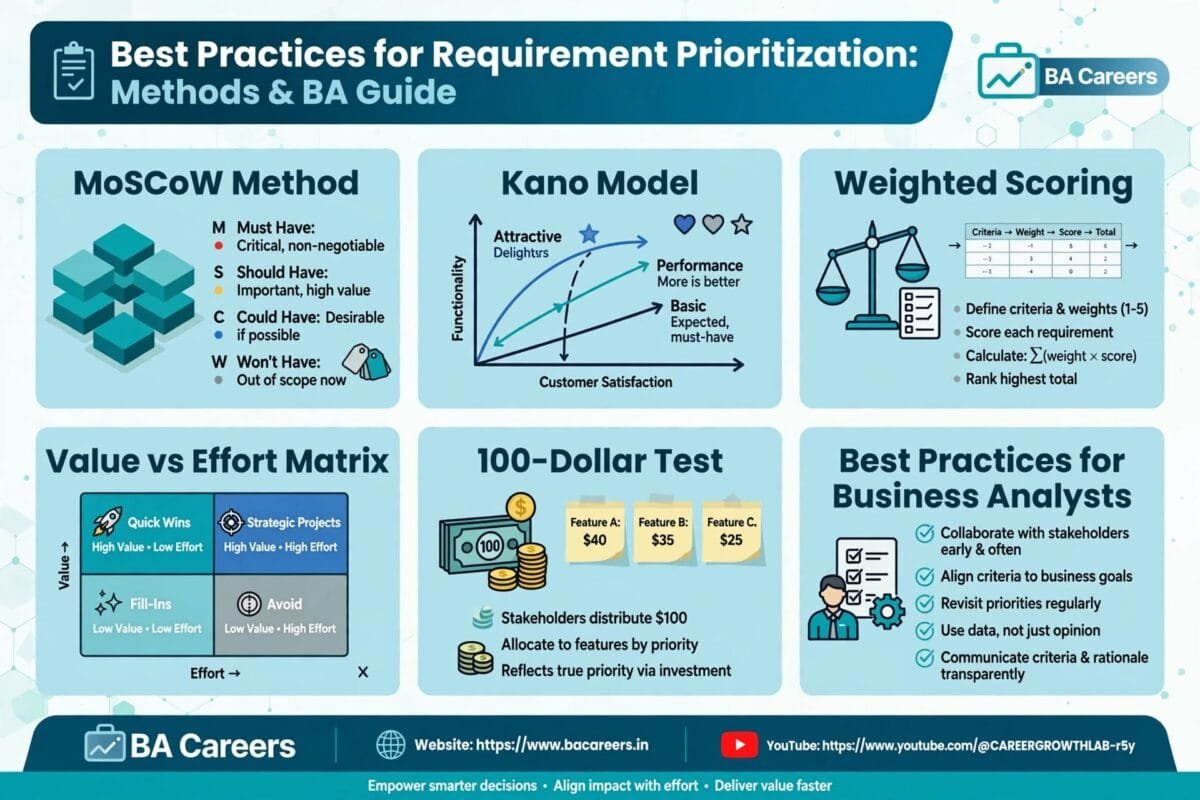
| MoSCoW Method | Classifies requirements into Must-have, Should-have, Could-have, and Won’t-have (this cycle). | BRDs, fixed-scope projects, and fast stakeholder alignment. |
| Kano Model | Evaluates customer satisfaction against Basic Needs, Performance Needs, and Delighters. | Customer-facing mobile apps, SaaS product features. |
| Value vs. Effort Matrix | Plots business value against technical complexity on a 2×2 grid (Quick Wins, Major Projects, Fill-ins, Thankless Tasks). | Sprint backlog refinement and product roadmap planning. |
| WSJF (Weighted Shortest Job First) | Calculates Cost of Delay divided by Job Duration (used in SAFe). | Scaled Agile enterprise environments with large feature backlogs. |
| Eisenhower Matrix | Categorizes items by Urgency and Importance (Do First, Schedule, Delegate, Eliminate). | Immediate crisis management and defect triage. |
4-Step Requirement Prioritization Process for BAs
Step 1: Stakeholder & Constraint Identification $\rightarrow$ Gather core constraints (budget, timeline, regulatory deadlines) and identify decision-makers.
Step 2: Objective Scoring & Criteria Alignment $\rightarrow$ Establish clear scoring metrics (e.g., business value 1–5, risk 1–5) rather than relying on subjective opinions.
Step 3: Framework Application (MoSCoW / Value vs Effort) $\rightarrow$ Facilitate a prioritization workshop (JAD session) to categorize requirements into actionable tiers.
Step 4: Baseline Lock & Change Control Integration $\rightarrow$ Document finalized priority ratings in the Business Requirements Document (BRD) or Jira backlog, establishing formal Change Request rules for mid-sprint adjustments.
🏦 Real-Time Scenario: Prioritizing Requirements for a Digital Wallet Launch
Context & Objective
A Business Analyst is managing 25 functional requirements for a new Digital Wallet App. The launch deadline is strictly set in 3 months due to regulatory compliance.
Prioritization Execution Flow
Step 1: Establishing MoSCoW Categories $\rightarrow$ The BA conducts a 2-hour JAD session with Risk, Marketing, and Engineering leads.
Step 2: Classifying Features $\rightarrow$
Must Have: Biometric User Login, KYC Verification, Instant P2P Transfer API (Non-negotiable for launch).
Should Have: Transaction History Filter, Push Notification Alerts (High value; can launch 1 week post-release if delayed).
Could Have: Custom Profile Avatar, Dark Mode Theme (Low effort; moved to Phase 2 backlog).
Won’t Have: Crypto Asset Trading (Deferred to next fiscal year).
Step 3: BRD Approval $\rightarrow$ Executive sponsors sign off on the prioritized BRD, ensuring engineering focuses strictly on the 8 Must-Have features for Day 1 deployment.
Business Analysis Resource Hub
📘 Documentation Guide: BRD vs FRD Differences & Real-World Examples — Learn how to embed prioritized requirements into formal BRDs.
🛠️ Agile Prioritization: Role of Business Analyst in Agile Scrum Projects — Master backlog refinement and user story prioritization.
👥 Stakeholder Alignment: Stakeholder Meaning: Definition, Types & Role in BA — Manage conflicting stakeholder demands during prioritization workshops.
Frequently Asked Questions (FAQ)
Prioritizing requirements ensures that project teams focus on delivering the highest business value first, manage budget and time constraints effectively, and prevent scope creep during development.
In a Business Requirements Document (BRD), requirements are typically prioritized using the MoSCoW method (Must, Should, Could, Won’t) or a numerical priority scale (High, Medium, Low) assigned during stakeholder alignment workshops.
In Waterfall, requirements are prioritized upfront during the initial analysis phase and locked in the BRD. In Agile, requirement prioritization is a continuous process occurring every sprint during Product Backlog Refinement sessions using frameworks like WSJF or Value vs. Effort.
🎁 Become a Better Business Analyst
Join 1,200+ Business Analysts learning every week.
Get instant access to:
📘 FREE Business Analyst Templates
🎯 Interview Preparation Guides
🚀 Agile & Scrum Tutorials
🤖 AI for Business Analysts
📈 Career Growth Tips
100% Free • No Spam • Unsubscribe Anytime
