

FREE DOWNLOAD: Business Analyst Documentation Toolkit
Get instant access to real-world BRD, FRD, and project story templates used by senior BAs.
Download Free Templates PDFWhat is SQL and Why Do Business Analysts Need It?
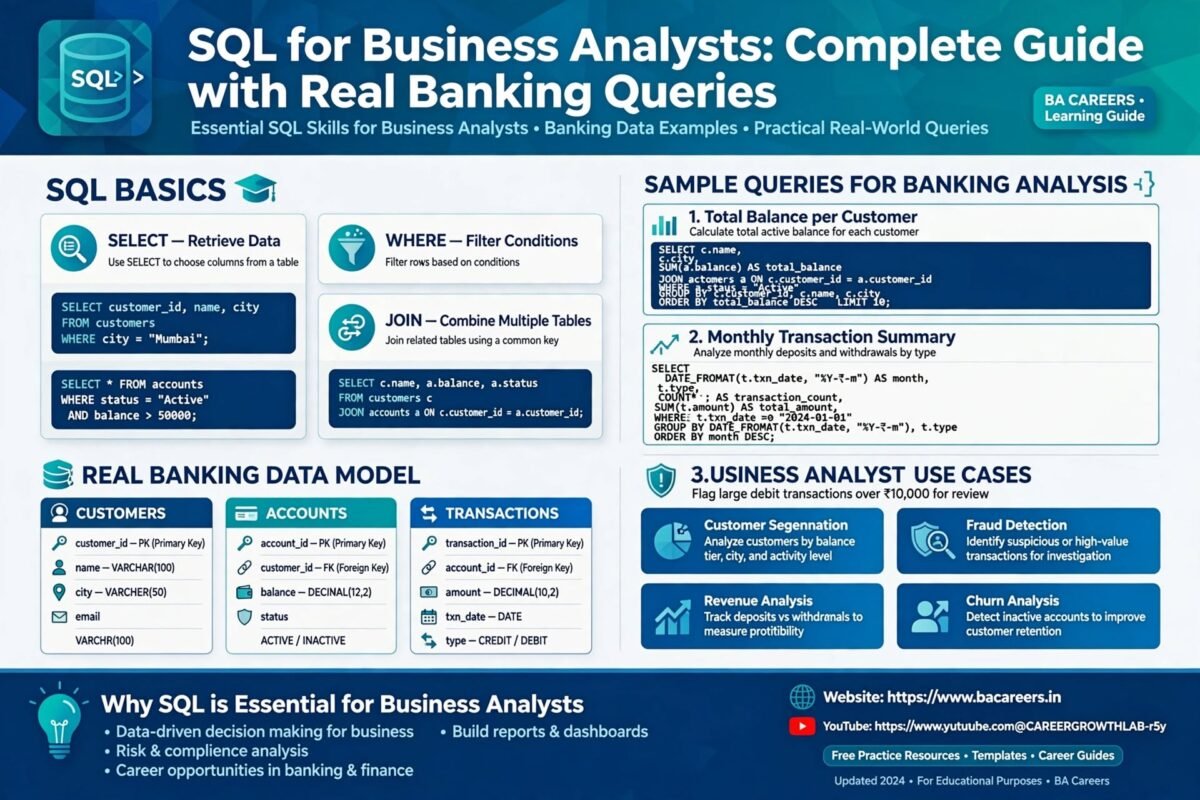
SQL (Structured Query Language) is the standard domain-specific programming language used by Business Analysts to query, retrieve, filter, and analyze structured data stored in relational database management systems (RDBMS) like PostgreSQL, MySQL, Oracle, and Microsoft SQL Server.
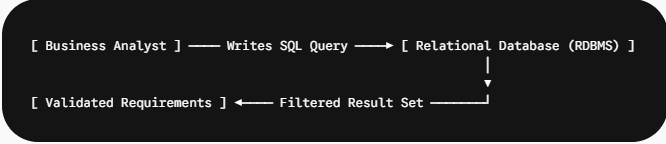
In modern IT and enterprise projects, Business Analysts rely on SQL to independently validate backend data flows, verify system requirements during User Acceptance Testing (UAT), perform root cause analysis on software defects, and map data fields between legacy systems and modern APIs without relying on busy database administrators (DBAs).
Top 5 Essential SQL Clauses Every BA Must Master
| SQL Clause | Primary Function | Business Analyst Use Case Example |
SELECT | Specifies the exact table columns or fields to retrieve. | Pulling customer_id, email, and account_status fields. |
WHERE | Filters records based on specific business conditions. | Filtering for accounts created within the last 30 days (created_date >= '2026-01-01'). |
GROUP BY | Aggregates duplicate data into summary rows. | Calculating total deposit balances grouped by branch location. |
HAVING | Filters aggregated summary groups created by GROUP BY. | Displaying only branches where total deposits exceed $1,000,000. |
ORDER BY | Sorts the final query result set in ascending (ASC) or descending (DESC) order. | Sorting high-priority pending support tickets from newest to oldest. |
Understanding SQL Joins (The BA Data Mapping Visual Grid)
Relational databases split data across multiple specialized tables to prevent duplication. Business Analysts use SQL JOINs to combine fields from two or more tables based on a shared key column (like customer_id).
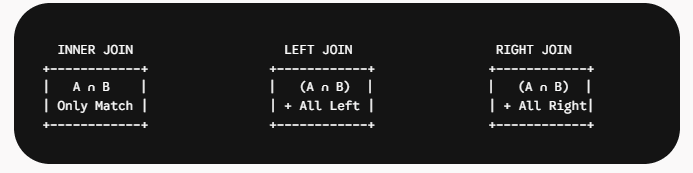
INNER JOIN: Returns only rows where matching values exist in both tables.LEFT JOIN(Left Outer Join): Returns all records from the left table, plus matching records from the right table. (If no match exists,NULLis returned).RIGHT JOIN(Right Outer Join): Returns all records from the right table, plus matching records from the left table.FULL OUTER JOIN: Returns all records when a match exists in either left or right table.
🏦 Real-Time Scenario: SQL Data Validation in a Banking AML System
Context & Objective
A Business Analyst working on an Anti-Money Laundering (AML) Compliance project needs to verify that a new backend microservice correctly flags accounts attempting high-value transfers over $10,000 while their account status is marked as “UNVERIFIED”.
Step-by-Step SQL Execution
Instead of waiting for developers to build UI reports, the BA directly connects to the staging database and executes the following query:
-- Query: Find Unverified Accounts Executing High-Value Transfers
SELECT
    c.customer_id,
    c.customer_name,
    c.verification_status,
    t.transaction_id,
    t.amount,
    t.transaction_date
FROM customers c
INNER JOIN transactions t ON c.customer_id = t.customer_id
WHERE c.verification_status = 'UNVERIFIED'
  AND t.amount >= 10000
  AND t.transaction_date >= '2026-09-01'
ORDER BY t.amount DESC;
Business Analyst Outcome
The query returned 14 transactions that bypassed security flags. The BA attached this query result set to a high-priority Jira Defect Bug Report, enabling developers to fix the backend authorization logic before production deployment.
Business Analysis Resource Hub (Internal Links)
📘 Documentation Guide: BRD vs FRD Differences & Real-World Examples — Learn how database fields map into functional requirements.
🧪 Testing Lifecycle: User Acceptance Testing (UAT) Guide for Business Analysts — Use SQL to populate and verify UAT test case scenarios.
🛠️ System Integration: API Full Form: What It Is & How It Works — See how database schemas feed into REST API data payloads.
Frequently Asked Questions (FAQ)
No. Business Analysts do not write complex database triggers or stored procedures. BAs primarily use data retrieval queries (SELECT, WHERE, JOIN, GROUP BY) to validate requirements and analyze business performance.
A Database Schema is the structural blueprint showing how tables, columns, and relationships are organized. A SQL Query is the written command used to pull or filter specific data out of that schema.
During system integration or data migration projects, BAs use SQL to compare source table structures (Source SQL) against target table structures (Target SQL) to identify field mismatches, data type inconsistencies, and missing primary keys.
🎁 Become a Better Business Analyst
Join 1,200+ Business Analysts learning every week.
Get instant access to:
📘 FREE Business Analyst Templates
🎯 Interview Preparation Guides
🚀 Agile & Scrum Tutorials
🤖 AI for Business Analysts
📈 Career Growth Tips
100% Free • No Spam • Unsubscribe Anytime
