

FREE DOWNLOAD: Business Analyst Documentation Toolkit
Get instant access to real-world BRD, FRD, and project story templates used by senior BAs.
Download Free Templates PDFWhat is the BRD vs FRD difference?
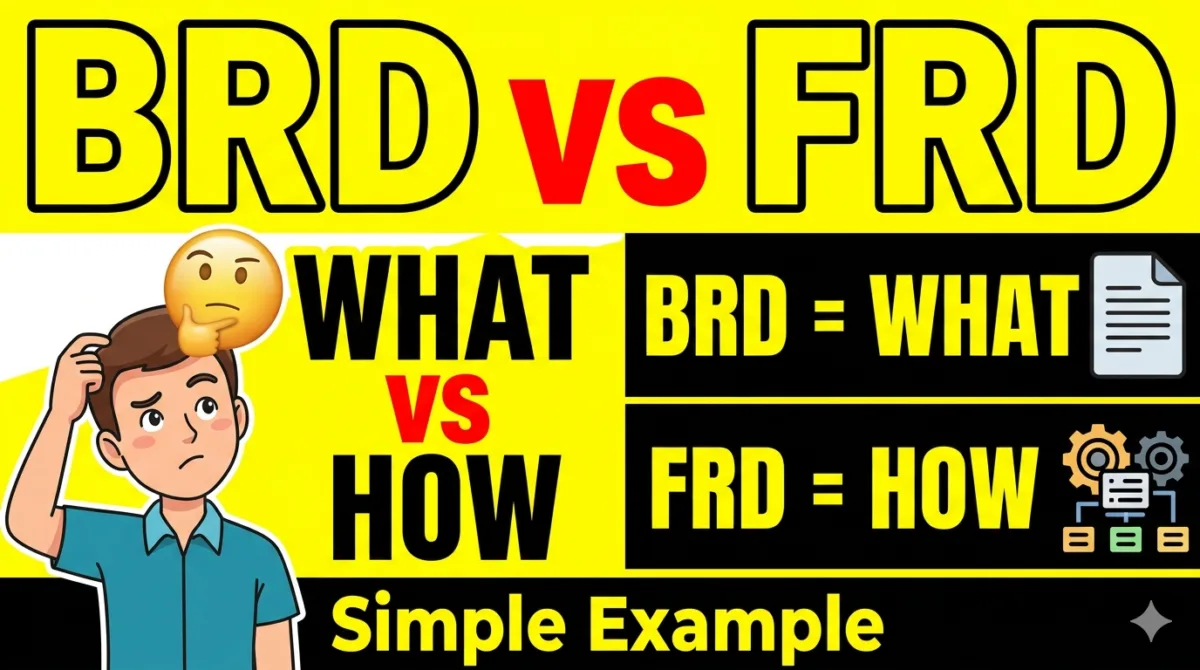
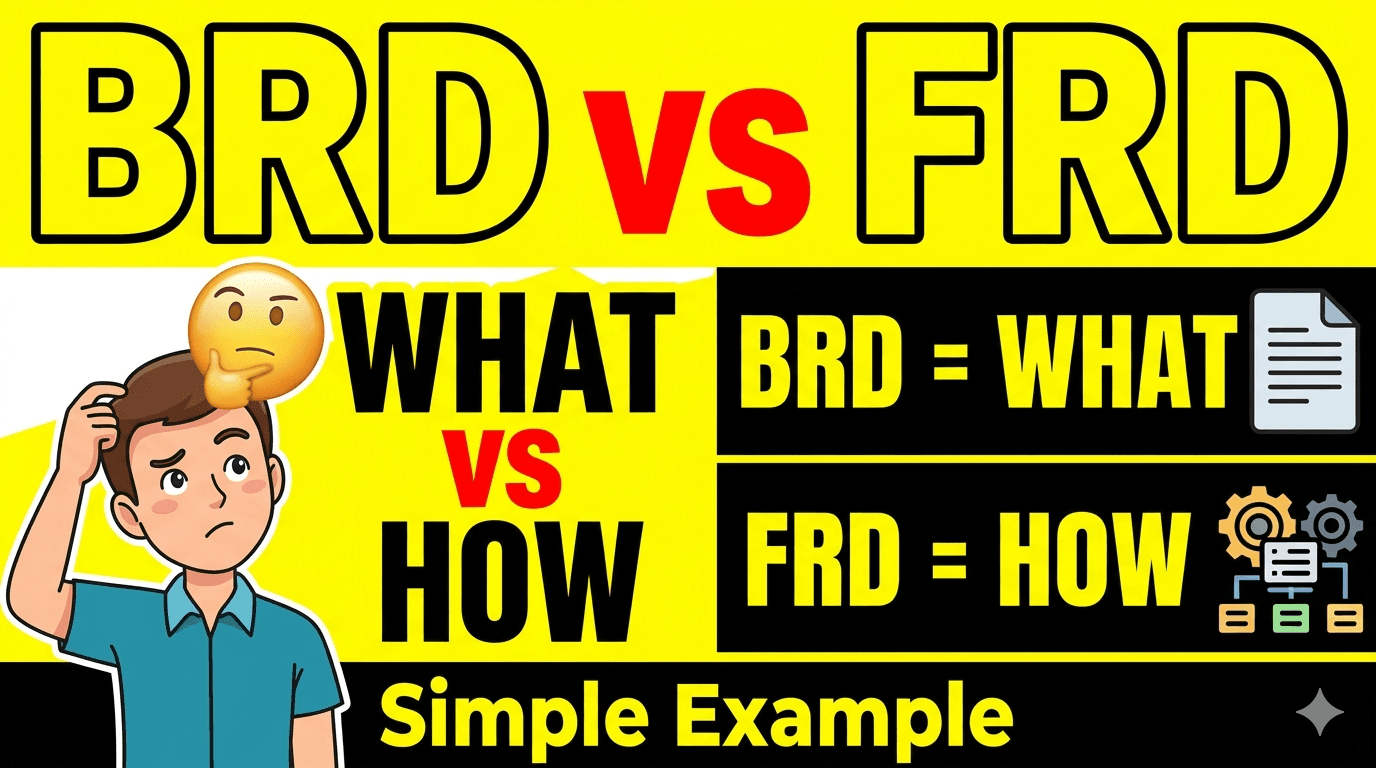
Here’s the difference between a BRD and FRD, in brief. The main differences between a BRD and FRD is: who the intended audience of the document is, and scope. BRD covers a high-level look at what is being accomplished from a business standpoint (business objectives, ROI, company policy).
FRD provides the specific technical guidelines on how an application should function in order to accomplish the stated business goals (what each user journey involves, user workflows, specific validation of data, the necessary data fields and data relationships, system inputs, and system outputs) for use by software developers, test engineers, QA specialists, and designers.
BRD vs FRD Difference Introduction:
The BRD vs FRD difference is a core competency to develop as a business analyst. More often than not, an IT project, its budget, and its scope “suck” not because of a lack of skilled software engineers, but because the desire of a business cannot be “ translated” to concrete instructions the technical team can work with. While a BRD outlines the business strategy, the high-level problem, and the desired outcome of a business need, the FRD transforms these strategic goals into actual software and system functionality. In this write-up we are going to highlight the important differences between a BRD and an FRD, as well as walk you through some of the characteristics of each type of document.
What is a Business Requirement Document (BRD)?
The Business Requirements Document (BRD) is your project’s central source of truth for what the business wants to accomplish, why, and at a high level what must be done to achieve these business objectives.
Purpose of a BRD:
Align business stakeholders. It clarifies the vision of the project for project sponsors, executives, and business stakeholders.
Business Justification. It details the why behind the project, justifying the project through a business case and ROI analysis.
Set Project Scope. It helps limit project “scope creep” and outlines what will and will not be included in the project deliverables.
Key Sections of a BRD:
- Executive Summary – A high-level summary of the project, rationale, and key business goals.
- Business Objectives and KPIs (Key Performance Indicators). – Specific metrics related to the business goals that must be tracked and reported to determine the success of the project (e.g., ‘Increase sales conversion by X% by the end of the year).
- Current and Future States (As-Is and To-Be). – An overview of the existing business process and how it will be impacted or changed.
- User Personas and Stakeholders – High level overview of the types of people who will be interacting with the resulting product/solution.
- Business Rules and Constraints. – Any applicable policies, laws, and regulations that govern the project, as well as technology restrictions or budgetary limitations.
What is a Functional Requirement Document (FRD)?
The Functional Requirements Document (FRD), or Functional Specifications Document (FSD) as it is often called, serves as the key documentation connecting business requirements to a technology system, such as software applications. Its purpose is to detail exactly how an IT application or software must behave and function from an end-user perspective.
Purpose of an FRD:
Assist with Development. Developers must have a crystal clear understanding of exactly how each feature and system component should function.
Guide Quality Assurance (QA).The FRD allows testers to develop specific test cases, to ensure the application works as specified.
Clarify User Interactions and Validations. It shows exactly how the system will interact with a user, what happens on user actions, error handling, validation rules for all data, and the output of that data.
Key Sections of an FRD:
System Functional Specifications. – Step-by-step definition of how each feature of the application should work.
Use Cases. – A diagram or textual description of a user’s interaction with a system.
Screen Mockups or Wireframe References – Visual representations of how the system will appear, how users will interact with the different fields on a screen, and user navigation between screens.
Data Dictionary and Validations. – Details about data fields in the system, what data types each field accepts, valid ranges, formatting, required field designations, and data flow between system components.
System Interface and API Specifications – Information about how the application will interact with other systems (internal or external) via APIs or other interfaces.
Side-by-Side Comparison: BRD vs FRD
To clearly grasp the BRD vs FRD difference, analyze how each document functions across critical project dimensions:
| Feature / Attribute | Business Requirement Document (BRD) | Functional Requirement Document (FRD) |
| Primary Focus | High-level business strategy (What business needs to solve). | Technical system behavior (How system will execute). |
| Primary Audience | Executive Sponsors, Business Leaders, BAs, Project Managers. | Software Developers, Architects, QA Testing Teams, BAs. |
| Created By | Lead Business Analyst / Product Manager. | Business Analyst / Systems Analyst / Technical Lead. |
| Technical Depth | Low (uses plain business language, free of jargon). | High (includes data schemas, screen flows, API interactions). |
| Document Input | Stakeholder Interviews, Market Analysis, Business Case. | Approved BRD, User Workflows, Prototyping sessions. |
| Key Output | Scope Baseline, Business Approval, Budget Release. | Code Architecture, Test Cases, System Design Specs. |
| Change Impact | High (Changing BRD alters budget & delivery timeline). | Medium (Changing FRD alters design & story estimates). |
👉 “The above BRD vs FRD comparison table clearly explains the difference between business requirement document and functional requirement document with examples, making it easier for beginners to understand.”
BRD & FRD Guide: Core Areas & Deep-Dive Topics
| Core Pillar | Deep-Dive Knowledge Areas (Click to Read) | Why It Matters for a Business Analyst |
BRD | Brd Vs Frd Difference With Examples Business Analyst Guide For Beginners 2026 | Helps BAs understand how requirements are documented, structured and communicated. |
| Brd Vs Frd | Helps BAs understand how requirements are documented, structured and communicated. | |
| How To Write A Business Requirements Document Brd | Helps BAs understand how requirements are documented, structured and communicated. | |
| What Is A Brd Business Requirements Document | Helps BAs understand how requirements are documented, structured and communicated. | |
| Brd Format 10 Tips For Writing An Effective Brd | Helps BAs understand how requirements are documented, structured and communicated. | |
| How To Write Brd Business Requirement Document Step By Step With Example Ba Guide 2026 | Helps BAs understand how requirements are documented, structured and communicated. | |
| Brd Document Tips To Write Brd Document | Helps BAs understand how requirements are documented, structured and communicated. | |
FRD / SRS / FRS | Frs Full Form In Software Engineering | Helps BAs understand how requirements are documented, structured and communicated. |
| Frd Document In Software Development | Helps BAs understand how requirements are documented, structured and communicated. | |
| What Is Frs Document In Software Development | Helps BAs understand how requirements are documented, structured and communicated. | |
| Frd Full Form Functional Requirement Document Guide Template | Helps BAs understand how requirements are documented, structured and communicated. | |
| A Comprehensive Guide To Prepare Frs Document | Helps BAs understand how requirements are documented, structured and communicated. | |
| What Is Srs Full Form In Software Engineering | Helps BAs understand how requirements are documented, structured and communicated. | |
| Frd Crafting A Comprehensive Frd A Step By Step Guide | Helps BAs understand how requirements are documented, structured and communicated. | |
| What Is Srs Document The Ultimate Primer For Project Managers And Developers | Helps BAs understand how requirements are documented, structured and communicated. |
BRD vs FRD Difference Example: E-Commerce Self-Service Product Returns
Let’s look at an e-commerce self-service product return scenario:
1.The BRD Way:
Business Goal: To allow customers to process product returns online without contacting customer service.
Desired KPI: Reduce the number of calls to the customer service department regarding returns by 30% in the first 6 months after launch.
BRD requirement: “Customers will be able to initiate a return of eligible products through a self-service portal on the e-commerce website, within 30 days of purchase, thereby reducing the load on customer support.”
2.The FRD Way:
FR-01: Return Item eligibility check Trigger: When a registered customer clicks “Return Item” next to an order line item on their “Order History” page.
Action: The system must: 1. Retrieve the Order_Date for the selected order from the database.
2.Compare OrderDate with CurrentDate.
Logic: If CurrentDate is within 30 days of OrderDate, display the return request form and enable the “Return Item” button for that item. If CurrentDate is beyond 30 days of OrderDate, disable the “Return Item” button for that item and display the message “Item is outside of the 30-day return window”.
FR-02: Return Form Input and Validation Required fields: Return Reason (dropdown – Defective, Wrong item received, Changed my mind, Other).
If “Defective” is selected, prompt the user to upload an image of the defect, require a file upload (max 5MB, JPG or PNG allowed).
If a defective item image is required and not provided, display an error message “Please provide a photo of the defect” below the upload button.
FR-03: Generate Return Shipping Label Action: Upon successful form submission (all validations passing), call the third-party shipping provider’s API (POST /returns/label) with order and return details.
Response: Return the generated shipping label in PDF format and prompt the user to download it within 3 seconds.
Real-Time Example (Food Delivery App)
Imagine a company wants to build a food delivery mobile app. Customer should be able to browse restaurants, place orders, make payments. Here you can imagine Zomato app or Swiggy app.
Before development starts, business analysts prepare two important documents. The first document is BRD and the second document is FRD. But these documents explain different levels of details.
What is BRD?
What is business requirement document? BRD explains business goals, project objectives, high-level requirements.
Example BRD requirement:
The system should allow customers to order food online.
Notice something important here. BRD explains what the business needs. That means what client is expecting or what customer is expecting from the IT company.
What is FRD?
What is FRD? Functional requirement document. FRD explains system functionality, detailed workflows, technical behavior.
Example FRD:
User selects a restaurant, adds food items, proceeds to checkout, payment is processed, order confirmation is generated.
FRD explains how the system will work.
Another Real-Time Example
Let us compare one requirement
BRD requirement:
The system should allow users to transfer money.
FRD requirement:
User enters account number system validates account user enters amount system checks the balance then transaction completed.
Now you can clearly see the difference between BRD and FRD.
When are BRD and FRD Created?
Then have these these documents created.
BRD is created first. It defines the business need. Sometimes even client will prepare the BRD and they will share with us.
Based on that BRD our BS will prepare the functional specification document or FRD.
FRD is created after the BRD. It explains how developers will build the system.
Why BRD and FRD are Important?
Understanding the difference between BRD and FRD is an important skill for business analysts because these documents help teams understand requirements clearly, reduce project mistakes, build the correct solution.
If you want to learn more about business analyst skills, BA documentation, BA career roadmap then please visit our website:
👉 https://www.bacareers.in
How Business Analysts bridge the BRD to FRD gap:
As a Business Analyst, your job is to guide requirements through this life cycle:
[ Business Problem ] ──► [ BRD: Business Goals ] ──► [ FRD: System Rules ] ──► [ Working Code ]
Understand the Business Problem. Engage with stakeholders and users to uncover and document the “why” in the BRD.
Gain Buy-in. Obtain formal sign-off of the BRD by key business stakeholders and sponsors.
Break Down Requirements.Divide high-level business objectives into specific user stories, workflows, or use cases that represent end-user interactions.
Define Functional Details. Translate user workflows and objectives into precise functional rules, validations, error messages, and system behaviors that go into the FRD.
Collaborate and Review. Work with development and QA teams to review the FRD for technical feasibility and ensure clarity and understanding. Frequently Asked Questions.
Simple Trick to Remember
Here is a simple trick to remember what is BRD and what is FRD.
What does the business need?
BRD answers what does the business need or what does the business requirement.
FRD answers how will the system implement it.
This is the core difference between BRD and FRD.
Frequently Asked Questions. (FAQ’s)
1.Do Agile Scrum teams use BRD and FRD?
While Agile methodologies typically rely on lightweight documentation such as Epics and User Stories, some organizations, especially in highly regulated industries (finance or healthcare), still utilize BRDs and FRDs for documentation and compliance purposes, or as part of an initial high-level plan. Epics often serve the function of a BRD and User Stories with well-defined acceptance criteria can function as an FRD.
2.Can you combine BRD and FRD documents?
Yes, you can create a Business and Functional Requirements Document (BFRD) which combines the elements of both the BRD and the FRD.
This is usually for smaller, less complex projects to simplify documentation.
3.Who is responsible for BRD and FRD sign-off?
For a BRD: Usually the Project Sponsor, key Business Unit stakeholders, or Product Owners who have the business’s vision for the project. For an FRD: Typically approved by the Technical Lead, Solution Architect, or QA Manager to ensure the technical solution is well-defined and testable.
Related Articles :
- https://www.bacareers.in/how-to-write-brd/ (How to Write BRD)
- https://www.bacareers.in/business-analyst-skills/ ( Business Analyst Skills)
- https://www.bacareers.in/ba-career-roadmap/ (BA Career Roadmap)
- https://www.bacareers.in/requirement-elicitation-techniques/ ( Requirement Elicitation Techniques)
FAQ’s
BRD explains what the business needs, while FRD explains how the system will implement those requirements.
Business analysts usually prepare BRD, and based on that FRD is created for developers and testers.
Yes, BRD is created first and FRD is created after BRD.
In some projects, BRD and FRD can be combined into a single document, but generally they are separate.
BRD helps in understanding business goals and ensures the project meets client expectations.
🛠️ Free Business Analyst Templates Library
Don’t start your documentation from scratch. Access our complete repository of real-world Agile & Scrum templates, including BRDs, FRDs, User Story blueprints, and RTM matrices.
Download Free Templates Now →🎁 Become a Better Business Analyst
Join 1,200+ Business Analysts learning every week.
Get instant access to:
📘 FREE Business Analyst Templates
🎯 Interview Preparation Guides
🚀 Agile & Scrum Tutorials
🤖 AI for Business Analysts
📈 Career Growth Tips
100% Free • No Spam • Unsubscribe Anytime
