

FREE DOWNLOAD: Business Analyst Documentation Toolkit
Get instant access to real-world BRD, FRD, and project story templates used by senior BAs.
Download Free Templates PDFWhat is a Business Requirements Document (BRD)?
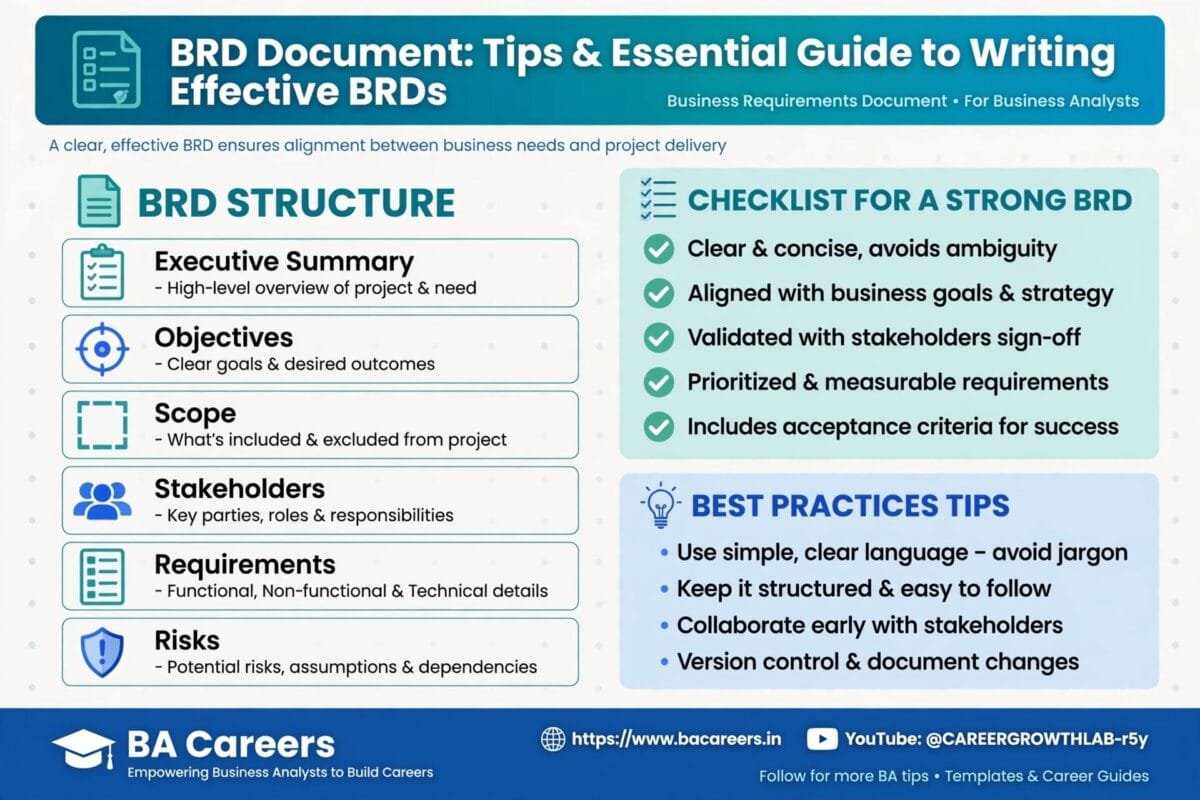
A Business Requirements Document (BRD) is a formal project artifact that outlines the high-level business goals, project scope, success criteria, and operational needs of a proposed software solution or business initiative. Written primarily by a Business Analyst (BA), the BRD serves as a binding contract between corporate business stakeholders and the technical delivery team.

Purpose & Primary Objectives of a BRD
The primary purpose of a BRD is to justify project investment and ensure cross-functional alignment before development begins. Key objectives include:
Defining Project Scope: Establishes explicit functional boundaries (In-Scope vs. Out-of-Scope) to prevent scope creep.
Aligning Stakeholder Expectations: Bridges communication gaps between business leaders, technical leads, operations teams, and external vendor partners.
Establishing Success Metrics: Outlines measurable Return on Investment (ROI) targets, Key Performance Indicators (KPIs), and business outcomes.
Guiding Downstream Documentation: Acts as the single source of truth for creating Functional Requirements Documents (FRDs) and User Stories.
Core Components of a Standard BRD Structure
A well-structured BRD follows a standardized framework that allows executive sponsors and project leads to quickly locate vital project parameters.
| Section Name | Core Purpose | Typical Contents |
| 1. Executive Summary | High-level project background and strategic vision. | Business problem statement, proposed project solution, high-level objectives. |
| 2. Business Objectives & Success Criteria | Measurable parameters defining project success. | Expected ROI, operational cost reduction percentage, processing time targets. |
| 3. Project Scope | Strict operational boundaries of the software initiative. | Feature list in-scope, explicit out-of-scope capabilities, future phases. |
| 4. Current vs. Future State | Gap analysis mapping operational workflow transformation. | As-Is process flow diagram, To-Be process flow diagram. |
| 5. Business Requirements & Rules | High-level functional specifications and constraints. | User access permissions, regulatory compliance guidelines, business workflows. |
| 6. Stakeholders & Governance | Responsibility assignments across the project lifecycle. | RACI matrix (Responsible, Accountable, Consulted, Informed), document sign-off leads. |
Key Stakeholders & Document Ownership
Document Owner / Primary Author: Business Analyst (BA)
Document Approver(s): Executive Sponsor / Product Owner / Business Lead
Key Contributors / Reviewers:
Subject Matter Experts (SMEs): Provide detailed operational process insights.
System Architects / Tech Leads: Ensure high-level technical feasibility.
Quality Assurance (QA) Leads: Verify requirements traceability for future testing.
Practical Real-World BRD Example: Online Banking Loan Application
Business Need Example
A retail bank aims to decrease loan processing times from 5 business days to 24 hours by replacing manual paper verification with an automated digital onboarding portal.
High-Level Business Requirements:
BR-01: The system shall allow applicants to upload identity verification documents via mobile and web channels.
BR-02: The system shall integrate with external credit bureau APIs to fetch credit scores within 30 seconds of authorization.
BR-03: The system shall enforce regulatory compliance (KYC and Anti-Money Laundering) prior to automated underwriting approval.
Project Success Metric: Reduce customer churn during loan onboarding by 35% within the first two quarters post-launch.
BRD vs. FRD: Key Differences Explained
Understanding the distinction between a Business Requirements Document (BRD) and a Functional Requirements Document (FRD) is fundamental for every Business Analyst.
| Feature / Aspect | Business Requirements Document (BRD) | Functional Requirements Document (FRD) |
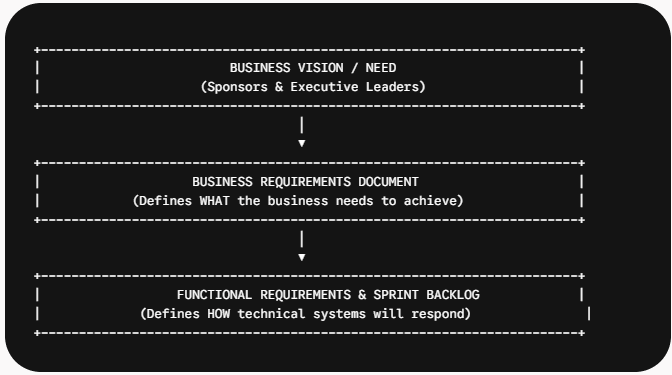
| Focus | Defines WHAT the business needs to accomplish. | Defines HOW the system must behave to fulfill that need. |
| Target Audience | Business Sponsors, Executives, Product Owners, BAs. | Developers, System Architects, QA Engineers, Testers. |
| Level of Detail | High-level business strategy, scope, and objectives. | Detailed system logic, data fields, UI flows, and API specs. |
| Owner | Lead Business Analyst & Business Stakeholder. | Technical BA, System Analyst, or Technical Lead. |
Top 5 Essential Tips for Writing Clear BRDs
Focus on Business Goals, Not Software Architecture: Avoid dictating specific technical code structures, UI button colors, or database schemas in a BRD. Keep the emphasis strictly on business outcomes.
Eliminate Ambiguity: Use explicit language. Replace passive words like “system should ideally…” with direct, testable statements like “the system shall…”.
Engage Stakeholders Early via Collaborative Workshops: Do not draft a BRD in isolation. Conduct structured requirement-gathering workshops and JAD sessions to capture silent expectations early.
Incorporate Visual Process Maps: Supplement dense textual descriptions with visual flowcharts (BPMN / UML activity diagrams) to make complex workflows immediately scannable.
Establish Traceability: Assign a unique Identifier (e.g.,
BR-01,BR-02) to every business requirement to ensure seamless tracing into functional specifications, user stories, and acceptance criteria.
Business Analysis Resource Hub (Internal Links & Toolkits)
Master your documentation workflow with these recommended guides, deep dives, and downloadable templates on BACareers.in:
📘 Deep-Dive Guide: BRD vs FRD Differences & Real-World Examples — Explore step-by-step documentation examples, structural breakdowns, and beginner walkthroughs.
📄 Templates & Artifacts: Documents Prepared by a Business Analyst — Access complete templates for BRDs, FRDs, FRS documents, and traceability matrices.
👥 Elicitation & Collaboration: Requirement Gathering Techniques for BAs — Learn how to conduct stakeholder interviews, JAD sessions, and requirement workshops.
🚀 Agile Artifacts: How to Write Clear User Stories with Acceptance Criteria — Discover how to slice high-level BRD epics into agile user stories using Gherkin syntax.
- What is a BRD (Business Requirements Document) ?
- BRD Vs FRD, Difference between BRD Document and FRD Document
Frequently Asked Questions (FAQ)
The primary sign-off authorities for a BRD are the Executive Project Sponsor, Business Lead / Client Lead, and the Product Owner / Business Analysis Manager. Technical leads also review and sign off to confirm high-level project feasibility.
Yes. While pure Scrum teams rely heavily on Epics and User Stories, enterprise Agile organizations often utilize lightweight BRDs (or Epic Briefs) to establish strategic alignment and project budgeting before breaking down work into sprint backlogs.
A BRD focuses on high-level business goals and corporate scope. A System Requirements Specification (SRS) is a technical document that outlines both functional and non-functional requirements (performance, hardware, security, scaling) required for software development.
🎁 Become a Better Business Analyst
Join 1,200+ Business Analysts learning every week.
Get instant access to:
📘 FREE Business Analyst Templates
🎯 Interview Preparation Guides
🚀 Agile & Scrum Tutorials
🤖 AI for Business Analysts
📈 Career Growth Tips
100% Free • No Spam • Unsubscribe Anytime

Thank You.
Thank You