

FREE DOWNLOAD: Business Analyst Documentation Toolkit
Get instant access to real-world BRD, FRD, and project story templates used by senior BAs.
Download Free Templates PDFIn software engineering, SRS stands for Software Requirements Specification. An SRS document serves as the single source of truth that bridges the gap between business stakeholders, system architects, software developers, and quality assurance (QA) teams.
It provides a complete, detailed description of how a software application should behave, its functional capabilities, technical constraints, and performance parameters before actual development begins.

What Is a Software Requirements Specification (SRS)?
A Software Requirements Specification (SRS) is a formal document created by Business Analysts (BAs) or System Analysts. It lays out the complete functional and non-functional behavior of a proposed system.
While a Business Requirements Document (BRD) focuses on high-level business goals (why the system is being built), an SRS focuses on system capabilities and technical parameters (how the software must perform).
Key Components of a Standard SRS Document
To meet IEEE 830 / ISO 29148 standards, an enterprise SRS document typically includes the following core sections:
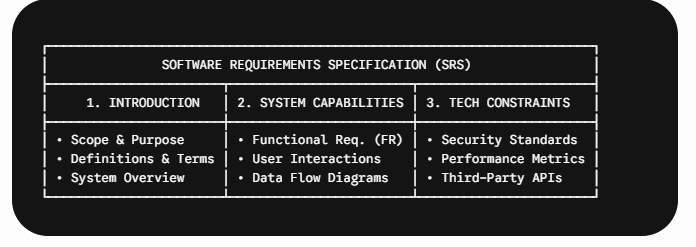
1. Functional Requirements (FRs)
Defines exact system behaviors, business rules, inputs, processing logic, and expected outputs.
Example: “The system shall process payment transactions via the Stripe API and issue an encrypted confirmation receipt within 2 seconds.”
2. Non-Functional Requirements (NFRs)
Specifies quality attributes and performance parameters.
Performance: “The application shall support up to 5,000 concurrent users with page load times under 1.5 seconds.”
Security: “All sensitive user passwords must be hashed using bcrypt before database storage.”
Availability: “The system must maintain 99.9% uptime during operational hours.”
3. User & System Interfaces
Outlines user interface (UI) expectations, hardware interactions, software dependencies, and external communications protocols (e.g., RESTful JSON APIs).
4. Constraints & Assumptions
Identifies architectural limitations, regulatory compliance frameworks (e.g., GDPR, HIPAA, PCI-DSS), or language/framework restrictions imposed on the engineering team.
SRS vs. BRD vs. FRD: Quick Comparison
| Feature / Aspect | Business Requirements Document (BRD) | Functional Requirements Document (FRD) | Software Requirements Specification (SRS) |
| Primary Audience | Executives, Sponsors, Business Leads | Business Analysts, Dev Leads, QA Teams | Solution Architects, Software Developers, Testers |
| Focus Area | Business vision, ROI, and high-level scope | Functional system behaviors and workflows | Technical design parameters, NFRs, and implementation specs |
| Technical Depth | Low / High-level | Medium / Functional | High / Technical |
| Key Question | Why are we building this product? | What features must the system perform? | How will the software operate technically? |
Real-World Example: SRS for an E-Commerce Inventory Gateway
Context: A Business Analyst is writing an SRS for an online retail platform integrating automated stock synchronization across multiple warehouses.
Requirement ID:
SRS-INV-01Module Name: Real-time Inventory Audit
Functional Specification: “When stock levels for any SKU drop below 10 units, the system shall trigger an automated JSON payload to the central ERP system to generate a reorder request.”
Non-Functional Specification: “The inventory audit loop must execute every 30 seconds without increasing server CPU load beyond 15%.”
Related Articles
- What is a BRD (Business Requirements Document) ?
- What are the Documents prepared by Business Analyst?
- Sample BA Document Templates
SRS stands for Software Requirements Specification.
A Software Requirements Specification (SRS) is a complete, detailed description of the behavior, functional capabilities, non-functional performance metrics, and technical constraints of a system to be developed.
📄 Business Analysis Documentation Hub
Explore where SRS fits into the complete software documentation lifecycle:
| Knowledge Area | Deep-Dive Article | Why It Matters for a Business Analyst |
|---|---|---|
| Requirements Engineering | What is a Functional Requirement? | Explains how individual system behaviors and business rules are specified within an SRS document. |
| Requirements Engineering | Business Analysis Templates & Examples | Access standardized templates for BRD, FRD, SRS, RTM, and Use Case specifications. |
| Business Strategy & Analytics | Business Analysis in Digital Marketing | Learn how technical requirements and MarTech integrations are documented for enterprise platforms. |
| Software Lifecycles | Waterfall Methodology in Software Development | Details the formal baseline sign-off process for SRS documents in traditional SDLC projects. |
Frequently Asked Questions (FAQs)
In software engineering, SRS stands for Software Requirements Specification.
The Business Analyst (BA) or System Analyst usually authors the SRS document in close collaboration with System Architects, Technical Leads, and key business stakeholders.
Yes, but in an adapted format. While traditional Waterfall uses long-form SRS documents upfront, Agile projects capture SRS-level technical requirements as Epics, User Stories, and Technical Enablers inside the product backlog.
🎁 Become a Better Business Analyst
Join 1,200+ Business Analysts learning every week.
Get instant access to:
📘 FREE Business Analyst Templates
🎯 Interview Preparation Guides
🚀 Agile & Scrum Tutorials
🤖 AI for Business Analysts
📈 Career Growth Tips
100% Free • No Spam • Unsubscribe Anytime

2 thoughts on “SRS Full Form in Software Engineering: Complete Guide & Key Components”