

FREE DOWNLOAD: Business Analyst Documentation Toolkit
Get instant access to real-world BRD, FRD, and project story templates used by senior BAs.
Download Free Templates PDFBusiness Analysis documents created by the BA function as important communication tools linking Business stake holders, product owners, developers and qa teams within the software development or project management organization. Business Analysis documents aka BA Artifacts, convert top-level business goals to concrete business requirement, thus helping in keeping the project in schedule and within budget while also catering to end-users. About:
Overview: Core Documents Prepared by a Business Analyst
Common documents published by BA in SDLC and Agile sprints Business analysts develop and contribute to various functional and technical BA documents over course of a SDLC, sprint cycles, including
• Basic Information of all Business Analysis Documents
• Basic BA Document types
• The Most Important BA Documents: Common Software documents published by a BA … and others as may be needed or relevant. Bottom line:
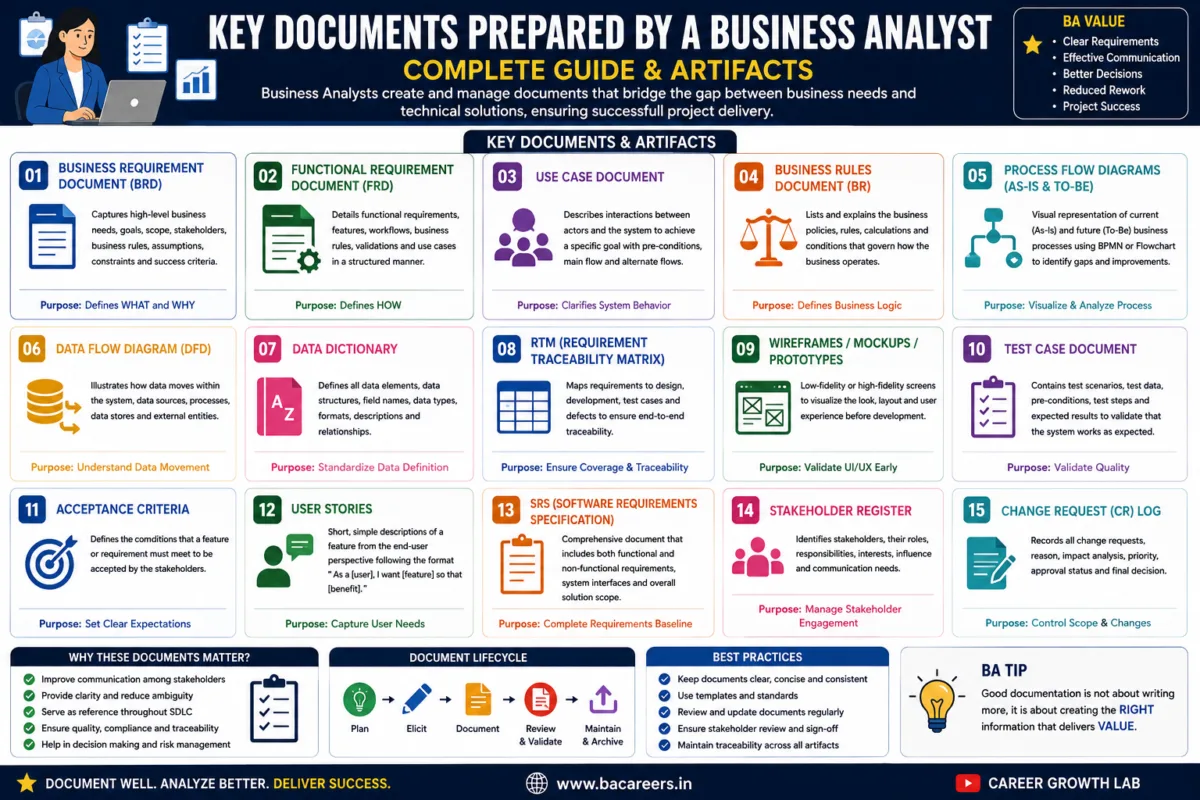
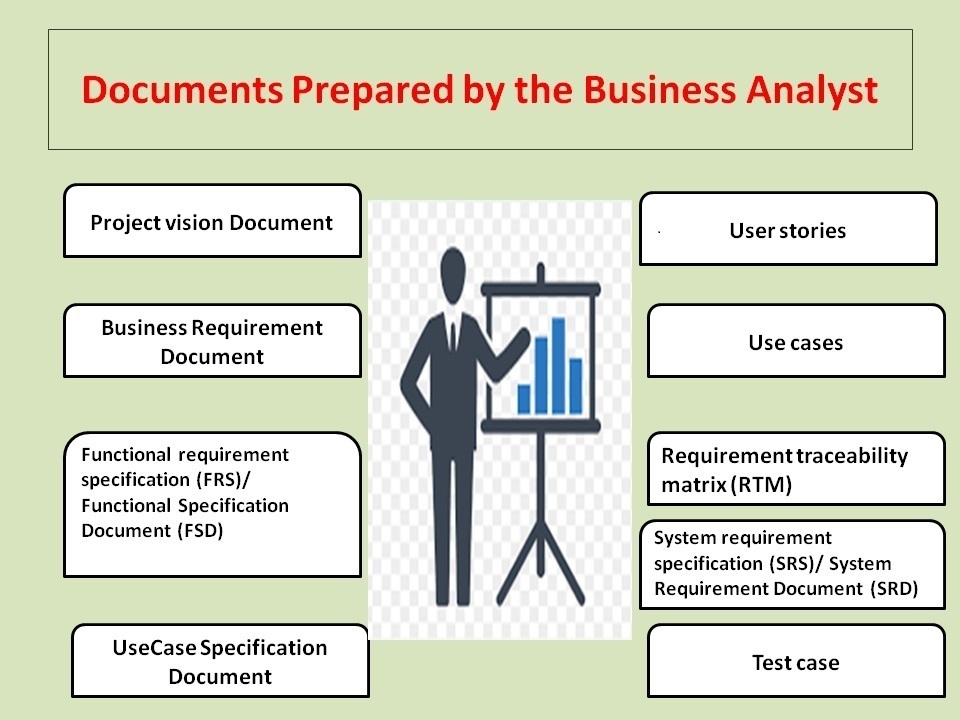
Key business documents created by BA comprise of the Business requirements Document( BRD ) , functional requirements document / functional requirements specification (FRD / FRS ) , requirements specification (SRS ) , Requirements Traceability Matrix ( RTM ), and Agile User Story.
Detailed Breakdown of Primary Business Analyst Artifacts
1. Business Requirements Document (BRD)
The BRD outlines the high-level business vision, project scope, business drivers, financial ROI goals, and client expectations.
Primary Audience: Business Executives, Project Sponsors, Steering Committees.
Core Question Answered: Why are we undertaking this project and what problem does it solve?
Key Components: Project background, business objective statements, current vs. target state, project constraints, and risk logs.
2. Functional Requirement Specification (FRS / FRD)
The FRS or FRD provides a detailed breakdown of how features in the software system will behave, step-by-step.
Primary Audience: Business Analysts, Software Engineers, QA Engineers.
Core Question Answered: What must the system do when a user performs an action?
Key Components: Input/output field specifications, business validation rules, screen navigation flows, and error-handling paths.
3. Software Requirements Specification (SRS)
The SRS bridges functional behavior with low-level technical architecture and non-functional requirements (NFRs).
Primary Audience: Lead Developers, Systems Architects, Infrastructure Engineers.
Core Question Answered: How will the technical platform fulfill functional and structural demands?
Key Components: Performance benchmarks, security protocols (OAuth, SSL), system scalability, hardware constraints, and API schemas.
4. Requirements Traceability Matrix (RTM)
The RTM is a grid document used to map each business requirement directly to its corresponding design specification, code component, and QA test script.
Primary Audience: Project Managers, QA Leads, Compliance Auditors.
Core Question Answered: Are all requested business requirements accounted for and verified by test cases?
Key Components: Requirement ID, Requirement Description, Functional Rule ID, Test Case ID, Implementation Status.
5. User Stories & Acceptance Criteria (Agile Backlog)
In Agile and Scrum environments, traditional long-form documents are broken down into User Stories managed within tools like Jira or Confluence.
Primary Audience: Scrum Teams, Product Owners, Developers, Testers.
Core Question Answered: What increment of value is being built for the user in this sprint?
Key Components: Standard story template (As a… I want to… So that…), INVEST criteria, and Given-When-Then Acceptance Criteria.
Summary Matrix: BA Documents Across Project Frameworks
| Document Name | Primary Purpose | SDLC Framework | Target Stakeholders |
| BRD | Defines high-level business goals and ROI scope | Waterfall / Hybrid | Executives, Project Sponsors |
| FRD / FRS | Details system behavior, rules, and workflows | Waterfall / Hybrid | Developers, QA Engineers |
| SRS | Specifies technical, structural, and non-functional rules | Waterfall / Systems | Tech Leads, Architects |
| RTM | Ensures 100% requirement coverage and test tracking | All Frameworks | Project Managers, QA Leads |
| User Stories | Captures incremental user features and acceptance logic | Agile / Scrum | Scrum Developers, POs |
| Wireframes / Mockups | Visualizes screen layouts and user navigation paths | All Frameworks | UI/UX Designers, End Users |
| Process Maps (BPMN) | Maps As-Is and To-Be operational business flows | All Frameworks | Domain SMEs, Operations |
Secondary Artifacts Created by Business Analysts
In addition to formal specification documents, Business Analysts create supporting documentation throughout project lifecycles:
Business Process Model & Notation (BPMN) Diagrams: Visual flowcharts showing As-Is (current) and To-Be (future) business processes using swimlanes.
Use Case Specifications: Textual documents detailing user interactions with the system, alternative paths, and pre/post-conditions.
Gap Analysis Documents: Comparative reports highlighting missing capabilities between legacy software and prospective solutions.
UAT Test Plan & Execution Reports: User acceptance guides detailing end-to-end test scenarios and formal business sign-off criteria.
Related Articles :
- BRD Vs FRD, Difference between BRD and FRD Documents
- FRD Document in Software Development: Complete Guide & Template
- Business Analyst Templates & Sample Documents | BA Careers
- What are the Documents prepared by Business Analyst?
- 7 Standard Business Analyst Documents and Its Uses
Frequently Asked Questions (FAQ)
What is the most important document prepared by a Business Analyst?
The most critical documents are the BRD (for defining project vision and scope) and the FRD/User Stories (for guiding technical development and QA testing).
Does a Business Analyst prepare documents in Agile projects?
Yes. While Agile relies less on massive upfront documentation, Business Analysts actively create and maintain Epics, User Stories, Acceptance Criteria, Process Flowcharts, and Confluence Knowledge Bases.
What is the difference between a BRD and an FRD?
A BRD focuses on high-level business goals (what business needs to achieve), whereas an FRD focuses on detailed functional software behaviors (how the system responds to user actions).
The most critical documents are the BRD (for defining project vision and scope) and the FRD/User Stories (for guiding technical development and QA testing).
Yes. While Agile relies less on massive upfront documentation, Business Analysts actively create and maintain Epics, User Stories, Acceptance Criteria, Process Flowcharts, and Confluence Knowledge Bases.
A BRD focuses on high-level business goals (what business needs to achieve), whereas an FRD focuses on detailed functional software behaviors (how the system responds to user actions).
🎁 Become a Better Business Analyst
Join 1,200+ Business Analysts learning every week.
Get instant access to:
📘 FREE Business Analyst Templates
🎯 Interview Preparation Guides
🚀 Agile & Scrum Tutorials
🤖 AI for Business Analysts
📈 Career Growth Tips
100% Free • No Spam • Unsubscribe Anytime

Thank you, You can reach us.
Thank You
We only did