Get new posts by email:
Powered by follow.it

Business Analyst Role in Product-Based Companies: Duties & Skills

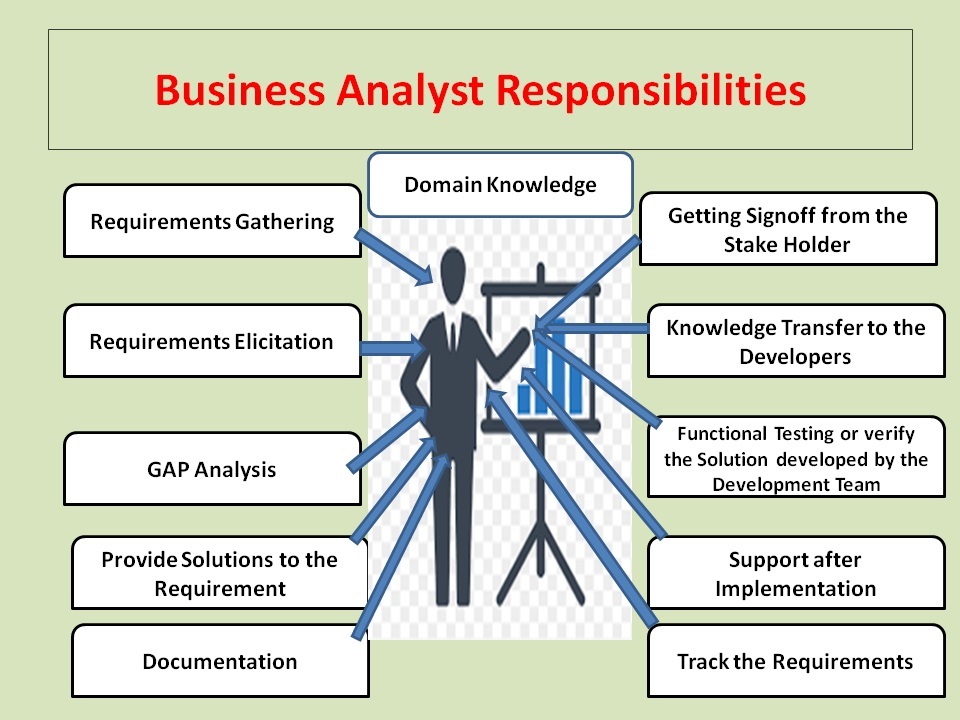
Business Analyst roles and responsibilities in a product based software company explaining user data and product backlog

Role and Responsibilities of Business Analyst

What is the Business Analyst role in a product-based company?

Business Analysts in Product Companies – A Complete Guide , What is a Business Analyst role in a product-based company? A Business Analyst (BA) in a product-based company focuses on continually improving a single software product (like a SaaS product, an enterprise tool, or a mobile app) serving a broad customer base. Unlike BAs at service-based firms, who build a custom product at the prompt of a specific client using the scope of a fixed contract, a product-based BA works closely with Product Managers to analyze user data, create product roadmaps, and discover how to drive more user value.


Business Analyst roles and responsibilities in a product based software company explaining user data and product backlog
In product-based companies, Business Analysts analyze telemetry data, manage Jira backlogs, and collaborate on product features.

What exactly is the Business Analyst job at a product business?

The rise of subscription software models & constant updates mean that business analysts have become an indispensable role for these types of organizations.

But we get often get asked: how, exactly, is the role of a BA in a product company different from that of a BA working for a service company? Where BAs in services perform their client’s project work according to external mandates, and manage tasks such as custom development for multiple clients; those in a product team take on internal “product strategist” roles, relying more on telemetry data and A/B tests to optimize features that scale to many users.

Below are the key responsibilities and requirements for an enterprise software BA, and differences vs service roles, all wrapped up in an extensive guide.

Service-Based vs. Product-Based BA: 4 Key Differences

To be a killer BA in the product space, take notice of these crucial differences:

SERVICE-BASED BA ──► Driven by: Client Scope, Fixed Milestones, Contractual Sign-offs.
PRODUCT-BASED BA ──► Driven by: User Analytics, Feature Adoption, Continuous Value Delivery.

DimensionService-Based Business AnalystProduct-Based Business Analyst
Primary FocusDelivering client-specific contractual requirements.Solving real end-user problems to improve the product and business metrics.
Core StakeholdersExternal clients, Project Managers, Business Sponsors, Client SMEs.Internal Product Managers, Product Owners, UX/UI Designers, Developers, QA Teams.
Project LifecycleProject-based with a defined start and end date.Product lifecycle with continuous enhancements, releases, and iterations.
Success MetricsOn-time delivery, budget compliance, client satisfaction, project completion.Monthly Active Users (MAU), User Retention, Feature Adoption, Customer Satisfaction, Churn Reduction.
Requirement SourcesClient RFPs, stakeholder meetings, workshops, business requirement documents.User feedback, customer interviews, product analytics, A/B testing, market research, product telemetry.

Business Analyst Roles and Responsibilities in Product-Based Companies

In a typical product-based organization, you’ll often find BAs working as a partner with the Product Manager (PM) or serving as Product Owner (PO) for a Scrum pod. As such, responsibilities for a BA include:

1. Product-Minded Analysis

Using Telemetry Tools : Instead of asking stakeholders directly (even for product metrics!), a BA in a product setting uses product telemetry tools(e.g., Mixpanel, Google Analytics, Amplitude) to understand how the usersareinteracting with your software.

For example, is a certain onboarding flow dropping more than 45% of usersto the next step?

Perhaps it’s possibleto reduce these points with specific feature tweaks, instead.

2.Backlog Management & User Stories as Code

One important part of a product BA’s job is to take a product manager’s strategic roadmap and translate itintoa concrete plan:Develop User Stories using the 3-amigos format to outline the “how”-even a vague design idea in high-fidelitywireframes, user journey flows-intoa workable user stories for the sprint teams.facilitatethe Refinement and Planning activities required to get them in to the backlog.

3. Market Research & Competitor Analysis

In today’s interconnected market, your software will always compete, at a minimum, in the mind of your users, so it will help to understand where and how to leadin your industry .

The product BA is responsible for analyzing the competitor software:Conduct competitive analyses comparing current offerings against market leaders to identify feature gaps or areas where the product may be at a disadvantage; and recommend solutions to keep the product on top.

4.Testing & Validating

Products as they roll out A / B testing helps BAs measure the overall business value of new or updated features, by comparing them against benchmarks before launching to the entire user base.

Business Analyst Requirements for Product-Based Roles

The product BA will work with the UX team to ensure the tests meet the goal and are accurately implemented before being launched to end customers.

Requirements of the Trade : For you as a business analyst in the product industry

For applying for a product-based job position, the hiring team usually looks for BA professionals with business, technical and data analytics skills like this -A Bachelor’s Degree in Business, Information System, or relevant fields

Agile and Scrum background ; experience with userstory mapping, backlog management tools (e.g., JIRA, Trello) and Scrum principles.

Product Analytics Expertise ; strong knowledge of SQL and data visualization tools (e.g., PowerBI, Tableu) and product metric tracking software.

UX experience. If the product-oriented Business analyst also holds some UX certifications or work Experience with UI/UX design; even with Balsamiq or Balsamiq; it can strengthen their resume by highlighting an intuitive understanding of user pathways and experience designs in the softwarethey will ultimately bring products too;

Product experience in related fields, as many product BA roles also require knowledge of your domain(SAAS,mobile.etc..)

Real-World Scenario: Enhancing a Product Feature

Real-world Scenarios: Enhancing Product with a BA approach. Here is a practical example of a typical approach in the product-world using a business Analyst: At a SaaS based e-learning company, user behavior analytics show that 45% of the users on an eLearning platform never complete and cannot download the course certificate.

The BA at the e-learning firm analyzes user behavior data in Mix panel, and finds that after the user is finished with the final module of the course and has successfully reached the ” download your certificat e ” section,the system requires them to enter in a profile update in a mandatory 8 – field form prior to downloading the final certificate, which users find unnecessary.

Thus, the BA creates the first in a series of Product roadmap requirements, namely a feature specification in Jira ,entailinga 1 – click download button that will allow users to pull a fully automated certificate pulling data from their existing profiles.

Outcome : A/B and other tests that are run the next month reduce download abandonment rates from45% down to 4%, thereby decreasing users’ frustration and increasing social sharing on the platform.

Frequently Asked Questions (FAQs)

1. What is the primary objective of a BA in a product firm?

A BA’s primary goal in a product company is to guide the development process with the help of user analytics and other data-driven insights that contribute to enhancing product adoption, user loyalty and the overall success of the company.

2.Should a BA take on roles such as “Product Analyst” in the product context?

The terms “Business Analyst” and “Product Analyst” are often used interchangeably in product-led companies, reflecting the shared responsibilities of data analysis, user requirement gathering, and the execution of product strategy.

3.Can service-company BA transition into a product BA position?

Definitely!

If you have solid requirements gathering andelicitation skillsthat you gained during your work in a product firm; and you had experience writing user stories for sprints in a business analysis role; skills such as data analysis and product use will quickly transfer. Make sure to highlight your product success to demonstrate how and why your talents are transferable.

Related Articles :

  1. How to Become a Business Analyst in IT field
  2. Top Business Analyst Interview Questions & Answers (Scenario-Based)
  3. Role of Business Analyst in Agile Scrum: Responsibilities & Workflow
  4. Business Analyst Roles and Responsibilities in IT Projects (With Real Examples)
  5. Business Analyst Role in Project Management
  6. Business Analyst Role in Mergers and Acquisitions
  7. Business Analyst Role in Agile Projects


DimensionService-Based BAProduct-Based BA
Primary FocusDelivering client-specific contractual requirements.Solving real end-user problems to drive product metrics.
Core StakeholdersExternal clients, Project Managers, Sponsors.Internal Product Managers, UX Designers, Development Teams.
Project LifecycleProject-based (defined start and end date).Product lifecycle (continuous feature updates and iterations).
Success MetricsOn-time delivery, within budget, client satisfaction.Monthly Active Users (MAU), User Retention, Churn Rate, Feature Adoption.
Requirement SourcesClient RFPs, stakeholder workshops, business requirements.Product analytics, user feedback, A/B testing, customer research, market trends.

🎁 Become a Better Business Analyst

Join 1,200+ Business Analysts learning every week.

Get instant access to:

📘 FREE Business Analyst Templates
🎯 Interview Preparation Guides
🚀 Agile & Scrum Tutorials
🤖 AI for Business Analysts
📈 Career Growth Tips

Loading

100% Free • No Spam • Unsubscribe Anytime

Pallavi

Author: Pallavi

Experienced Business Analyst, SME (Subject Matter Expert), and Educator specializing in Agile and Scrum methodologies, requirement gathering, BRD/FRD documentation, User Stories, and Business Process Management.

5 thoughts on “Business Analyst Role in Product-Based Companies: Duties & Skills”

Leave a Reply

Your email address will not be published. Required fields are marked *