

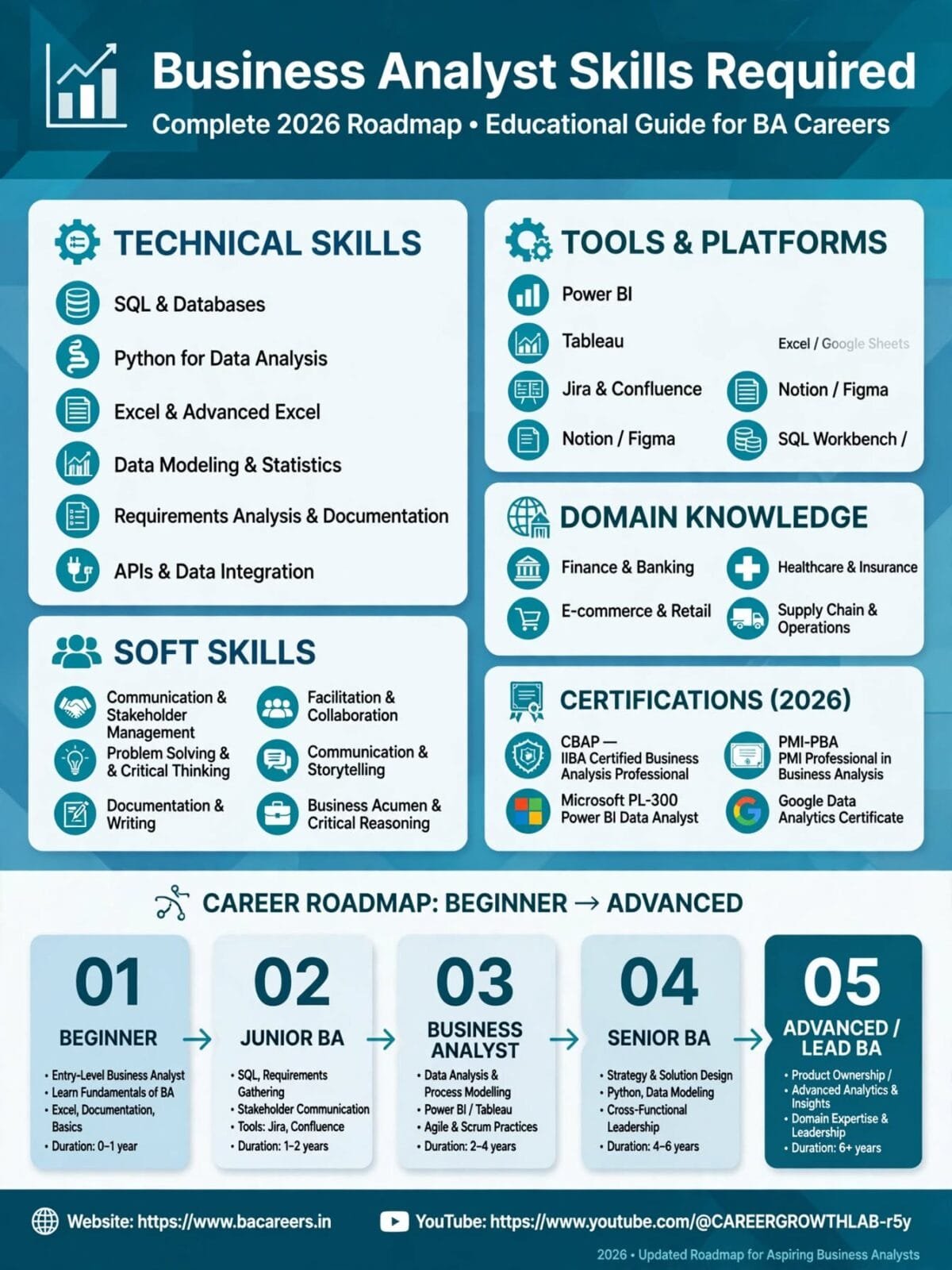
FREE DOWNLOAD: Business Analyst Documentation Toolkit
Get instant access to real-world BRD, FRD, and project story templates used by senior BAs.
Download Free Templates PDFWhat are the Core Business Analyst Skills Required?
The Business Analyst skills required to succeed in modern IT and enterprise environments fall into three core pillars: Hard / Technical Skills (like SQL, Jira, and BRD documentation), Core BA Competencies (such as requirements elicitation and process mapping), and Soft Skills (such as stakeholder management and conflict resolution).
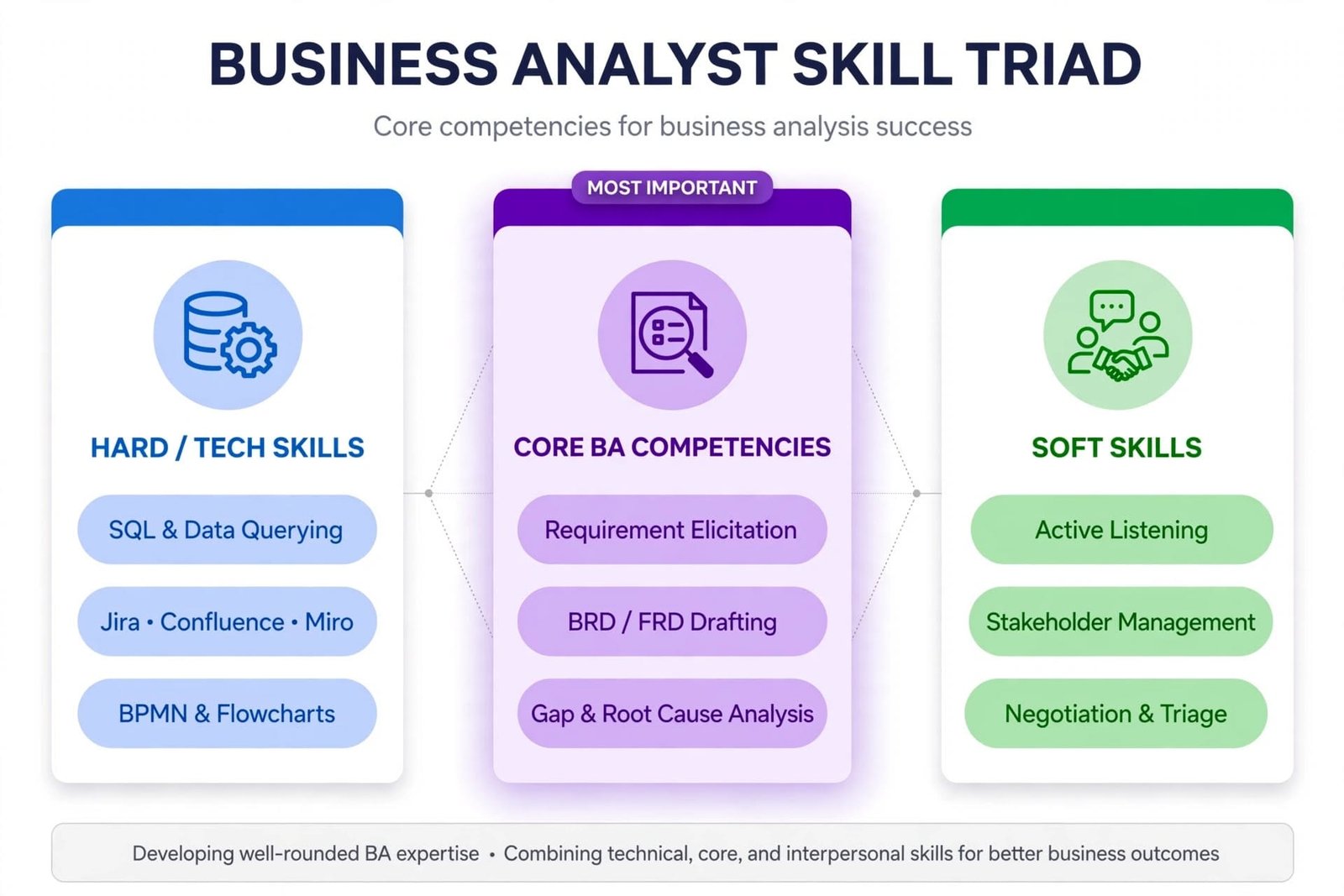

1. Technical & Hard Skills Required
Modern Business Analysts act as the technical translator between non-technical business leaders and software engineering teams.
| Technical Skill Area | Specific Tools / Knowledge Needed | Real-World Application in Projects |
| Requirements Documentation | BRD, FRD, SRS, User Stories | Drafting clear acceptance criteria and business rule matrices. |
| Process Mapping & Modeling | BPMN 2.0, Lucidchart, Visio, Draw.io | Drawing AS-IS vs. TO-BE workflow diagrams and Use Case maps. |
| Data Analysis & Databases | SQL (SELECT, JOIN, GROUP BY), Excel | Querying relational databases to validate data flows and generate reports. |
| Agile & Project Management | Jira, Confluence, Trello, Azure DevOps | Managing product backlogs, sprint boards, and burndown reports. |
| Prototyping & Wireframing | Balsamiq, Figma, Miro | Creating low-fidelity screen mockups during JAD sessions. |
2. Core BA Functional Competencies
Functional competencies represent the foundational business analysis skills outlined in the IIBA BABOK® Guide:
Requirement Elicitation & Collaboration: Conducting stakeholder interviews, focus groups, document analysis, and Joint Application Design (JAD) workshops.
Requirements Life Cycle Management: Tracing requirements from initial business strategy through design, testing, and production deployment (Traceability Matrix).
Strategy & Gap Analysis: Assessing current business capabilities (AS-IS) against target objectives (TO-BE) to identify functional operational gaps.
Scope Management & Impact Analysis: Preventing scope creep by evaluating incoming change requests against core project timelines and budgets.
3. Essential Soft Skills for Business Analysts
Active Listening & Empathy: Understanding true business pain points rather than just writing down feature wishlists.
Negotiation & Conflict Resolution: Balancing conflicting priorities between executive sponsors and development teams.
Structured Problem Solving: Breaking down complex business challenges using frameworks like Root Cause Analysis (5 Whys) and SWOT Analysis.
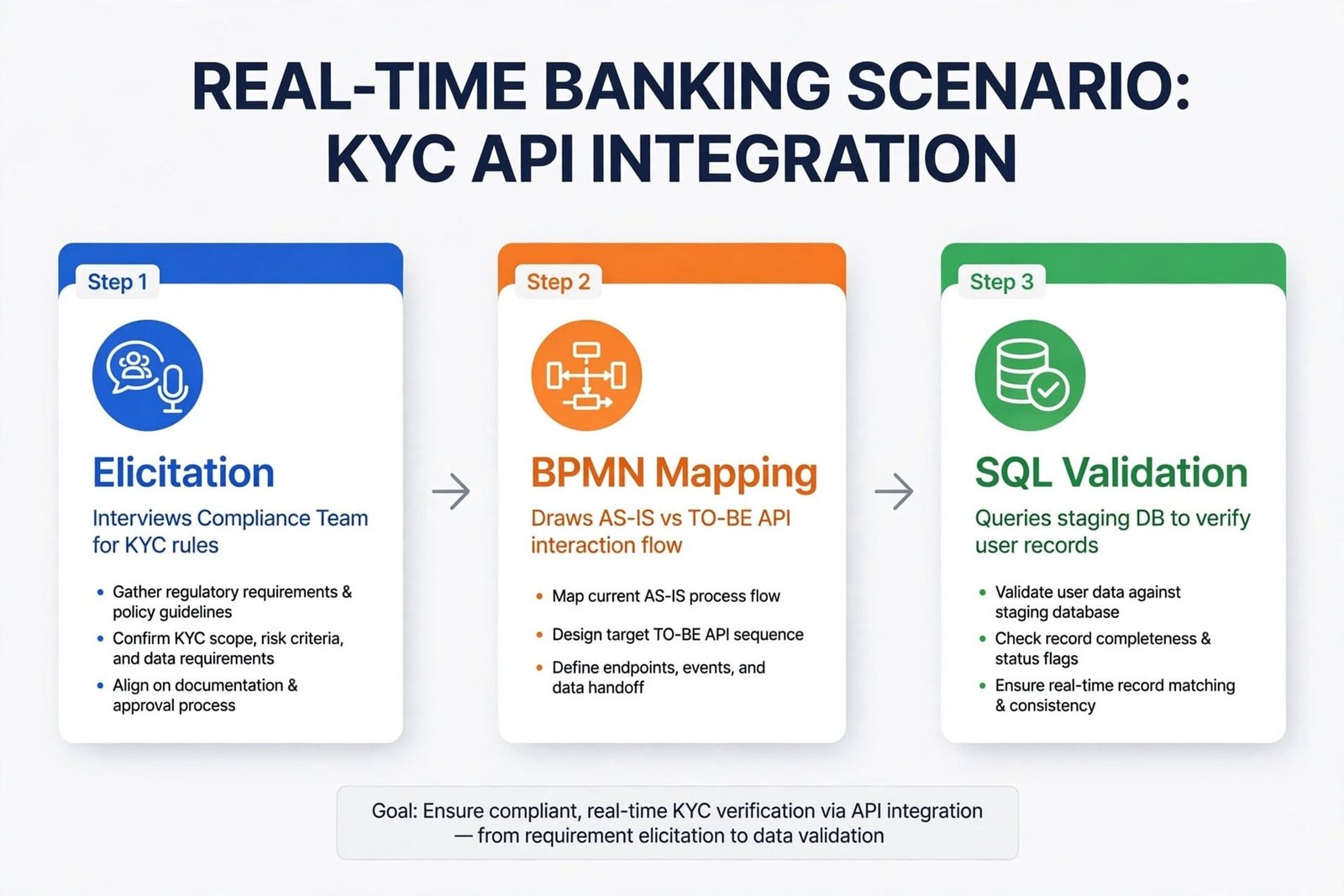
🏦 Real-Time Scenario: Applying BA Skills in a Banking API Integration Project
Context & Objective
A Business Analyst is tasked with integrating a Third-Party KYC (Know Your Customer) Verification API into a mobile banking app.
How the BA Applied the Skill Matrix
Technical Skill (SQL & Wireframing): The BA ran SQL queries on staging databases to verify user identity fields, then prototyped a 3-screen ID upload wireframe in Balsamiq.
Functional Skill (FRD & Traceability): Elicited strict 30-second timeout requirements from compliance leads and drafted the functional specification document.
Soft Skill (Negotiation): When developers stated the API response time took 45 seconds, the BA negotiated a phased approach: basic checks run instantly, with deep checks running asynchronously via SMS alerts.
Business Analyst Skill Matrix: Beginners vs. Senior BAs
| Skill Area | Entry-Level BA (0–2 Yrs) | Senior Business Analyst (5+ Yrs) |
| Documentation | Assists with User Story writing and meeting notes. | Authors complex BRD/FRDs and Enterprise Architecture blueprints. |
| Data Analysis | Basic Excel formulas (VLOOKUP, Pivot Tables). | Advanced SQL, Python/R data modeling, and BI Dashboards. |
| Stakeholder Management | Communicates with module leads and QA testers. | Leads C-suite alignment, vendor evaluation, and change management. |
Business Analysis Resource Hub
📘 Documentation Blueprint: BRD vs FRD Differences & Real-World Examples — Master the documentation skills required for BAs.
🛠️ Agile Toolkits: Agile BA Tools: Essential Tools with Real-Time Scenarios — Learn Jira, Confluence, and Miro.
🎓 Certifications Guide: Top Business Analyst Certifications (ECBA, CCBA, CBAP) — Map these required skills into certified career credentials.
What Skills Are Required for a Business Analyst?
Business Analysts need a mix of technical, analytical, and communication skills. Below are the top skills required:
1. Analytical and Critical Thinking
Business Analysts must evaluate business problems, identify solutions, and make data-driven decisions.
2. Requirement Gathering and Documentation
Strong understanding of requirement elicitation techniques, including interviews, surveys, and workshops.
3. SQL and Data Analysis
SQL is widely used for querying databases and analyzing business data.
4. Business Process Modeling
Knowledge of BPMN (Business Process Model and Notation) helps in visualizing processes.
5. Communication and Stakeholder Management
Business Analysts must collaborate with multiple stakeholders and clearly convey requirements.
Is SQL Required for Business Analysts?
While SQL is not mandatory for all Business Analyst roles, it is highly recommended, especially for those working in data-driven projects. SQL helps in retrieving, analyzing, and manipulating data for decision-making.
Is Business Analyst an IT Role?
A Business Analyst role is not strictly an IT role but rather a hybrid position that involves both business and technology aspects. Business Analysts work with IT teams to implement solutions but also collaborate with business stakeholders to ensure alignment with company goals.
What is the Key Role of a Business Analyst?
The key responsibilities of a Business Analyst include:
Identifying business needs and opportunities.
Gathering and documenting requirements.
Analyzing data and providing insights.
Collaborating with stakeholders.
Assisting in solution design and implementation.
Is SQL Mandatory for Data Analysts?
For Data Analysts, SQL is often mandatory as they deal extensively with data extraction and reporting.
Should Analysts Know SQL?
Yes, SQL knowledge is beneficial for both Business Analysts and Data Analysts. It helps in accessing and analyzing structured data efficiently.
Can I Be a Data Analyst Without SQL?
It is possible to work as a Data Analyst without SQL if you use tools like Excel, Power BI, or Tableau. However, learning SQL can significantly improve your job prospects and efficiency.
How Long Does It Take to Learn SQL for a Business Analyst?
Learning SQL basics can take 2-3 weeks, while mastering advanced queries may require a few months of practice.
Business Analyst Technical Skills Required
SQL and database management
Data visualization (Power BI, Tableau)
Microsoft Excel (Advanced functions, Pivot Tables)
Requirement analysis
Agile and Scrum methodologies
Top 5 Skills for Business Analysts
Business Process Analysis
Communication and Stakeholder Management
Data Analysis and SQL
Agile and Scrum Knowledge
Problem-Solving and Critical Thinking
Skills Required for Business Analyst Fresher
Freshers should focus on:
Basic SQL and data analysis
Understanding business processes
Requirement documentation
Learning Agile methodologies
Improving communication skills
Business Analyst Skills Roadmap
Beginner Level: Learn Excel, basic SQL, and Agile methodologies.
Intermediate Level: Master business process modeling, stakeholder management, and data visualization.
Advanced Level: Gain expertise in advanced analytics, automation, and business strategy.
Data Analyst Skills Required
SQL and database querying
Data visualization (Tableau, Power BI)
Statistics and analytics
Python/R programming (optional but beneficial)
Business intelligence reporting
Business Analyst Tools
Some popular tools used by Business Analysts include:
JIRA & Confluence (for Agile project management)
Microsoft Excel (for data analysis)
Tableau/Power BI (for data visualization)
Lucidchart, Visio (for process modeling)
SQL Databases (for querying data)
Related Articles
Conclusion
Becoming a successful Business Analyst requires a blend of technical, analytical, and interpersonal skills. While SQL is not always mandatory, it is a valuable skill that enhances data-driven decision-making. By following the right skills roadmap and mastering essential tools, you can build a strong career as a Business Analyst.
For more insights, visit BACareers.
Frequently Asked Questions (FAQ)
The top 3 core skills are Requirements Elicitation & Documentation (BRD/FRD), Process Mapping (BPMN/Flowcharts), and Data Analysis (SQL & Database Basics).
No, heavy software coding is not required for traditional Business Analysts. However, basic database knowledge like SQL and an understanding of REST APIs are highly beneficial.
Yes. Many successful Business Analysts transition from business operations, customer support, domain specialist roles, or finance by mastering requirements gathering, process mapping, and Agile workflows.
🎁 Become a Better Business Analyst
Join 1,200+ Business Analysts learning every week.
Get instant access to:
📘 FREE Business Analyst Templates
🎯 Interview Preparation Guides
🚀 Agile & Scrum Tutorials
🤖 AI for Business Analysts
📈 Career Growth Tips
100% Free • No Spam • Unsubscribe Anytime
