

FREE DOWNLOAD: Business Analyst Documentation Toolkit
Get instant access to real-world BRD, FRD, and project story templates used by senior BAs.
Download Free Templates PDFIn software development and organizational change, documentation is the primary mechanism for aligning stakeholders, engineering teams, and business leadership. Having a standardized set of Business Analysis Templates ensures consistency, accelerates requirement gathering, and reduces communication gaps across project lifecycles.
Whether operating in traditional Waterfall, Agile, or hybrid delivery environments, Business Analysts (BAs) rely on proven structures to capture, track, and manage scope.
Why Standardized Business Analysis Templates Matter
Using pre-structured templates streamlines project execution and ensures quality across deliverables:
Consistency: Establishes a uniform standard for documentation across multiple teams and projects.
Efficiency: Eliminates the need to build artifacts from scratch, saving time during initiation and elicitation.
Completeness: Ensures crucial sections—such as non-functional requirements, edge cases, and risk logs—are not overlooked.
Traceability: Facilitates seamless mapping between business needs, system designs, and testing suites.
Essential Business Analysis Templates & Examples
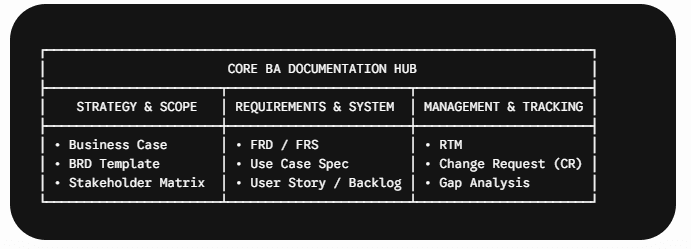
1. Business Requirements Document (BRD) Template
The BRD defines what the business wants to achieve from a high-level strategic perspective.
Core Structure:
Executive Summary & Business Objectives
Project Scope (In-Scope vs. Out-of-Scope)
Stakeholder Identification & Roles
Current State (AS-IS) vs. Future State (TO-BE)
High-Level Business Requirements
Constraints, Assumptions, and Dependencies
Example Excerpt: “The platform shall reduce invoice processing time by 40% by automating data extraction from incoming PDF vendor bills.”
2. Functional Requirements Document (FRD / FRS) Template
The FRD translates business objectives into explicit system behaviors and functional workflows.
Core Structure:
System Overview & Architecture Diagrams
Detailed Functional Requirements (Categorized by Module)
Data Input Validation Rules & Business Logic
User Interface (UI) Wireframes & Screen Workflows
Non-Functional Requirements (Performance, Security, SLA)
Example Excerpt: “FR-INV-01: The system shall validate that the ‘Invoice Amount’ field contains only positive numeric values with up to two decimal places.”
3. Requirement Traceability Matrix (RTM) Template
An RTM is a grid used to track every requirement from initial elicitation down to design elements, code modules, and test cases.
| Req ID | Requirement Description | Category | Source | Design Doc Ref | Test Case ID | Status |
| BRD-01 | User Multi-Factor Authentication | Security | Compliance | HLD-SEC-04 | TC-SEC-101 | Approved |
| BRD-02 | Automated Daily Sales Report | Reporting | Finance Ops | LLD-REP-02 | TC-REP-204 | In Progress |
4. Use Case Specification Template
Use Cases describe explicit interactions between an external Actor and the System to achieve a specific goal.
Standard Use Case Structure:
Use Case ID & Name: UC-01: User Password Reset
Primary Actor: End User / Customer
Pre-conditions: User account exists and has a verified email address.
Post-conditions: Account password is updated, and an automated audit email is dispatched.
Main Success Scenario (Happy Path):
User clicks “Forgot Password” on the login screen.
System prompts for registered email address.
User enters email and clicks “Send Reset Link.”
System validates email and dispatches a time-sensitive reset token via email.
Alternative / Exception Paths:
3a. Email not found: System displays generic message: “If the email exists, a reset link has been sent.” (Prevents user enumeration attacks).
5. Agile User Story & Acceptance Criteria Template
In Agile delivery, functional requirements are expressed concisely using the standard User Story format combined with Given-When-Then acceptance criteria.
USER STORY FORMAT:
As a [User Role],
I want [Feature Action],
So that [Business Value/Benefit].
Acceptance Criteria (Gherkin Syntax Example):
Scenario: Successful Promo Code Application
Given a user has items in their shopping cart exceeding $50,
When they enter valid promo code “SAVE10” at checkout,
Then the system deducts 10% from the order subtotal and updates the balance due.
6. Change Request (CR) Form Template
When scope changes occur after baseline sign-off, a formal Change Request form assesses feasibility, budget impact, and schedule adjustments.
Key Fields:
CR ID & Project Name
Description of Requested Change
Justification / Business Drivers
Impact Analysis (Budget, Timeline, Technical Debt, Resources)
Approval Sign-off Section (Change Control Board – CCB)
Real-World Example: Template Usage in Healthcare Integration
Project Context: Modernizing a Hospital Information Management System (HIMS) to integrate patient record sharing via HL7 / FHIR APIs.
BRD: Captures business intent—”Ensure HIPAA-compliant sharing of patient lab results within 5 minutes of authorization.”
FRD: Defines exact system requirements—”System must parse inbound JSON FHIR payloads and encrypt stored records using AES-256.”
Use Case Spec: Outlines the clinician workflow for requesting patient records from an external laboratory system.
RTM: Maps the regulatory requirement (HIPAA Rule 164.312) to the functional API specification and QA security penetration test scripts.
Knowledge Hub Matrix
| Knowledge Area | Deep-Dive Article | Why It Matters for a Business Analyst |
| Business Strategy & Analytics | Cost Benefit Analysis Techniques for Business Analysts | Essential financial evaluation template for estimating ROI, NPV, and payback periods during initiation. |
| Business Analysis in Digital Marketing: Comprehensive Guide | Practical templates and workflows applied to digital transformation and MarTech integrations. | |
| Requirements Engineering | Functional Requirements vs Non-Functional Requirements | Detailed breakdown to help populate requirement specification templates accurately. |
| What is a Functional Requirement? | Learn how to write structured, testable functional requirement entries in your FRD template. | |
| Software Development Lifecycles | Waterfall Methodology in Software Development | Step-by-step framework detailing when and how to deploy formal document baselines (BRD, FRD, RTM). |
Frequently Asked Questions (FAQs)
A BRD template focuses on high-level business goals, scope boundaries, and project ROI (why and what the business needs). An FRD template focuses on technical features, data validation logic, and detailed system behaviors (how the software must function).
Agile teams primarily rely on User Story Backlogs, Acceptance Criteria (Gherkin) Templates, Product Vision Boards, and Sprint Burndown Charts, rather than long-form BRDs.
BAs tailor base templates by incorporating specialized compliance sections (e.g., PCI-DSS for FinTech, GDPR for European markets, HIPAA for Healthcare) and specific domain workflows.
🎁 Become a Better Business Analyst
Join 1,200+ Business Analysts learning every week.
Get instant access to:
📘 FREE Business Analyst Templates
🎯 Interview Preparation Guides
🚀 Agile & Scrum Tutorials
🤖 AI for Business Analysts
📈 Career Growth Tips
100% Free • No Spam • Unsubscribe Anytime
