
FREE DOWNLOAD: Business Analyst Documentation Toolkit
Get instant access to real-world BRD, FRD, and project story templates used by senior BAs.
Download Free Templates PDFWhat is FRS? (Definition & Full Form)
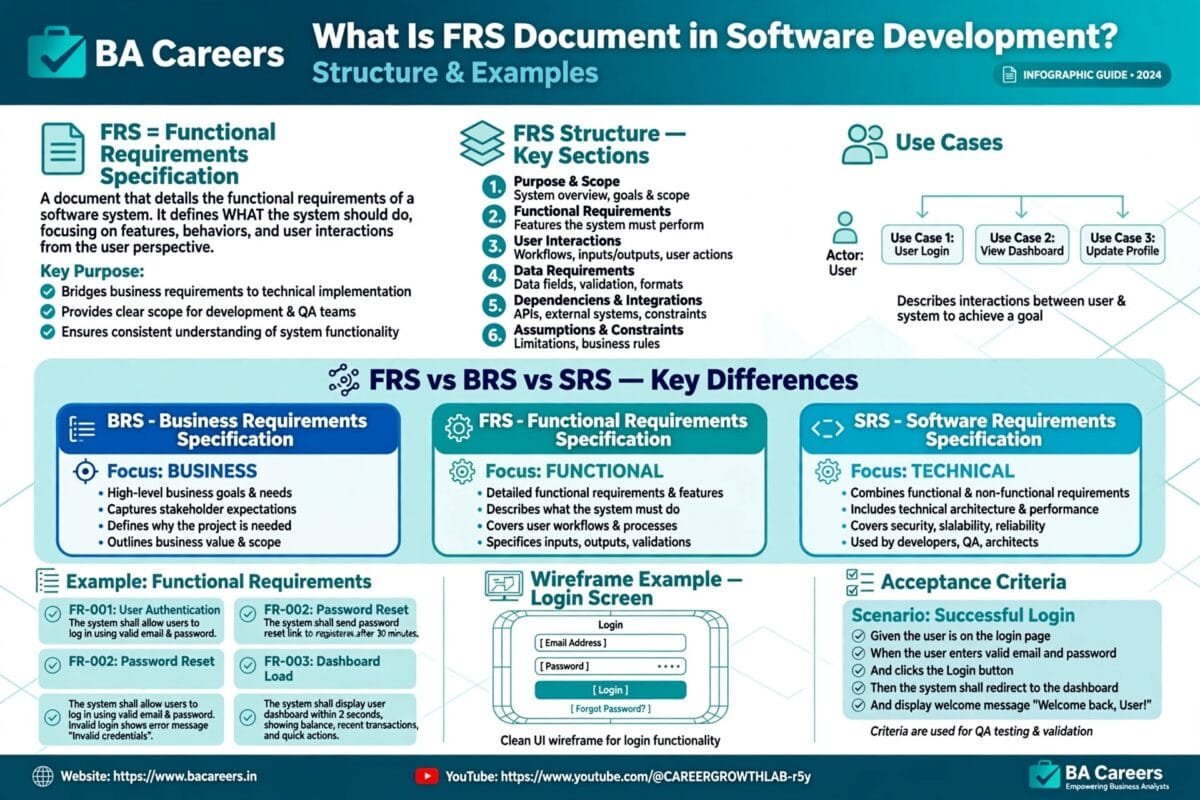
FRS stands for Functional Requirement Specification (also referred to as a Functional Requirements Document or FRD). An FRS document is a formal technical blueprint in software engineering that defines how a software system must behave, detailing every specific feature, user interaction, screen validation, business rule, data input/output, and system workflow required to fulfill high-level business objectives.
While a Business Requirements Document (BRD) explains what the business wants to achieve, the FRS document translates those goals into exact functional behaviors that developers build and QA engineers test against.
Key Components of an FRS Document
A standard, enterprise-ready FRS document includes the following core sections:
1. Document Control & Revision History —-> Tracks version numbers, author details, review dates, and stakeholder sign-off approvals.
2. Purpose & System Scope —-> Summarizes the specific module or software release covered, explicitly listing in-scope and out-of-scope features.
3. User Roles & Permissions Matrix —-> Defines system actors (e.g., Admin, Customer, Approver) and role-based access control (RBAC) privileges.
4. Detailed Functional Requirements —-> Breaks down screen-by-screen behavior, field-level validations, error messages, and button actions using unique Requirement IDs (
FR-001,FR-002).5. Process Flows & Wireframes —-> Includes AS-IS / TO-BE flowcharts, Use Case diagrams, and low-fidelity UI mockups to visualize user journeys.
6. External Interface & API Requirements —-> Specifies data payloads, third-party payment gateways, and backend database integrations.
7. Non-Functional Requirements (NFRs) —-> Outlines performance benchmarks, response times, data encryption standards, and system availability targets.
5-Step Workflow: How a Business Analyst Creates an FRS Document
Step 1: Review the Approved BRD —-> Analyze the Business Requirements Document to understand high-level business goals, project constraints, and stakeholder expectations.
Step 2: Conduct Detailed Elicitation & JAD Sessions —-> Collaborate with Subject Matter Experts (SMEs), UX designers, and tech leads to uncover granular screen rules and edge cases.
Step 3: Draft Wireframes & Functional Logic —-> Map out user flows, field validations (mandatory vs. optional, character limits), and conditional business rules.
Step 4: Build the Requirements Traceability Matrix (RTM) —-> Link every Functional Requirement ID (
FR-ID) back to its parent Business Requirement ID (BR-ID) to ensure zero scope gaps.Step 5: Walkthrough & Formal Sign-Off —-> Present the FRS to development, QA, and business sponsors for peer review and formal baseline approval before coding begins.
BRD vs. FRS vs. SRS: Key Differences
| Comparison Metric | BRD (Business Requirements Document) | FRS (Functional Requirement Specification) | SRS (Software Requirements Specification) |
| Primary Focus | What the business wants to achieve (business goals & ROI). | How the system behaves functionally for end-users. | Complete technical blueprint (functional + non-functional + system architecture). |
| Primary Author | Business Analyst (BA) | Business Analyst (BA) / Systems Analyst | Systems Architect / Lead BA / Tech Lead |
| Target Audience | Executive Sponsors, Stakeholders, Clients. | Developers, QA Testers, UI/UX Designers. | Software Engineers, Architects, DevOps. |
| Level of Detail | High-level business objectives and scope. | Detailed screen rules, validations, workflows. | Granular system specs, hardware/software interfaces, protocols. |
🏦 Real-Time Scenario: FRS Specification for a UPI Fund Transfer Feature
Context & Objective
A Business Analyst is drafting the FRS for a Mobile Banking UPI Transfer Module. The high-level business requirement (BR-01) states: “Customers must be able to transfer money instantly using a UPI ID.”
FRS Functional Breakdown (FR-101 to FR-103)
FR-101(VPA Input Validation) $\rightarrow$ The UPI ID input field must accept alphanumeric characters and the@symbol (e.g.,name@bank). If the@symbol is missing, the system displays inline error messageERR-01: "Please enter a valid UPI ID."FR-102(Transaction Limit Check) $\rightarrow$ The transfer amount field must accept numeric values between₹1and₹1,00,000per transaction. Amounts exceeding₹1,00,000disable the Proceed button and displayERR-02: "Maximum single UPI limit is ₹1,00,000."FR-103(MPIN Authentication & Receipt) $\rightarrow$ Upon clicking Pay, the system invokes the NPCI MPIN screen. Once authenticated, the transaction settles in real time and generates a downloadable PDF receipt with a 12-digit UTR reference number.
Business Analysis Resource Hub
📘 Full Form & Acronym Guide: FRS Full Form in Software Engineering — Deep dive into FRS terminology and abbreviations.
📋 Document Comparisons: BRD vs FRD Differences & Real-World Examples — Compare business and functional documents side by side.
🧪 Testing Verification: User Acceptance Testing (UAT) Guide for Business Analysts — Learn how QA and BAs validate FRS requirements during UAT.
The following are some of the reasons why FRD documents are necessary:
- To ensure that the product meets its intended purpose.
- To avoid wasting time and money on projects that do not meet their goals.
- To provide a basis for comparison between different products.
- To help keep track of changes to the product over time.
- To make sure that the product is built according to specifications.
- To ensure that no mistakes are made when building the product.
- To allow for future changes to the product.
- To ensure that the product is built correctly.
- To ensure quality control.
- To ensure customer satisfaction.
- To ensure compliance with regulations.
- To ensure safety.
- How to write the FRS document in software development?
Introduction
The FRS (Functional Requirements Specification) document is a document that describes the functional requirements of a product. It includes the description of the system’s functionality, its purpose, and how it should work. A good FRS document helps the project team understand what they need to build and how it should work, and it provides a basis for defining the scope of the project.
Functional Requirement Statement
A functional requirement statement (FRS) is a short sentence that states the function of the system. An example of a functional requirement statement would be “the system shall provide access to the user’s account information”.
User Stories
User stories describe the use cases of the system. Each story contains a brief description of a specific task performed by the user of the system. An Example of a user story might be “as a customer I want to view my order history”.
Use Cases
Use cases are a way of describing the interactions between users and the system. In each use case, there is a user who performs some action and the system responds. An example of a use case might be “As a customer, I want to view my account balance”.
Acceptance Criteria
Acceptance criteria define the quality attributes of the system. These are the characteristics that make something acceptable. Examples of acceptance criteria might be “the system must be able to display the current date and time” or “the system must allow customers to view their orders”.
Business Rules
Business rules are guidelines that help ensure the integrity of data. For instance, if a customer enters his/her credit card number, then the system must verify that the number entered is valid before processing the transaction.
Technical Specifications
Technical specifications are the technical details of the system. They may include things like hardware configuration, operating systems, programming languages, etc.
Tips to write the FRS document in software development
Introduction
The first step to writing any document is to introduce yourself and what you want to do. In this case, we are going to write about tips to write the FRs (Functional Requirements) document in software development.
Document structure
The FRs document should have a clear structure. You need to define the scope of the project, the deliverables, and the acceptance criteria.
Scope
The scope defines the requirements of the project. It includes the goals, objectives, and the constraints.
Deliverables
This section describes the deliverables of the project. These are the documents that describe how the project will be delivered.
Acceptance Criteria
Acceptance criteria is the list of conditions that must be met before the project is considered complete.
Project plan
A project plan is a roadmap of the project. It shows the milestones and tasks that need to be completed.
Risk management
Risk management is the process of identifying risks and mitigating them.
- What is a BRD (Business Requirements Document) ?
- BRD Vs FRD, Difference between BRD and FRD
- What is SRS full form in software Engineering?
- What are the Documents prepared by Business Analyst?
Frequently Asked Questions (FAQ)
FRS stands for Functional Requirement Specification. It is a detailed document created by a Business Analyst that describes the exact features, user interactions, screen validations, and workflows a software application must perform.
FRS (Functional Requirement Specification) and FRD (Functional Requirements Document) refer to the exact same deliverable in software engineering. Different organizations simply use one acronym over the other to describe their functional specification document.
A Business Analyst (BA) or Systems Analyst is primarily responsible for gathering requirements from stakeholders, drafting the FRS document, and securing sign-off from engineering and QA teams.
🎁 Become a Better Business Analyst
Join 1,200+ Business Analysts learning every week.
Get instant access to:
📘 FREE Business Analyst Templates
🎯 Interview Preparation Guides
🚀 Agile & Scrum Tutorials
🤖 AI for Business Analysts
📈 Career Growth Tips
100% Free • No Spam • Unsubscribe Anytime

Thank You