

FREE DOWNLOAD: Business Analyst Documentation Toolkit
Get instant access to real-world BRD, FRD, and project story templates used by senior BAs.
Download Free Templates PDFBPM in Banking: Optimizing Loan Origination & Onboarding Workflows
Business Process Management (BPM) Software is the heart that beats within modern banking operations. As a Business Analyst (BA) working on a banking BPM implementation, your role goes beyond simply sketching out a standard sequence diagram. You’ll be tasked with choreographing intricate, multi-system workflows that straddle regulatory adherence and user experience excellence. Let’s take a look at how BAs leverage BPM best practices to transform high-value retail banking functions.
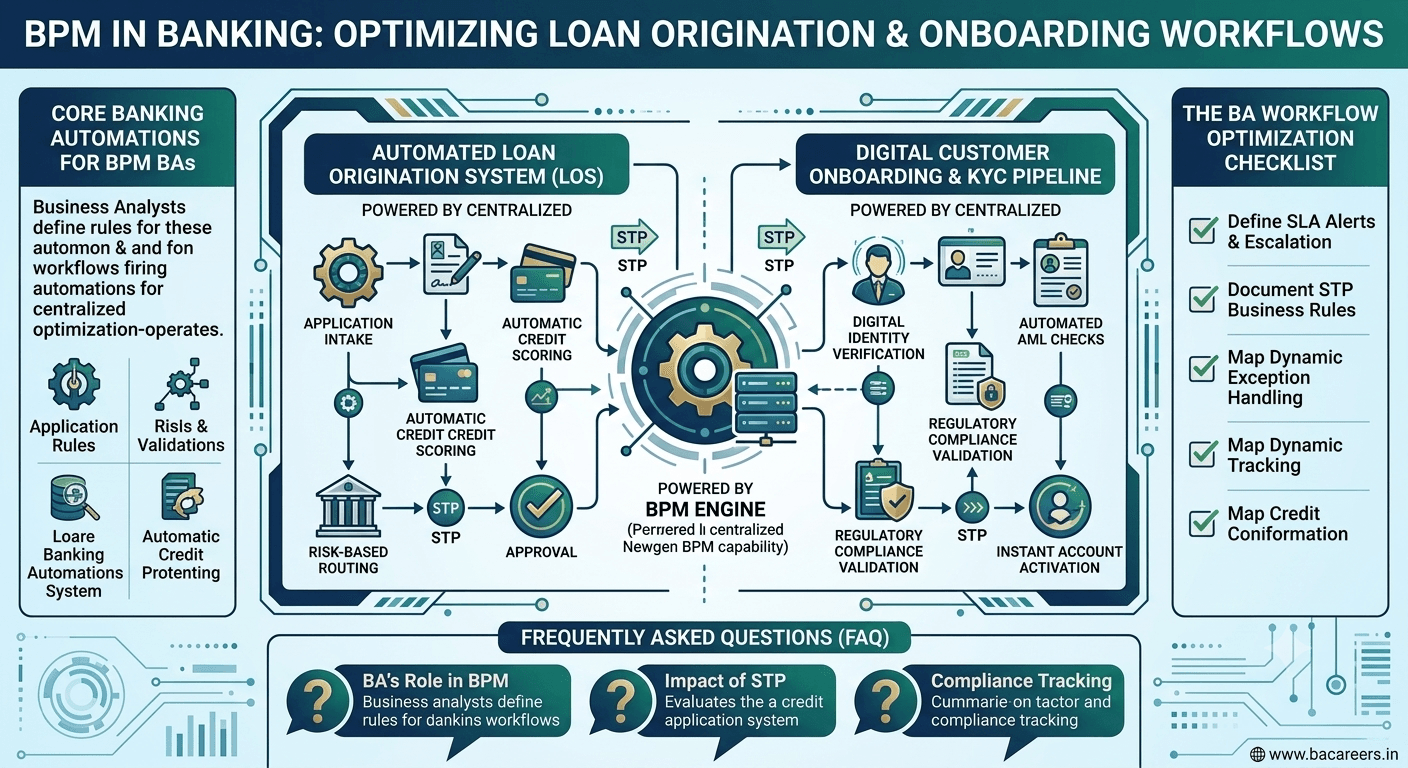
The core banking automations BAs focus on within BPM initiatives include:
– Automated Loan Origination Systems (LOS): These systems typically manage the journey of a loan from its application, credit scoring engine, income verification tool, through to underwriter review, based on certain risk levels. As a BA, you’ll document the complete workflow, ensuring appropriate routing to each relevant stage of the process.
– Digital Customer Onboarding & KYC Pipelines: Verifying a new customer requires compliance checks for all applicable KYC data. In a BPM implementation, BAs are tasked with ensuring the process design facilitates seamless, real-time checks via multiple APIs (biometric validation tool, identity databases, AML watchlist).
BA Workflow Optimization Checklist for BPM Implementation:
Your functional requirements should clearly define these parameters to ensure a seamless handover to the enterprise engine:
– SLA Alerts and Escalation Paths: You must explicitly detail the precise logic and notification flows that trigger when manual tasks within the process remain unaddressed past their designated SLA, including automated rerouting procedures.
– Straight-Through Processing (STP) Limits: Identify and precisely define the business rules that allow certain applications to proceed with complete automation, from submission to final disbursement, without human intervention.
– Dynamic Exception Handling: Outline how the system should respond to failures in external integration points or incomplete data, ensuring that process state is safely maintained without terminating active user sessions.
FAQs: Banking and BPM
Q1: What is the role of a Business Analyst in banking BPM?
Answer: In a banking BPM project, a Business Analyst’s role is to act as the liaison between business needs and the technology solution. They translate complex manual banking policies into actionable, automated processes and ensure that the BPM engine executes these processes in a compliant and efficient manner. This includes defining business rules, system integrations, user interfaces, and reporting requirements.
Q2: How does Straight-Through Processing (STP) impact workflow design in banking?
Answer: STP enables an entire process to flow through the system without any manual intervention, thus significantly increasing speed and efficiency. For BAs, this means meticulously defining the exact criteria-like credit score thresholds, transaction limits, and data accuracy checks-an item must meet to qualify for STP.
Q3: How do BAs ensure compliance within a BPM workflow?
Answer: BAs incorporate compliance measures by designing audit trails and control checks directly into the process model. They define rules that trigger required verifications, log every step and approval, and generate reports for regulatory scrutiny. Ensuring that every decision and data point is traceable and auditable is crucial for compliance.
Related Articles :
- Payments Business Analyst: Job Description, Skills & Career Path (2026)
- Stakeholder Management Matrix: A Complete Guide to Stakeholder Analysis (2026)
- Requirement Elicitation Techniques: A Complete Guide with Real-Time Examples (2026)
- Scrum Framework: A Complete Guide with Examples and Real-Time Scenarios (2026)
🎁 Become a Better Business Analyst
Join 1,200+ Business Analysts learning every week.
Get instant access to:
📘 FREE Business Analyst Templates
🎯 Interview Preparation Guides
🚀 Agile & Scrum Tutorials
🤖 AI for Business Analysts
📈 Career Growth Tips
100% Free • No Spam • Unsubscribe Anytime
