
FREE DOWNLOAD: Business Analyst Documentation Toolkit
Get instant access to real-world BRD, FRD, and project story templates used by senior BAs.
Download Free Templates PDFRequirement elicitation is the pivotal first step in software development projects. It involves understanding and documenting the needs, desires, and constraints of stakeholders to create a comprehensive set of requirements for the system to be developed. Effective requirement elicitation lays the foundation for successful project outcomes by ensuring alignment between the stakeholders’ expectations and the final product. To navigate this crucial phase efficiently, various techniques are employed, each tailored to uncover specific types of requirements. Let’s delve into the world of requirement elicitation techniques and explore how to utilize them effectively.
Understanding Requirement Elicitation Techniques:
- Interviews: Interviews involve direct interaction with stakeholders to gather insights into their requirements. Open-ended questions allow for a deeper understanding of their needs, while structured interviews follow a predetermined set of questions to ensure consistency. Conducting interviews with key stakeholders, users, and subject matter experts helps in capturing diverse perspectives.
- Surveys and Questionnaires: Surveys and questionnaires are valuable tools for collecting input from a large number of stakeholders efficiently. They can be distributed electronically or on paper, allowing stakeholders to provide feedback at their convenience. However, careful design is essential to ensure clarity and relevance of questions to elicit meaningful responses.
- Workshops and Focus Groups: Workshops and focus groups bring together stakeholders in a collaborative environment to discuss requirements collectively. Brainstorming sessions facilitate idea generation, while group discussions help in clarifying ambiguities and resolving conflicts. These interactive sessions foster engagement and promote consensus among participants.
- Observation: Observation involves directly observing users or stakeholders in their natural environment to understand their behaviors, workflows, and pain points. By witnessing firsthand how users interact with existing systems or processes, valuable insights can be gained, leading to more accurate requirements.
- Prototyping: Prototyping involves creating preliminary versions of the system to gather feedback from stakeholders. Prototypes can range from simple sketches to interactive simulations, allowing stakeholders to visualize the proposed solution and provide feedback early in the development process. Iterative prototyping enables incremental refinement of requirements based on stakeholder input.
- Document Analysis: Document analysis involves reviewing existing documentation such as business plans, user manuals, and regulatory requirements to extract relevant information. Analyzing documentation provides insights into organizational goals, constraints, and business processes, helping to shape the requirements elicitation process.
Modern Challenges: Elicitation in a Hybrid & AI Landscape.
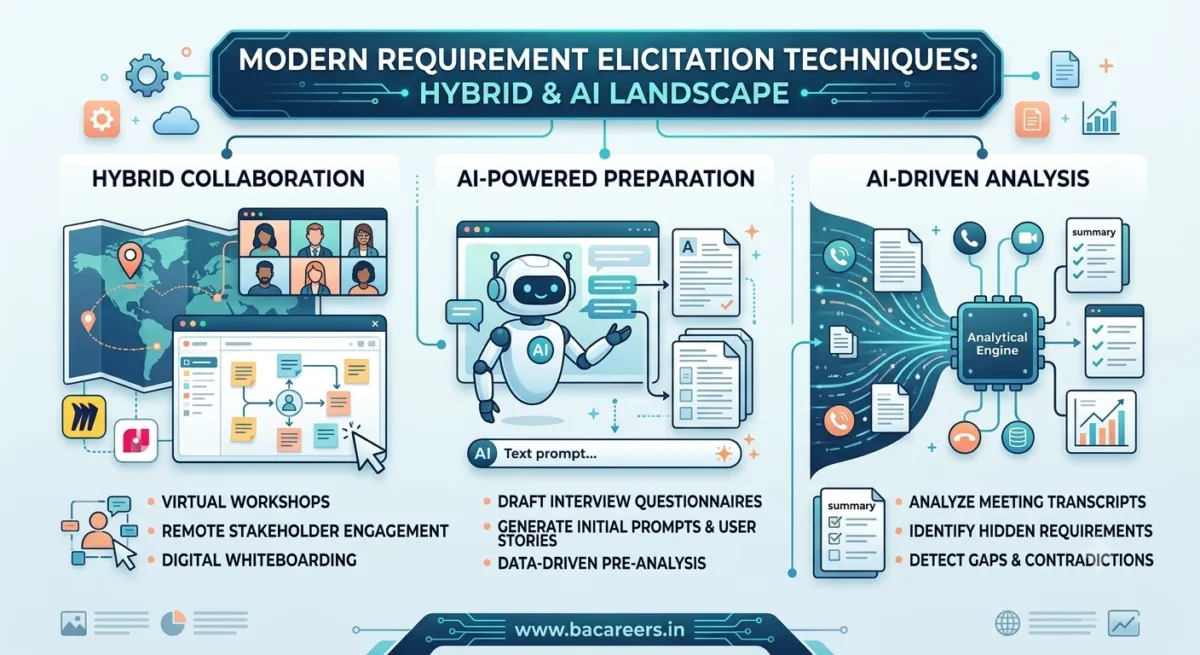
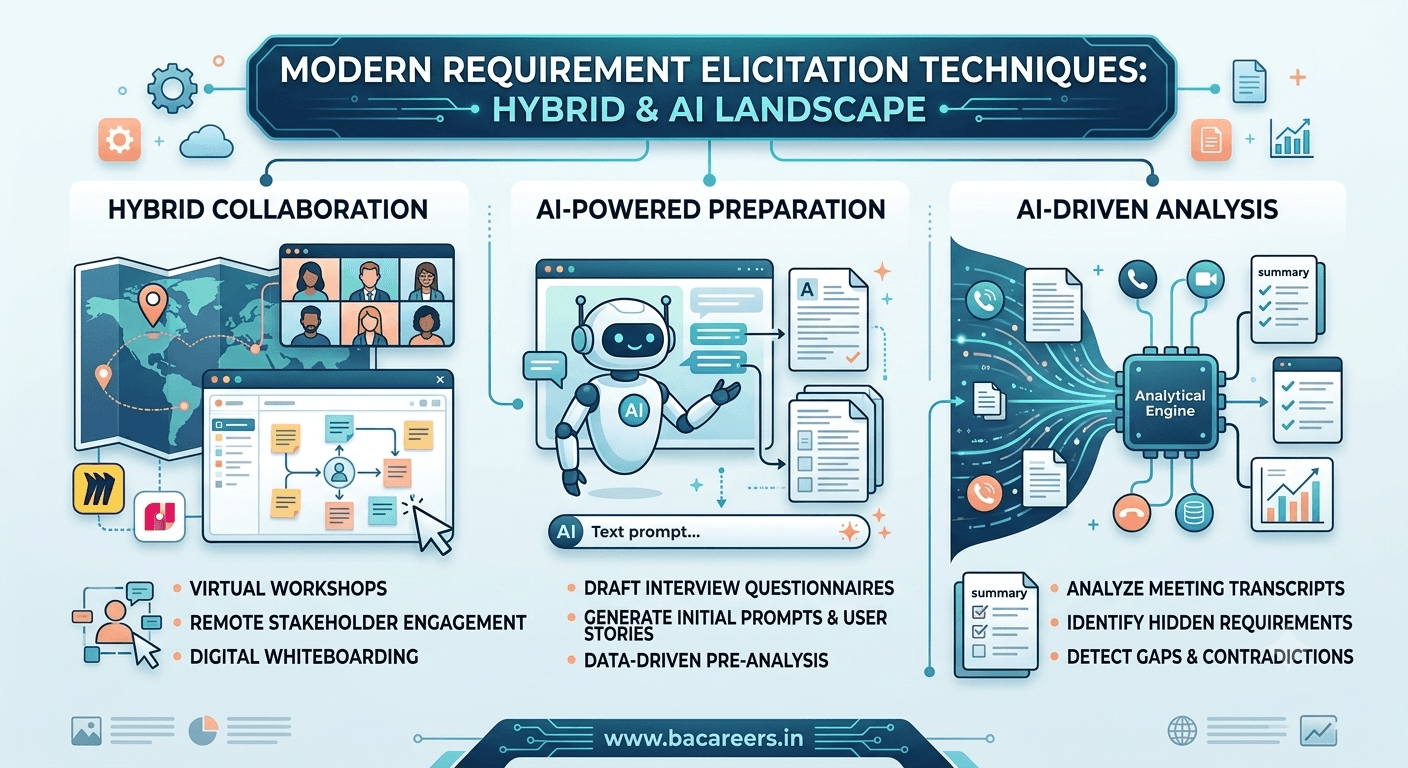
Distributed teams and Artificial Intelligence have fundamentally changed the role of a Business Analyst (BA). In the days gone by, BAs organized physical requirements gathering workshops to bring all stakeholders together in a room. But in this new, hybridized, distributed world, they have to ensure they can effectively use video conferencing to run interactive virtual meetings across different time zones.
To avoid that notorious “Zoom fatigue” and keep their stakeholders actively participating in requirement discovery, effective BAs now utilize tools like Miro or Mural to make sessions interactive.
They can collaboratively brainstorm ideas on digital stickies, build visual mind maps in real time, and, more importantly, actually capture the information they need during the virtual sessions. “They’re so quick to adopt new, engaging ways to capture requirements that might otherwise just be lost in long, email chains. Using a digital whiteboard like Miro can bring requirements out of stakeholders that wouldn’t otherwise be able to express them.” BA Manager at Tech Company Not only are BAs adopting more effective methods to engage with stakeholders, but they’re also leveraging AI to boost their pre-elicitation and post-elicitation productivity.
Before heading into a elicitation session, instead of starting with nothing, a modern BA will often use a generative AI tool to help prepare: They will leverage AI to draft the structure of their prompts, create outlines for interview questions, and build basic user story skeletons.
“Using AI in preparation speeds up my workflow by helping me build foundational structures for my questionnaires and user stories,” shares BA at Pharma Company “By the time I get to a stakeholder session, I’m able to focus on deeper, more insightful questions because I’m already starting with a solid framework.” Once an elicitation session is complete, AI becomes an even more valuable analytical resource for BAs. Previously, a BA might have spent hours poring over transcripts of recorded interviews to uncover the nuances of the discussion.
Now, they can upload meeting transcripts to AI tools, which can quickly identify previously missed requirements, generate concise summaries of key discussion points, and spot any contradictions or gaps in what the stakeholders have provided. In other words, the way a BA interacts with stakeholders and the processes they employ in discovery have been dramatically impacted by digital collaboration tools and AI.
Utilizing Requirement Elicitation Techniques:
- Define Objectives and Scope: Clearly define the objectives and scope of the requirement elicitation process to ensure focus and alignment with project goals. Identify the key stakeholders and prioritize their involvement based on their relevance to the project.
- Select Appropriate Techniques: Choose requirement elicitation techniques based on the nature of the project, the complexity of requirements, and the characteristics of stakeholders. A combination of techniques may be necessary to capture diverse perspectives and uncover hidden requirements.
- Prepare Thoroughly: Prepare for requirement elicitation sessions by developing interview questions, designing surveys, or creating prototypes. Ensure that all necessary resources, such as meeting facilities or survey tools, are available and accessible to stakeholders.
- Facilitate Collaboration: Foster open communication and collaboration among stakeholders during requirement elicitation sessions. Encourage active participation, listen attentively to stakeholder feedback, and facilitate discussions to resolve conflicts or address misunderstandings.
- Document and Validate Requirements: Document requirements systematically, ensuring clarity, completeness, and traceability. Use techniques such as requirements prioritization, validation workshops, or reviews to validate requirements with stakeholders and ensure their accuracy and relevance.
- Iterate and Refine: Recognize that requirement elicitation is an iterative process and be prepared to refine requirements based on ongoing feedback and changing project dynamics. Continuously engage with stakeholders throughout the development lifecycle to adapt to evolving needs and mitigate risks.
Conclusion:
Requirement elicitation is a dynamic and collaborative process that lays the groundwork for successful software development projects. By employing a diverse range of elicitation techniques and following best practices, project teams can effectively capture, analyze, and validate requirements to deliver solutions that meet stakeholder expectations. Embracing the art of requirement elicitation is essential for navigating the complexities of modern software development and ensuring the delivery of valuable and sustainable solutions.
Requirement elicitation is a crucial step in the process of software development. It involves gathering and understanding the needs and specifications of stakeholders to ensure that the final product meets their expectations. There are various techniques that can be used to elicit requirements effectively, such as interviews, surveys, observations, and brainstorming sessions.
One common technique is the use of prototypes or mockups to help stakeholders visualize the final product and provide feedback on its features. Another effective method is the use of use cases or user stories to describe the interactions between users and the system.
By mastering the art of requirement elicitation techniques, software developers can ensure that they have a clear understanding of what is needed to create a successful product that meets the needs of its users. This process is essential for delivering high-quality software that fulfills the requirements and expectations of all stakeholders involved.
Related Articles :
- Difference between functional and non functional requirements
- What is Requirement Traceability Matrix and How to use it
- Functional Requirements: Best Practices for Writing Functional Requirements
- What are the types of requirements in software engineering
- How Business Analysts Gather Requirements
Frequently Asked Questions FAQs.
Q1: What is the difference between requirement gathering and requirement elicitation?
A1: Requirement gathering: Assumes the stakeholders have the requirements readily available to pick up. Requirement elicitation: assumes the requirements are not all evident or well understood.
In this approach the business analyst needs to actively explore, discover, or derive the required requirements by using several collaborative techniques to elicit out business needs from stakeholders.
Q2: How do you select the correct technique?
A2: How do you select the appropriate elicitation technique?
Based on stakeholders Availability ,project timeline ,and your organization’s culture you will select your elicitation techniques. For instance if you are dealing with the executives, then it’s always the individual or short interviews or small survey form .
For instance if your stakeholders are at disagreement and then there is the requirement workshop which has a process to establish consensus among the stakeholders .
Q3: What is the common mistake in requirement elicitation?
A3: The most common mistake is Solution focus rather than Problem focus . A user would ask for the solutions i.e. For example for features such as blue colored button in a certain location ,whereas BA has to understand the core problem of the user in the underlying business context and bring solutions around it .
🎁 Become a Better Business Analyst
Join 1,200+ Business Analysts learning every week.
Get instant access to:
📘 FREE Business Analyst Templates
🎯 Interview Preparation Guides
🚀 Agile & Scrum Tutorials
🤖 AI for Business Analysts
📈 Career Growth Tips
100% Free • No Spam • Unsubscribe Anytime

Sure