

FREE DOWNLOAD: Business Analyst Documentation Toolkit
Get instant access to real-world BRD, FRD, and project story templates used by senior BAs.
Download Free Templates PDFWhat is Scrum?
“Since Scrum is an interactive, ordered framework, learning about it means knowing what Scrum Roles, Scrum Ceremonies and Scrum Artifacts you’re working with to maintain flow on a project. Use this index to check out Scrum in detail across the site, as you click into our dives here:
AgileScrum Core Pillars – Deep-Dive Knowledge Areas | ||
| Knowledge Area | Deep-Dive Article | Why It Matters for a Business Analyst |
|
Scrum Roles | Product Owner in a Scrum Project | Helps BAs understand who owns the product vision, backlog, and priorities. |
| Scrum Roles – Detailed Guide | Helps BAs understand Product Owner, Scrum Master, and Development Team responsibilities. | |
| Business Analyst in Scrum | Explains how a BA contributes to requirements, user stories, refinement, and stakeholder communication. | |
| BA Role in Agile Scrum | Connects traditional BA responsibilities with Agile/Scrum delivery. | |
| Product Owner vs Scrum Master | Helps BAs understand role boundaries, responsibilities, and collaboration. | |
|
Scrum Ceremonies | What Are Scrum Meetings? | Helps BAs understand how to participate in Scrum ceremonies and support requirement clarification and delivery. |
| Sprint Planning | Helps BAs prepare requirements and acceptance criteria for sprint commitment. | |
| Daily Standup | Helps BAs track progress, identify blockers, and clarify requirement-related issues. | |
| Daily Standup – Complete Guide | Provides practical guidance for effective Scrum communication. | |
| Running a Successful Sprint | Helps BAs understand how requirements move through a sprint. | |
|
Scrum Artifacts | Product Backlog Prioritization | BAs often support backlog refinement, prioritization, and requirement sequencing. |
| Backlog and Sprint | Explains how requirements move from the product backlog into sprint delivery. | |
| Sprint Backlog | Helps BAs understand how selected stories are organized for a sprint. | |
| Backlog Refinement | One of the most important activities for requirement clarification and refinement. | |
| Sprint Burndown Chart | Helps BAs monitor sprint progress and identify delivery risks. | |
| Create Burndown Chart in Jira | Provides practical Jira knowledge useful for Agile BAs. | |
| Scrum Board Example | Helps beginners visualize how Scrum work items move through delivery. | |
|
User Stories & Epics | What Is a User Story? | User stories are one of the primary ways Agile teams capture requirements. |
| How to Write User Stories | Helps BAs convert stakeholder requirements into actionable Agile stories. | |
| User Story Examples | Provides practical examples that beginners can use when learning Agile requirements. | |
| Acceptance Criteria | Acceptance criteria define testable conditions and improve requirement clarity. | |
| User Story + Acceptance Criteria + INVEST | Combines three important Agile BA concepts into one workflow. | |
| What Is INVEST? | Helps BAs evaluate whether user stories are clear, valuable, and ready for development. | |
| What Is an Epic? | Helps BAs understand how large requirements are broken down into features and user stories. | |
| Epic in Agile Development | Provides additional context on epics and Agile requirement decomposition. | |
| User Story Mapping | Helps BAs visualize customer journeys, features, dependencies, and release priorities. | |
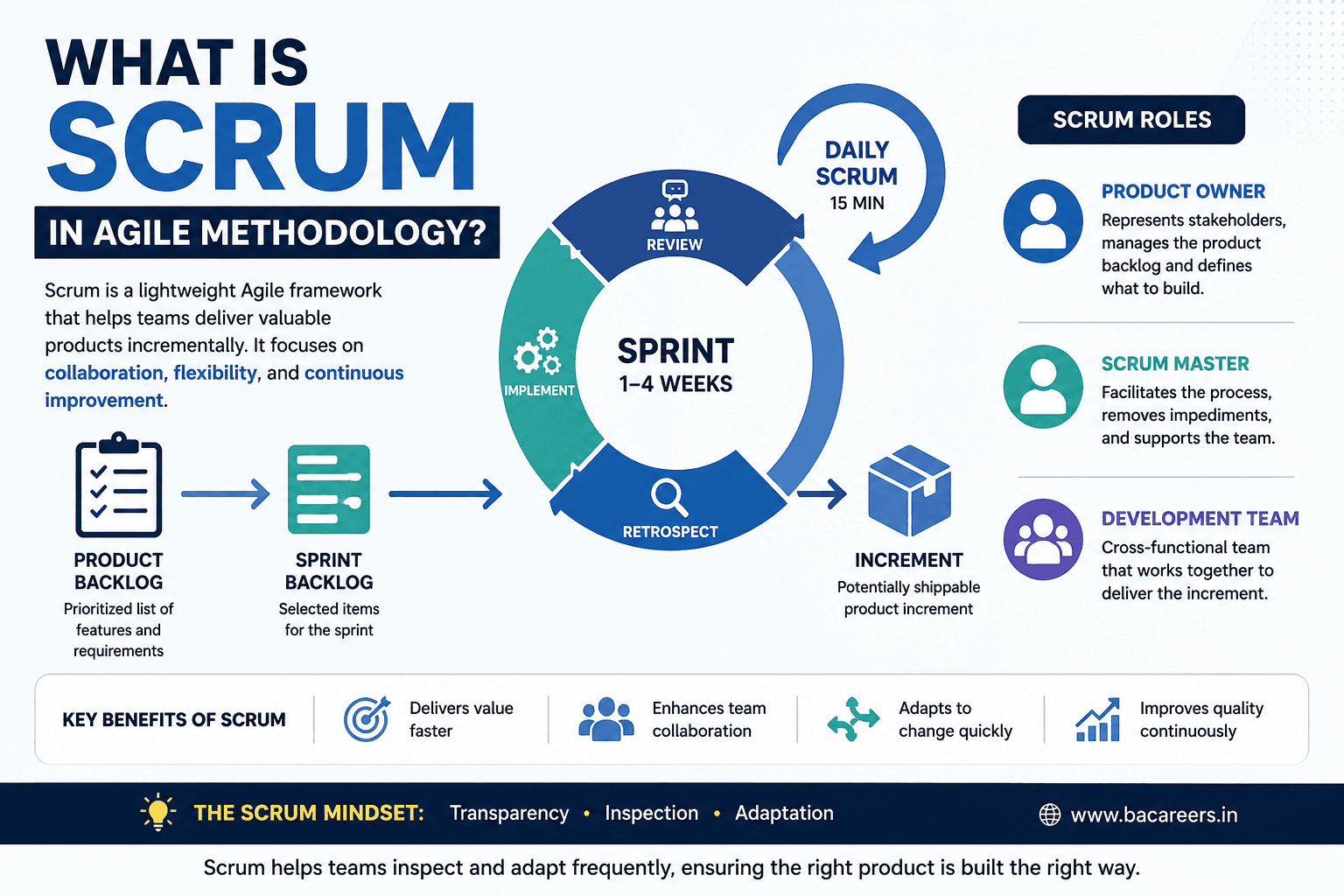
Scrum: Scrum is not a methodology, Scrum is a framework. That means it provides opportunity to work as per the project needs or requirements with cross functional team to reach the project goals. It helps us to interact with the people easily.
Scrum is very popular now days and we can say without putting Agile in your resume you will not get even interview calls also. Don’t worry and do not think too much to understand what is scrum. Let us discuss in simple words.
Mostly it will use in implementation of projects.
When we are discussing about Scrum, we should understand and remember the ScrumTerminology and terms used. I am trying to explain in simple way.
Product Backlog:
Need to prepare the product backlog, it contains the list of user stories, user story is nothing but requirements.
Once we prepare the Product backlog, will prioritize the user stories which can be implemented in this Sprint.
ScrumRoles:
Product Owner(PO)
: He will decide what needs to done in this sprint/project and he is the responsible for managing the product backlog. He will be the responsible person for product like how product should be and all.
- He interacts with Business Analysts and Customers. This role may be played by BA or any person who is having strong knowledge on product and who works with end users for a long time. Depends on the project client also may play this role.
ScrumMaster (SM)
He will monitor the performance of the team within the sprint. Team will raise all their concerns and issues to ScrumMaster.
- He is responsible to provide solutions to the team. He will interact with the stake holders to address the issues and concerns raised by the team. This role can be played by any person in team usually Business Analyst will play this role.
- Development Team (Cross functional team who are self organized)
Scrum Team: Resources who are working in this project are formed as Scrum team which comprises of Business Analyst, Developers and Testers.
If you are looking for Certification, you can refer scrum.org
🎁 Become a Better Business Analyst
Join 1,200+ Business Analysts learning every week.
Get instant access to:
📘 FREE Business Analyst Templates
🎯 Interview Preparation Guides
🚀 Agile & Scrum Tutorials
🤖 AI for Business Analysts
📈 Career Growth Tips
100% Free • No Spam • Unsubscribe Anytime
