
FREE DOWNLOAD: Business Analyst Documentation Toolkit
Get instant access to real-world BRD, FRD, and project story templates used by senior BAs.
Download Free Templates PDF
What is a Stakeholder? (Stakeholder Meaning & Definition)
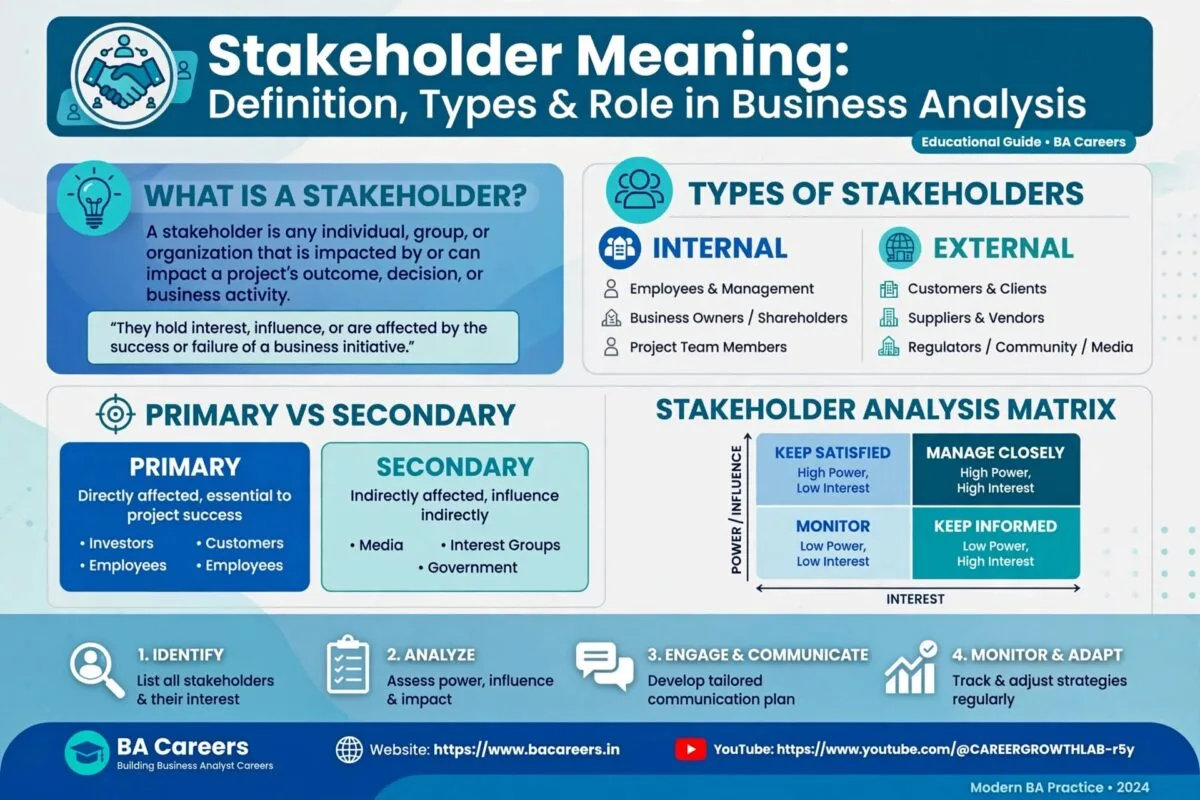
A stakeholder is any individual, group, organization, or entity that can affect, be affected by, or perceive itself to be affected by a decision, project activity, software implementation, or organizational objective.
In business analysis and project management, stakeholders include anyone from executive sponsors and product owners to end-users, customers, developers, regulatory compliance officers, and external vendors.
Internal vs. External Stakeholders
Understanding stakeholder meaning requires distinguishing between individuals operating inside an organization versus external groups:
Internal Stakeholders: Individuals or groups directly embedded within the organization executing the project.
Examples: Business Analysts, Project Managers, Software Developers, QA Engineers, Executive Sponsors, and Internal Employees.
External Stakeholders: Entities outside the organization who are impacted by or exert influence over the project’s outcome.
Examples: End-users, Customers, Third-Party API Vendors, Government Regulators, and Investors.
4-Step Stakeholder Engagement Workflow in Business Analysis
Step 1: Stakeholder Identification $\rightarrow$ Eliciting and listing all individuals and groups impacted by the new system or software release.
Step 2: Power-Interest Mapping $\rightarrow$ Evaluating stakeholders based on their level of authority (Power) and investment (Interest) using an engagement grid.
Step 3: Requirements Elicitation & Alignment $\rightarrow$ Conducting interviews, focus groups, and JAD workshops to capture clear business requirements.
Step 4: Continuous Communication & Conflict Resolution $\rightarrow$ Managing expectations, reviewing sprint demos, and securing formal sign-offs.
The RACI Matrix: Defining Stakeholder Roles
Business Analysts use a RACI Matrix to define exact stakeholder responsibilities for every project deliverable:
| RACI Letter | Role Title | Description & Business Analyst Application |
| R | Responsible | The person who does the actual work to achieve the deliverable (e.g., BA writing the BRD). |
| A | Accountable | The single decision-maker who has final approval authority (e.g., Project Sponsor / Product Owner). |
| C | Consulted | Subject matter experts (SMEs) providing input and advice (e.g., Legal, Security, Finance). |
| I | Informed | Stakeholders kept updated on progress but not directly involved in creation (e.g., Executive Leadership). |
🏦 Real-Time Scenario: Managing Stakeholders in a Core Banking Upgrade
Context & Objective
A Business Analyst is leading requirements elicitation for a Core Banking Platform Migration. The project involves competing stakeholder priorities between the Risk Compliance team and the UI/UX Design team.
Stakeholder Management Execution Flow
Step 1: Stakeholder Identification $\rightarrow$ The BA identified 12 key stakeholder groups, including Chief Risk Officers, Customer Support Leads, and Retail Branch Managers.
Step 2: Power-Interest Mapping $\rightarrow$ The Executive Sponsor was classified as High Power / High Interest (requiring close collaboration and weekly milestone briefings), while end-customer groups were classified as Low Power / High Interest.
Step 3: Conflict Resolution & RACI Alignment $\rightarrow$ When compliance demanded stricter biometric login prompts that slowed down customer checkout, the BA facilitated a JAD workshop, utilizing a RACI matrix to give Risk the final Accountability (
A) on security while keeping UX Responsible (R) for streamlining screen latency.
🔗 Business Analysis Resource Hub (Internal Links)
📘 Requirements Gathering: Unlocking Success: A Comprehensive Guide to Requirements Elicitation — Learn stakeholder interview techniques.
🛠️ Agile Roles: Role of Business Analyst in Agile Scrum Projects — Understand how BAs collaborate with Product Owners and Scrum Masters.
📋 Documentation Guides: BRD vs FRD Differences & Real-World Examples — Ensure all stakeholder requirements map cleanly into functional documents.
Frequently Asked Questions (FAQ)
A stakeholder is anyone who has a “stake” or vested interest in the success, failure, or outcome of a business project, product, or company.
A shareholder owns shares of stock in a company and is strictly focused on financial returns. A stakeholder is a broader category that includes shareholders, employees, customers, suppliers, and community members affected by business operations.
Stakeholders provide the raw business requirements, constraints, and success criteria. Without active stakeholder engagement, software projects risk building features that users do not need or want.
🎁 Become a Better Business Analyst
Join 1,200+ Business Analysts learning every week.
Get instant access to:
📘 FREE Business Analyst Templates
🎯 Interview Preparation Guides
🚀 Agile & Scrum Tutorials
🤖 AI for Business Analysts
📈 Career Growth Tips
100% Free • No Spam • Unsubscribe Anytime

Thank You
Thank You