

FREE DOWNLOAD: Business Analyst Documentation Toolkit
Get instant access to real-world BRD, FRD, and project story templates used by senior BAs.
Download Free Templates PDFIn modern software delivery, the 12 Agile principles serve as the foundational philosophy guiding high-performing Agile teams, product owners, and business analysts. First published in 2001 alongside the Agile Manifesto, these core tenets define how organizations continuously deliver value, adapt to changing market demands, and build customer-centric software.
For an Agile Business Analyst, understanding the 12 Agile principles is essential for facilitating sprint refinement, managing requirements change, and bridging communication between business stakeholders and engineering teams.

The 12 Agile Principles Explained
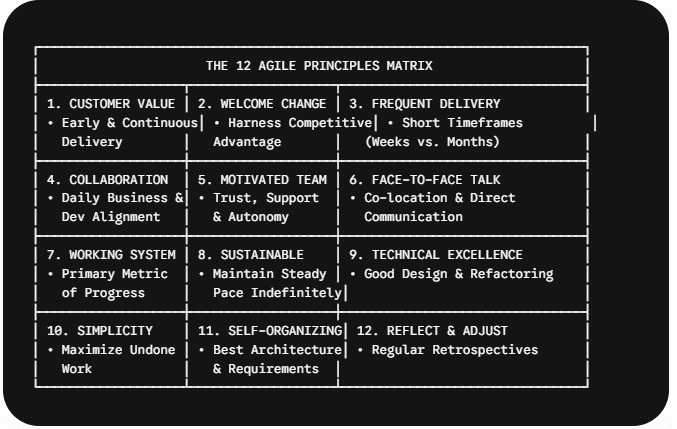
1. Highest Priority: Customer Satisfaction Through Early Delivery
Our highest priority is to satisfy the customer through early and continuous delivery of valuable software.
2. Welcome Changing Requirements
Welcome changing requirements, even late in development. Agile processes harness change for the customer’s competitive advantage.
3. Deliver Working Software Frequently
Deliver working software frequently, from a couple of weeks to a couple of months, with a preference for the shorter timescale.
4. Daily Business & Developer Collaboration
Business people and developers must work together daily throughout the project.
5. Build Projects Around Motivated Individuals
Build projects around motivated individuals. Give them the environment and support they need, and trust them to get the job done.
6. Face-to-Face Conversation Is Most Effective
The most efficient and effective method of conveying information to and within a development team is face-to-face conversation.
7. Working Software Is the Primary Measure of Progress
Working software (or functional increments) is the primary metric of progress.
8. Sustainable Development Pace
Agile processes promote sustainable development. The sponsors, developers, and users should be able to maintain a constant pace indefinitely.
9. Continuous Attention to Technical Excellence
Continuous attention to technical excellence and good design enhances agility.
10. Simplicity Is Essential
Simplicity—the art of maximizing the amount of work not done—is essential.
11. Self-Organizing Teams Yield the Best Results
The best architectures, requirements, and designs emerge from self-organizing teams.
12. Regular Reflection & Adjustment
At regular intervals, the team reflects on how to become more effective, then tunes and adjusts its behavior accordingly.
Real-World BA Scenario: Applying Principle #2 (Welcoming Change)
Context: An Agile Business Analyst working on a digital banking application learns during Sprint 3 that central regulations have altered identity verification requirements.
How the BA Executes:
Instead of Blocking Change: Rather than rejecting the change due to “frozen baseline specs,” the BA uses JIRA backlog management to groom the new requirement into prioritized User Stories.
Documenting Traceability: The BA updates the functional specification in Confluence and collaborates with the Scrum Master to swap out lower-priority backlog items, maintaining the team’s sprint velocity while keeping the product compliant.
1. Agile Principles
Agility is a set of values and practices that help teams work effectively together. These principles are designed to ensure that we have the right people, processes, tools, and culture to deliver value to our customers. We believe that these principles should guide how we operate at all levels of the company.
Agility is the ability to adapt to change and respond effectively to unexpected situations. Agility is the ability to act quickly and efficiently in order to achieve goals. There are many different ways to define agility, however, they all have similar characteristics.
2. Continuous Improvement
We strive to continuously improve everything we do. We constantly seek out ways to make ourselves better and the products and services we provide even better. We embrace change and welcome feedback. We don’t wait until problems arise before we try to fix them. We’re always looking for ways to innovate and find new solutions.
3. Customer Focus
We focus on delivering great customer experiences. We listen to our customers and learn from their feedback. We put their needs first and act accordingly. We’re committed to building long-term relationships with our customers.
4. Openness & Transparency
We share information openly and honestly with each other and our stakeholders. We’re open about what we’re doing, who we’re working with, and where we’re going. We’re honest with our stakeholders and hold ourselves accountable for our actions.
5. Respect for People
We treat everyone with respect and dignity. We recognize that people’s differences enrich us rather than divide us. We celebrate people’s individuality and uniqueness. We encourage others to follow their passions and live their lives to the fullest.
6. Communication
We communicate clearly and often. We know when to talk and when to listen. We take the time to understand each other’s perspectives and point of view. We use plain language and avoid jargon whenever possible. We keep things simple and get straight to the point.
7. Self-Awareness
We’re self-aware and aware of our own strengths and weaknesses. We’re humble enough to admit when we need improvement and brave enough to ask for help when we need it. We’re transparent about what we’re doing and why. We’re not afraid to fail or make mistakes.
The following agile principles are listed below.
a. Continuous Integration
Continuous integration is a software development practice where each check-in (commit) triggers automated testing and deployment. This ensures that code changes are tested before being deployed.
b. Test Driven Development
Test driven development (TDD) is a software development methodology that involves writing tests first, then coding the application logic. TDD helps developers write high quality code by forcing them to think about how their code will behave before actually writing any code.
c. Refactoring
Refactoring is the process of changing a program’s internal structure without modifying its external behavior. Developers use refactoring to improve the design and maintainability of their programs.
d. Pair Programming
Pair programming is a software development technique in which two programmers work together to develop software. One programmer writes code while the other monitors the code and provides feedback.
e. Continuous Deployment
Continuous deployment is a software development practice in which deployments occur frequently and automatically. In continuous deployment, there is no need to manually deploy applications. Instead, the build server builds the application and immediately deploys it to production.
You Can go through below to learn more about Agile.
- What is Agile Methodology ?
- What is Scrum ?
- What are the differences between Waterfall and Agile
- Difference between Waterfall and Agile Methodologies
Frequently Asked Questions (FAQs)
The 4 Agile Values define the high-level mindset (e.g., Individuals and Interactions over Processes and Tools), while the 12 Agile Principles provide actionable, operational guidelines on how teams should build software and manage requirements daily.
A BA uses these principles to prioritize backlogs based on value (Principle #1), slice large requirements into small deliverable user stories (Principle #3 & #10), and ensure business and tech teams collaborate daily (Principle #4).
The 12 Agile principles provide the operational foundation for modern software engineering, guiding how teams build products, iterate rapidly, and respond to change.
For an Agile Business Analyst, mastering the Agile Manifesto principles ensures seamless collaboration between stakeholders and developers while maintaining a sustainable release cycle.
📄 Business Analysis & Agile Execution Hub
Explore how Agile principles connect with BA tooling, documentation standards, and career growth:
| Knowledge Area | Deep-Dive Guide | Why It Matters for a Business Analyst |
|---|---|---|
| Agile Methodology | 12 Agile Principles Guide | Understand core Agile values, continuous delivery, self-organizing teams, and customer feedback. |
| Agile Tooling | JIRA & Confluence Setup Guide | Configure JIRA boards and Confluence templates to execute Agile backlog management effectively. |
| Career Growth 2026 | Future-Proof Your BA Career in 2026 | Learn how AI tools and product management mindsets enhance traditional Agile BA roles. |
| Technical BA Skills | API Requirement Documentation Guide | Break down complex REST API integrations into deliverable Agile user stories. |
| Requirements Engineering | What is a Functional Requirement? | Write clean, testable acceptance criteria adhering to the Definition of Ready (DoR). |
🎁 Become a Better Business Analyst
Join 1,200+ Business Analysts learning every week.
Get instant access to:
📘 FREE Business Analyst Templates
🎯 Interview Preparation Guides
🚀 Agile & Scrum Tutorials
🤖 AI for Business Analysts
📈 Career Growth Tips
100% Free • No Spam • Unsubscribe Anytime

3 thoughts on “What Are the 12 Agile Principles? A Complete Guide for Business Analysts”