

FREE DOWNLOAD: Business Analyst Documentation Toolkit
Get instant access to real-world BRD, FRD, and project story templates used by senior BAs.
Download Free Templates PDFIn Agile software development frameworks like Scrum and Kanban, agile user stories serve as the core building blocks for product backlogs. Rather than writing long, rigid technical requirement documents upfront, teams rely on user stories to capture business needs from the end user’s perspective.
For an Agile Business Analyst, writing high-quality user stories ensures that developers understand not just WHAT to build, but WHY it delivers value to the customer and business.

What Is an Agile User Story?
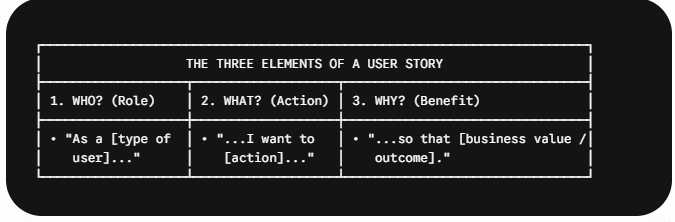
An Agile User Story is a short, plain-language description of a software feature written from the end-user’s viewpoint. It establishes a shared understanding between business stakeholders, product owners, and technical teams.
Key Components: The 3Cs Framework
To prevent user stories from becoming static specification sheets, Agile co-creator Ron Jeffries defined the 3Cs Model:
Card: The physical index card or JIRA ticket containing the concise story statement.
Conversation: The ongoing discussion between the Business Analyst, Product Owner, and Engineering team during backlog refinement.
Confirmation: The explicit acceptance criteria used to verify that the story is fully implemented and working as intended.
User Story Quality: The INVEST Checklist
Before adding an agile user story to a sprint backlog, a Business Analyst must validate it against the INVEST framework:
I – Independent: Can be developed and delivered without tightly coupling to unfinished backlog items.
N – Negotiable: Details are open to discussion and optimization with developers.
V – Valuable: Delivers clear, measurable value to the user or business entity.
E – Estimable: Contains clear scope so engineers can assign story points or effort metrics.
S – Small: Sized appropriately to fit comfortably within a single sprint iteration (typically 1–2 weeks).
T – Testable: Includes objective acceptance criteria for Quality Assurance (QA) validation.
Practical User Story Splitting Techniques for BAs
When an agile user story is too large (an Epic), a Business Analyst must split it into smaller, deliverable items. Use these four proven splitting techniques:
| Splitting Strategy | Description | Example |
| By Workflow Step | Split a multi-step workflow into individual step stories. | Story A: Search products $\rightarrow$ Story B: Add to cart $\rightarrow$ Story C: One-click checkout. |
| By Data Variations | Split by data types or input parameters. | Story A: Pay via credit card $\rightarrow$ Story B: Pay via UPI/PayPal. |
| By Operations (CRUD) | Split basic Create, Read, Update, Delete actions. | Story A: View profile details $\rightarrow$ Story B: Edit profile details. |
| By Rule Complexity | Implement basic business logic first, then add edge cases. | Story A: Basic password validation $\rightarrow$ Story B: Advanced multi-factor security rules. |
Real-World BA Scenario: E-Commerce Order History Feature
Context: A BA is writing a user story for an e-commerce platform’s customer dashboard.
User Story Statement:
“As a frequent online shopper, I want to filter my order history by date range, so that I can easily locate past receipts for expense reimbursement.”
Acceptance Criteria (Given-When-Then Format):
Scenario 1: Applying a valid date range filter
Given the customer is on the “My Orders” tab,
When they select a custom date range (e.g., Jan 1 to Jan 31) and click “Apply Filter”,
Then the page displays only orders placed within those dates.
Scenario 2: No records found for selected range
Given no orders exist within the selected range,
When the customer applies the filter,
Then the system displays: “No orders found for this timeframe.” along with a “Reset Filters” button.
Related Articles :
- User Story Mapping: How to Visualize Product Development for Improved Collaboration and Success
- Mastering the Art of User Story Format: Strategies for Creating Impactful Software
- How to Write an Effective User Story
- Invest User Story Examples
- What is Agile User Story Acceptance Criteria ?
- User Story Examples and User Stories
- The Art of Agile Story Pointing: How to Prioritize Tasks and Boost Team Productivity
Frequently Asked Questions (FAQs)
Functional Requirements describe system behavior and technical functions (e.g., “The database shall encrypt user passwords using AES-256”). Agile User Stories describe human-centric goals and business outcomes (e.g., “As a user, I want my payment credentials secured so that my financial data is protected”).
Typically, a well-scoped user story contains 3 to 6 acceptance criteria. If a story requires more than 8–10 scenarios, it is usually a sign that the story is too large and should be split using the INVEST model.
Mastering agile user stories is a fundamental skill for any Agile Business Analyst. A well-written user story bridges business goals and engineering execution.
By applying the 3Cs framework, validating tickets against the INVEST criteria, and mastering user story splitting techniques, BAs can maintain clean, deliverable sprint backlogs.
📄 Business Analysis & Agile Execution Hub
Explore how user stories connect with Agile principles, requirements documentation, and technical BA skills:
| Knowledge Area | Deep-Dive Guide | Why It Matters for a Business Analyst |
|---|---|---|
| Agile Requirements | Agile User Stories Comprehensive Guide | Master user story structure, 3Cs model, INVEST checklist, and story splitting techniques. |
| User Story Writing | What is a User Story in Agile? | Learn user story templates, Given-When-Then acceptance criteria, and JIRA backlog formatting. |
| Agile Methodology | 12 Agile Principles Guide | Understand core Agile values, continuous delivery, self-organizing teams, and iterative releases. |
| Agile Tooling | JIRA & Confluence Setup Guide | Learn how to organize Epics, User Stories, and sub-tasks within JIRA backlog boards. |
| Technical BA Skills | API Requirement Documentation Guide | Detail backend REST API payloads and integration validation rules within User Story tickets. |
🎁 Become a Better Business Analyst
Join 1,200+ Business Analysts learning every week.
Get instant access to:
📘 FREE Business Analyst Templates
🎯 Interview Preparation Guides
🚀 Agile & Scrum Tutorials
🤖 AI for Business Analysts
📈 Career Growth Tips
100% Free • No Spam • Unsubscribe Anytime
