
FREE DOWNLOAD: Business Analyst Documentation Toolkit
Get instant access to real-world BRD, FRD, and project story templates used by senior BAs.
Download Free Templates PDFOverview
“Tell me about yourself” is almost always the first question in any Business Analyst interview. While it sounds like an informal icebreaker, the interviewer is evaluating your professional summary, domain relevance, analytical mindset, communication skills, and value proposition.
A strong response sets the tone for the rest of the interview by briefly connecting your background, key BA competencies, real-world accomplishments, and alignment with the prospective company.

[ Present Role & Core Focus ] ──► [ Key BA Achievements & Skills ] ──► [ Future Goals & Alignment ]
The Present-Past-Future Framework for Business Analysts
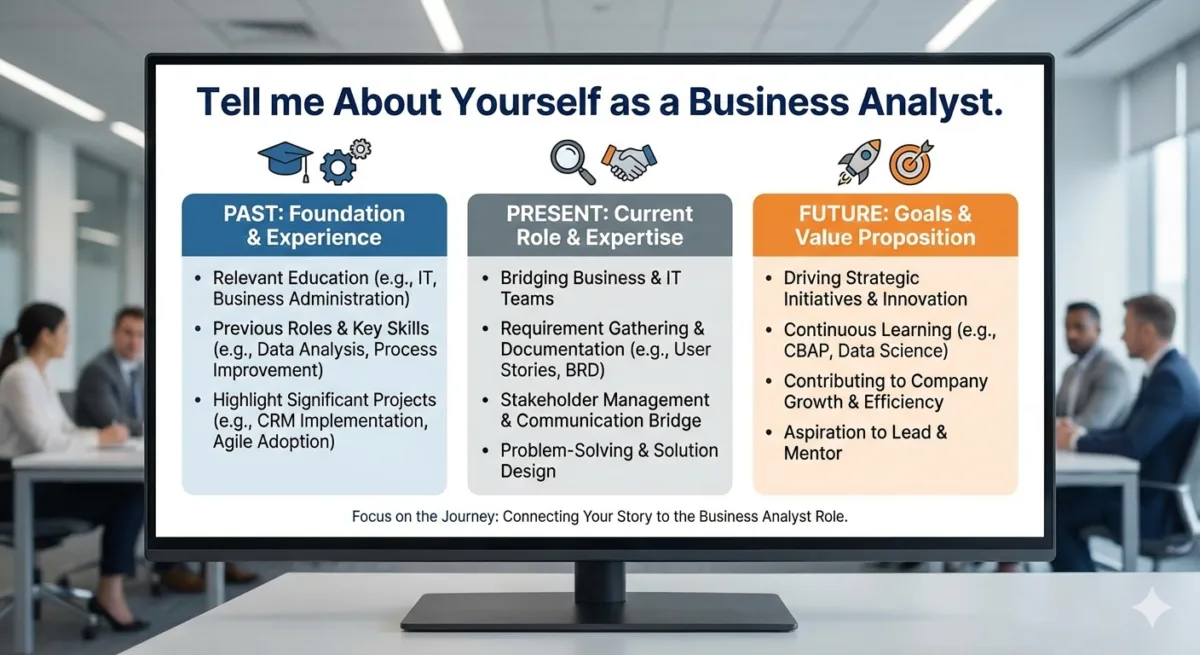
The most effective way to structure your response is the Present-Past-Future (PPF) formula:
1. Present (30 Seconds) $\rightarrow$ State your current designation, years of experience, primary domain (e.g., Banking, E-Commerce, Healthcare), and core BA focus areas.
2. Past (45 Seconds) $\rightarrow$ Highlight 1–2 key career accomplishments, specific methodologies used (Agile, Scrum, Waterfall), tools mastered (Jira, SQL, BPMN), and measurable impacts delivered.
3. Future (15 Seconds) $\rightarrow$ Summarize why you are excited about this specific opportunity and how your skill set bridges business needs with technical solutions.
Key BA Competencies to Highlight
When delivering your pitch, seamlessly weave in these core competencies expected of a Business Analyst:
| BA Skill Category | Specific Competencies & Tools to Mention |
| Requirements Management | Requirements Elicitation, BRD/FRD Drafting, User Stories, Acceptance Criteria, Traceability Matrix (RTM). |
| Process Modeling | AS-IS vs. TO-BE Workflows, BPMN 2.0, Flowcharts, Use Case Diagrams, Wireframing (Lucidchart, Visio, Figma). |
| Agile & SDLC Knowledge | Scrum Ceremonies, Backlog Refinement, JAD Workshops, Sprint Planning, UAT Management. |
| Technical & Data Skills | SQL Querying, Data Mapping, API Basics, Excel (Pivot Tables/VLOOKUP), Jira, Confluence. |
| Soft Skills | Stakeholder Management, Active Listening, Conflict Resolution, Scope Negotiation. |
Sample Answers by Experience Level
1. Sample Answer for Experienced Business Analysts (3+ Years)
“I am a Business Analyst with over [X] years of experience specializing in [Domain, e.g., FinTech / Banking / E-Commerce]. In my current role at [Company Name], I bridge the gap between non-technical business stakeholders and software development teams. My day-to-day focus centers on requirement elicitation, process mapping using BPMN 2.0, and drafting comprehensive BRD/FRD documents and user stories.
Recently, I led the business analysis phase for an API integration project that automated loan origination workflows. By facilitating structured JAD workshops and refining acceptance criteria, we reduced manual processing errors by 25% and delivered the sprint 2 weeks ahead of schedule.
I’m well-versed in both Agile Scrum and Waterfall environments, proficient with tools like Jira, Confluence, Visio, and basic SQL. I’m looking forward to applying my stakeholder alignment and process optimization skills to help your team solve complex business challenges.”
2. Sample Answer for Entry-Level / Fresher Business Analysts
“I am a recent graduate with a degree in [Your Field, e.g., Computer Science / Business Administration / Finance], passionate about leveraging data and analytical thinking to solve real business problems. During my academic curriculum, I developed a strong foundation in core business analysis concepts, including requirement gathering, wireframing, and Agile methodologies.
For my capstone project, I acted as the student BA for a simulated e-commerce platform. I conducted stakeholder interviews, mapped AS-IS and TO-BE process flows in Lucidchart, and authored 15 detailed user stories with Gherkin acceptance criteria in Jira.
I’ve also earned certifications in [e.g., ECBA / Agile Scrum Basics] and trained in tools like Excel, SQL, and Trello. I am excited about the opportunity to kickstart my career with your company and contribute to your upcoming software projects.”
3. Sample Answer for Non-IT Career Changers Transitioning to BA
“I have [X] years of experience in [Previous Industry, e.g., Operations / Customer Service / Banking Sales], where I spent significant time managing client relationships, analyzing operational bottlenecks, and improving business processes. Throughout my career, I realized that my core passion lies in problem-solving and optimizing software workflows.
To transition into a formal Business Analyst role, I completed intensive hands-on training covering the BABOK® framework, SDLC lifecycles, and Agile documentation. I learned how to translate non-technical business pain points into functional specifications, create wireframes, and use tools like Jira, SQL, and Miro.
My domain experience gives me a unique advantage in understanding real user pain points, while my BA skill set allows me to translate those needs effectively to technical teams. I am eager to leverage this blended background in your team.”
4 Common Mistakes to Avoid
1. Reciting Your Resume Word-for-Word $\rightarrow$ Avoid repeating your chronological work history item by item. Focus on a compelling narrative and high-level wins.
2. Being Too Vague or Generic $\rightarrow$ Saying “I am a hardworking BA” is less impactful than mentioning specific tools (SQL, Jira, Visio) and deliverables (BRDs, Use Cases).
3. Rambling Beyond 2 Minutes $\rightarrow$ Keep your answer concise (between 90 and 120 seconds).
4. Sharing Irrelevant Personal Information $\rightarrow$ Focus purely on your professional story, education, key skills, and career motivations rather than personal details.
Recommended Next Steps
📘 Interview Preparation: Review Top Business Analyst Interview Tips for Freshers.
🛠️ Skills & Tools Roadmap: Explore Business Analyst Skills Required: Complete Roadmap.
📋 Documentation Guides: Learn the differences between requirements in BRD vs FRD Guide.
As we know this is the common question for everyone when we are facing any interview, it is tricky question and ensure to respond in proper way. This is the question where interviewer can estimate your knowledge and skills, this is only question where we can express our strengths and positive areas.
We do not know what interviewer is expecting from us, some of them may expect your current work experience, some of them may concentrate on your projects, it could be anything.
Ensure to cover everything when you are answering this question, prepare a story about yourself to convince the others.
- Be confident.
- Cover present past and future.
- Highlight your strengths as a Business Analyst, For Example: Gathering requirements, Stake holder Management, GAP Analysis, Impact Analysis.
- Highlight the areas in SDLC where you are strong (Agile/Waterfall).
- Read and understand the Job description, and prepare on Domain knowledge (Ex: Healthcare/Banking/Insurance)
- Your Accomplishments.
- The most important thing is we should not lose confidence when answering to interviewer questions.
- Highlight your major areas only when you are answering for “Tell me about Yourself”, it should be short and sweet. As per my previous experiences I can say it should be between 3 to 5 minutes.
And prepare the skills needed to prove as a Business Analyst and Business Analyst Role in Project before attending the interview.
For Business Analyst Certification, you can visit IIBA
Frequently Asked Questions (FAQ)
Your response should ideally last between 1 to 2 minutes (around 150 to 250 words). Keep it structured, engaging, and focused on relevant professional highlights.
In addition to technical tools, emphasize your ability to bridge the gap between business stakeholders and technical developers through clear requirement elicitation and active communication.
Yes. Mentioning foundational familiarity with tools like Jira, Confluence, Visio, Excel, and SQL demonstrates initiative, practical knowledge, and readiness to work in modern IT project environments.
🎁 Become a Better Business Analyst
Join 1,200+ Business Analysts learning every week.
Get instant access to:
📘 FREE Business Analyst Templates
🎯 Interview Preparation Guides
🚀 Agile & Scrum Tutorials
🤖 AI for Business Analysts
📈 Career Growth Tips
100% Free • No Spam • Unsubscribe Anytime

Yes, you go through our website.