

FREE DOWNLOAD: Business Analyst Documentation Toolkit
Get instant access to real-world BRD, FRD, and project story templates used by senior BAs.
Download Free Templates PDFIntroduction
Product Owner: The “secret sauce” to Scrum’s real product value Scrum is not about moving at a fast pace to churn out software; rather, it’s about producing the correct product. What a lot of traditional project management styles lack: They disconnect the engineer from the business user. Solution: the Product Owner Meet the clever role that the Scrum framework has implemented to make sure the product being delivered is the “right one”: the Product Owner.
Let’s delve into the role of the Product Owner and what it takes for the PO to drive value on a product.
What is a Product Owner in Scrum?
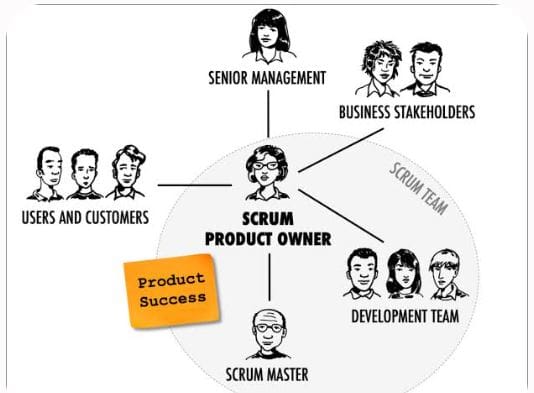
The Product Owner is the primary responsible person for the Product Backlog, and for maximizing the value delivered by the Scrum development team. The Product Owner is often thought of as the “voice of the customer” within the Scrum Team, and the key liaison between business stakeholders and the engineering team. He alone is the gatekeeper of what should be built and the desired delivery cadence, focusing energies to deliver products with high ROI.
In Scrum, the Product Owner is a key role responsible for defining and prioritizing the product backlog. The product backlog is a dynamic and ordered list of features, enhancements, bug fixes, and other work that needs to be done to deliver a product. The Product Owner works closely with the development team and other stakeholders to ensure that the team is working on the most valuable and high-priority items.
The Core Collaboration Matrix of a PO
A Product Owner does not work in a vacuum. They must collaborate with developers, Scrum Masters, and Business Analysts to keep the team moving in unison.
| Key Project Deliverable | Product Owner (PO) | Business Analyst (BA) | Scrum Master (SM) | Development Team |
| Defining Product Vision & Strategy | Accountable (A) | Consulted (C) | Informed (I) | Informed (I) |
| Writing & Refining User Stories | Accountable (A) | Responsible (R) | Consulted (C) | Consulted (C) |
| Prioritizing the Product Backlog | Accountable (A) | Consulted (C) | Informed (I) | Consulted (C) |
| Defining Sprint Goals | Accountable (A) | Consulted (C) | Facilitates | Responsible (R) |
Characteristics of a Rockstar PO
You need to possess the following traits to be a phenomenal PO:
Visionary Thinker– Can see “the forest through the trees” and drive the product vision forward.
Decisive– Is able to turn away customers and stakeholders, saying “no,” to keep scope manageable.
Deep Domain Knowledge– Possesses an in-depth understanding of the business domain, customer needs and wants, as well as where the market is headed.
Availability- It’s a must! – Developers need constant clarification and can’t waste time waiting for the business user.
Here are some key responsibilities and aspects of the role of a Product Owner in a Scrum project:
Defining and Prioritizing the Product Backlog: The Product Owner is responsible for creating and maintaining the product backlog. This involves identifying and describing the desired features, improvements, and bug fixes and ordering them based on priority and business value.
Stakeholder Communication: The Product Owner acts as a liaison between the development team and stakeholders. They gather feedback, communicate priorities, and ensure that the team understands the business goals and objectives.
Setting Sprint Goals: Before each sprint, the Product Owner works with the team to define the goals and scope for the upcoming sprint. This involves selecting the highest-priority items from the product backlog to be included in the sprint.
Acceptance Criteria: The Product Owner provides clear and detailed acceptance criteria for each backlog item. Acceptance criteria define the conditions that must be met for a product backlog item to be considered complete.
Availability: The Product Owner needs to be available to the development team during the sprint to answer questions, provide clarification, and make timely decisions. This helps to ensure that the team can work efficiently without unnecessary delays.
Decision-Making Authority: The Product Owner has the authority to make decisions about the product backlog and priorities. They are empowered to make trade-offs between features, schedule, and other constraints based on the overall goals of the product.
Adaptability: The Product Owner should be adaptable and open to feedback. As the product evolves and the team learns more, priorities may need to be adjusted, and the product backlog may need to be refined.
Collaboration: Successful collaboration between the Product Owner, Scrum Master, and the Development Team is crucial for the success of the project. The Product Owner collaborates with the team to ensure that the product backlog is well-understood and that everyone is aligned on the project goals.
Conclusion:
In a nutshell, The PO is ultimately accountable for driving the value of the product in Scrum. Whether by casting a vision, guiding the Product Backlog, or partnering with the development team, this PO is essential for a successful Scrum project that generates value.
Frequently Asked Questions (FAQ’s)
What is the difference between a Product Manager and a Product Owner?
Although the Product Manager and Product Owner are somewhat similar roles, Product Managers focus on market and competitive analysis, product pricing and defining product strategy, future vision, and growth. Conversely, a PO is a role centered more directly on the Scrum Team and is focused on translating the vision into an actionable Product Backlog for that team and steering the development work.
Can the Scrum Master also serve as a Product Owner?
No.
The developers and the Product Owner each depend on the Scrum Master for support and facilitation.
Asking the Scrum Master to serve the Product Owner as well as the developers is like asking someone to juggle two sets of incompatible balls — you’ll end up with dropped balls.
Whom is responsible for the ordering of the Product Backlog items in Scrum?
The Product Owner is singularly accountable for the ordering of the Product Backlog items.
Although external stakeholders or management might have strong opinions on the order and will often have significant influence over the final product, the outcome is still up to the PO.
Related Articles :
Product Owner Responsibilities That Ensure Success
what is a product owner in agile?
What is a Product Owner: Key Roles and Responsibilities
🎁 Become a Better Business Analyst
Join 1,200+ Business Analysts learning every week.
Get instant access to:
📘 FREE Business Analyst Templates
🎯 Interview Preparation Guides
🚀 Agile & Scrum Tutorials
🤖 AI for Business Analysts
📈 Career Growth Tips
100% Free • No Spam • Unsubscribe Anytime
