

FREE DOWNLOAD: Business Analyst Documentation Toolkit
Get instant access to real-world BRD, FRD, and project story templates used by senior BAs.
Download Free Templates PDFIntroduction :
A product owner (PO) in an agile development team oversees the product being developed. He or she stands between the business and the act – between an idea and the final product, to deliver value by developing software for customers. POs can only fulfill their potential with constant, active and involved cooperation from the development backlog and by the PO conversations with all his or her stakeholders. The PO becomes the “voice of the customer” and de facto product owner of the product backlog and liaises with all the stakeholders involved.
Let’s look at the PO role with respect to the product in detail.
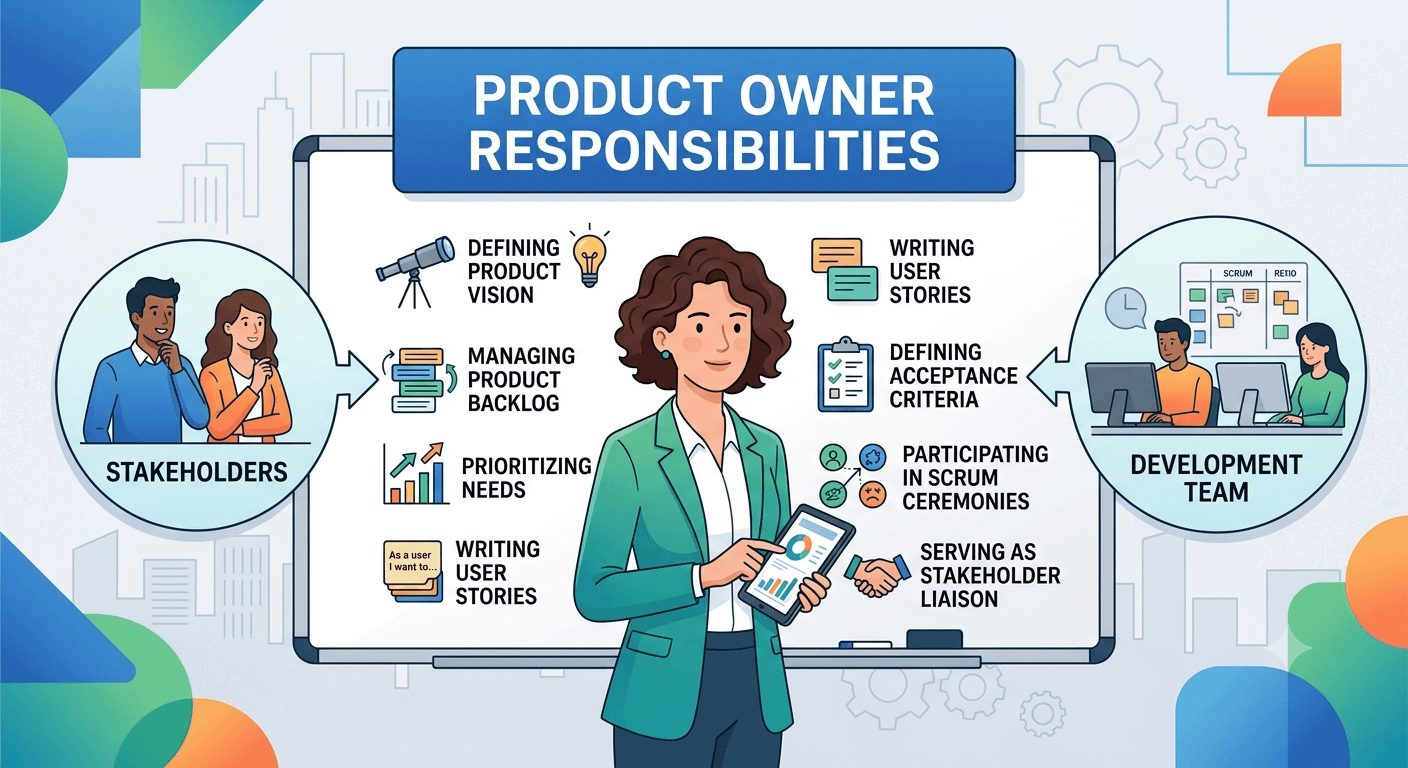
7 Product Owner tasks
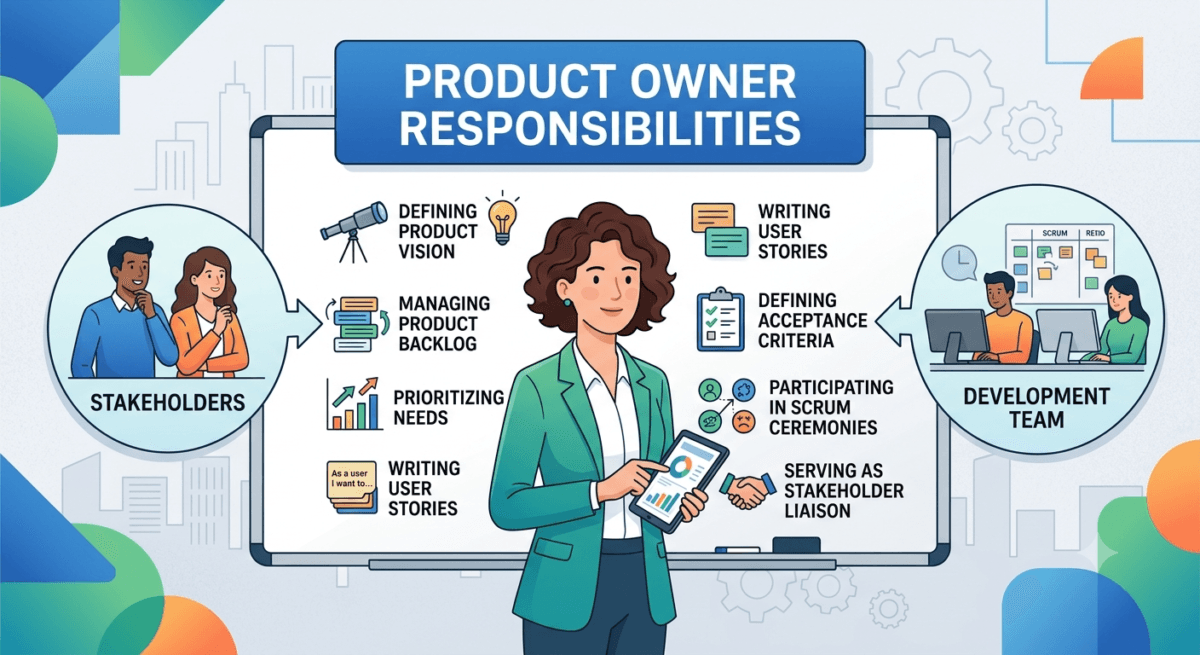
1. Product vision defined and communicated
POs work with stakeholders to define and communicate a long-term product vision. The product vision clarifies the product in the future and describes which objectives can be achieved with it, by which customer groups and for what reason. It helps unite stakeholders and development teams around a shared goal.
2. Product backlog managed and refined
The PO is the single point of authority for the content of the product backlog, listing all that is needed for the product, including features, functions, requirements, enhancements, and fixes. POs should ensure order within the backlog by elaborating, prioritizing, and ordering backlog entries to create a roadmap.
3. Features, tasks, and requirements prioritized
POs define priorities for product backlog entries to optimize resource utilization and time for a sprint. POs will take the following factors into account when setting priorities for individual entries: value, cost, and implementation complexity. The backlog will also need to be periodically prioritized by POs based on current requirements.
4. User stories created and refined
User stories are short descriptions of how end users should behave with the end product, which specify desired features, functions, and benefits for end users. POs formulate clear, concrete, and actionable user stories that should be clearly articulated by POs until the development team fully understands how the product should function.
5. Acceptance criteria defined
POs must ensure that for each backlog item (or User Story), the conditions are defined for how the development of such item will be considered complete and the item delivered in final condition. The Product Owner will judge whether an item has been completed according to its Acceptance Criteria – that determines its status of being finalized and therefore will grant his or her acceptance, by validating whether the item is finally “done”.
6. Trust built with people and teams (stakeholder management)
The PO serves as the primary point of contact between the stakeholders (e.g., clients, management, sales, marketing, customer support) and the development team. The PO must manage the stakeholders’ expectations and represent the stakeholders to the team, while protecting the team from external interference. An important component of the PO role is to build relationships based on trust.
7. Scrum ceremonies attended and participatived
Although the Product Owner is not directly engaged in the day-to-day work of sprint execution, they play an essential role in the Scrum process and are actively engaged in all Scrum ceremonies. In sprint planning meetings, POs provide context, assist the development team in refining the sprint goal, and help choose backlog items to be included in the sprint. They attend sprint reviews to verify that completed sprint items meet the defined acceptance criteria and accept them or request adjustments. In sprint retrospectives, POs participate in analyzing the team’s process to identify improvements.
Product Owner – Much more than backlog management
Here are some of the more critical functions performed by a PO:
* Requirements Elicitation – Beyond surface-level assumptions, the PO drills down into the specific steps a customer would take to use the product to achieve a specific business objective. This often involves engaging customers, performing market research, and analyzing product usage data.
* Release planning – In partnership with release management teams, the PO coordinates the timeline and strategy for when product features and new releases will be delivered. This include release windows, testing requirements, infrastructure needs and post-release support plans.
* Monitoring and Analysis – Following product launches, the PO monitors performance using specific metrics to track such things as user engagement, feature adoption rates, and customer satisfaction. Findings from performance monitoring can inform future product development plans.
Conclusion
By diligently performing all the previously listed tasks and functions, Product Owners become the strategic drivers that align product development efforts with business objectives, deliver maximum customer value and help organizations navigate changes and complexity, making their products successful. They are the architects of success!
Frequently Asked Questions (FAQs)
Q: What does the PO do during a Sprint?
A: During a Sprint, the Product Owner remains available to developers for any questions, reviews completed User Stories for acceptance, and begins refining and preparing the backlog for upcoming sprints.
Q: What is “Backlog Grooming” or “Refinement”?
A: Backlog Grooming (or Refinement) is a continuous process performed by the Product Owner, often with input from the Development Team and possibly a Business Analyst, to detail, prioritize, estimate, and clarify backlog items to ensure they are ready to be worked on in an upcoming Sprint.
Q: Who has final sign-off authority over completed work?
A: The Product Owner holds exclusive authority for the acceptance of completed User Stories based on their adherence to defined acceptance criteria.
🎁 Become a Better Business Analyst
Join 1,200+ Business Analysts learning every week.
Get instant access to:
📘 FREE Business Analyst Templates
🎯 Interview Preparation Guides
🚀 Agile & Scrum Tutorials
🤖 AI for Business Analysts
📈 Career Growth Tips
100% Free • No Spam • Unsubscribe Anytime
