
FREE DOWNLOAD: Business Analyst Documentation Toolkit
Get instant access to real-world BRD, FRD, and project story templates used by senior BAs.
Download Free Templates PDFWhat Is Ethics in Business Analysis? (Definition & Meaning)
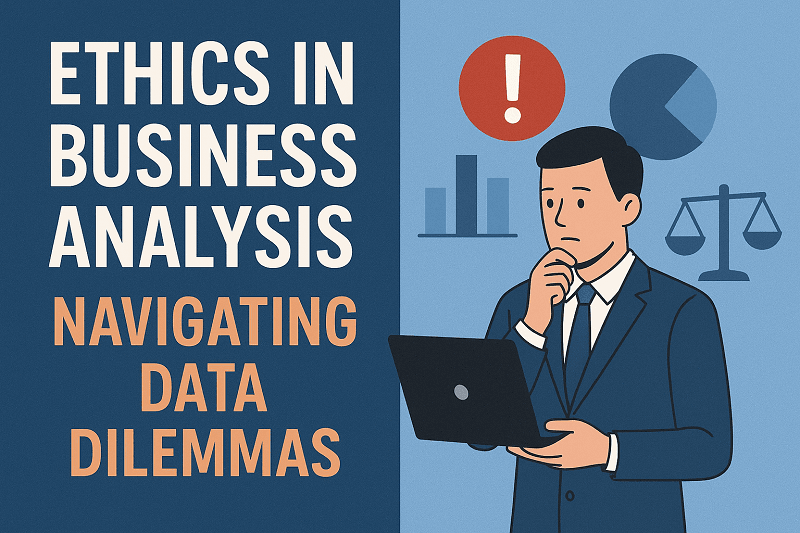
Business analysis ethics defines the ethics, professional standards and rules of regulatory governance through which a Business Analyst can keep requirements human, examine business and customer data properly, and propose solutions based on the data.
Business Analysts operate at the cross-section of executive strategy, customer data, and software engineering. By adhering to a code of ethics, business solutions can protect user privacy (GDPR, DPDPA), avoid algorithmic bias, foster stakeholder transparency, and safeguard long-term trust versus the short-term numbers.
5 Core Pillars of Ethical Business Analysis
1. Data Privacy & Confidentiality –> Ensuring robust access controls and data anonymisation of PII, financials & proprietary trade secrets during analysis and UAT.
2. Objective & Impartial Analysis –> Avoid cherry-picking metrics that would support a preconceived notion of their value or attractiveness of the overall story to the sponsor.
3. Algorithmic & AI Fairness –> Auditing training data, and AI decision rules to remove demographic & income biases prior to adoption of any AI/ML feature.
4. Transparency & Consent –> Moving away from dark UI patterns by being transparent about collection, storage, and sharing of customer data.
5. Transparency & Avoiding Conflicts of Interest –> Disclosing potential conflicts of interest, financial or vendor incentives, that could influence tool recommendation or requirements prioritisation.
Common Ethical & Data Dilemmas Faced by Business Analysts
| Dilemma Scenario | Ethical Conflict | Ethical Business Analyst Resolution |
| Using Production PII in QA/UAT | Developers or testers request real customer database dumps to speed up UAT environment setup. | Refuse raw PII access; specify synthetic test data or automated data masking rules in the FRD/NFRs. |
| Manipulating KPIs in Reports | A department head asks the BA to exclude negative churn data from an executive dashboard. | Present the complete dataset transparently while adding contextual notes explaining temporary anomalies. |
| Biased AI Credit Scoring Rules | Historical lending data penalizes applicants from specific zip codes, creating discriminatory loan rejections. | Flag the proxy bias during requirement validation, remove sensitive attributes, and define fairness audit criteria. |
| Deceptive Opt-In Checkboxes | Marketing requests pre-checked consent boxes to boost newsletter and third-party data-sharing sign-ups. | Enforce explicit, un-checked opt-in workflows aligned with GDPR/DPDPA compliance standards. |
4-Step Framework: How a BA Resolves Ethical & Data Dilemmas (Option 3 Workflow)
Step 1: Identify the Ethical Conflict & Affected Stakeholders —> Pinpoint whether the proposed requirement violates data privacy laws, internal governance policies, or fair user treatment, and map who is harmed.
Step 2: Gather Objective Evidence & Regulatory Baselines —-> Reference applicable legal frameworks (GDPR, HIPAA, PCI-DSS, India’s DPDPA) and organizational compliance policies to ground the discussion in facts rather than personal opinion.
Step 3: Propose Compliant Alternative Solutions —-> Draft practical requirement workarounds—such as data anonymization, explicit consent toggles, or aggregated reporting—that achieve the business goal legally and ethically.
Step 4: Document & Escalate Through Governance Channels —-> Record the compliance risk in the RAID log (Risks, Assumptions, Issues, Dependencies) and escalate to the Data Protection Officer (DPO), Legal team, or Project Sponsor if unresolved.
🏦 Real-Time Scenario: Navigating a Data Privacy Dilemma in FinTech Lending
Context & Objective
A Business Analyst is gathering requirements for an AI-Powered Instant Personal Loan Eligibility Engine. To accelerate model accuracy, the Product Manager proposes feeding 2 years of unmasked customer bank statements and transaction descriptions directly into an external third-party analytics sandbox.
Ethical Resolution Execution Flow
Step 1: Spotting the Compliance Violation $\rightarrow$ The BA immediately flags that transmitting unmasked customer names, account numbers, and merchant histories to an external vendor violates banking data privacy regulations and customer consent agreements.
Step 2: Defining Data Minimization & Masking Rules $\rightarrow$ Working with Information Security, the BA updates the Functional Requirement Document (
FRD) to mandate tokenization of customer IDs and stripping of PII fields before any data leaves the core banking firewall.Step 3: Delivering Secure Business Value $\rightarrow$ The third-party engine receives clean, anonymized financial behavioral patterns—achieving the exact same predictive accuracy while keeping 100% of customer identities protected and audit-compliant.
Business Analysis Resource Hub
👥 Stakeholder Alignment: What Is Stakeholder Management? Process, Matrix & BA Best Practices — Learn how to navigate conflicting stakeholder priorities constructively.
🛡️ Security & Payment Governance: UPI ID Meaning: Usage, Examples & Security Measures — Explore practical data security controls in digital payments.
📋 Requirement Documentation: FRD Full Form in Software Engineering: Complete Guide & Template — Document Non-Functional Requirements (NFRs) for privacy and compliance.
🧪 Safe Testing Practices: User Acceptance Testing (UAT) Guide for Business Analysts — Validate compliance and data protection rules before production go-live.
🧪 Key Success : Ethics in Business Analysis: The Key to Trust and Success
External Links
- GDPR Guidelines: https://gdpr.eu/
- OECD AI Ethics Principles: https://oecd.ai/en/ai-principles
- ISO Standards for Data Privacy: https://www.iso.org/standards.html
Frequently Asked Questions (FAQ)
Ethics in business analysis is vital because Business Analysts shape software systems and data models that directly affect customers, employees, and business integrity. Ethical practices protect sensitive data, prevent regulatory fines, eliminate AI bias, and build lasting stakeholder trust.
A common ethical dilemma occurs when stakeholders ask a Business Analyst to use live production customer data (PII) for software testing or to omit unfavorable metrics from an executive performance dashboard.
Business Analysts ensure data privacy by incorporating Privacy by Design into requirements—specifying data minimization, PII masking/anonymization in test environments, role-based access controls (RBAC), and explicit user consent workflows aligned with laws like GDPR and DPDPA.
🎁 Become a Better Business Analyst
Join 1,200+ Business Analysts learning every week.
Get instant access to:
📘 FREE Business Analyst Templates
🎯 Interview Preparation Guides
🚀 Agile & Scrum Tutorials
🤖 AI for Business Analysts
📈 Career Growth Tips
100% Free • No Spam • Unsubscribe Anytime
