

Get new posts by email:
Powered by follow.it

Requirement Gathering Techniques for Business Analysts | Real-Time Examples & Guide

Requirement Gathering Techniques for Business Analysts

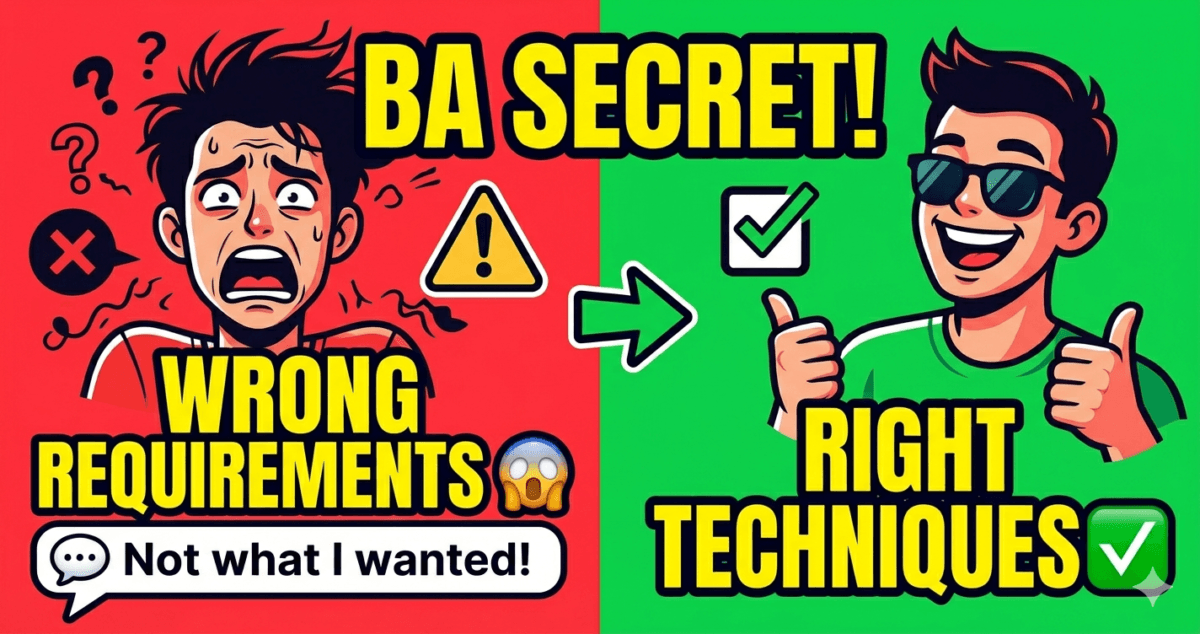
Have you ever seen a project fail… not because of coding… but because the requirements were wrong?

Imagine this… a company spends 6 months building a product… and the client says…
πŸ‘‰ β€œThis is NOT what I wanted!” 😳

Sounds scary, right? But this happens all the time… because of poor requirement gathering.

πŸ‘‰ In this article, I’ll show you powerful requirement gathering techniques that every Business Analyst must know β€” with real examples.

Requirement Gathering Techniques for Business Analysts Real-Time Examples & Guide

🎯 Section 1: What is Requirement Gathering?

Requirement gathering is the process of understanding what the business actually needs.

πŸ“Œ Example:
A client says: β€œWe need a mobile app.”
But what kind of app? For whom? What features?

πŸ‘‰ If you don’t ask the right questions… you build the wrong product.

Β 

Let me ask you something…

πŸ‘‰ Have you ever assumed something… and later realized it was completely wrong?

That’s exactly what happens in projects.


🎯 Section 2: Top Requirement Gathering Techniques (Main Content)

1️⃣ Interviews

πŸ‘‰ One-on-one discussion with stakeholders

πŸ“Œ Example:
Bank manager explains loan approval process

🎯 Tip:
Ask open-ended questions

β€œWhat challenges do you face?”
β€œWhat do you expect from the system?”


2️⃣ Workshops

πŸ‘‰ Group discussions with stakeholders

πŸ“Œ Example:
Developers + Business + Users in one meeting

🎯 Benefit:
Faster decisions + fewer misunderstandings


3️⃣ Observation

πŸ‘‰ Watching users perform tasks

πŸ“Œ Example:
Observe how a cashier uses billing software

🎯 Insight:
Users may not explain problems… but you can see them


4️⃣ Surveys / Questionnaires

πŸ‘‰ Collect data from large audience

πŸ“Œ Example:
Customer feedback form

🎯 Best for:
Large user base


5️⃣ Document Analysis

πŸ‘‰ Study existing documents

πŸ“Œ Example:
BRD, SOP, Reports

🎯 Benefit:
Understand current system


6️⃣ Prototyping

πŸ‘‰ Create sample screens/mockups

πŸ“Œ Example:
Show app UI before development

🎯 Benefit:
Early feedback β†’ fewer changes later


Β 

Wait… here’s the biggest mistake most beginners make…

πŸ‘‰ They jump to solutions WITHOUT understanding the problem.


🎯 Section 3: Real-Life Scenario

Let’s say a company wants an e-commerce website.

❌ Without proper gathering:

Wrong features
Poor user experience

βœ… With proper techniques:

Clear requirements
Happy client
Successful project


🎯 Conclusion

If you want to become a successful Business Analyst… mastering requirement gathering is a MUST.

πŸ‘‰ Comment below: Which technique do you use most?

Related Articles :

Agile Methodology for Business Analysts

How to Become a Business Analyst)

Business Process Modeling Techniques)

Β 

FAQ’s

1. What is requirement gathering in business analysis?

Requirement gathering is the process of understanding what the business actually needs by interacting with stakeholders, asking questions, and analyzing current systems.

2. What are the main requirement gathering techniques?

The main requirement gathering techniques include:
Interviews
Workshops
Observation
Surveys / Questionnaires
Document Analysis
Prototyping

3. Why is requirement gathering important in projects?

Requirement gathering is important because it helps avoid misunderstandings, ensures the right product is built, and reduces project failure due to unclear or incorrect requirements.

4. What is the difference between requirement gathering and requirement elicitation?

Requirement gathering and requirement elicitation are often used interchangeably, but elicitation focuses more on actively discovering requirements, while gathering includes documenting and organizing them.

5. Which requirement gathering technique is best?

There is no single best technique. The choice depends on the project, stakeholders, and business needs. In most cases, a combination of techniques works best.

6. What are common mistakes in requirement gathering?

Some common mistakes include:
Not asking the right questions
Assuming requirements without validation
Ignoring stakeholders
Jumping to solutions without understanding the problem

7. How do Business Analysts gather requirements effectively?

Business Analysts gather requirements effectively by:
Asking open-ended questions
Actively listening to stakeholders
Validating requirements
Using multiple techniques like interviews and prototyping

8. What is an example of requirement gathering?

Example:
A client says they need a mobile app.
A Business Analyst gathers requirements by asking:
Who will use the app?
What features are required?
What problem should the app solve?

9. What tools are used for requirement gathering?

Common tools include:
Microsoft Excel
JIRA
Confluence
Google Forms (for surveys)
Wireframing tools for prototyping

10. How can beginners learn requirement gathering techniques?

Beginners can learn requirement gathering by:
Studying real-time examples
Practicing with case studies
Observing business processes
Taking Business Analyst training courses

Storytelling for BAs: Presenting Complex Solutions

Storytelling for Business Analysts

Are your presentations often met with blank looks or just polite nods? You’ve done the workβ€”analyzed data, designed processes, and come up with smart ideasβ€”but when it’s time to present, the group seems lost.

That’s because numbers and facts alone don’t grab people‘s attentionβ€”stories do.

In today‘s busy business world, Business Analysts need to do more than just show results.
They need to connect with people, build trust, and make others want to take action.
Let’s see how using stories can turn your presentations from boring to engaging.

The Power of Storytelling in Business

People love stories.

From ancient drawings on cave walls to today‘s popular talks, we remember stories, not just lists of numbers.

For a Business Analyst, storytelling helps make complex data easier to understand and connect with business goals.

Why stories work:

They help people understand complicated data better.

They build trust by showing real feelings and connections.

They make your message stick and show what action to take.

Example:

Imagine a BA talking about a new automation tool.
Instead of saying:

Using this tool cuts manual work by 40%.”

Try this:

“Meet Priya, our operations manager, who spends half her day checking invoices.
With our new tool, she’ll finally have time to focus on solving problems, not just entering data.

Suddenly, people care.
They can see the real difference.

Reallife Example:

In a bank, a BA used a storybased approach to get support for a compliance project.
By focusing on “keeping customers safeinstead of “upgrading systems,” leadership approved the project quicklyβ€”within one meeting.

1.
Identify the Hero and the Villain

Hero: Your customer, user, or stakeholder
Villain: The problem, inefficiency, or risk

Example:

Finance managers (the hero) get stuck with manual work (the villain).
Our new tool (the solution) helps them escape the mess of data entry.

2.
Structure Your Story

Beginning: The current situationβ€”what’s wrong or inefficient
Middle: The journeyβ€”your solution and how it changes things
End: The futureβ€”how much better things get, how efficient, or how happy customers are

3.
Highlight ‘Aha!’ Moments

Show key ideas that make your audience say, “Oh, I get it now!”

For example, show how dashboards save time and help people make better decisions.

Tip:
If you’re presenting in a workshop or sprint review, use visualsβ€”flow diagrams, before-and-after charts, or short user stories can make your message more real.Effective Requirement Elicitation Techniques
β€” Learn how to get the details that help build your story.

Practical Storytelling Tips for BAs

Here‘s how to use storytelling in your everyday presentations.

1.
Use Analogies and Metaphors

Make complex ideas simple by comparing them to something familiar.

Example:

Think of this workflow like a GPSβ€”it shows the way and warns about traffic ahead.”

2.
Use Real Stories

Client stories: Show the human side of success.

Case studies: Share real outcomes, not just features.

Personal stories: Share lessons from past projects.

3.
Simplify Jargon

Use simple business language instead of technical terms.

Example:

Instead of sayingAPI integration reduces latency,” say, “Our systems will finally work together in realtime.”

4.
Use Visual Storytelling

Use picturesβ€”process maps, storyboards, or mockupsβ€”to help your audiencesee” the story.
Tools like Miro, Lucidchart, or Figma can help.

Your Call to Action: Be a Storytelling BA

Key Points:

Facts help, but stories move people.

A clear story turns complex ideas into easy-to-understand messages.

Storytelling makes you a better communicator and changemaker.

Try This:

In your next presentation, replace one data slide with a storyβ€”someone real, a problem they face, and how your solution helps them.

You’ll notice the difference right awayβ€”more interest, more questions, and more support.

Conclusion

Storytelling isn’t just a “soft skill”β€”it’s a powerful way to communicate that sets good BAs apart from great ones.

When you tell a story, you don’t just show dataβ€”you inspire people to act, build trust, and create real change.

So, the next time you’re making a BRD, an executive presentation, or a sprint demo, remember:
Don’t just show the data.
Tell the story behind it.

PMI – The Importance of Communication in Project Success.

πŸ”— Related Articles:

  1. Agile Methodology for Business Analysts

  2. Stakeholder Engagement Strategies

  3. Effective Requirement Elicitation Techniques

  4. Business Analyst Interview Tips

  5. Change Management for Business Analysts

🌐 External Links

  1. Harvard Business Review – Why Your Brain Loves Good Storytelling

  2. International Institute of Business Analysis (IIBA)

  3. PMI – The Importance of Communication in Project Success

error

Enjoy this blog? Please spread the word :)