
Get new posts by email:
Powered by follow.it

What Does a Business Analyst Do ? Roles, Responsibilities & Real Project Example

What Does a Business Analyst Actually Do?

Business Analyst Roles and Responsibilities in Real Projects

Most people think a Business Analyst just writes documents. But the truth is very different.

Most people think a Business Analyst is someone who writes documentation, works in Excel, and attends meetings. But the truth is very different.
A Business Analyst is the person who connects business problems with technology solutions.

In simple words, they help companies to build the right product.

Today, I will explain what a Business Analyst actually does in real projects.

If you have ever wondered:

  • What does a BA do every day?

  • Does BA need coding?

  • What tools do BA use?

Then this article will give you a complete real-world example with examples.

What does a Business Analyst do

What Does a BA Actually Do?

A BAΒ is a professional who identifies business problems and helps organizations build the right technology solutions.

In real projects, a BA performs the following responsibilities:

  1. Understand the business problem by talking to stakeholders and customers

  2. Gather requirements such as business rules, features, and system needs

  3. Document requirements using BRD, user stories, and functional specifications

  4. Create process flows and diagrams to explain how the system should work

  5. Communicate between business teams and developers

  6. Support testing to ensure the product works as expected

In simple words, a BA connects business needs with technology solutions and ensures the company builds the right product for users.

πŸ’‘ This section is optimized to rank for:

  • Whatdoes a BA do

  • BA roles and responsibilities

  • BAΒ  job explained


Real Project Example

Let’s imagine a real story.

A bank wants to build a mobile app where customers can check balance, transfer money, and pay bills.

But developers cannot start coding immediately because they don’t know:

  • What features are required

  • How users will use the app

  • What the business rules are

This is where the Business Analyst enters the project.


Step 1: BA Understands the Business Problem

The BA talks to stakeholders like:

  • Business managers

  • Customers

  • Product owners

He will ask the right questions to understand exactly what they expect from the system.

Example Question

What problem are we trying to solve?

Example Answer

We want customers to transfer money faster.


Step 2: Gather Requirements

The BA collects detailed requirements like:

  • Transfer limit

  • Security verifications

  • OTP validation

These requirements are documented as:

  • User Stories

  • BRD (Business Requirement Document)

  • Functional Requirements


Step 3: Create Process Flow

The BA creates simple diagrams like:

  • Process flows

  • Wireframes

  • Use cases

If you need clarity on process flows, wireframes, and use cases, please comment in the comment section so that I will cover them in the next article.

Example Process Flow

Customer Login β†’ Enter Amount β†’ OTP Verification β†’ Transfer Complete

Whenever we do any transaction, for example when you are doing a payment transaction, you can observe this process flow.

For example, when you use applications like:

  • GPay

  • PhonePe

You can observe the same flow:

  1. Login to the application

  2. Enter the amount

  3. Receive OTP

  4. Enter OTP

  5. Get confirmation message whether it is success or failure

Business Analysts prepare documentation like this so developers clearly understand what needs to be developed in the system.


Step 4: Communicate Between Teams

One of the most important responsibilities of a BA is communication.

Business people speak business language.

Developers speak technical language.

The BA translates between both teams.


Step 5: Support in Testing

Before the product goes live, the BA verifies whether:

  • Requirements are implemented correctly

  • Features match business expectations

Before releasing to the client, the BA verifies the RTM (Requirement Traceability Matrix).

He also verifies whether the application is working as per the client requirement.

If any issues are found, he will ask the development team to fix them.

In software development, these issues are called defects.


What Does a BA Do Daily?

Typical BA daily tasks include:

Morning

  • Stand-up call or daily meeting

Afternoon

  • Requirement discussions with stakeholders

  • Writing user stories

Evening

  • Working with developers and testers


What Tools Do Business Analysts Use?

Some common BAnalyst tools include:

  • Excel

  • Jira

  • Confluence

  • Visio

  • Figma

Coding is not required for Business Analysts.

A BA does not need to write code.

The main role of the BA is to understand the client requirement and explain it to the development team so they can build the application.


Who Can Become a Business Analyst?

Many professionals successfully switch to BA roles from non-IT backgrounds like:

  • Banking

  • Sales

  • Finance

  • Support roles


Important Skills for Business Analysts

The most important skills are:

  • Communication

  • Problem solving

  • Business understanding

Related Articles :

  1. How to Become a BusinessAnalyst
  2. Top Business Analyst Skills
  3. Business Analyst Interview Questions
  4. Agile Methodology for Business Analysts

Learn More About Business Analyst Career

If you want to learn:

  • How to become a Business Analyst

  • Business Analyst salary in India

  • Business Analyst interview questions

Visit our website:

πŸ‘‰ https://www.bacareers.in

On this website, we explain the Business Analyst career step by step.

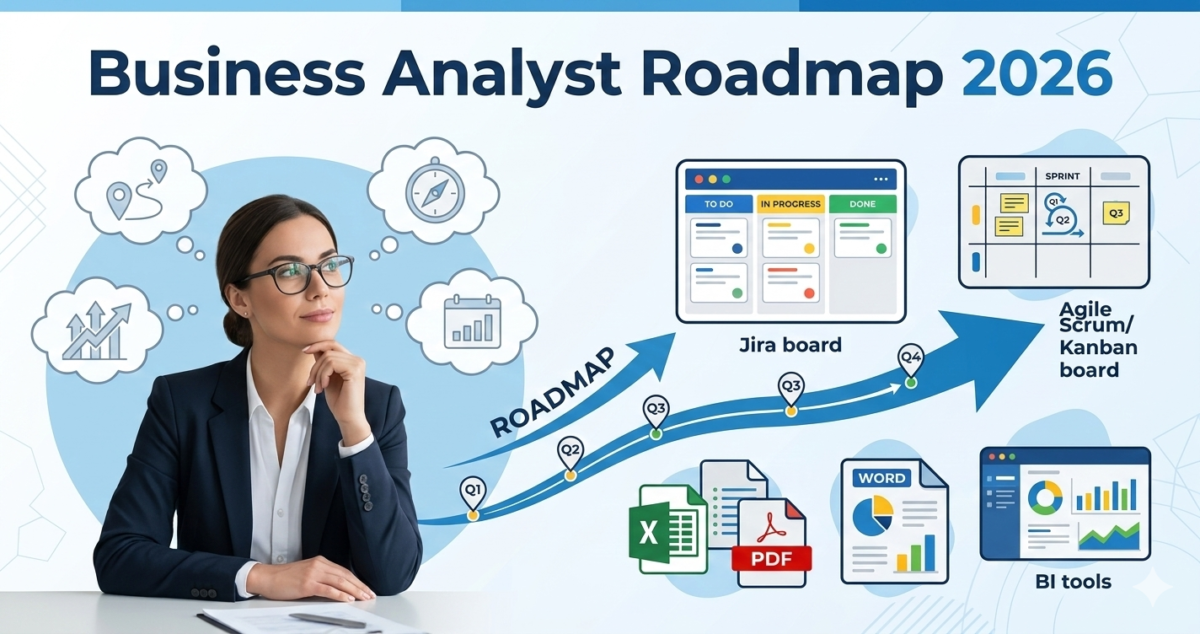
Business Analyst Roadmap 2026 (Complete Beginner Guide)

How to Become a Business Analyst in 2026 – Step by Step Roadmap

Hi friends, do you want to become a Business Analyst in 2026 but don’t know where to start? Business Analyst Roadmap 2026.Β 

Are you confused about skills, certifications, tools, Agile, SQL or whether coding is required to become a business analyst?

In this article we will give you a complete step by step Business Analyst roadmap for 2026, whether you are a fresher or a non-IT professional or already working in IT.

Read till the end because we will also share what not to waste time on, and we will share the important sample documents related to BRD, FRD and Use Case diagrams.

We will share the sample documents at the end and we will also provide answers to important FAQs. On this channel and website we help you build a successful career in Business Analysis with practical guidance, real world examples and structured roadmaps.

Let us break this roadmap into six clear steps.


Step 1: Understand What a Business Analyst Really Does

First, we need to understand that a Business Analyst is not a coder. That means a Business Analyst will not do coding always. It is better to have knowledge of coding, but it is not mandatory for a Business Analyst.

A Business Analyst acts as a bridge between business stakeholders and the technical teams.

That means a Business Analyst understands the business requirements, exactly what requirement is given by the business, and explains that requirement clearly to the internal technical teams.

Here let us understand on which areas we need to concentrate to become a Business Analyst.

Core competencies or core responsibilities of a Business Analyst include:

  • Requirements gathering

  • Writing BRD & FRD

  • Creating user stories

  • Stakeholder communication

  • Process modelling

  • Supporting UAT

Don’t worry about all these terms. We will share the website links where all relevant articles are covered. These articles explain:

  • how to gather requirements

  • how to write BRD and FRD

  • how to create user stories successfully

  • how to do process modelling

  • how to support during UAT

This is Step 1.


Step 2: Learn Business Analysis Concepts

In Step 2, you need to concentrate on Business Analysis concepts.

Here you need to learn about:

  • SDLC

  • Agile

  • Scrum

  • Requirement types

  • Use cases

  • User stories

  • Acceptance criteria

You need to understand and learn these terms clearly.

Documentation skills are also very important because the primary role of a Business Analyst is preparing documents.

A Business Analyst prepares important documents such as:

  • BRD – Business Requirement Document

  • FRD – Functional Requirement Document

  • User Stories

  • RTM – Requirement Traceability Matrix


Tools Business Analysts Need to Learn

Business Analysts should learn some basic tools.

Important tools include:

  • Jira

  • Confluence

  • MS Excel

  • PowerPoint

  • Basic SQL

You need to learn only basic SQL, such as:

  • how to write SELECT queries

  • how to write UPDATE queries

  • how to write DELETE queries

That is more than enough, and it is always good to have knowledge of SQL.


Step 3: Learn Agile Methodology

Now most companies are working on Agile methodology.

So you need to understand and learn about Agile concepts such as:

  • Scrum roles

  • Sprint planning

  • Product backlog

  • Backlog grooming

  • Story estimation

  • UAT support

Understanding Agile is very important for Business Analysts.


Step 4: Build Real Time Projects

This is where most people fail.

Just watching videos will not give practical knowledge. You need to practice creating documents and understanding how to apply the concepts.

Once you understand how to create documents, take sample requirements and try to prepare documents yourself.

If you need sample requirements or sample documents, we can share them.

Here are some practice ideas:

  • Prepare a sample BRD for an e-commerce application

  • Create user stories for a banking application

  • Create a process flow diagram for a hospital system

For example, in a hospital system you can create a workflow starting from patient onboarding until patient discharge.

You can also create a Jira board for practice.


Step 5: Business Analyst Certifications

Certifications are not mandatory, but they can help your career.

If you are interested in certifications, you can consider the following:

  • ECBA – for beginners

  • CCBA – for mid-level professionals

  • CBAP – for experienced professionals

Certifications can help, but skills matter more.


Step 6: Prepare Resume and Start Applying for Jobs

Once you complete the learning process, prepare your resume and start applying for jobs.

Try to apply for at least 5 to 10 jobs per day.

Do not use the same resume for every job. Based on the job description, modify your resume before applying.

You can target roles such as:

  • Junior Business Analyst

  • Business Analyst

  • Functional Consultant

  • Product Analyst

In some companies, Business Analysts are also called Functional Consultants or Product Analysts.

Popular job portals include:

  • Indeed

  • LinkedIn

  • Naukri


What Not to Do in 2026

Now we discussed what to do. Let us also understand what not to do.

  • Do not spend too much time learning coding deeply

  • Do not collect too many certifications

  • Do not wait until you feel 100% ready

  • Do not ignore communication skills


90 Day Action Plan to Become a Business Analyst

Here is a quick 90-day action plan.

Month 1

Focus on Business Analyst fundamentals and practice documentation.

Month 2

Learn Agile methodology and tools, and build two practice projects.

Month 3

Prepare your resume and start applying for jobs.


Final Thoughts

Becoming a Business Analyst in 2026 is absolutely achievable if you follow a structured roadmap.

You do not need luck. You need clarity, consistency, and execution.

If this roadmap helped you, comment β€œRoadmap 2026” and follow for more structured career guidance.

As mentioned earlier, we are also providing useful links in the description to learn more about:

  • Agile

  • Business Analysis skills

  • How to become a Business Analyst

If you are interested, you can go through those resources to improve your knowledge and skills.

If you have any doubts or clarifications, feel free to mention them in the comments so they can be addressed in the next article or video.

Learn more about Agile for Business Analysts

https://www.bacareers.in/agile-methodology-for-business-analysts/

Learn Business Analyst skills

https://www.bacareers.in/soft-skills-for-business-analysts/

How to become a Business Analyst

https://www.bacareers.in/how-to-become-a-business-analyst/

Requirement elicitation techniques

https://www.bacareers.in/effective-requirement-elicitation-techniques/

Is coding required to become a Business Analyst?

No. Coding is not mandatory for Business Analysts. The role mainly focuses on requirement gathering, communication with stakeholders, documentation, and supporting development teams.

Can non-IT professionals become Business Analysts?

Yes. Many professionals from finance, HR, operations, and customer support transition into Business Analyst roles.

What tools should a Business Analyst learn?

Common tools include Excel, Jira, Confluence, PowerPoint, Lucidchart, Visio, and basic SQL.

What is the career path for Business Analysts?

A typical path is Junior Business Analyst β†’ Business Analyst β†’ Senior Business Analyst β†’ Product Owner β†’ Product Manager.

Β 

Is coding required to become a Business Analyst?

No. Coding is not mandatory for Business Analysts. The role mainly focuses on requirement gathering, communication with stakeholders, documentation, and supporting development teams.

Can non-IT professionals become Business Analysts?

Yes. Many professionals from finance, HR, operations, and customer support transition into Business Analyst roles.

What tools should a Business Analyst learn?

Common tools include Excel, Jira, Confluence, PowerPoint, Lucidchart, Visio, and basic SQL.

What is the career path for Business Analysts?

A typical path is Junior Business Analyst β†’ Business Analyst β†’ Senior Business Analyst β†’ Product Owner β†’ Product Manager.

🧭 Top Tools for Modern Business Analysts

business analyst tools 2025

“What if I told you that the secret to becoming a top-tier business analyst isn’t just about your skills, but the powerful tools you wield?”
Forget outdated methods. In this new era of digital transformation, Business Analysts (BAs) are no longer just requirement gatherers β€” they’re strategic enablers. The tools you master today determine your efficiency, insights, and even your career growth tomorrow.

In this article, we’ll explore the top tools every modern Business Analyst must know in 2025, why they matter, and how mastering them keeps you ahead in a rapidly evolving job market.


πŸ”Ή The Evolving BA Landscape & Why Tools Matter

The Business Analyst role has transformed drastically in recent years. With organizations moving towards data-driven decision-making and Agile methodologies, the traditional β€œgeneralist BA” is fast becoming a specialized BA β€” equipped with analytical, visualization, and collaboration tools.

Why this matters:

  • In 2025, companies expect BAs to go beyond documentation.

  • They want professionals who can analyze data, visualize insights, and collaborate seamlessly across distributed teams.

Example scenario:
Imagine a BA working in a fintech startup. Instead of manually collecting requirements through Excel sheets, the BA now uses Jira for Agile sprint management, Power BI for visualizing KPIs, and Confluence to maintain live project documentation. The result? Faster decisions, fewer errors, and complete alignment across teams.

In short, mastering tools is not optional anymore β€” it’s your career security in a competitive landscape.


πŸ”Ή Data Wrangling & Visualization Powerhouses

Data is the new oil, and Business Analysts are its refiners. Modern BAs must know how to extract, clean, and interpret data for actionable insights.

πŸ’‘ 1. SQL – The Foundation of Every Data-Driven BA

Whether you’re working in banking, healthcare, or retail, SQL is non-negotiable. It allows BAs to fetch and analyze raw data directly from databases without relying on developers.

  • Example: A BA in an e-commerce company uses advanced SQL queries to identify why a specific product category’s conversion rate dropped last quarter.

  • Integration Tip: Combine SQL with visualization tools like Power BI or Tableau to present those findings visually.

πŸ’‘ 2. Power BI and Tableau – Visualization with Intelligence

Visualization is storytelling with data.

  • Power BI (by Microsoft) excels in integration with Excel and Azure, offering AI-driven insights and collaborative dashboards.

  • Tableau provides more flexibility in data blending and advanced analytics.
    Both are essential for turning raw numbers into business insights that management can act on.

πŸ’‘ 3. Python – The New Analytical Edge

Python is fast becoming a must-have for BAs who handle complex datasets. Libraries like Pandas, Matplotlib, and Seaborn allow analysts to automate repetitive tasks and perform deeper analysis.

  • Example: A BA automates a monthly sales performance report using Python instead of spending hours in Excel.

πŸ‘‰ For a deeper dive into data analytics for business analysts, visit your detailed guide here:
Data Analysis for Business Analysts – BA Careers


πŸ”Ή Process Mapping & Requirements Management Masters

Understanding business processes and managing requirements remain the BA’s core strengths β€” and the right tools amplify those abilities.

πŸ’‘ 1. Microsoft Visio and Lucidchart – Visual Process Powerhouses

  • Visio helps BAs create detailed process flow diagrams that connect directly with Excel or Power BI.

  • Lucidchart offers cloud-based collaboration, enabling real-time process mapping even across remote teams.

  • Example: During a system migration project, a BA uses Lucidchart to visually represent the β€œas-is” and β€œto-be” workflows for all stakeholders.

πŸ’‘ 2. Jira and Azure DevOps – The Agile Requirement Hubs

These tools go beyond task tracking. They are essential for requirement management, backlog grooming, and tracking development progress.

  • Jira integrates seamlessly with Confluence for documentation.

  • Azure DevOps connects directly with pipelines, helping BAs bridge the gap between requirements and deployment.

  • Example: A BA uses Jira to create user stories and trace them through testing and production in an Agile project.

πŸ’‘ 3. AI-Powered NLP Tools – The Future of Requirement Analysis

Emerging tools now use Natural Language Processing (NLP) to analyze stakeholder emails or chat logs and extract potential requirements automatically.

  • Tools like IBM Watson NLP or GPT-based analysis bots are revolutionizing how BAs interpret unstructured text data.


πŸ”Ή Communication & Collaboration Command Centers

Modern BAs often lead cross-functional, global teams. Hence, mastering collaboration tools is critical.

πŸ’‘ 1. Miro and Mural – The Digital Whiteboards

These are perfect for brainstorming, ideation sessions, and journey mapping with remote stakeholders.

  • Example: A BA conducts a virtual β€œas-is process” workshop on Miro, gathering stakeholder feedback live through sticky notes and diagrams.

πŸ’‘ 2. Microsoft Teams and Slack – Communication Simplified

BAs use these tools for daily syncs, file sharing, and integrated task management.

  • Teams offers direct integration with Microsoft Planner and Power BI.

  • Slack’s new workflow automation features reduce manual updates and follow-ups.

πŸ’‘ 3. Confluence and SharePoint – The Knowledge Hubs

  • Confluence serves as a centralized documentation system, linking directly to Jira.

  • SharePoint supports version control, approvals, and secure storage for business documents.
    These platforms ensure transparency and traceability across the project lifecycle.

πŸ‘‰ Learn more about managing stakeholders effectively here:
Stakeholder Engagement Strategies for Business Analysts – BA Careers


πŸ”Ή AI & Automation: The BA’s New Superpowers

Welcome to the future. Artificial Intelligence and automation are now augmenting the BA’s capabilities like never before.

πŸ’‘ 1. Generative AI Tools – The Analyst’s Assistant

  • Tools like ChatGPT and Google Bard can automate report generation, summarize long documents, or create draft requirements.

  • Example: A BA uses ChatGPT to summarize 50 customer feedback forms into 5 actionable insights β€” saving hours of manual effort.

πŸ’‘ 2. RPA Tools – UiPath and Automation Anywhere

Business Analysts play a critical role in identifying automation opportunities.

  • UiPath and Automation Anywhere help create bots that automate repetitive workflows.

  • The BA documents and validates these processes before automation begins.

πŸ’‘ 3. Future-Proofing Your Career

Continuous learning is key. BAs should explore low-code/no-code platforms like Power Automate and Appian to stay relevant as automation evolves.


πŸ”Ή Conclusion

The modern Business Analyst is a strategic technologist β€” blending analytical thinking with tool mastery.
Whether you’re visualizing data in Power BI, mapping workflows in Lucidchart, or automating reports with AI, these tools elevate your effectiveness, accuracy, and value.

Remember: In 2025 and beyond, it’s not about working harder β€” it’s about working smarter with the right tools.

Related Articles:

The Evolving BA Landscape & Why Tools Matter

πŸ”Ή IIBA (International Institute of Business Analysis) – Official resource for BA certifications, career paths, and standards.
πŸ‘‰ https://www.iiba.org/

πŸ”Ή PMI (Project Management Institute) – Learn how BA tools integrate with project management practices.
πŸ‘‰ https://www.pmi.org/

error

Enjoy this blog? Please spread the word :)