
Get new posts by email:
Powered by follow.it

Business Analyst Career growth Explained: From Junior BA to Product Manager

Business Analyst Career Growth Explained

If you are planning to become a business analyst, you must understand the businessanalyst career growth.

Many people want to become a BA, but one big question always comes up.

  • What happens after you become a BA?

  • What is the career growth for BA?

  • Can we grow in this career path or not?

So let us see what are the roles and what is the career path for business analyst.

Senior roles, product management, and leadership positions are part of this career path.

In this article, I will explain the complete business analyst career path step by step.


business analyst career path

Reality of Business Analyst Career Growth

Most people think the career path looks like this:

Business Analyst β†’ Senior Business Analyst β†’ Done

But the reality is very different.

There are multiple career directions a Business Analyst can grow into.

Let us explore them.


Example Scenario

Let me share a simple example.

Imagine a fresh graduate who joins a company as a Junior Business Analyst.

At the beginning, he works on tasks like:

  • Documenting requirements

  • Assisting senior analysts

  • Attending stakeholder meetings

But as he gains experience, his responsibilities grow and his career path expands into multiple opportunities.


Level 1: Junior Business Analyst (0–2 Years Experience)

Responsibilities

  • Assist senior Business Analysts

  • Document requirements

  • Create simple user stories

  • Participate in meetings

Skills Required

  • Communication

  • Documentation

  • Understanding business needs

This stage is mainly about learning the fundamentals of business analysis.


Level 2: Business Analyst (2–5 Years Experience)

Responsibilities include:

  • Gathering requirements from stakeholders

  • Creating BRD and functional documents

  • Working with developers and testers

  • Analyzing business problems

At this stage, the BA becomes independent and confident.

He handles the requirements end to end, from gathering requirements until delivering the requirement to the client.


Level 3: Senior Business Analyst (5–8 Years Experience)

Responsibilities

  • Lead requirement workshops

  • Manage complex projects

  • Guide junior Business Analysts

  • Work closely with Product Owners

Senior Business Analysts become strategic contributors to the project.


Career Path Direction 1: Product Owner

Some Business Analysts transition into Product Owner roles.

Responsibilities

  • Define product vision

  • Prioritize backlog

  • Work closely with Agile teams

This role focuses on product strategy and decision making.

In upcoming articles, we will cover what Agile is and what teams are involved in Agile meetings.

If you need any clarifications or want to know about any particular topic in Agile, please let us know.


Career Growth Direction 2: Product Manager

Another growth path is Product Management.

Responsibilities

  • Define product roadmap

  • Analyze market needs

  • Drive product growth

This role involves business strategy and innovation.


Career Growth Direction 3: Business Analyst Manager

Some professionals move into leadership roles.

Examples include:

  • BA Manager

  • Head of Business Analysis

Responsibilities

  • Manage BA teams

  • Define analysis standards

  • Guide project strategy


Career Growth Direction 4: Domain Specialist

Some Business Analysts specialize in particular domains like:

  • Banking

  • Healthcare

  • Finance

  • Telecom

  • Insurance

These professionals become domain experts.

In many companies, they are called SMEs (Subject Matter Experts).


Skills Needed to Grow in a BA Career

To grow in the Business Analyst career path, focus on developing these skills:

  • Communication

  • Analytical thinking

  • Stakeholder management

  • Domain knowledge

  • Agile methodology


Final Thoughts

The Business Analyst career path offers many exciting opportunities.

You can grow into:

  • Senior Business Analyst

  • Product Owner

  • Product Manager

  • BA Manager

If you want more articles about:

  • Business Analyst career roadmap

  • Business Analyst salary insights

  • Business Analyst interview preparation

Visit our website:

πŸ‘‰ https://www.bacareers.in

We regularly publish articles explaining Business Analyst careers step by step.

Related Articles :Β 

How to Become a Business Analyst

Business Analyst Skills

Business Analyst Interview Questions

Agile Methodology for Business Analysts

FAQ’s

What is the career path of a Business Analyst?

How long does it take to become a Senior Business Analyst?

Can a Business Analyst become a Product Manager?

What skills are required to grow in a Business Analyst career?

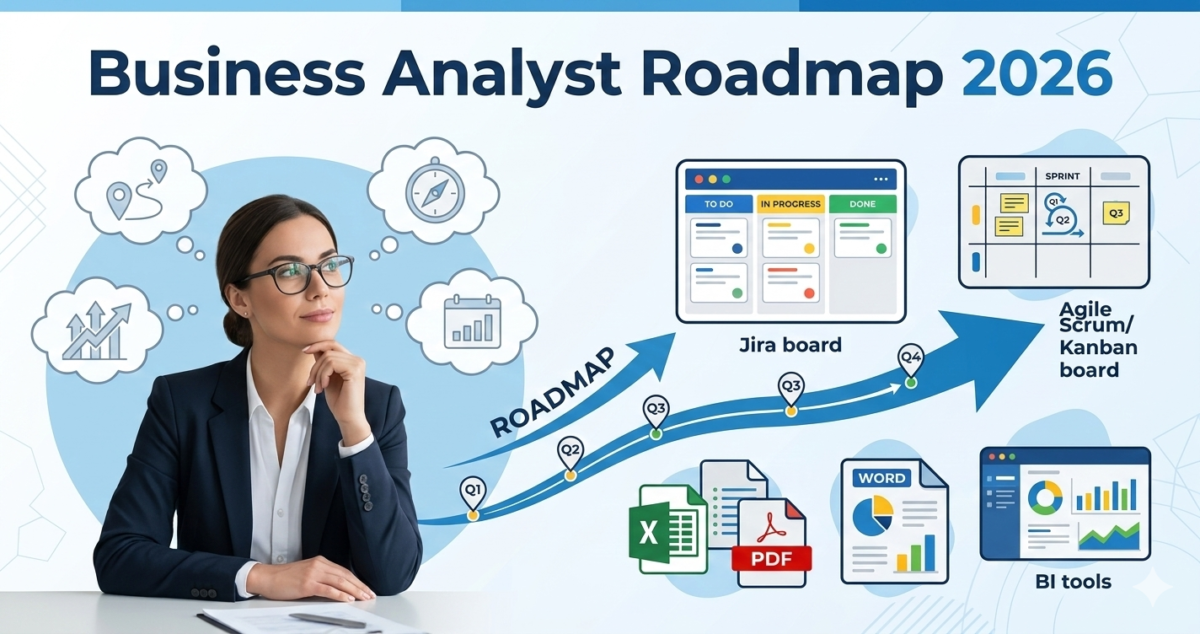
Business Analyst Roadmap 2026 (Complete Beginner Guide)

How to Become a Business Analyst in 2026 – Step by Step Roadmap

Hi friends, do you want to become a Business Analyst in 2026 but don’t know where to start? Business Analyst Roadmap 2026.Β 

Are you confused about skills, certifications, tools, Agile, SQL or whether coding is required to become a business analyst?

In this article we will give you a complete step by step Business Analyst roadmap for 2026, whether you are a fresher or a non-IT professional or already working in IT.

Read till the end because we will also share what not to waste time on, and we will share the important sample documents related to BRD, FRD and Use Case diagrams.

We will share the sample documents at the end and we will also provide answers to important FAQs. On this channel and website we help you build a successful career in Business Analysis with practical guidance, real world examples and structured roadmaps.

Let us break this roadmap into six clear steps.


Step 1: Understand What a Business Analyst Really Does

First, we need to understand that a Business Analyst is not a coder. That means a Business Analyst will not do coding always. It is better to have knowledge of coding, but it is not mandatory for a Business Analyst.

A Business Analyst acts as a bridge between business stakeholders and the technical teams.

That means a Business Analyst understands the business requirements, exactly what requirement is given by the business, and explains that requirement clearly to the internal technical teams.

Here let us understand on which areas we need to concentrate to become a Business Analyst.

Core competencies or core responsibilities of a Business Analyst include:

  • Requirements gathering

  • Writing BRD & FRD

  • Creating user stories

  • Stakeholder communication

  • Process modelling

  • Supporting UAT

Don’t worry about all these terms. We will share the website links where all relevant articles are covered. These articles explain:

  • how to gather requirements

  • how to write BRD and FRD

  • how to create user stories successfully

  • how to do process modelling

  • how to support during UAT

This is Step 1.


Step 2: Learn Business Analysis Concepts

In Step 2, you need to concentrate on Business Analysis concepts.

Here you need to learn about:

  • SDLC

  • Agile

  • Scrum

  • Requirement types

  • Use cases

  • User stories

  • Acceptance criteria

You need to understand and learn these terms clearly.

Documentation skills are also very important because the primary role of a Business Analyst is preparing documents.

A Business Analyst prepares important documents such as:

  • BRD – Business Requirement Document

  • FRD – Functional Requirement Document

  • User Stories

  • RTM – Requirement Traceability Matrix


Tools Business Analysts Need to Learn

Business Analysts should learn some basic tools.

Important tools include:

  • Jira

  • Confluence

  • MS Excel

  • PowerPoint

  • Basic SQL

You need to learn only basic SQL, such as:

  • how to write SELECT queries

  • how to write UPDATE queries

  • how to write DELETE queries

That is more than enough, and it is always good to have knowledge of SQL.


Step 3: Learn Agile Methodology

Now most companies are working on Agile methodology.

So you need to understand and learn about Agile concepts such as:

  • Scrum roles

  • Sprint planning

  • Product backlog

  • Backlog grooming

  • Story estimation

  • UAT support

Understanding Agile is very important for Business Analysts.


Step 4: Build Real Time Projects

This is where most people fail.

Just watching videos will not give practical knowledge. You need to practice creating documents and understanding how to apply the concepts.

Once you understand how to create documents, take sample requirements and try to prepare documents yourself.

If you need sample requirements or sample documents, we can share them.

Here are some practice ideas:

  • Prepare a sample BRD for an e-commerce application

  • Create user stories for a banking application

  • Create a process flow diagram for a hospital system

For example, in a hospital system you can create a workflow starting from patient onboarding until patient discharge.

You can also create a Jira board for practice.


Step 5: Business Analyst Certifications

Certifications are not mandatory, but they can help your career.

If you are interested in certifications, you can consider the following:

  • ECBA – for beginners

  • CCBA – for mid-level professionals

  • CBAP – for experienced professionals

Certifications can help, but skills matter more.


Step 6: Prepare Resume and Start Applying for Jobs

Once you complete the learning process, prepare your resume and start applying for jobs.

Try to apply for at least 5 to 10 jobs per day.

Do not use the same resume for every job. Based on the job description, modify your resume before applying.

You can target roles such as:

  • Junior Business Analyst

  • Business Analyst

  • Functional Consultant

  • Product Analyst

In some companies, Business Analysts are also called Functional Consultants or Product Analysts.

Popular job portals include:

  • Indeed

  • LinkedIn

  • Naukri


What Not to Do in 2026

Now we discussed what to do. Let us also understand what not to do.

  • Do not spend too much time learning coding deeply

  • Do not collect too many certifications

  • Do not wait until you feel 100% ready

  • Do not ignore communication skills


90 Day Action Plan to Become a Business Analyst

Here is a quick 90-day action plan.

Month 1

Focus on Business Analyst fundamentals and practice documentation.

Month 2

Learn Agile methodology and tools, and build two practice projects.

Month 3

Prepare your resume and start applying for jobs.


Final Thoughts

Becoming a Business Analyst in 2026 is absolutely achievable if you follow a structured roadmap.

You do not need luck. You need clarity, consistency, and execution.

If this roadmap helped you, comment β€œRoadmap 2026” and follow for more structured career guidance.

As mentioned earlier, we are also providing useful links in the description to learn more about:

  • Agile

  • Business Analysis skills

  • How to become a Business Analyst

If you are interested, you can go through those resources to improve your knowledge and skills.

If you have any doubts or clarifications, feel free to mention them in the comments so they can be addressed in the next article or video.

Learn more about Agile for Business Analysts

https://www.bacareers.in/agile-methodology-for-business-analysts/

Learn Business Analyst skills

https://www.bacareers.in/soft-skills-for-business-analysts/

How to become a Business Analyst

https://www.bacareers.in/how-to-become-a-business-analyst/

Requirement elicitation techniques

https://www.bacareers.in/effective-requirement-elicitation-techniques/

Is coding required to become a Business Analyst?

No. Coding is not mandatory for Business Analysts. The role mainly focuses on requirement gathering, communication with stakeholders, documentation, and supporting development teams.

Can non-IT professionals become Business Analysts?

Yes. Many professionals from finance, HR, operations, and customer support transition into Business Analyst roles.

What tools should a Business Analyst learn?

Common tools include Excel, Jira, Confluence, PowerPoint, Lucidchart, Visio, and basic SQL.

What is the career path for Business Analysts?

A typical path is Junior Business Analyst β†’ Business Analyst β†’ Senior Business Analyst β†’ Product Owner β†’ Product Manager.

Β 

Is coding required to become a Business Analyst?

No. Coding is not mandatory for Business Analysts. The role mainly focuses on requirement gathering, communication with stakeholders, documentation, and supporting development teams.

Can non-IT professionals become Business Analysts?

Yes. Many professionals from finance, HR, operations, and customer support transition into Business Analyst roles.

What tools should a Business Analyst learn?

Common tools include Excel, Jira, Confluence, PowerPoint, Lucidchart, Visio, and basic SQL.

What is the career path for Business Analysts?

A typical path is Junior Business Analyst β†’ Business Analyst β†’ Senior Business Analyst β†’ Product Owner β†’ Product Manager.

error

Enjoy this blog? Please spread the word :)