

FREE DOWNLOAD: Business Analyst Documentation Toolkit
Get instant access to real-world BRD, FRD, and project story templates used by senior BAs.
Download Free Templates PDFProject Delays? The Single Cause & The Solution
Introduction
By far the biggest culprit behind delays and team conflicts is role confusion. Whenever responsibilities are nebulous, either critical tasks go missing – because everybody assumed someone else was handling them, or far too many people were vying to make decisions about the same activity – which resulted in endless back-and-forths. To tackle this, both project managers and business analysts rely on a primary tool of project governance: the RACI matrix (also called a Responsibility Assignment Matrix). This write-up demonstrates precisely how to create a RACI matrix from scratch to achieve immediate clarity within your team.
What is a RACI Matrix?
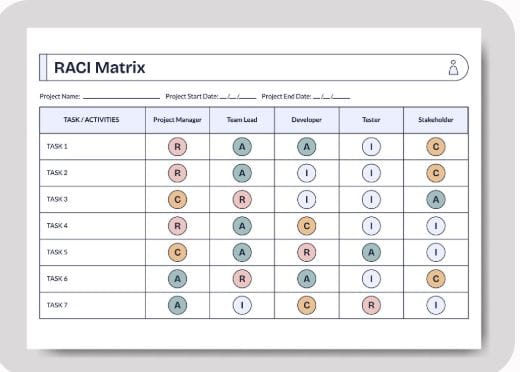
A RACI matrix is an important diagram, or table, that depicts all activities, milestone points, or significant decision factors of a given project, alongside the specific individuals assigned to perform, approve or analyze them.
A RACI matrix guarantees full transparency with regards to job roles and accountability, preventing both duplicated efforts and confusion.
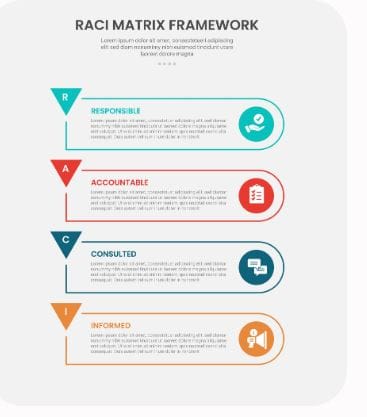
*The Four RACI Levels:
R* stands for Responsible (the one who gets it done).
A* stands for Accountable (the one who owns it).
C* stands for Consulted (those whose advice is required).
I* stands for Informed (those who are notified).
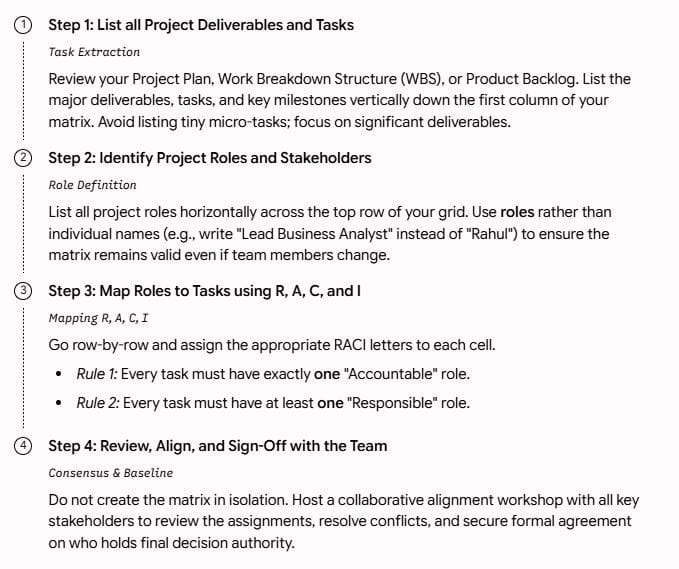
Step-by-Step: How to Create a RACI Matrix
An outlay of your RACI is an uncomplicated investment, which pays large dividends by improving team efficiency. Through upfront defining of bounds and responsibilities, you can guard your team from executive over-involvement, reduce overlapping job roles, and boost task completion.
Frequently Asked Questions (FAQ’s)
Can more than one individual be the “A”?
Absolutely not. This is a key principle in RACI design: each item may only have one “A.” If you allocate more than one “A,” you are dividing accountability and likely creating confusion and conflict later on.
How is a “R” different from an “A”?
A “R” does the legwork – they actively carry out the task. An “A” is responsible for the ultimate output, has the final say in decisions made related to the task and is accountable for the outcome.
Can a person have both a “R” and an “A”?
Yes. On a small team, often the one doing the work is also accountable for the task’s final output and decisions. In such cases, enter A/R in the relevant cell.
Related Articles :
- What is a Requirement Traceability Matrix (RTM) in Software Testing?
- How to Prepare a Requirement Traceability Matrix (RTM) Step-by-Step
- What is a JAD Session? Joint Application Development Guide for BAs
🎁 Become a Better Business Analyst
Join 1,200+ Business Analysts learning every week.
Get instant access to:
📘 FREE Business Analyst Templates
🎯 Interview Preparation Guides
🚀 Agile & Scrum Tutorials
🤖 AI for Business Analysts
📈 Career Growth Tips
100% Free • No Spam • Unsubscribe Anytime
