

FREE DOWNLOAD: Business Analyst Documentation Toolkit
Get instant access to real-world BRD, FRD, and project story templates used by senior BAs.
Download Free Templates PDFIntroduction :
Here’s the Ultimate Sprint Retrospective Guide: (How to be the best version of you, on the next sprint, and the sprint after that) It’s no secret that the foundation of the agile way of life is constant improvement (also known as Kaizen). When a team finds themselves making the very same errors during sprint 10 that they made during sprint 1, they are in fact no longer operating under the guise of agile, and instead are performing waterfall in 2 week chunks. Your Sprint Retrospective is the powerhouse where this vital, continuous improvement occurs.
In this extensive manual, you will learn how to structure, facilitate, and operate your retrospective, so it actually yields positive results.
What’s the Purpose of the Sprint Retrospective?
A Sprint Retrospective is a dedicated ceremony, taking place at the end of each Sprint. It is where the Scrum Team evaluates its work process, procedures, connections and its sprint implementation. The team discusses and determines what transpired well, what can be improved, and which measures it should take within the coming sprint.
This Sprint Retro differs to your Sprint Review in that whereas your review looks externally at the product, your retrospective delves inward at the process your team is utilising in order to produce that product.
Retrospective Formats & Boards for you
The Scrum Master, or the person overseeing the Sprint, should vary and spice up their retrospective. Here are two of the most effective board approaches:
1. “Start-Stop-Continue”
Model Start: What new processes, tools, or habits do you want the team to adopt in the upcoming sprint?
Ex. “start creating acceptance criteria for all API end-points”.
Stop: Which habits, processes or tools create friction and can be discontinued during the next sprint? Ex. “stop interrupting developers in the midst of focused work time”.
Continue: Which practices are currently serving you well, and would you like to maintain going forward?
Ex. “continue to utilise our Slack for fast dependency checks.”
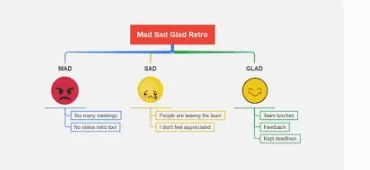
2. “Glad-Sad-Mad” Model
A superb choice for excavating deep-seated emotions and dynamics within your team:
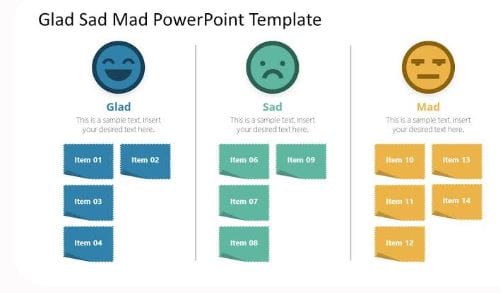
Glad: What did your team find joyful or exciting within the sprint?
Sad: Which areas were a disappointment to the team or did not live up to your expectations?
Mad: What actions or events incited strong feelings of frustration or blocked the team in a significant way?
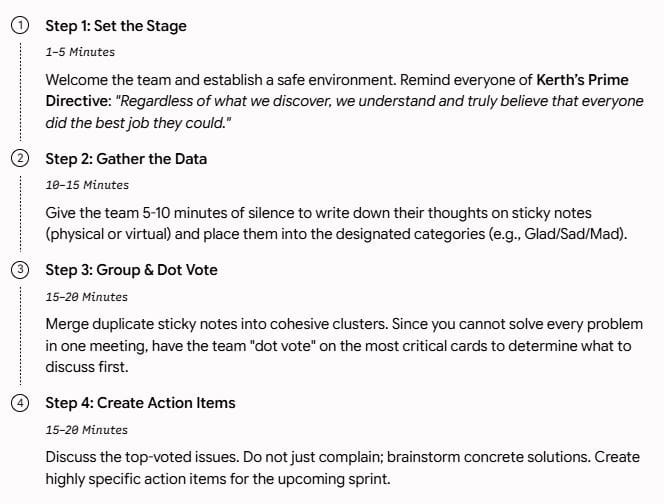
How to facilitate your Sprint Retro – A Step by By-Step
Guide You as the lead Scrum Master or Business Analyst would implement the following agenda when facilitating your retrospective.
The Golden rule of retrospective actions
It is common for a retrospective to fail if it concludes with an action like, “We need to do a better job of communicating.” If you want your team to see significant positive change from your retrospective meetings, all action items must satisfy SMART criteria:
Specific: Precisely what are we going to do?
Measurable: How will we ascertain success?
Assignee: Who is going to own this responsibility? (Don’t use the collective noun ‘the team,’ rather, specify a person.)
Achievable: Can this be accomplished in the upcoming sprint?
WRONG action item: “Be better at code reviews.”
RIGHT action item: “John will update the pull request to ensure it requires at least two approvers before merging into production.”
Conclusion
When run effectively, your Sprint Retro can metamorphose a struggling team into a high-performing one, that can overcome any challenge and perform at its highest level. By consistently allocating a time slot for genuine reflection, learning, and adjustment, your team will gain speed, polish their craft, and develop remarkable resilience over each Sprint.
Frequently Asked Questions FAQs:
Who should participate in a Sprint Retrospective?
All team members: the Developers, Product Owner and Scrum Master.
External participants, including stakeholders or managers, should not be invited because it would deter truthful and open discussion.
How much time should I set aside for the retro?
It is a widely-held standard to allocate a Sprint Retro time frame equal to one hour for every week the sprint covers (e.g., a two-week Sprint needs about 2 hours max for retro).
How to address a non-responsive team?
If team members are hesitant to share their views, consider using anonymous online tools, such as Miro or MetroRetro, allowing individuals to submit thoughts freely without concern of judgment. This will boost engagement levels substantially.
🎁 Become a Better Business Analyst
Join 1,200+ Business Analysts learning every week.
Get instant access to:
📘 FREE Business Analyst Templates
🎯 Interview Preparation Guides
🚀 Agile & Scrum Tutorials
🤖 AI for Business Analysts
📈 Career Growth Tips
100% Free • No Spam • Unsubscribe Anytime
