


What is the Role of Business Analyst
A Business Analyst (BA) acts as a vital bridge between business stakeholders and technical execution teams. The primary role of a Business Analyst is to analyze business processes, identify operational bottlenecks, elicit requirements, and translate business needs into technical specifications that software development teams can execute.
Whether operating in Waterfall, Agile, or hybrid environments, a Business Analyst ensures that software solutions deliver measurable business value, satisfy user expectations, and align with enterprise strategy.
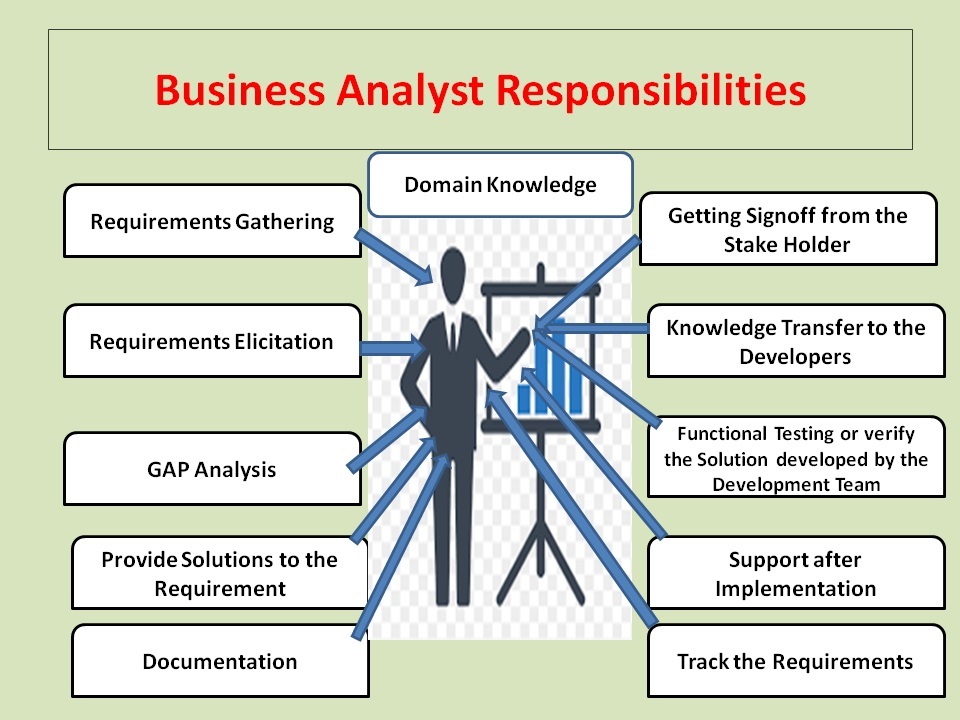
What Does a Business Analyst Do? (Core Definition)
At its core, business analysis is the discipline of identifying business needs and determining solutions to enterprise problems. Solutions often include software system development, process improvements, organizational change, or strategic planning.
A Business Analyst evaluates how an organization functions, interviews key business domain leaders, drafts functional specifications, and guides software development through the entire Software Development Life Cycle (SDLC).
Key Takeaway: A Business Analyst translates ambiguous business goals into structured, actionable software specifications while ensuring communication flows smoothly between non-technical stakeholders and technical teams.
Business Analyst Hub – Deep-Dive Knowledge Areas
| Knowledge Area | Deep-Dive Article | Why It Matters for a Business Analyst |
Requirements Documentation | BRD Full Form and Template | Helps BAs write comprehensive Business Requirements Documents (BRDs) that capture high-level enterprise goals. |
| Difference Between BRD and FRD | Clarifies the distinction between business-level needs and granular functional software specifications. | |
| Documents Prepared by Business Analyst | Provides a master checklist of all core deliverables BAs produce across the entire project lifecycle. | |
| FRD Document in Software Development | Explains how to document detailed functional flows, UI rules, and system behavior for engineering teams. | |
| FRS Full Form in Software Engineering | Details Functional Requirement Specifications and how technical teams use them during construction. | |
Elicitation & Requirements Analysis | Requirement Elicitation Techniques | Teaches BAs active discovery strategies like interviews, workshops, and observation to extract unstated user needs. |
| Business Analyst JAD Session | Guides BAs on facilitating high-alignment Joint Application Development workshops with multi-disciplinary teams. | |
| MoSCoW Prioritization Technique | Shows BAs how to manage project scope and balance stakeholder feature demands using Must, Should, Could, Won’t categories. | |
| 10 Examples of Activity Diagrams | Helps BAs visually map complex, multi-branch business process flows using standard UML notations. | |
Tools & Technical Skills | Tools Used by Business Analysts | Outlines the foundational software toolkit required for wireframing, documentation, data analysis, and modeling. |
| Agile BA Tools with Scenarios | Demonstrates how to leverage Jira, Confluence, Miro, and Figma in modern fast-paced Agile environments. | |
| What is Data Mapping | Teaches BAs how to define field-level data transformations between source and target systems during integrations. | |
| Understanding Domain Knowledge | Explains why mastering industry-specific rules (banking, healthcare, retail) is essential for effective requirement analysis. | |
Agile Frameworks & Execution | BA Role in Product-Based Company | Contrasts the continuous feature delivery focus of product BAs against traditional service-based project consulting. |
| Scrum Roles – Detailed Guide | Details Product Owner, Scrum Master, and Developer responsibilities and how BAs collaborate within Scrum teams. | |
| User Story Example & Guide | Teaches BAs how to write INVEST-compliant user stories accompanied by Given-When-Then acceptance criteria. | |
| Kanban Methodology | Explains continuous delivery, WIP limits, and lead/cycle time management for teams operating outside fixed sprints. | |
| UAT Meaning and Importance | Guides BAs through preparing UAT test plans, helping business users validate features, and obtaining sign-off. | |
| Defect Meaning & Life Cycle | Helps BAs identify software flaws, classify severity vs priority, and manage bugs through resolution. |
Key Responsibilities of a Business Analyst
While specific daily duties vary depending on company size and domain, core Business Analyst responsibilities fall into six primary areas:
Business Analysis Process Flow
| 1. Problem Identification | ➜ | 2. Requirement Elicitation | ➜ | 3. Analysis & Modeling |
|---|---|---|---|---|
| Identify the business problem, opportunity, or need. | Gather requirements from stakeholders. | Analyze requirements and create process/data models. |
| 6. UAT & Implementation | ◀ | 5. Stakeholder Alignment | ◀ | 4. Documentation (BRD/FRD) |
|---|---|---|---|---|
| Support UAT, validate the solution, and assist with implementation. | Review requirements, resolve conflicts, and obtain stakeholder agreement. | Document approved requirements in BRD, FRD, or other relevant artifacts. |
1. Discovering Business Needs & Problem Statement Definition
Conducting gap analysis to contrast current operational states (As-Is) against target future states (To-Be).
Defining clear business objectives, scope boundaries, and success metrics for new software projects.
2. Requirement Elicitation & Gathering
Leading collaborative discovery sessions with Subject Matter Experts (SMEs).
Utilizing structured techniques like interviews, observation, surveys, and facilitated workshops.
Deep Dive: Read our full guide on Requirement Elicitation Techniques to explore top discovery strategies.
3. Requirements Analysis & Visual Modeling
Structuring raw notes into logical business process flows, data models, and workflow diagrams.
Creating visual models using UML diagrams such as Use Case Diagrams and Activity Diagrams.
Deep Dive: See 10 Examples of Activity Diagrams in Software Engineering for practical workflow models.
4. Technical Documentation Preparation
Drafting formal requirement specifications based on project delivery frameworks.
Writing high-level business logic and granular functional rules.
Deep Dive: Learn more about Documents Prepared by a Business Analyst and review our breakdown on BRD vs FRD Differences.
5. Stakeholder Management & Backlog Refinement
Facilitating agreement across competing department priorities.
Prioritizing user stories and business requirements based on value, effort, and business urgency.
Deep Dive: Learn how BAs prioritize features using the MoSCoW Prioritization Technique.
6. Supporting QA, Testing, and User Acceptance
Reviewing QA test scenarios to ensure full test coverage against business requirements.
Assisting end-users during User Acceptance Testing (UAT) to validate system readiness.
Deep Dive: Understand test execution principles in our guide on UAT Meaning and Importance.
The Business Analyst Role Across Delivery Methodologies
The day-to-day functions of a Business Analyst shift depending on whether the project executes via Waterfall, Agile, or Product-Led frameworks:
| Methodology | Primary Role Title | Core Deliverables | Focus Area |
| Waterfall / Traditional | Systems / Business Analyst | BRD, FRD, Traceability Matrix | Upfront, detailed documentation |
| Agile / Scrum | Agile BA / Proxy Product Owner | Epics, User Stories, Acceptance Criteria | Iterative backlog grooming & sprint support |
| Product-Based Company | Product Business Analyst | User journeys, feature roadmaps, metrics | Product adoption, growth, and UX |
Explore Agile Roles: Read about Scrum Roles and the BA Perspective and Business Analyst Roles in Product-Based Companies.
Essential Skills Required for a Business Analyst
To succeed in a modern Business Analyst role, professionals balance technical skills, business acumen, and interpersonal communication:
Hard / Technical Skills
Requirements Management Software: Jira, Azure DevOps (ADO), Confluence.
Process Modeling & Prototyping: Vision, Lucidchart, Miro, Figma, Balsamiq.
Data Analysis & Querying: SQL queries, Data Mapping, Excel pivot tables, Power BI / Tableau.
Deep Dive: Explore the complete suite of Tools Used by Business Analysts and specialized Agile BA Tools.
Soft / Interpersonal Skills
Active Listening & Elicitation: Asking probing questions to uncover unstated requirements.
Negotiation & Conflict Resolution: Aligning differing stakeholder goals amicably.
Critical Thinking: Evaluating root causes rather than applying quick surface fixes.
Real-Time Project Scenario: A Day in the Life of a Business Analyst
Project Background
A retail bank is launching a mobile app feature called “Instant Micro-Loans.”
How the BA Drives the Project Success:
9:00 AM (Discovery): The BA leads a JAD Session with the Risk Compliance Team, Credit Product Manager, and Mobile Lead to define qualification rules.
11:30 AM (Analysis & Documentation): The BA writes User Stories with Given-When-Then Acceptance Criteria in Jira, specifying API response limits for credit scoring checks.
2:00 PM (Data Mapping & Architecture): The BA updates the Data Mapping Document showing how customer application inputs map to backend core banking databases.
4:00 PM (Development Support): During backlog grooming, developers flag a missing edge case (“What happens if credit check services time out?”). The BA logs a requirement update and attaches an updated error flow diagram.
Knowledge Hub Navigation: Explore Key BA Topics
Continue exploring our comprehensive Business Analysis learning portal:
Core Documentation: BRD Full Form | BRD vs FRD Guide
Methodologies & Frameworks: Kanban Methodology | Scrum Framework
Domain Knowledge: Understanding Domain Knowledge in Business Analysis
Frequently Asked Questions (FAQ)
No, coding is generally not required for traditional Business Analyst roles. BAs focus on process modeling, business logic, requirement gathering, and stakeholder management. Basic knowledge of SQL or data querying is helpful but not mandatory.
A Business Analyst focuses primarily on business problems, operational processes, and user needs, whereas a Systems Analyst focuses more heavily on technical architecture, system design, database schemas, and API configurations.
A Product Manager owns product vision, market strategy, pricing, and long-term positioning. A Business Analyst translates that product vision into detailed functional requirements, user stories, and execution specifications for technical development teams.
🎁 Become a Better Business Analyst
Join 1,200+ Business Analysts learning every week.
Get instant access to:
📘 FREE Business Analyst Templates
🎯 Interview Preparation Guides
🚀 Agile & Scrum Tutorials
🤖 AI for Business Analysts
📈 Career Growth Tips
100% Free • No Spam • Unsubscribe Anytime

Good
Thanq
Thank You
Thank You.
Thank you
Thank You.
Thank You.
Thank You.
Thank You.
Thank You.
not required