

Artificial Intelligence is fundamentally transforming the software development lifecycle (SDLC) and how Business Analysts (BAs) gather, analyze, document, and validate requirements. Rather than replacing the BA, AI acts as a force multiplier—automating repetitive administrative tasks so BAs can focus on high-level stakeholder management, strategic problem-solving, and solution design.
From drafting initial Business Requirements Documents (BRDs) to generating test scenarios and user stories, leveraging AI Tools in Business Analysis allows teams to reduce documentation time by up to 40% while improving requirement consistency.

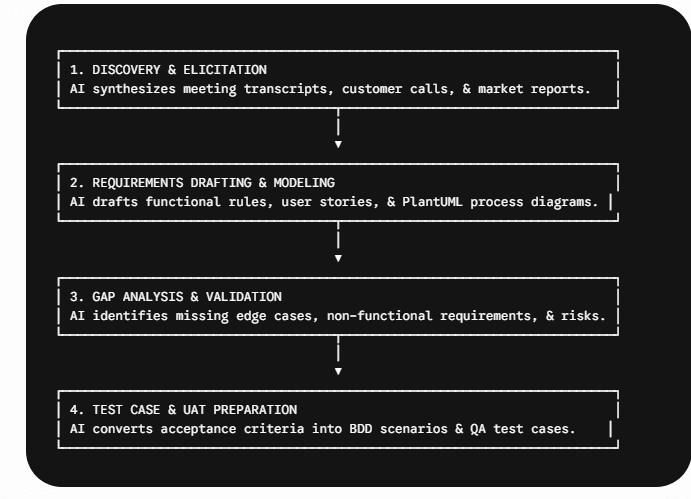
The AI-Assisted Business Analysis Workflow
Top AI Tools for Business Analysts
| Tool / Platform | Primary Category | Best Use Case for Business Analysts |
| ChatGPT (GPT-4o) / Claude 3.5 Sonnet | Generative AI LLMs | Drafting BRDs/FRDs, writing user stories with acceptance criteria, and process flow logic. |
| Microsoft Copilot (365) | Enterprise Productivity | Summarizing stakeholder meetings in Teams, creating PowerPoint decks from spec sheets. |
| Otter.ai / Fireflies.ai | Elicitation & Transcription | Recording stakeholder interviews, auto-extracting action items and key business rules. |
| Miro AI / Whimsical AI | Visual Modeling | Auto-generating flowcharts, activity diagrams, mind maps, and user story maps from text prompts. |
| Jira AI / Confluence AI | Agile & Documentation | Auto-filling acceptance criteria, summarizing long epics, and creating documentation pages. |
Practical Applications Across Core BA Deliverables
1. Automated Elicitation & Meeting Summarization
Instead of spending hours reviewing recorded stakeholder interviews:
Tool: Otter.ai or Fireflies.ai integrated with Teams/Zoom.
Outcome: Converts 60-minute raw transcripts into structured lists of business needs, constraints, and stakeholder decisions.
2. Writing User Stories with Acceptance Criteria
BAs can use Generative AI to generate structured INVEST-compliant user stories accompanied by Given-When-Then (Gherkin syntax) scenarios.
Tested BA Prompt Template:
“Act as a Senior Business Analyst. I am building an e-commerce checkout system. Write a user story for a logged-in customer applying a promotional discount code during checkout. Include 3 acceptance criteria using Gherkin format (Given-When-Then), including one failure edge case (e.g., expired coupon).”
Deep Dive: Learn how to structure user stories manually in our guide on User Story Examples and Acceptance Criteria.
3. Gap Analysis & Edge Case Identification
AI excels at finding logic gaps that humans might overlook in complex system flows.
Input: Paste your draft functional specification into an LLM.
Prompt: “Review the following payment flow logic. List 5 potential edge cases, security risks, or unhandled system exceptions that are missing from this specification.”
4. Diagram & Process Flow Generation
BAs can ask LLMs to generate PlantUML or Mermaid.js code, which renders instantly into visual process diagrams in tools like Draw.io or Miro.
Deep Dive: Explore visual modeling patterns in 10 Examples of Activity Diagrams in Software Engineering.
Critical Limitations & Ethical AI Guidelines for BAs
While AI tools offer immense speed, BAs must maintain human oversight:
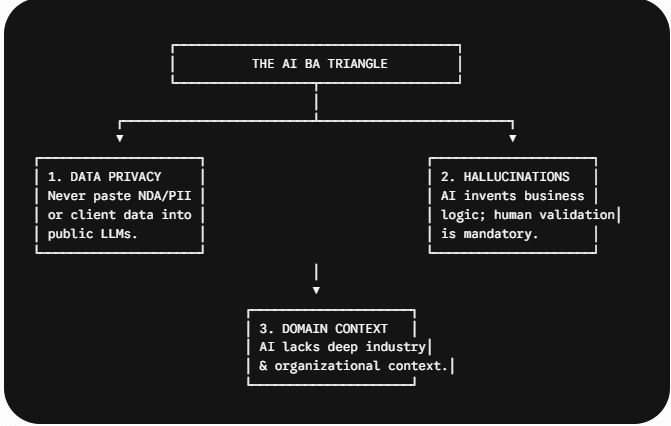
Data Privacy & Compliance (No PII): Never upload client confidential data, enterprise source code, or personally identifiable information (PII) into public AI models.
Hallucination Risk: Generative AI can state incorrect business rules with high confidence. BAs must fact-check all output before presenting to engineering teams.
Lack of Domain Context: AI lacks institutional memory, corporate politics awareness, and deep regulatory nuances. Human SME verification remains irreplaceable.
Deep Dive: Read why domain understanding is vital in Understanding Domain Knowledge.
Real-Time Scenario: Using AI to Accelerate a Banking Feature Rollout
1. Background & Context
A Business Analyst at a retail bank was tasked with defining requirements for an Instant Personal Loan Approval feature within the mobile banking app. The project had a tight deadline of 2 weeks for initial discovery and documentation.
2. AI-Assisted BA Execution Workflow
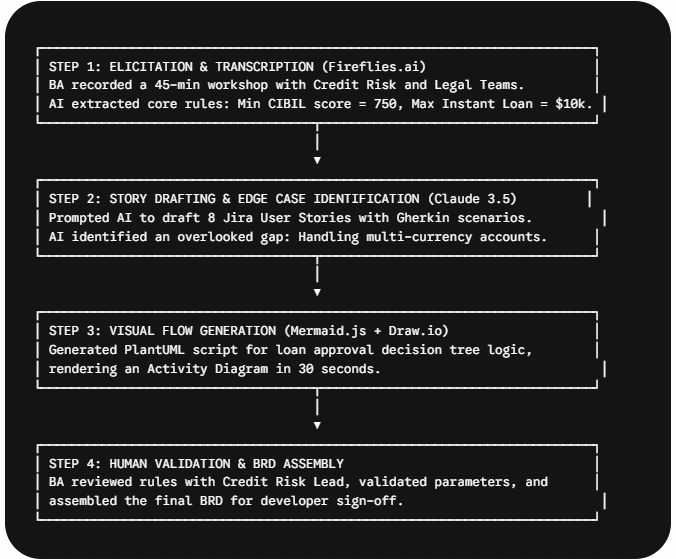
3. Measurable Outcome
Documentation preparation time was reduced from 10 business days down to 3 days, allowing the project to enter the initial sprint early with zero missing compliance requirements.
AI Tools & BA Core Competencies – Knowledge Hub
Below is the structured Knowledge Area matrix connecting AI workflows, business analysis deliverables, and SDLC frameworks:
| Knowledge Area | Deep-Dive Article | Why It Matters for a Business Analyst |
| Requirements Documentation | BRD Full Form and Template | Master the core structural framework when prompting AI to draft BRDs. |
| Difference Between BRD and FRD | Learn how to guide AI models to separate business needs from technical specs. | |
| Documents Prepared by Business Analyst | Comprehensive inventory of deliverables BAs can streamline using AI workflows. | |
| Domain & Strategy | Understanding Domain Knowledge | Why human domain expertise is critical to validate and correct AI-generated output. |
| Business Analyst Role in Product Companies | How product BAs leverage AI analytics to refine product backlogs and features. | |
| Agile & Execution | User Story Example & Acceptance Criteria | Benchmark manual user story quality against AI-generated user stories. |
| Agile BA Tools with Scenarios | Integrating native AI tools across Jira, Confluence, Miro, and Figma. | |
| Elicitation & Validation | Requirement Elicitation Techniques | Combining traditional stakeholder techniques with automated transcription AI. |
| UAT Meaning and Importance | Using AI to generate test scripts and validate business outcomes during UAT. |
Related Articles
- Internal Links:
- Learn more about Business Process Modeling Techniques.
- Explore Agile Methodology for Business Analysts.
- External Links:
- Check out Google AI for AI-powered tools.
- Discover IBM Watson for AI-driven business insights.
Conclusion
AI is reshaping business analysis by automating tasks, improving efficiency, and providing data-driven insights. By leveraging AI-powered tools, business analysts can make informed decisions, optimize processes, and stay ahead in the competitive landscape. Investing in AI courses and certifications will help professionals upskill and advance in their careers.
Do you use AI in business analysis? Share your thoughts in the comments below!
Frequently Asked Questions (FAQ)
No. AI automates task execution (drafting, formatting, transcription), but cannot replace human critical thinking, stakeholder negotiations, empathy, or strategic decision-making.
Claude 3.5 Sonnet and ChatGPT (GPT-4o) are currently top-tier for drafting long-form BRD sections, structured user stories, and Gherkin acceptance criteria due to their strong contextual reasoning.
🎁 Become a Better Business Analyst
Join 1,200+ Business Analysts learning every week.
Get instant access to:
📘 FREE Business Analyst Templates
🎯 Interview Preparation Guides
🚀 Agile & Scrum Tutorials
🤖 AI for Business Analysts
📈 Career Growth Tips
100% Free • No Spam • Unsubscribe Anytime
