

How to Write a Banking BRD: Templates, Examples & Functional Rules
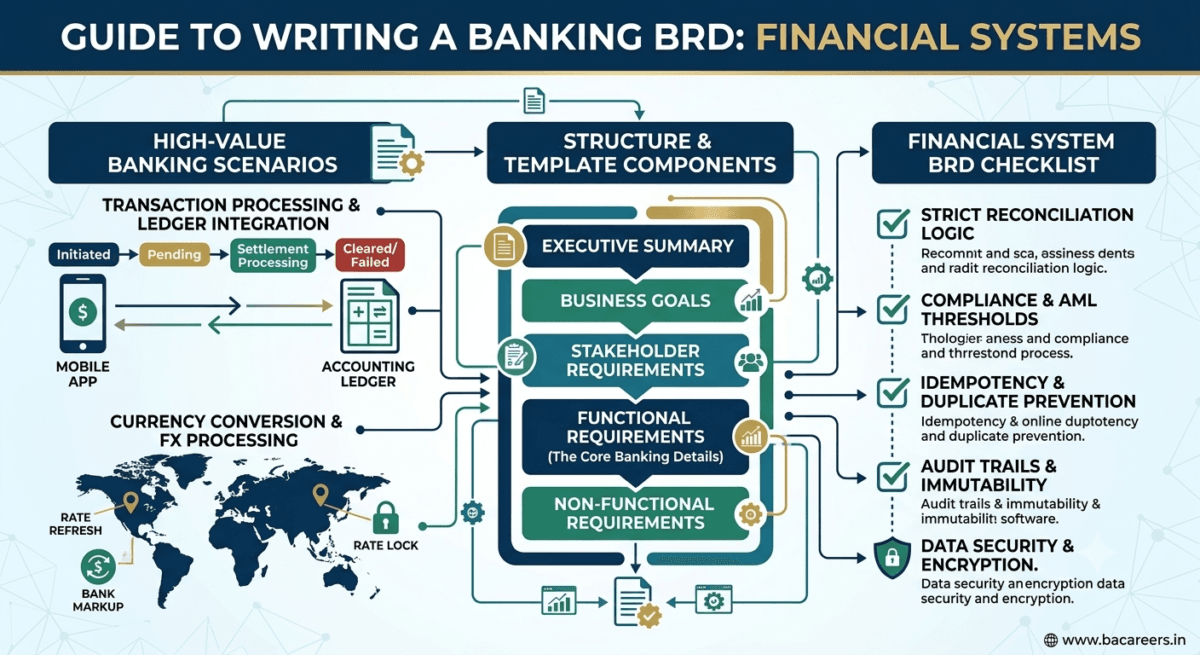
Writing a Banking Business Requirements Document (BRD) for financial software requires an attention to detail that goes way beyond any general business analysis. In banking, a faulty requirement doesn’t just cause software bugs; it leads to compliance failure, security breaches or, worse, large scale reconciliation issues. Below we outline the structure for a professional banking BRD with a practical financial software scenario in mind.
High-value Banking Scenarios for Your BRD
When preparing requirements for a banking platform, such as an International Remittance System, or a Peer-to-Peer Payment App, your BRD will need to cleanly explain the full operation architecture:
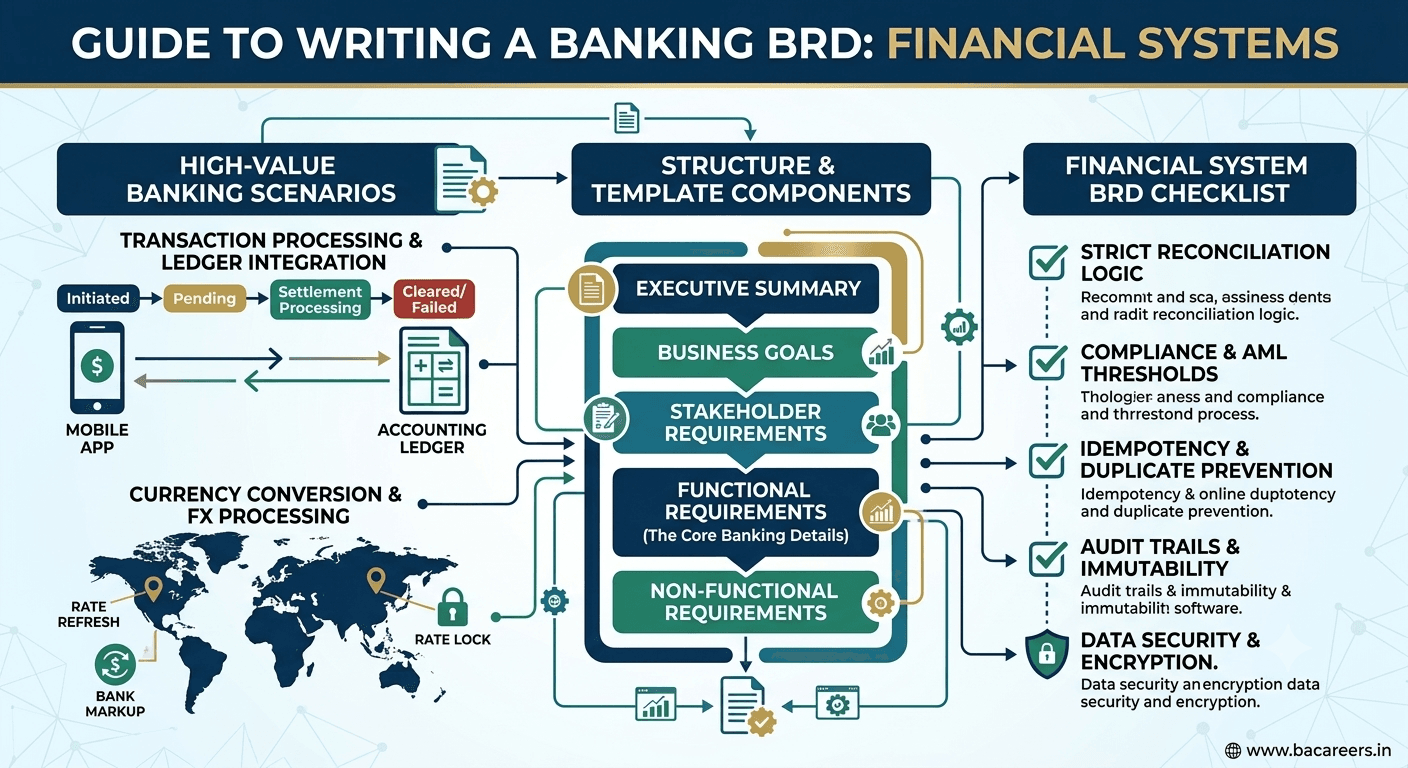
- Transaction Processing and Ledger Integration: Explain the exact business rules for processing payments in real-time, including the exact states of a transaction lifecycle (e.g., initiated, pending, settlement, cleared, failed), and how the system will talk to core ledgers for double entry accounting.
- Currency Conversion and FX Processing: International remittances will require exact details of how the app accesses the latest FX rates from live FX providers. Details on refresh rates, the percentage markup added by the bank, and a reasonable buffer for the user to lock in FX before the rate expires are crucial.
- Financial System BRD Checklist: Below are some key operational boundaries that you must cover within your functional sections:
- Exact Reconciliation Logic: Mandate the end-of-day process for reconciliation between the application ledgers and the external clearing network and define the exact procedure for handling discrepancies.
- Compliance and AML Thresholds: Define exact FX thresholds for a transaction to be passed onto manual AML compliance checks. Specify necessary data fields for compliance such as Purpose Codes for international remittances.
- Idempotency and Duplicate Prevention: Define API behaviours, for example, that regardless of a user pressing the ‘pay’ button more than once due to slow internet, the system processes the transaction exactly once.
I want to discuss about what is a BRD and how to prepare BRD?
Topics Covered
- What is a BRD or Business Requirements Document?
- Who will prepare the BRD and who is Responsible for BRD?
- Objectives of a business requirement document?
- Business Requirements Document- Key elements
- How to prepare BRD?
- Business Requirement Document Template – Sample Template.
- Tips for writing a business requirements document?
1.What is a BRD or Business Requirements Document?
BRD is a Business Requirement Document, in some organizations it is also called as Business Requirements Specifications Document. By seeing the name we can understand in this document we will capture all the requirements and how we are going to provide solution to the client. We can say it is the communication document between Business and Technical Team.
In simple words we can say, BRD indicates what the business wants to achieve. The BRD indicates all the project deliverable and the inputs and outputs associated with each process function. This document will have customer needs and expectations.
BRD definition: “A Business Requirement Document (BRD) focuses on the business perspective as it holds the details of the business solution for a project.”
2.Who will prepare the BRD and who is Responsible for BRD?
Business Analyst prepares this document with the help of respective stakeholders. While creating Business requirements document, we should include the project stake holders, and the Business stake holders, that means we should invite or include all the stake holders who are needed to complete this project smoothly.
In some organizations client prepares the BRD and share with IT organization to deliver their changes or requirements, once IT team receives the BRD then they will do the feasibility analysis and release FSD or FRD based on the BRD.
Who should be involved in business requirements document creation?
A number of teams and partners should create the BRD:
- Core team of the project (BA, Development Team, QA and all)
- Business partner’s or stake holders
- Process owner(s) or representatives
- Subject matter experts
- Change/project/product management, quality department and/or IT management as needed or available
- Change Management Team.
3. Objectives of a business requirement document?
- To get an agreement and common understanding among all the stakeholders
- Communicate to the technology server provider, the business needs, the customer needs, and what the solution needs to provide to satisfy business and customer needs
- Describe in details of the customer needs or requirements.
- Describe clearly what solution we are going to provide.
4.Business Requirements Document- Key elements
A Business Analyst or Project Manager prepares the Business Requirement Document as they have good understanding on the client requirements and if there is any ambiguity or clarification required from client, then they are the persons can reach the Business stake holders.
The most important and critical component of a Business Requirement Document is the scope of the project. We (Project Managers and Business Analysts) should understand the restrictions and constraints.
- Why project initiated
- What is the goal or objective of the project?
- What are the problems which the business wants to solve?
- What are the restrictions?
- What are the limitations?
- Is it worth to invest the time and money required for the project?
5.How to prepare / Business Requirement Document BRD?
We should take care of few important things before creating BRD.
- We should define the need or requirement of the company or organizations.
- We should ensure all the stake holders involved.
- We should identify the phases of the project.
- We can use a suitable template to capture the requirements.
6. Business Requirement Document Template – Sample Template.
- Document revision
- Approvals
- Introduction
- Business goals and objectives
- Stake holders
- Business rules
- Project background
- Project objective
- Project scope
- In-scope functionality (Requirements)
- Out-scope functionality (Requirements)
- Business requirements
- Data requirements
- Functional requirements
- Non_functional requirements
- Assumptions
- Constraints
- Risks
- Business process overview (modeling diagrams for instance, Use Case and Activity Diagram)
- Legacy systems
- Proposed recommendations
- List of acronyms
- Glossary of terms
- Related documents
- Dependencies of existing systems
This document may vary depends on the organizations, some organizations may have their own template and format. If no standard template or format not available in your organization then you can use the suitable template as per your client requirements.
7.Tips for writing a business requirements document
Here I am trying to give some simple tips to write Business Requirement Document.
- Engage stakeholders:Encourage all the project stakeholders to get involved in elicitation techniques such as brainstorming, surveys, focus groups, interviews, and ideas for prototyping.
- Include mockups:Include visuals and graphical representations, such as charts and diagrams, when necessary, as they can be powerful in making your point. We can use so many open source tools to draw diagrams and to create process flow diagrams and charts.
- Do feasibility research:Research some of the past projects to determine the feasibility of your BRD. Evaluate your project to understand whether the solution desired can be developed within the constraints of time & cost.
- Use Simple Language:Don’t use complex words rather use simple easy to understand language that encourages action.
- Validate the Document and contents:After writing the business requirements document, have it reviewed thoroughly before distribution. Obtain validation of the information and the contents–including the assumptions–and ensure that all errors are corrected.
8. What are the differcnes between BRD and FRD?
Answer: While a standard BRD covers broader business requirements, a Banking BRD delves into intricate details including financial compliance, double-entry accounting, end-of-day reconciliation processes, and robust transaction state management within the core business rules.
Answer: Idempotency ensures that a transaction, even if submitted multiple times by a user due to a network issue, is processed by the system only once. This is vital for preventing duplicate debits in banking systems and ensuring transaction accuracy.
Answer: Business Analysts document this by detailing the specific international regulations, the thresholds that trigger compliance checks, and the data requirements for regulatory reporting. This includes specifying required fields, the origin and destination countries of funds, and compliance with sanctions screening.
🎁 Become a Better Business Analyst
Join 1,200+ Business Analysts learning every week.
Get instant access to:
📘 FREE Business Analyst Templates
🎯 Interview Preparation Guides
🚀 Agile & Scrum Tutorials
🤖 AI for Business Analysts
📈 Career Growth Tips
100% Free • No Spam • Unsubscribe Anytime

