
FREE DOWNLOAD: Business Analyst Documentation Toolkit
Get instant access to real-world BRD, FRD, and project story templates used by senior BAs.
Download Free Templates PDFWho is Project Manager?
Introduction
Every organization undertakes projects to achieve specific business goals. These projects may involve developing software, launching a new product, improving business processes, implementing a banking system or upgrading an existing application.
But who makes sure that the project is properly planned, coordinated and delivered? This is where a Project Manager (PM) plays an important role.
A Project Manager is responsible for leading a project team, coordinating activities, managing resources and monitoring project progress. The primary objective is to help the team achieve the agreed project goals within the approved scope, schedule, budget and quality expectations.
In this article, we will understand who a Project Manager is, what they do, their responsibilities, essential skills and how their role differs from that of a Business Analyst.
1. Who Is a Project Manager?
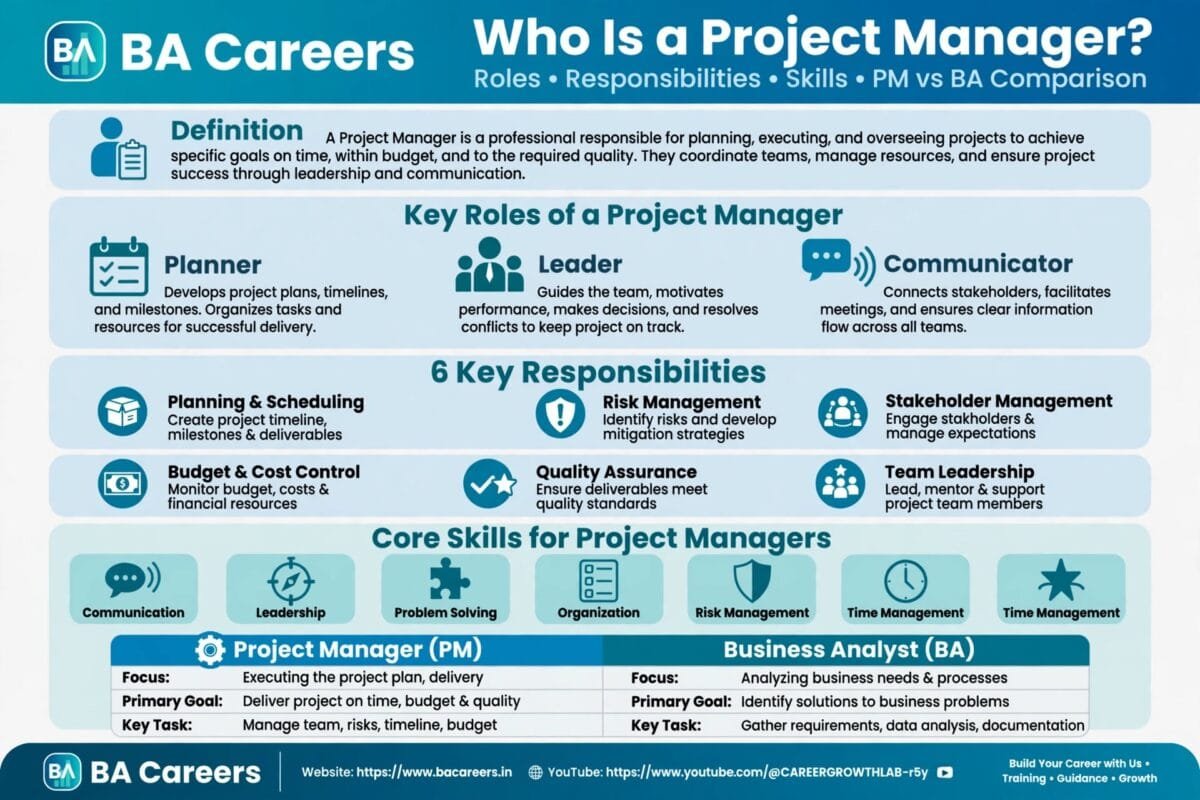
A Project Manager is a professional assigned by an organization to lead a project and guide the team towards achieving its objectives.
The Project Manager coordinates people, processes, resources and activities throughout the project lifecycle. They work with stakeholders, team members, clients, vendors and senior management to ensure that project activities remain aligned with business expectations.
According to the Project Management Institute (PMI), a Project Manager is responsible for leading the team that works towards achieving project objectives.
A Project Manager does not necessarily perform every project task personally. Instead, they coordinate the people responsible for completing those tasks and help resolve issues that may affect project delivery.
Example:
Imagine a bank wants to introduce a mobile banking application. The project requires Business Analysts, developers, testers, UI/UX designers, security specialists and banking operations teams.
The Project Manager coordinates these teams, prepares the project plan, monitors progress, manages risks and communicates project status to stakeholders.
The Business Analyst focuses on understanding and documenting business requirements, while the Project Manager coordinates the overall project delivery.
2. What Does a Project Manager Do?
A Project Manager performs several activities to ensure that a project progresses according to its objectives and approved plans.
The responsibilities may vary depending on the project size, industry, organization and delivery methodology.
Some common activities include:
Understanding project objectives and expected outcomes.
Defining project scope and major deliverables with relevant stakeholders.
Preparing project schedules and coordinating activities.
Identifying the resources required for project execution.
Assigning responsibilities and coordinating team members.
Monitoring project progress and delivery milestones.
Identifying and managing project risks and issues.
Communicating project status to stakeholders.
Managing changes that may affect project scope, time or cost.
Coordinating project closure and documenting lessons learned.
The Project Manager works closely with different teams to identify potential problems early and take appropriate action.
3. Roles and Responsibilities of a Project Manager
The Project Manager’s responsibilities extend across different stages of the project lifecycle.
3.1 Project Planning
Project planning is one of the most important responsibilities of a Project Manager.
The Project Manager works with stakeholders and team leads to understand project objectives, scope, timelines, dependencies and resource requirements.
Typical planning activities include:
Defining project milestones and deliverables.
Preparing project schedules.
Estimating project costs and resources.
Identifying dependencies between activities.
Establishing communication and reporting processes.
Preparing project management plans.
A well-prepared project plan provides direction to the team and helps stakeholders understand how the project will be executed.
3.2 Team Management and Coordination
A Project Manager coordinates different individuals and teams working on the project.
They ensure that team members understand their responsibilities and have the information required to complete their activities.
For example, in a software development project, the Project Manager may coordinate the Business Analyst, development team, testing team and deployment team.
They also help resolve coordination issues and escalate problems when necessary.
3.3 Project Schedule Management
The Project Manager monitors project activities against the agreed schedule.
They track milestones, identify delays and coordinate corrective actions when project activities fall behind schedule.
For example, if development is delayed because the requirements are incomplete, the Project Manager may coordinate discussions between the Business Analyst and development team to resolve the dependency.
3.4 Budget and Resource Management
Every project operates within certain resource and financial constraints.
The Project Manager coordinates resource allocation and monitors project expenditure against the approved budget.
Responsibilities may include:
Identifying resource requirements.
Coordinating team availability.
Monitoring project costs.
Managing resource conflicts.
Escalating budget-related concerns.
Supporting financial reporting.
The level of financial authority depends on the organization’s project governance structure.
3.5 Risk and Issue Management
Projects may encounter unexpected challenges during execution.
A Project Manager identifies potential risks, evaluates their impact and coordinates appropriate responses.
For example, a banking application project may face delays because an external payment gateway integration is not ready.
The Project Manager works with the relevant teams to understand the impact, identify alternatives and communicate the issue to stakeholders.
3.6 Stakeholder Communication
A Project Manager communicates with internal and external stakeholders to maintain a common understanding of project progress.
They may conduct project status meetings, share progress reports, discuss risks and escalate decisions requiring management attention.
Effective communication helps stakeholders understand project achievements, challenges and upcoming activities.
3.7 Quality and Delivery Coordination
The Project Manager coordinates activities to ensure that project deliverables meet agreed acceptance criteria and quality expectations.
They work with Business Analysts, developers, testers and business stakeholders to monitor delivery readiness.
However, the Project Manager does not personally perform every quality assurance activity. Specialist teams remain responsible for their respective technical and business validations.
3.8 Project Closure
Once the agreed project deliverables are completed, the Project Manager coordinates project closure.
Typical activities include:
Confirming deliverable acceptance.
Completing outstanding project activities.
Obtaining relevant stakeholder approvals.
Closing contracts and administrative activities where applicable.
Documenting lessons learned.
Transitioning deliverables to operations or support teams.
Project closure helps ensure that responsibilities are transferred properly and important project knowledge is retained.
4. What Are the Skills Required to Become a Good Project Manager?
A successful Project Manager needs a combination of leadership, communication, organizational and problem-solving skills.
The following skills are particularly important.
4.1 Leadership Skills
A Project Manager should be able to guide and motivate team members towards achieving common project objectives.
Leadership also involves helping teams overcome challenges, resolving conflicts and encouraging collaboration.
4.2 Communication Skills
Project Managers communicate with stakeholders, team members, clients and senior management.
They should be able to explain project status, discuss issues, communicate expectations and facilitate decisions clearly.
4.3 Planning and Organizational Skills
Project Managers must organize activities, manage priorities and coordinate multiple dependencies.
Good planning helps teams understand what needs to be completed, who is responsible and when activities are expected to finish.
4.4 Problem-Solving Skills
Unexpected problems can arise at any stage of a project.
A Project Manager should evaluate the situation, understand its impact and coordinate practical solutions with the relevant stakeholders.
4.5 Risk Management Skills
Identifying risks before they become major issues is an important project management capability.
Project Managers should understand how to assess risks, prioritize them and coordinate appropriate mitigation plans.
4.6 Negotiation and Conflict Management
Different stakeholders may have different priorities and expectations.
A Project Manager should facilitate discussions, manage disagreements and help stakeholders reach workable decisions.
4.7 Time Management
Project Managers handle multiple activities, meetings and decisions.
Effective time management helps them prioritize important tasks and maintain focus on project milestones.
4.8 Adaptability
Project priorities, requirements and business conditions may change during project execution.
A good Project Manager should adapt to changing circumstances while maintaining alignment with the project’s objectives and governance.
5. What Are the Different Types of Project Managers?
Project Managers work across different industries. Their responsibilities depend on the type of project and the business domain.
Some common types include:
| Type of Project Manager | Main Responsibilities |
|---|---|
| IT Project Manager | Coordinates software development, infrastructure and technology projects. |
| Construction Project Manager | Manages construction schedules, contractors, materials and site activities. |
| Banking Project Manager | Coordinates banking transformation, digital banking and financial technology projects. |
| Marketing Project Manager | Manages marketing campaigns, schedules, budgets and creative deliverables. |
| Product Development Project Manager | Coordinates activities involved in developing and launching products. |
| Business Transformation Project Manager | Leads projects involving business process changes and organizational improvements. |
| Infrastructure Project Manager | Coordinates network, cloud, hardware and infrastructure implementation projects. |
A Project Manager may specialize in one industry or manage projects across different business domains, depending on their experience and expertise.
6. What Is the Difference Between a Project Manager and a Business Analyst?
This is a common question, particularly among people who are starting a Business Analyst career.
A Project Manager and a Business Analyst work closely together, but their primary responsibilities are different.
The Project Manager focuses on coordinating project delivery, while the Business Analyst focuses on understanding business needs and defining requirements for the solution.
Business Analyst Responsibilities
| Area | Project Manager | Business Analyst |
|---|---|---|
| Primary focus | Project delivery | Business needs and requirements |
| Main objective | Achieve project objectives | Ensure the solution addresses business needs |
| Planning | Coordinates project planning | Supports requirements and analysis planning |
| Requirements | Ensures requirements activities are coordinated | Elicits, analyses and documents requirements |
| Stakeholders | Manages overall project communication and engagement | Works with stakeholders to understand business needs |
| Schedule | Monitors project timelines and milestones | Supports analysis activities and requirement-related dependencies |
| Risks | Coordinates overall project risk management | Identifies and analyses business and requirements-related risks |
| Documentation | Maintains or coordinates project management documents | Prepares BRDs, FRDs, user stories and process models as required |
| Testing | Coordinates delivery and testing activities | Supports requirement validation and UAT |
| Success measure | Achievement of project objectives | Alignment of the solution with business needs |
Example: Project Manager and Business Analyst in a Banking Project
Imagine a bank wants to implement a digital account-opening facility.
The Business Analyst interacts with business users, understands the existing account-opening process, gathers requirements and prepares functional documentation.
The Project Manager coordinates the project schedule, resources, development activities, testing milestones and stakeholder communication.
Both professionals collaborate to ensure that the banking solution meets business expectations and is delivered successfully.
Important: The roles may overlap in smaller organizations or projects. Their exact responsibilities depend on organizational structure and project governance.
You can also read our guide on Business Analyst Roles and Responsibilities to understand the Business Analyst role in more detail.
7. What Are the Different Project Management Methodologies?
Project Managers use different methodologies and approaches depending on the project environment, requirements, complexity and organizational practices.
Some commonly used approaches include:
7.1 Waterfall Methodology
Waterfall is a sequential project delivery approach in which activities are generally organized into defined phases.
A typical software project may include requirements, design, development, testing, deployment and maintenance.
The Project Manager coordinates phase completion, dependencies, approvals and project progress.
7.2 Agile Methodology
Agile is an iterative approach that emphasizes collaboration, feedback and delivering work in smaller increments.
Project Managers working in Agile environments may coordinate planning, dependencies, stakeholder communication and impediment resolution.
In Scrum, the Scrum Master is a distinct accountability responsible for establishing Scrum and supporting Scrum effectiveness. The Project Manager title does not automatically make someone the Scrum Master.
7.3 Hybrid Project Management
Hybrid project management combines practices from traditional and Agile approaches.
For example, an organization may use structured budget approvals and milestone planning while delivering software features through Agile iterations.
The Project Manager helps coordinate both governance requirements and iterative delivery activities.
8. What Documents Does a Project Manager Prepare?
Project Managers prepare or coordinate different documents to plan, monitor and control project activities.
Common project management documents include:
| Document | Purpose |
|---|---|
| Project Charter | Defines project purpose, objectives and high-level authorization. |
| Project Management Plan | Explains how the project will be executed, monitored and controlled. |
| Project Schedule | Shows planned activities, durations, dependencies and milestones. |
| Work Breakdown Structure (WBS) | Breaks project scope into manageable components. |
| Risk Register | Records identified risks, their impact and planned responses. |
| Issue Log | Tracks current project issues and their resolution status. |
| Status Report | Communicates project progress, achievements and concerns. |
| Communication Plan | Defines how project information will be shared with stakeholders. |
| Change Log | Records changes and their approval or implementation status. |
| Lessons Learned Register | Captures knowledge and improvements from project activities. |
The specific documents depend on the project methodology, organization and governance requirements.
9. Which Tools Does a Project Manager Use?
Project Managers use different tools to plan activities, monitor progress, manage communication and track project deliverables.
Some commonly used tools include:
Microsoft Project: Used for project scheduling, dependencies and resource planning.
Jira: Used to manage work items, backlogs, sprints and project progress.
Trello: Used for visual task management and workflow tracking.
Microsoft Excel: Used for project trackers, reports, budgets and risk registers.
Microsoft Teams: Used for team communication and collaboration.
Asana: Used for task coordination and project tracking.
Monday.com: Used for work management and project coordination.
The choice of tools depends on the organization’s working practices, project complexity and delivery methodology.
10. How Does a Project Manager Work in a Software Development Project?
Let’s understand the Project Manager’s role through a practical example.
Imagine an organization wants to develop an online loan application system for its customers.
The project may involve the following activities:
| Project Stage | Project Manager’s Activities |
|---|---|
| Initiation | Coordinates project objectives, stakeholders and initial approvals. |
| Planning | Coordinates the project schedule, resources, budget and dependencies. |
| Requirements | Ensures that requirements activities are planned and coordinated with the Business Analyst. |
| Design and Development | Monitors progress and coordinates dependencies between teams. |
| Testing | Coordinates testing milestones, defect-related discussions and delivery readiness. |
| User Acceptance Testing | Coordinates UAT planning and stakeholder participation. |
| Deployment | Coordinates release readiness and deployment activities. |
| Closure | Coordinates acceptance, handover and project closure activities. |
Throughout the project, the Project Manager monitors progress and communicates important developments to stakeholders.
For example, if the loan application system is delayed because a third-party credit verification service is unavailable, the Project Manager coordinates the concerned teams to assess the impact and identify an appropriate response.
This illustrates how a Project Manager helps maintain coordination across different project activities.
11. How Can You Become a Project Manager?
Becoming a Project Manager generally requires a combination of education, practical experience, project coordination skills and knowledge of project management practices.
If you are interested in this career, you can follow these steps:
Understand Project Management Fundamentals: Learn about project scope, schedule, budget, risks, stakeholders and project lifecycle.
Develop Communication and Leadership Skills: Practise coordinating activities, conducting meetings and resolving conflicts.
Learn Project Management Tools: Gain practical experience with tools such as Microsoft Project, Jira and Excel.
Gain Practical Experience: Start by coordinating tasks, supporting project activities or managing smaller initiatives.
Understand Project Methodologies: Learn traditional project management, Agile, Scrum and hybrid approaches.
Build Documentation Skills: Understand project charters, schedules, risk registers, status reports and project plans.
Explore Relevant Certifications: Consider project management certifications based on your experience and career goals.
Professionals may also move into project management from roles such as Business Analyst, project coordinator, software developer, operations specialist or team lead.
A certification can support your learning, but practical experience and the ability to manage project responsibilities are important for career development.
Business Analyst Career Roadmap
12. What Are the Common Challenges Faced by Project Managers?
Project Managers may encounter several challenges while coordinating projects.
Some common challenges include:
Changing Requirements: New requirements may affect the project scope, schedule and budget.
Resource Constraints: Teams may not have sufficient resources or availability to complete planned activities.
Communication Gaps: Miscommunication between stakeholders and teams can cause delays.
Unclear Responsibilities: Team members may not understand who is responsible for particular activities.
Unexpected Risks: External dependencies, technical issues or business changes may affect project delivery.
Conflicting Priorities: Different stakeholders may have competing expectations.
Schedule Delays: Dependencies, resource issues and unexpected work can affect project timelines.
A good Project Manager identifies these challenges early, communicates their impact and coordinates appropriate responses.
Conclusion
A Project Manager plays an important role in helping organizations plan, coordinate and deliver projects successfully.
They work with different teams, manage resources, monitor project progress, handle risks and maintain communication with stakeholders.
Understanding the Project Manager’s responsibilities is also useful for Business Analysts because both roles work closely together throughout many project activities.
If you are planning to become a Business Analyst, understanding project management concepts will help you collaborate more effectively with Project Managers, development teams and business stakeholders.
Continue learning: Explore our Business Analyst guides, documentation templates and practical learning resources to strengthen your understanding of software development projects and Business Analysis.
Frequently Asked Questions About Project Managers
A Project Manager is a professional who leads and coordinates a project team to achieve agreed project objectives. They manage project planning, resources, schedules, risks, communication and delivery activities.
The main responsibilities include project planning, schedule management, resource coordination, risk management, stakeholder communication, progress monitoring and project closure.
A Project Manager should have leadership, communication, planning, problem-solving, negotiation, time management and risk management skills.
A Project Manager focuses on coordinating the overall project and achieving its objectives. A Business Analyst focuses on understanding business problems, gathering requirements and ensuring that the proposed solution meets business needs.
Technical knowledge depends on the project and industry. An IT Project Manager should understand the technology environment sufficiently to coordinate technical teams and manage dependencies. However, they do not necessarily need to perform programming or development activities.
Yes. Business Analysts can move into Project Management by developing skills in project planning, scheduling, resource management, risk management, stakeholder coordination and delivery management.
Their experience working with stakeholders and project teams can provide a useful foundation for this transition.
Some professionals consider certifications such as PMP, CAPM and PRINCE2 based on their experience, career goals and industry requirements. Agile-related certifications may also be useful for professionals working in Agile environments.
Always check the latest eligibility and certification requirements with the respective providers.
The Project Manager is responsible for leading and coordinating project delivery within the authority assigned by the organization. However, project outcomes also depend on sponsors, stakeholders, team members, organizational support and external factors.
🎁 Become a Better Business Analyst
Join 1,200+ Business Analysts learning every week.
Get instant access to:
📘 FREE Business Analyst Templates
🎯 Interview Preparation Guides
🚀 Agile & Scrum Tutorials
🤖 AI for Business Analysts
📈 Career Growth Tips
100% Free • No Spam • Unsubscribe Anytime
