

FREE DOWNLOAD: Business Analyst Documentation Toolkit
Get instant access to real-world BRD, FRD, and project story templates used by senior BAs.
Download Free Templates PDFIn retail banking and modern financial technology (FinTech) platforms, a Core Banking System (CBS) serves as the central operational backbone. It drives daily financial transactions, customer relationship management, interest calculations, deposit accounting, and general ledger updates.
For any FinTech Business Analyst working in digital banking, understanding core banking architecture and designing automated customer onboarding in banking applications are essential core skills. This guide breaks down core software modules, step-by-step account opening workflows, technical integration points, and real-world BA requirements.
What Is a Core Banking System?
A Core Banking System is an enterprise software platform used by financial institutions to support their most critical, real-time banking operations. The acronym “CORE” stands for Centralized Online Real-time Environment.
Central Purpose: Enables customers to access their accounts, perform deposits/withdrawals, and execute payments from any digital or physical channel (mobile app, web portal, ATM, branch).
Key Platforms: Leading enterprise core banking engines include Finacle (Infosys), TCS BaNCS, Temenos Transact, and Oracle FLEXCUBE.
Core Banking Architecture & Module Breakdown
When writing functional specifications or business rules for financial platforms, a FinTech Business Analyst interacts with six main integrated modules within the core banking architecture:
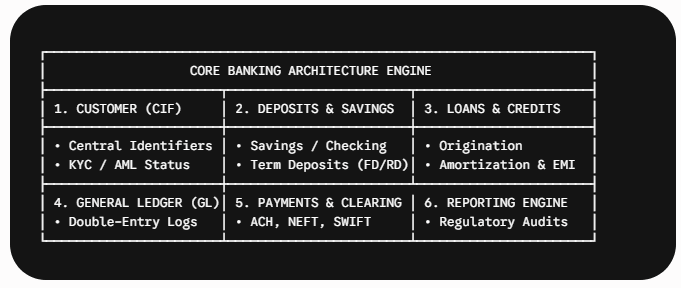
1. Customer Information File (CIF) / Central Customer Engine
Stores unified master data for every account holder, including personal demographics, risk category, tax status, and linked account relationships.
2. Deposit & Savings Account Engine
Manages product lifecycle logic, dynamic interest rate calculations, fee deductions, minimum balance triggers, and overdraft limits.
3. Payment Processing & Clearing Integration
Handles inbound and outbound money transfers across clearing networks (e.g., SWIFT, ACH, real-time instant payment rails).
4. General Ledger (GL) & Accounting Engine
Executes real-time double-entry bookkeeping rules, ensuring every transaction creates balanced debit and credit entries.
Step-by-Step Account Opening Workflows
An automated account opening workflow orchestrates the end-to-end journey of customer onboarding in banking, converting a prospective applicant into an active account holder:
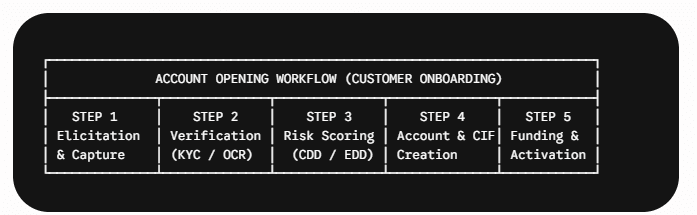
Step 1: Customer Data Capture & Consent
The applicant inputs identity details, address, employment info, and accepts regulatory compliance disclosures via a digital channel.
Step 2: Automated Identity Verification & Document OCR
Third-party verification services validate the ID document, execute facial recognition matching, and verify address details automatically during customer onboarding in banking.
Step 3: Sanctions Screening & Risk Engine Evaluation
The applicant’s details are screened against Politically Exposed Person (PEP) lists and global sanctions databases. Low-risk profiles proceed automatically; flagged profiles transition to compliance queues.
Step 4: CIF Generation & Account Provisioning
Upon approval, the system generates a unique CIF Number, provisions a new account number in the core banking architecture, and maps the relationship in the central database.
Step 5: Initial Funding & Account Activation
The customer completes an initial debit/credit card or bank transfer, triggering account status transition from PENDING_FUNDING to ACTIVE.
Real-World BA Scenario: Specifying Account Opening Workflows
Context: A FinTech Business Analyst is designing an instant mobile savings account opening flow integrated with an enterprise core banking engine.
Sample Requirements Specified by the BA:
Functional Requirement (FR-ACC-01): “The mobile API shall transmit the captured customer payload to the Core Banking Engine to generate a CIF before executing the
CreateAccountAPI call.”Business Rule (BR-ACC-02): “If the customer risk score returned by the compliance engine is $\ge 80$, the system shall restrict account activation within the account opening workflow and assign the state to Compliance Review.”
Frequently Asked Questions (FAQs)
A FinTech Business Analyst maps business compliance rules into technical system parameters, documents API data mappings between digital channels and core banking engines, defines validation rules, and designs automated account opening workflows.
A CIF (Customer Information File) number is a unique master identifier assigned to a single person or entity. An Account Number belongs to a specific financial product (e.g., Savings, Checking, Loan) linked under that master CIF within the core banking architecture.
A Core Banking System is the central software engine that handles real-time financial processing, deposit accounts, general ledger accounting, and customer data management across banking channels.
Every FinTech Business Analyst must understand core banking architecture to design seamless, compliant account opening workflows and optimize customer onboarding in banking through automated identity verification and risk scoring engines.
📄 Business Analysis Documentation Hub
Explore where Core Banking Systems fit into banking domain knowledge, process design, and functional requirements:
| Knowledge Area | Deep-Dive Article | Why It Matters for a Business Analyst |
|---|---|---|
| Domain Deep Dives (FinTech) | Core Banking Systems & Workflows | Master core banking architecture, CIF creation, account provisioning, and onboarding workflows. |
| Compliance & Risk | Enhanced Customer Due Diligence (EDD) | Understand how AML/KYC checks and risk-scoring engines evaluate high-risk account applications. |
| Diagramming & Modeling | Process Flow Diagram & BPMN 2.0 Guide | Learn how to map complex AS-IS and TO-BE account opening workflows using BPMN 2.0 swimlanes. |
| Visual Modeling & Diagrams | 5 Steps to Creating an Effective Use Case Diagram | Model customer and system interactions across mobile app and core banking API boundaries. |
| Requirements Engineering | What is a Functional Requirement? | Learn how to write explicit system specs for Core Banking APIs, status triggers, and data validation. |
| Documentation & Artifacts | Business Analysis Templates & Examples | Access standardized BRD, FRD, and data dictionary templates for banking transformation initiatives. |
🎁 Become a Better Business Analyst
Join 1,200+ Business Analysts learning every week.
Get instant access to:
📘 FREE Business Analyst Templates
🎯 Interview Preparation Guides
🚀 Agile & Scrum Tutorials
🤖 AI for Business Analysts
📈 Career Growth Tips
100% Free • No Spam • Unsubscribe Anytime
