

FREE DOWNLOAD: Business Analyst Documentation Toolkit
Get instant access to real-world BRD, FRD, and project story templates used by senior BAs.
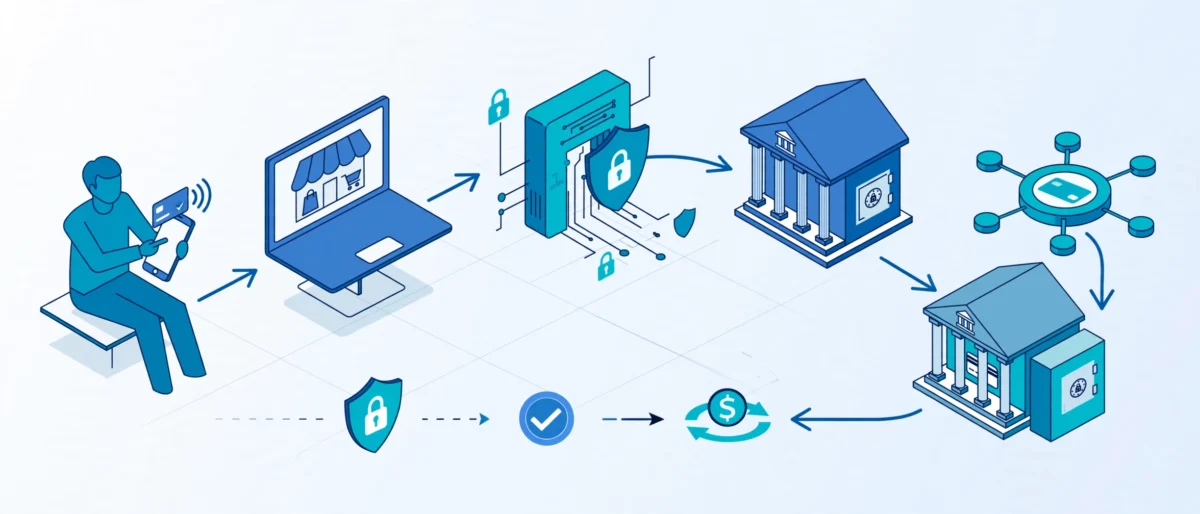
Download Free Templates PDFIn online commerce and financial technology (FinTech), a Payment Gateway acts as the digital front door for secure card processing, merchant checkout flows, and payment authorization.
For a FinTech Business Analyst, mastering how payment gateways work and understanding every phase of the transaction life cycle is critical for documenting functional requirements, API payloads, and fraud rules. This guide breaks down payment gateway mechanics, transaction processing stages, key participants, and real-world BA scenarios.
What Is a Payment Gateway?
A Payment Gateway is a technology application that captures, encrypts, and transmits payment card data from an online buyer or terminal to the acquiring bank and payment networks for approval.
Primary Function: Ensures sensitive cardholder data (PAN, CVV, Expiry) is encrypted using PCI-DSS standards while validating account balance availability in real time.
Core Difference: While a Payment Processor handles the actual movement of funds in the background, the Payment Gateway manages the customer-facing checkout interface and security handshake.
The 5 Key Entities in Payment Processing
Every payment gateway integration involves five major stakeholders across the transaction network:
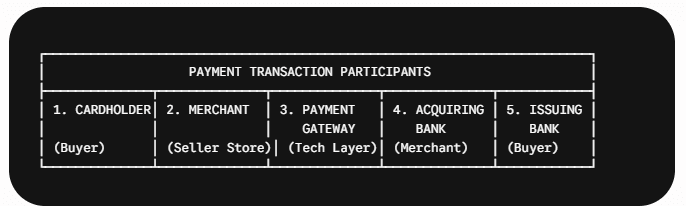
Cardholder: The customer initiating the transaction using a credit/debit card or digital wallet.
Merchant: The business accepting the payment for goods or services.
Payment Gateway: The middleware software that encrypts payload data and routes request signals.
Acquiring Bank (Acquirer): The merchant’s bank that receives transaction payloads and processes credit settlements.
Issuing Bank (Issuer): The customer’s bank that issued the credit/debit card and holds account funds.
The Complete Transaction Life Cycle
The transaction life cycle moves through distinct, automated phases from the moment a user clicks “Pay Now” to final bank settlement:
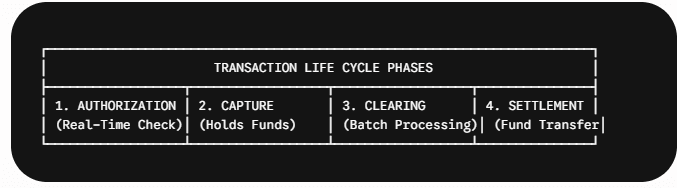
Phase 1: Authorization (Real-Time ~2 Seconds)
The cardholder submits payment details at checkout via the payment gateway.
The gateway encrypts data (tokenization) and sends an auth request to the Acquiring Bank $\rightarrow$ Payment Schemes (Visa/Mastercard) $\rightarrow$ Issuing Bank.
The Issuing Bank validates account balance, fraud risk, and returns an Approval Code (
00) or Decline Code (e.g.,51Insufficient Funds).
Phase 2: Capture
Once authorized, the funds are reserved/held on the customer’s account.
Depending on business logic, capture occurs instantly (e.g., digital download) or upon product shipment (e.g., physical e-commerce delivery).
Phase 3: Clearing (Batch Processing)
At the end of the business day, the merchant batches all captured transactions and sends them through their acquirer for merchant processing.
Clearing matches records between the acquiring bank and issuing bank to calculate net payable balances.
Phase 4: Settlement (1 to 3 Days)
The Issuing Bank transfers net funds to the Payment Network, which routes payment to the Acquiring Bank.
The Acquiring Bank deposits net transaction revenue (minus processing interchange fees) into the merchant’s bank account.
Handling Exceptions: Refunds, Reversals, and Chargebacks
A FinTech Business Analyst must specify system behavior for non-standard path flows within merchant processing:
| Exception Type | Description | Trigger / System Impact |
| Auth Reversal | Cancels an active authorization hold before capture occurs. | Unlocks reserved funds on customer’s card immediately. |
| Refund | Returns funds for an already settled transaction. | Initiates credit payload back to the customer’s account. |
| Chargeback | Formal payment dispute initiated by cardholder via Issuer. | Gateway locks disputed amount; merchant submits proof documents. |
Real-World BA Scenario: Designing Payment Gateway API Integration
Context: A FinTech Business Analyst is defining user stories and acceptance criteria for adding a new online payment gateway integration.
Sample Requirements Specified by the BA:
Functional Requirement (FR-PAY-01): “The system shall tokenize raw card numbers before sending API requests to the Payment Gateway to ensure full PCI-DSS compliance.”
Business Rule (BR-PAY-02): “If the payment gateway returns a 3D-Secure (3DS) challenge trigger, the checkout UI must launch an inline modal to complete two-factor authentication.”
Frequently Asked Questions (FAQs)
A BA maps merchant checkout states to gateway response codes, documents REST API request/response payloads, defines webhooks for asynchronous status updates (e.g., chargebacks), and specifies error handling for payment failures.
Authorization happens in real time to verify that cardholders have sufficient funds and hold them temporarily. Settlement is the background process occurring 1–3 days later where actual money moves from the issuing bank to the merchant’s account.
A Payment Gateway is the technology infrastructure that encrypts, validates, and routes digital payment transactions between merchant storefronts, acquiring banks, and issuing institutions.
Every FinTech Business Analyst must master the multi-stage transaction life cycle—including authorization, capture, clearing, and settlement—to write technical specifications for seamless payment gateway integration and automated merchant processing.
📄 Business Analysis Documentation Hub
Explore where Payment Gateways fit into banking domain knowledge, process design, and functional requirements:
| Knowledge Area | Deep-Dive Article | Why It Matters for a Business Analyst |
|---|---|---|
| Domain Deep Dives (FinTech) | Payment Gateways & Transaction Life Cycle | Master gateway mechanics, payment participants, authorization flows, and settlement stages. |
| Core Banking Domain | Core Banking Systems & Workflows | Understand how settled payment gateway funds post to central core banking ledgers. |
| Compliance & Risk | Enhanced Customer Due Diligence (EDD) | Explore fraud prevention rules, 3D-Secure validation, and high-risk merchant screening. |
| Diagramming & Modeling | Process Flow Diagram & BPMN 2.0 Guide | Learn how to map multi-party payment authorization sequence flows using BPMN 2.0. |
| Requirements Engineering | What is a Functional Requirement? | Learn how to write explicit specifications for payment API webhooks and response handling. |
| Documentation & Artifacts | Business Analysis Templates & Examples | Access standardized BRD and FRD templates for payment processing system upgrades. |
🎁 Become a Better Business Analyst
Join 1,200+ Business Analysts learning every week.
Get instant access to:
📘 FREE Business Analyst Templates
🎯 Interview Preparation Guides
🚀 Agile & Scrum Tutorials
🤖 AI for Business Analysts
📈 Career Growth Tips
100% Free • No Spam • Unsubscribe Anytime
