

FREE DOWNLOAD: Business Analyst Documentation Toolkit
Get instant access to real-world BRD, FRD, and project story templates used by senior BAs.
Download Free Templates PDFHow Business Analysts Work in Scrum Teams
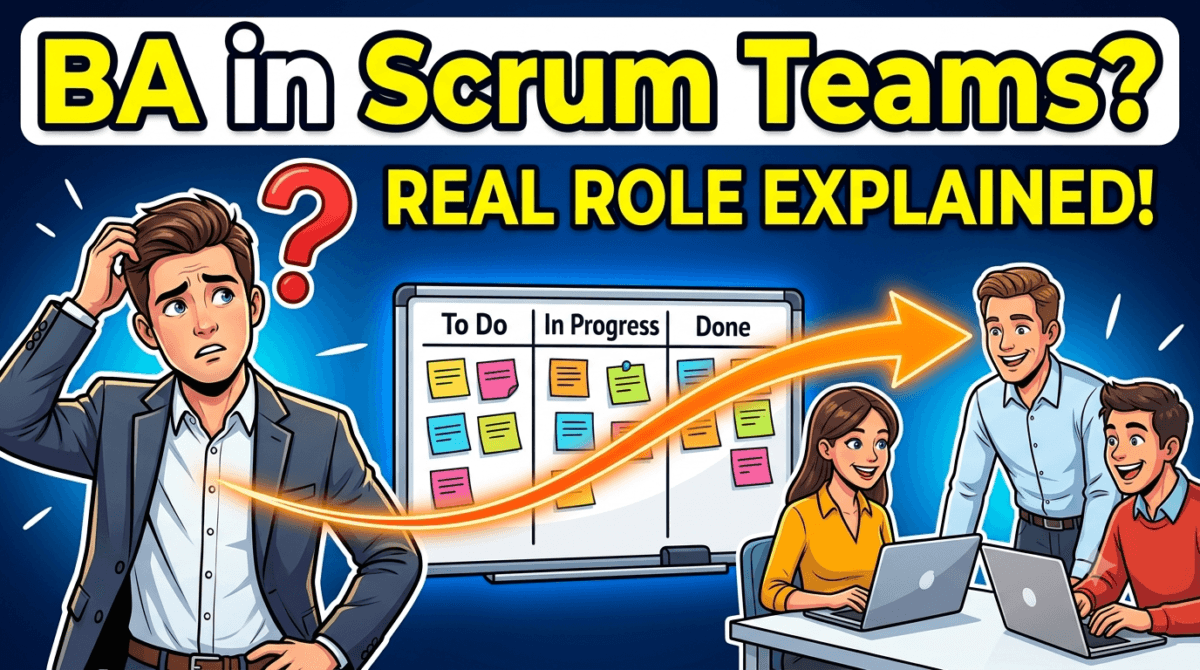
Business Analyst in Scrum Teams : Imagine joining a Scrum project as a Business Analyst.
You attend daily stand-ups, write user stories, talk to stakeholders, but suddenly during an interview, the recruiter asks:
“Why do we need a Business Analyst when we already have a Product Owner?”
Thousands of aspiring Business Analysts fail interviews because they don’t understand how a BA actually works inside a Scrum Team.
Today we are fixing that.
By the end of this article, you will learn:
- The exact role of a Business Analyst in Scrum Teams
- How BAs work with Product Owners, Scrum Masters, and Developers
- A real banking project example
- Daily activities of Agile BAs
- Daily activities of Business Analyst in Scrum Teams
- Interview questions recruiters ask
- Common mistakes that make BAs fail Agile interviews
- A real user story example
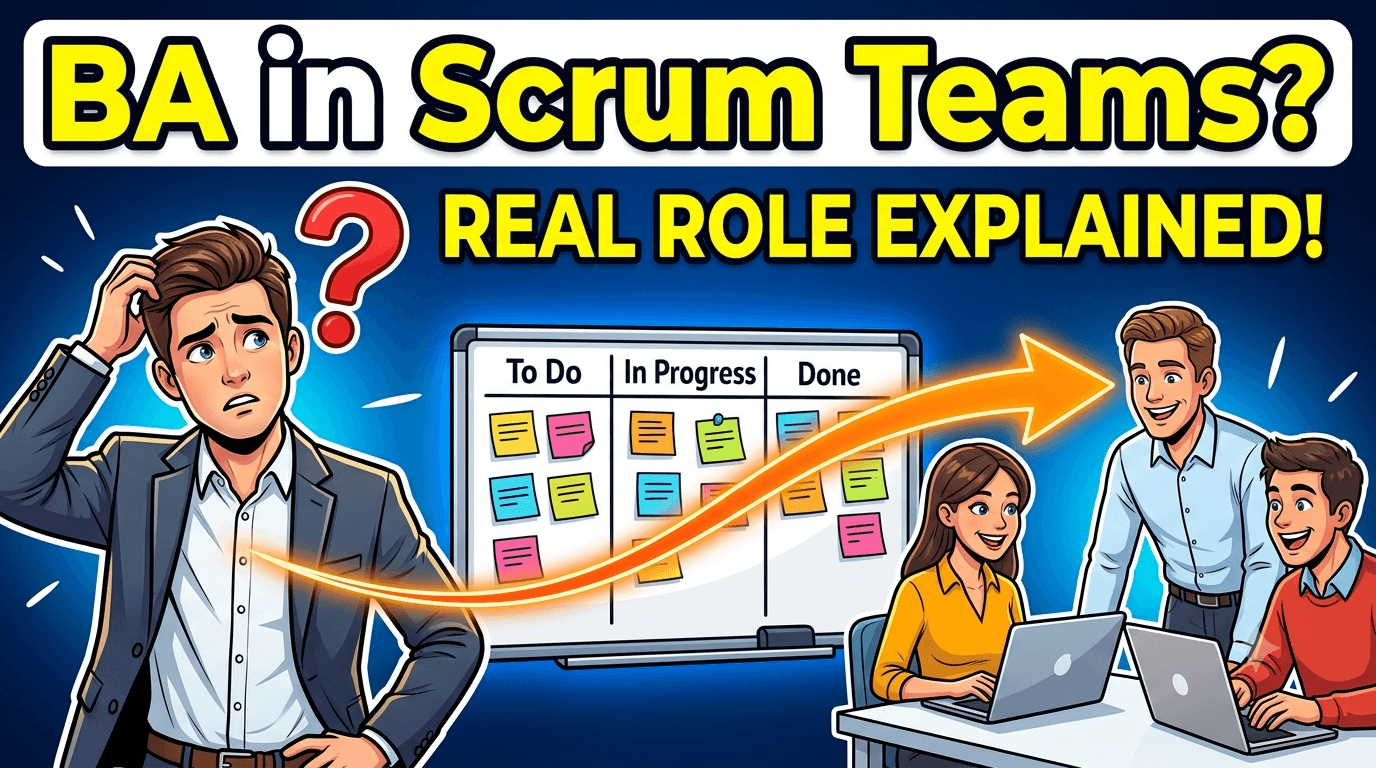
Why Scrum Needs a Business Analyst
Many people believe Agile Scrum eliminates the Business Analyst role.
That is completely wrong.
Imagine a banking application where customers want instant fund transfers.
Stakeholders say:
“We need faster transfers.”
Developers immediately ask:
“What exactly should we build?”
That is where the Business Analyst becomes critical.
The BA translates business language into development language.
Without that bridge, products become an expensive guessing game.
Common Misconception
Most people think writing user stories is the entire BA job.
It is not even 50% of the role.
Watch here –>
Understanding the Scrum Team Structure
A Scrum Team typically consists of:
- Product Owner
- Scrum Master
- Developers
- Business Analyst
- Stakeholders
Think of the Business Analyst as a translator and facilitator.
How the BA Connects Everyone
Product Owner says:
We need this feature.
Developers ask:
What exactly should happen?
Stakeholders say:
This is not what we wanted.
The Business Analyst ensures everyone stays aligned.
BA vs Product Owner
One of the most common interview questions is:
What is the difference between a Product Owner and a Business Analyst?
| Product Owner | Business Analyst |
|---|---|
| Decides what to build | Helps define and clarify requirements |
| Owns product vision | Owns requirement understanding |
| Prioritizes backlog | Refines requirements |
| Represents business goals | Bridges business and technical teams |
| Makes product decisions | Ensures shared understanding |
Simple Answer for Interviews
Product Owner decides what to build.
Business Analyst helps define how requirements should be understood.
Daily Activities of a Business Analyst in a Scrum Team
A typical Agile BA day may look like this:
Morning Activities
Daily Stand-Up Meeting
Questions discussed:
- What was completed?
- What is blocked?
- What is next?
After Stand-Up
Requirement Clarification Sessions
Discuss requirements with team members.
Stakeholder Discussions
Gather and validate business needs.
Backlog Refinement
Refine and prepare upcoming requirements.
User Story Writing
Create clear user stories.
Acceptance Criteria Creation
Define measurable success conditions.
Developer Support
Clarify requirements during development.
Testing Support
Help testers understand expected behavior.
Key Insight for Agile BA Interviews
The highest-performing Business Analysts spend:
Less time documenting
and
More time communicating
This is a major interview insight that recruiters love.
Real-Time Example: Banking Fund Transfer Project
Imagine a bank wants customers to transfer money instantly.
Stakeholder Requirement
I want faster fund transfers.
Bad Requirement
Create a fast transfer feature.
This requirement is useless because developers and testers cannot understand:
- What to build
- How to test
- What success looks like
Business Analyst Solution
The BA converts it into a proper user story.
User Story Example
As a customer,
I want to transfer funds instantly
So that I can make urgent payments.
Acceptance Criteria
- Transfer should complete within 5 seconds
- Success confirmation should be displayed
- Transaction history should be updated
- Failed transactions should show an error message
Now:
- Developers understand what to build
- Testers understand what to test
- Stakeholders understand what they will receive
That is the value of a Business Analyst.
Biggest Mistakes Business Analysts Make in Scrum
Mistake #1: Writing Poor User Stories
Poorly written stories create confusion and rework.
Mistake #2: Skipping Acceptance Criteria
Without acceptance criteria, teams don’t know when work is complete.
Mistake #3: Missing Backlog Refinement Meetings
Important requirement discussions happen during refinement sessions.
Mistake #4: Acting Like a Document Writer
Business Analysts should solve business problems, not just create documents.
Mistake #5: Waiting for Requirements
Successful Agile BAs actively discover requirements.
Important Lesson
Agile is not about documents.
Agile is about delivering value quickly.
Agile BA Interview Questions
Test your interview readiness.
Q1. What is the role of a Business Analyst in Scrum?
A Business Analyst bridges business needs and technical implementation by clarifying requirements and supporting delivery.
Q2. How is a BA different from a Product Owner?
The Product Owner decides what to build, while the BA ensures requirements are clearly understood.
Q3. How do you handle changing requirements during a sprint?
Assess impact, discuss with stakeholders and Product Owner, and follow Scrum change management practices.
Q4. What is backlog refinement?
Backlog refinement is the process of reviewing, clarifying, estimating, and preparing backlog items for future sprints.
Q5. How do you write acceptance criteria?
Acceptance criteria define the conditions that must be met for a user story to be considered complete.
Why Companies Hire Agile Business Analysts
Many freshers believe companies hire Agile BAs because they know Scrum terminology.
That is not true.
Companies hire Agile Business Analysts because they:
- Reduce misunderstandings
- Improve communication
- Clarify requirements
- Solve business problems
- Increase delivery success
Whether you work in:
- Banking
- Healthcare
- Retail
- Non-IT domains
These skills remain valuable.
User Story Challenge
Try writing a user story for an ATM cash withdrawal feature.
Use this format:
User Story Format
As a __________
I want __________
So that __________
Also write acceptance criteria for the feature.
This is excellent practice for Agile BA interviews.
Simple Trick to Remember
BA Role in Scrum = T.C.C.S
T – Translate Business Needs
C – Clarify Requirements
C – Communicate with Teams
S – Support Delivery
Whenever you are asked:
“What does a Business Analyst do in Scrum?”
Remember:
Translate → Clarify → Communicate → Support
BRD vs FRD Comparison Table
| Feature | BRD (Business Requirements Document) | FRD (Functional Requirements Document) |
|---|---|---|
| Purpose | Defines business needs | Defines system functionality |
| Audience | Business stakeholders | Developers and testers |
| Focus | What business wants | How system behaves |
| Prepared By | Business Analyst | Business Analyst / Functional Analyst |
| Detail Level | High-level | Detailed |
| Used During | Requirement gathering | Design and development |
| Example | Faster fund transfers | Transfer completed within 5 seconds |
Conclusion :
I hope this article helped you understand how Business Analysts work in Scrum teams and why their role continues to be important in Agile environments.
Related Articles :
- Functional Requirements Document (FRD)
- Business Analyst Career Roadmap
- Agile Methodology for Business Analysts
- User Story Writing Best Practices
- Business Analyst Interview Questions
- How to Become a Business Analyst
- Scrum Methodology Explained
- Business Analyst Skills
FAQ’s
Yes. Business Analysts help bridge the gap between business stakeholders and technical teams.
They gather requirements, write user stories, create acceptance criteria, support developers, and communicate with stakeholders.
The Product Owner decides what to build, while the Business Analyst helps clarify and refine requirements.
Yes. Writing user stories and acceptance criteria is one of the important responsibilities of Agile Business Analysts.
Communication, stakeholder management, requirement analysis, user story writing, backlog refinement, and problem-solving.
🎁 Become a Better Business Analyst
Join 1,200+ Business Analysts learning every week.
Get instant access to:
📘 FREE Business Analyst Templates
🎯 Interview Preparation Guides
🚀 Agile & Scrum Tutorials
🤖 AI for Business Analysts
📈 Career Growth Tips
100% Free • No Spam • Unsubscribe Anytime
