


Introduction
Role of Business Analyst in Agile Scrum : Imagine spending six months gathering requirements. The development team builds everything. After the succceful development client says :
“That is not the requirement what we given.”
Now the project is delayed because again team needs to work on the rework of this project , the company loses money, and everyone starts asking one question:
Where was the Business Analyst?
Here is the surprising part. In Scrum projects, a Business Analyst can actually prevent this disaster before it happens.
In this article let us observe Role of Business Analyst in Agile Scrum , you will learn exactly how Business Analysts work inside Scrum teams, what they do every day, how they collaborate with Product Owners and Developers, and why companies are paying Agile Business Analysts some of the highest salaries in the industry.
By the end, you will understand the complete role of a Business Analyst in Scrum.
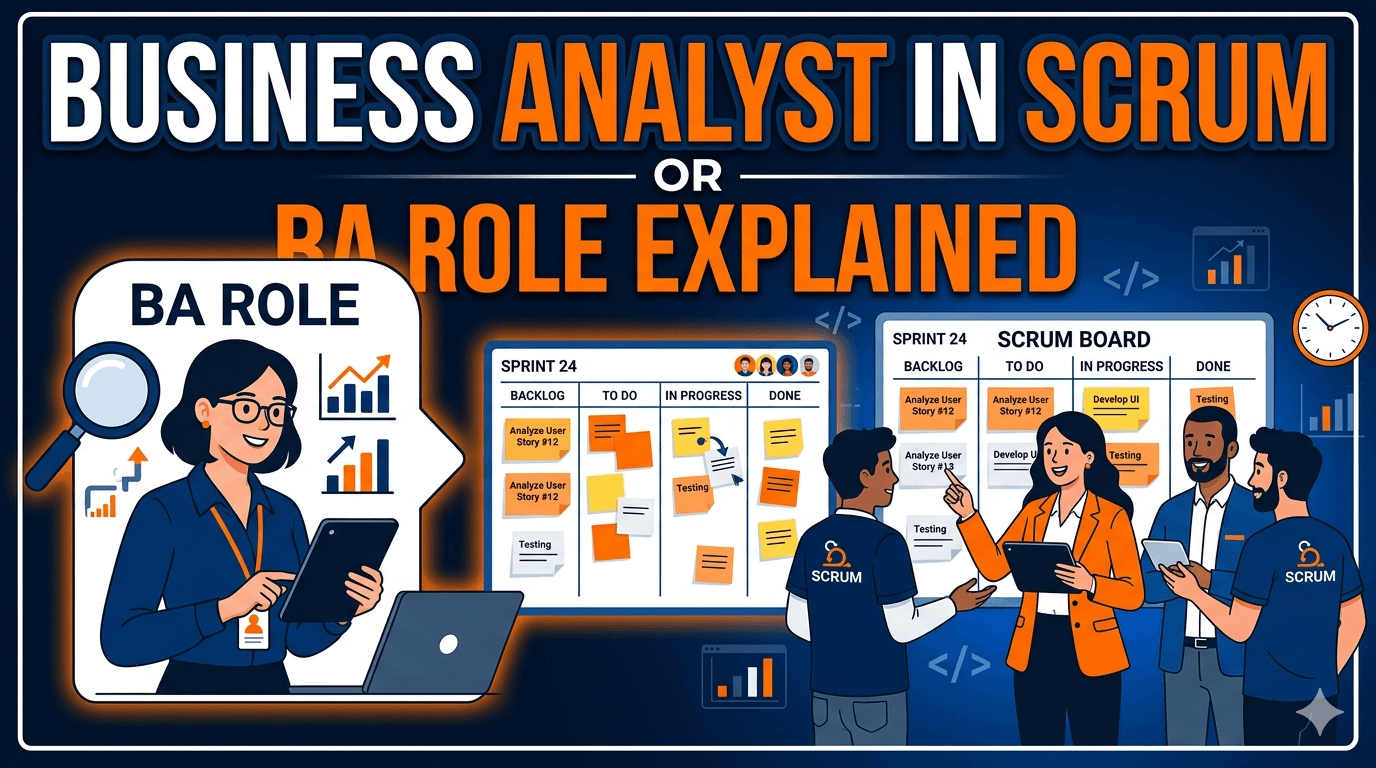
What Does a Business Analyst Do in a Scrum Team?
A Business Analyst acts as the bridge between stakeholders and the Scrum team.
They ensure:
- Requirements are clearly understood
- User stories are properly defined
- Acceptance criteria are documented
- Risks are identified early
- Business value is delivered
Without a Business Analyst, misunderstandings increase, rework becomes expensive, and projects often fail to meet expectations.
Real Banking Project Example
Imagine a bank wants to launch a new mobile loan application feature.
Customers should be able to apply for a loan directly from their phones.
Sounds simple, right?
Not really.
Different stakeholders have different needs:
- Developers need requirements
- Testers need acceptance criteria
- Product Owners need priorities
- Customers want usability
- Compliance teams need regulations
- Management wants faster delivery
Who connects all these people?
The Business Analyst.
Business Analyst Responsibilities Before Sprint Planning
Most people think Business Analysts start working when the sprint begins.
That is wrong.
Before Sprint Planning, Business Analysts:
- Gather requirements
- Conduct stakeholder discussions
- Clarify business needs
- Create user stories
- Define acceptance criteria
- Identify risks
- Prepare backlog items
Think about it.
If requirements are unclear:
- How can developers estimate effort?
- How can testers verify functionality?
- How can Product Owners prioritize correctly?
They cannot.
That is why backlog preparation is critical.
Business Analyst Role During Backlog Refinement
This is where things become interesting.
During backlog refinement, the Business Analyst becomes a translator.
Business Language
“I want customers to apply for loans quickly.”
Technical Language
User should complete the loan application in less than five minutes.
Acceptance Criteria
- Required documents uploaded
- Credit score verified
- OTP validated
- Confirmation message displayed
This translation skill is one of the most valuable skills recruiters look for in Business Analysts.
Business Analyst During Sprint Planning
Sprint Planning begins.
Developers start asking questions.
Examples:
- What happens if OTP fails?
- What if customers upload invalid documents?
- What if internet connectivity is lost?
Notice something?
Developers are no longer asking business questions.
They are asking scenario-based questions.
The Business Analyst provides clarity and removes ambiguity.
Benefits
- Reduces misunderstandings
- Reduces rework
- Improves quality
- Saves project costs
Clear requirements = Less rework
Business Analyst Role During Daily Scrum
This is a point many interview candidates miss.
Business Analysts do not always speak much during Daily Scrum.
Their role is:
- Observe progress
- Listen carefully
- Identify blockers
- Clarify requirements when required
Example
A developer says:
“I am confused about loan eligibility rules.”
The Business Analyst immediately clarifies the requirement.
Simple.
Fast.
No delays.
Common Mistake
Many Business Analysts start managing developers.
That is not a BA responsibility.
Managing the Scrum process is the responsibility of the Scrum Master.
Recruiters frequently ask this question during interviews.
Modern Scrum Teams Expect More from Business Analysts
Would you hire a Business Analyst who only writes requirements?
Probably not.
Modern Scrum teams expect Business Analysts to:
- Think strategically
- Understand customer journeys
- Analyze business data
- Support testing
- Influence product decisions
- Focus on business outcomes
Business Analyst Role During Testing
Many people think a Business Analyst’s work ends after requirements are documented.
Actually, this is where hidden issues often appear.
During testing, Business Analysts validate:
- Business rules
- Customer expectations
- Regulatory requirements
- Workflow accuracy
Banking Example
A developer successfully builds the loan approval process.
However, compliance validation is forgotten.
Without BA review, this can lead to:
- Production issues
- Customer complaints
- Regulatory penalties
That becomes very expensive.
Biggest Mistake Agile Business Analysts Make
The biggest mistake many Business Analysts make is focusing only on requirements.
Average BA Question
Did we build the feature correctly?
High-Performing BA Question
Did we solve the customer problem?
That mindset separates average Business Analysts from highly paid Business Analysts.
Scrum Meetings and Business Analyst Responsibilities
| Scrum Event | Business Analyst Responsibility |
|---|---|
| Backlog Refinement | Prepare and refine backlog items |
| Sprint Planning | Explain user stories and requirements |
| Daily Scrum | Clarify requirements and remove ambiguity |
| Sprint Review | Validate delivered business value |
| Sprint Retrospective | Identify improvement opportunities |
Interview Question: What is the Role of a Business Analyst in Scrum?
Sample Answer
A Business Analyst acts as a bridge between stakeholders and Scrum teams by refining requirements, creating user stories, supporting backlog management, clarifying requirements during development, validating business outcomes, and ensuring delivered features solve business problems.
This is a strong interview answer because it focuses on value delivery rather than just requirement gathering.
Real-Time Example
Business Need
A stakeholder says:
“I want faster loan approvals.”
Business Analyst Action
The BA:
- Conducts stakeholder discussions
- Identifies current bottlenecks
- Defines user stories
- Creates acceptance criteria
- Collaborates with developers and testers
- Validates outcomes after implementation
Result
Loan approval time decreases and customer satisfaction improves.
Simple Trick to Remember
Remember the acronym:
C.L.A.R.I.T.Y
C – Capture Requirements
L – Link Stakeholders
A – Analyze Needs
R – Refine Backlog
I – Improve Communication
T – Test Business Value
Y – Yield Better Outcomes
BRD vs FRD Comparison Table
| Feature | BRD | FRD |
| Full Form | Business Requirements Document | Functional Requirements Document |
| Purpose | Business needs | System functionality |
| Audience | Business stakeholders | Development and testing teams |
| Owner | Business Analyst | Business Analyst/System Analyst |
| Content | Business objectives | Functional specifications |
| Approval | Business stakeholders | Technical stakeholders |
| Example | Faster loan approvals | OTP validation workflow |
Conclusion
Business Analysts play a critical role in Scrum teams.
From gathering requirements and refining backlog items to supporting testing and validating business outcomes, they help ensure teams build the right solution for the right problem.
The most successful Agile Business Analysts focus not only on requirements but also on customer outcomes and business value.
If you want to become a successful Business Analyst, continue exploring practical Business Analysis tutorials, Agile concepts, Scrum practices, and interview preparation resources on BACareers.in.
Related Articles :
- How Business Analysts Work in Scrum Teams: Roles, Responsibilities, User Stories & Interview Questions
- Role of Business Analyst in Agile Scrum – Responsibilities, Examples & Real Story
- How to Write User Stories with Examples (Agile User Story Guide for Beginners)
FAQ’s
A Business Analyst bridges the gap between stakeholders and Scrum teams by refining requirements, creating user stories, defining acceptance criteria, and ensuring business value is delivered.
Although Scrum does not officially define a Business Analyst role, many organizations include BAs to improve requirement quality and stakeholder communication.
The Business Analyst explains requirements, clarifies user stories, answers developer questions, and helps the team understand business expectations.
Yes. Business Analysts attend Daily Scrums primarily to observe progress, identify blockers, and clarify requirements when needed.
Key skills include communication, requirement analysis, stakeholder management, backlog refinement, user story writing, testing support, and business process analysis.
🎁 Become a Better Business Analyst
Join 1,200+ Business Analysts learning every week.
Get instant access to:
📘 FREE Business Analyst Templates
🎯 Interview Preparation Guides
🚀 Agile & Scrum Tutorials
🤖 AI for Business Analysts
📈 Career Growth Tips
100% Free • No Spam • Unsubscribe Anytime
