

FREE DOWNLOAD: Business Analyst Documentation Toolkit
Get instant access to real-world BRD, FRD, and project story templates used by senior BAs.
Download Free Templates PDFWhat is User Acceptance Testing (UAT)?
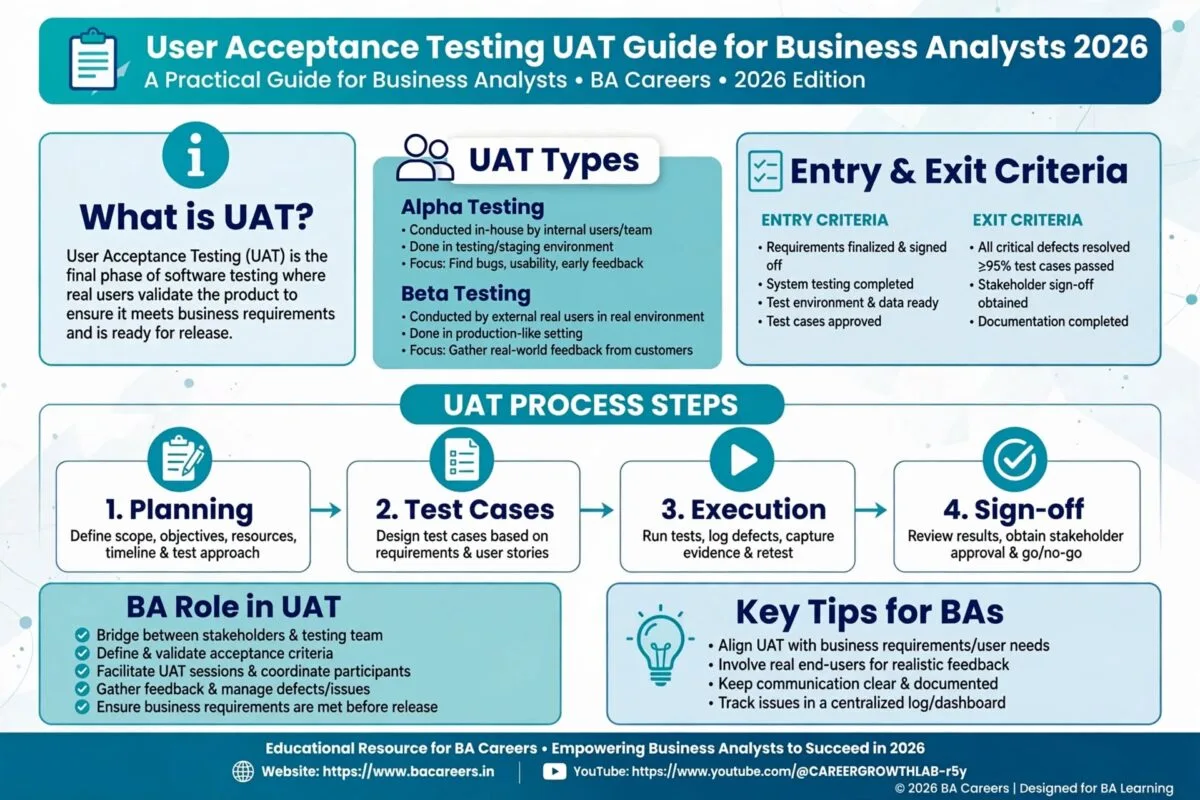
User Acceptance Testing (UAT)—also referred to as Business Acceptance Testing (BAT)—is the final phase of the software testing lifecycle where end-users, business stakeholders, and Business Analysts validate whether a software application fulfills agreed-upon business requirements before production deployment.
Unlike System Integration Testing (SIT), which focuses on technical code functionality and backend logic, UAT evaluates real-world business workflows, usability, and operational readiness.

[ Phase 1: Requirements (BRD/FRD) ] ──► [ Phase 2: System Integration Testing (SIT) ] │
▼
[Phase 4: Production Release ] ◄─── [ Phase 3: User Acceptance Testing (UAT) ]
The Business Analyst’s Role in UAT
The Business Analyst (BA) acts as the bridge between technical quality assurance (QA) teams and business stakeholders during UAT execution:
Developing the UAT Plan & Test Strategy: Defines test objectives, timeline schedules, resource allocation, and environment configurations.
Writing Business-Critical UAT Scenarios: Translates Functional Requirements (FRDs) and User Stories into user-friendly test scripts.
Facilitating UAT Execution Workshops: Guides end-users through testing sessions and clarifies expected system behavior.
Defect Triage & Impact Assessment: Evaluates reported bugs to classify them as Critical, Major, or Enhancement Requests.
Securing Stakeholder Sign-Off: Compiles the final UAT Summary Report and secures formal business sign-off.
UAT Entry & Exit Criteria
Establishing strict entry and exit conditions prevents premature testing and ensures software deployment readiness.
| Stage | Essential Criteria Checklist |
| UAT Entry Criteria (Prerequisites before UAT begins) | • System Integration Testing (SIT) 100% completed and signed off by QA. • Zero Critical or High-severity defects open. • UAT Environment configured with refreshed, anonymized test data. • UAT Test Cases reviewed and approved by business leads. |
| UAT Exit Criteria (Conditions required for Production Release) | • 100% execution of high-priority business test scripts. • 95%+ overall test case pass rate. • All Severity-1 (Showstopper) and Severity-2 (Major) defects resolved. • Formal written UAT Sign-Off received from Business Sponsors. |
🏦 Real-Time Scenario: UAT for a Retail Banking Mobile App
Context & Objective
A Business Analyst leads UAT for a new Fund Transfer Limit Modification feature in a banking app.
Sample UAT Test Case Grid
| Test Case ID | Test Scenario | Step-by-Step Execution | Expected Business Outcome | Actual Result | Status |
| UAT-FT-001 | Modify daily transfer limit from $5,000 to $10,000. | 1. Log in as Verified Customer. 2. Navigate to Account Settings. 3. Input $10,000 and submit OTP. | App displays “Limit Update Successful” and sends SMS alert. | Limits updated and SMS received within 5 seconds. | PASS |
| UAT-FT-002 | Exceed maximum allowed daily limit ($50,000). | 1. Input $75,000 as new limit. 2. Click Submit. | System blocks request with error: “Limit exceeds maximum threshold ($50k)”. | Correct error message displayed. | PASS |
Handling a Real UAT Defect
During testing, an executive user reported that international transfer limits were updating on screen but failing on backend core banking ledgers. The BA immediately flagged this as a Severity-1 Blocker, logged it in Jira, and coordinated with the middleware development team for a hotfix prior to final sign-off.
Business Analysis Resource Hub (Internal Links)
📘 Documentation Guide: BRD vs FRD Differences & Real-World Examples — See how functional requirements map directly into UAT test cases.
🛠️ Diagramming Guide: ATM Sequence Diagram Explained — Learn how backend sequence messages inform edge-case UAT scenarios.
🔄 SDLC Methodology: Waterfall Model in Software Engineering: 6 Phases & BA Role — Understand where UAT sits in traditional and hybrid development models.
Business Analyst Role in UAT
As a Business Analyst, lead or support the UAT, collaborate with stakeholders, understand requirements, and ensure that the solution being developed meets acceptance criteria. Following are the steps involved in UAT from a BA perspective:
Defining and documenting acceptance criteria:
Acceptance criteria are the key to UAT success. These criteria describe the conditions that must be met in order for a solution to be accepted. BA will work with stakeholders to ensure that this standard reflects the desired performance and outcomes.
Planning UAT test cases:
BA prepares test cases that match real-world scenarios, focusing on how end users interact with the system. Each test case should be clear, consistent with business requirements, and written in a way that is easy for business users to understand.
Prepare and organize test data:
BA ensures that accurate and relevant test data is available for UAT, reflecting the real conditions that end users will experience. This includes testing cases and changing user actions to simulate overall user behavior.
Organizing UAT activities:
Business analysts can organize UAT sessions by guiding users through the testing process, answering questions, and ensuring that testers understand each step. . They support business users in running test cases and resolving issues as they arise.
Analyzing and recording UAT feedback:
During UAT, users provide feedback on issues and unmet requirements. BA analyzes this feedback, detects user errors and misunderstandings, and works with developers to resolve issues.
Sign and Close:
Once all test cases pass and the users are satisfied, the BA gathers approval from key stakeholders to mark the product as ready for release.
What tests business analysts do?
Business analyst exams are not focused on technical or code-level testing. Instead, the tests performed by the BA emphasize performance, usability, and alignment with business requirements.
In the UAT and BA exams:
- Business scenarios: Ensure that the system can perform as expected in different business scenarios.
- Acceptance Criteria: Verify that all acceptance criteria are met.
- Workflow Validation: Check whether the end-to-end workflow makes sense to users and meets business requirements.
- Data Verification: Ensure data accuracy, completeness and availability of the entire system.
What are the eligibility criteria for a business analyst?
Acceptance criteria are the specific requirements and conditions that a system must meet in order to be accepted by business users. They can be measured, understood, and controlled so that each task meets its intended purpose. BAs work with stakeholders to define these standards, translating business requirements into testable information.
Examples of acceptance criteria include:
– Users can submit all orders without errors.
– The system automatically calculates taxes based on the user’s location.
Do business analysts write acceptance criteria?
Yes, writing acceptance criteria is an important part of a business analyst’s job. This process ensures that the requirements are clear and that the development team has a measurable process that must be met. BA develops acceptance criteria to define “done” for each requirement and guides the UAT. Well-written acceptance criteria can reduce misunderstandings and ensure that technical and business teams are aligned for success.
Business Analyst Duties and Responsibilities during UAT.
At UAT, business analysts have many roles and responsibilities:
- Requirements verification: Ensure that the developed system meets the business requirements.
- Test case development: Create, evaluate, and prepare test cases for business users. UAT Coordination: Acts as a liaison between the testing team and stakeholders.
- Feedback documentation: Collect, analyze, and communicate user feedback to the development team.
- Problem Solving: Helps resolve issues identified during UAT, clarify misunderstandings, and determine if changes are needed.
- Establish Sign-off: Establish final approval from business users and stakeholders upon successful completion of UAT.
Business Analyst Roles User Experience Testing
Many business analyst jobs require UAT experience because this aspect is critical to the success of the project. UAT-related skills are an important part of the BA job description and may include experience in test case creation, requirements analysis, and stakeholder management. For companies that focus on quality and user satisfaction in their product offerings, business analysts with UAT experience are invaluable.
UAT Business Analyst Consulting Update
If you are a business analyst with UAT experience, you should highlight your UAT skills on your resume.
Here are some tips:
- Emphasis on UAT Coordination: Demonstrate experience in managing and supervising UAT activities.
- Enter acceptance criteria: Demonstrate your expertise in defining and documenting acceptance criteria.
- Demonstrate Validation Requirements: Explain your experience testing and validating solutions to meet business needs.
- Write user feedback: Describe an experience collecting, analyzing and submitting user feedback.
Business User Experience Testing and BA Testing
“Business user acceptance testing” emphasizes the performance of business users, verifying whether the system meets their needs. The focus of BA involvement in BA testing is to ensure that the solution meets business requirements rather than technical requirements. BA testing verifies whether the workflow conforms to business processes and the solution is user-friendly and functional.
Which is not a user function of acceptance testing?
Although business users play an important role in UAT, some tasks are beyond their responsibilities.
For example:
- Technical bug fixes: When users find problems, they don’t fix them—the development team is responsible.
- Eligibility Document: The BA generally documents the requirements and acceptance criteria.
- Test case development: Users run test cases but usually don’t build them; This is basically what BA does.
Conclusion
User Acceptance Testing is a pivotal stage in delivering a successful solution that meets business needs. For Business Analysts, UAT presents an opportunity to ensure that the final product aligns with the requirements, supports end-user goals, and has been rigorously tested against acceptance criteria. BAs who are skilled in UAT can add immense value to their organizations by fostering smooth user transitions, minimizing rework, and ensuring a quality user experience. Whether you’re aiming to enhance your resume or seek a UAT-heavy role, understanding the BA’s role in UAT can be a significant career asset.
Frequently Asked Questions (FAQ)
While end-users, business subject matter experts (SMEs), and product owners execute the actual UAT test scripts, the Business Analyst coordinates the testing lifecycle, prepares scenarios, and manages defect triage.
System Integration Testing (SIT) is executed by technical QA teams to verify system architecture, API connectivity, and code logic. User Acceptance Testing (UAT) is performed by business users to verify that the application satisfies real-world business operations.
🎁 Become a Better Business Analyst
Join 1,200+ Business Analysts learning every week.
Get instant access to:
📘 FREE Business Analyst Templates
🎯 Interview Preparation Guides
🚀 Agile & Scrum Tutorials
🤖 AI for Business Analysts
📈 Career Growth Tips
100% Free • No Spam • Unsubscribe Anytime
