

FREE DOWNLOAD: Business Analyst Documentation Toolkit
Get instant access to real-world BRD, FRD, and project story templates used by senior BAs.
Download Free Templates PDFWhat is the Waterfall Model in Software Engineering?
The Waterfall Model is a linear, sequential Software Development Life Cycle (SDLC) framework where software development progresses systematically through distinct, non-overlapping phases. Introduced by Winston W. Royce in 1970, each phase must be fully completed, documented, and approved before the next phase can begin.
The 6 Sequential Phases of the Waterfall Model
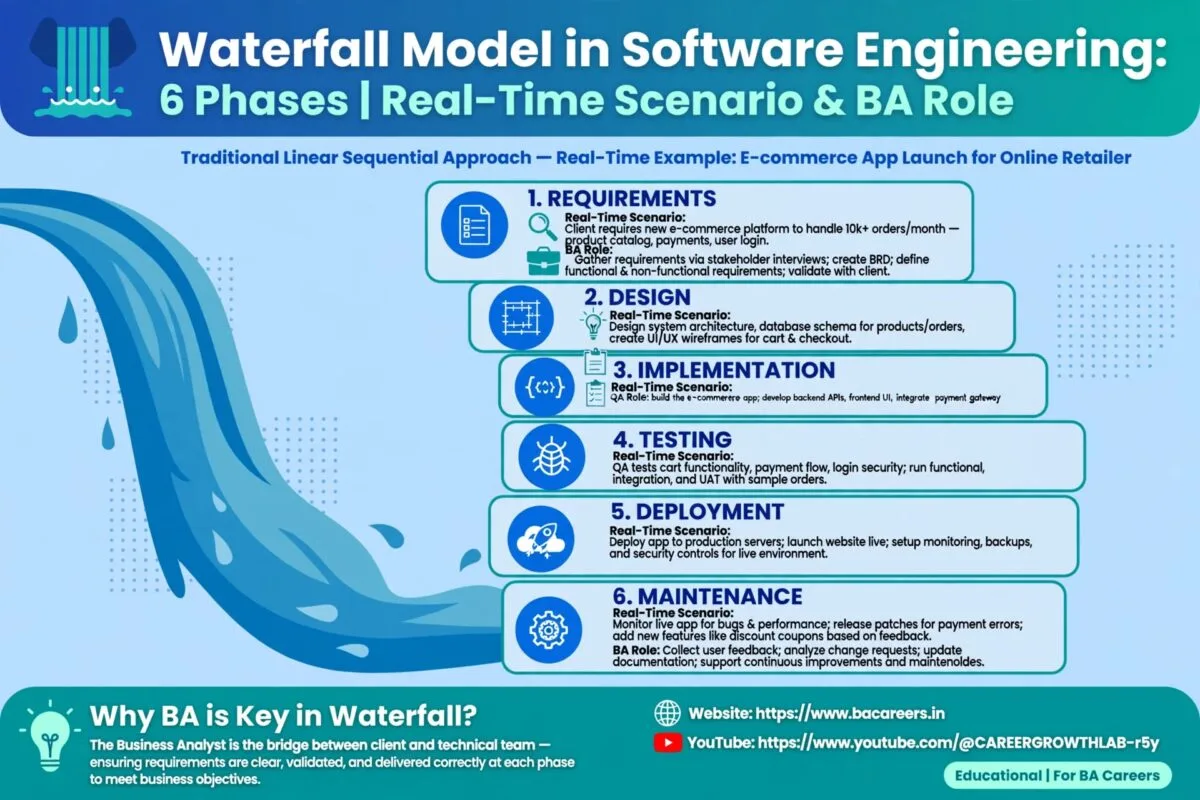
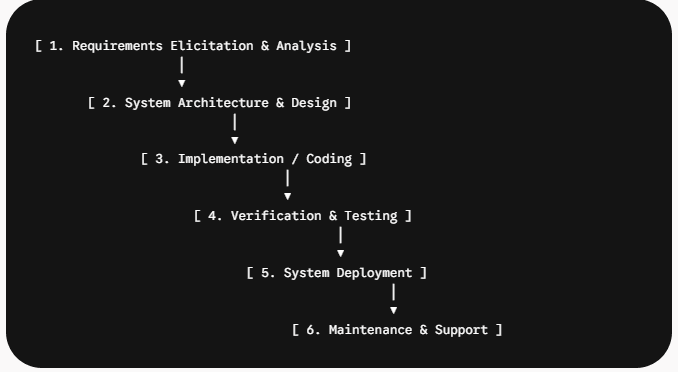
In the Waterfall methodology, project progress flows strictly downward like a waterfall.
| Phase # | Phase Name | Primary Objective | Key Business Analyst (BA) & Team Deliverables |
| 1 | Requirements Analysis | Elicit, validate, and document all business and technical specifications up front. | Business Requirements Document (BRD), Functional Requirements Document (FRD), Traceability Matrix. |
| 2 | System Design | Define system architecture, data models, hardware requirements, and UI mockups. | High-Level Design (HLD), Low-Level Design (LLD), ER Diagrams, System Architecture Specs. |
| 3 | Implementation (Coding) | Translate design specifications into functional software code modules. | Executable Source Code, Unit Test Cases, Code Documentation. |
| 4 | Verification & Testing | Validate software functionality against original requirements to catch defects. | System Integration Testing (SIT) Reports, User Acceptance Testing (UAT) Sign-off. |
| 5 | Deployment | Release the finalized software build into the production environment. | Deployment Guide, Production Release Notes, User Training Manuals. |
| 6 | Maintenance | Provide ongoing bug fixes, patch updates, and system maintenance. | Patch Releases, Defect Log Reports, Incident Management Tickets. |
Role of a Business Analyst in the Waterfall Model
In Waterfall projects, the Business Analyst (BA) carries heavy responsibility during the initial phase because requirements are “frozen” once signed off.
Upfront Requirement Elicitation: Hosts intensive interviews, JAD sessions, and workshops with stakeholders to capture every business rule and edge case.
Comprehensive Documentation: Drafts detailed BRDs, FRDs, and Software Requirement Specifications (SRS) containing rigid acceptance criteria.
Change Control Management: Since Waterfall restricts scope changes mid-project, the BA evaluates any new request through a formal Change Request (CR) process, assessing cost, timeline, and resource impact.
User Acceptance Testing (UAT) Facilitation: Leads end-users through structured test scripts during the Verification phase to verify that the final product matches original specifications.
Waterfall vs. Agile: Comparison for Business Analysts
| Feature / Aspect | Waterfall Model | Agile Framework (Scrum) |
| Development Approach | Linear, sequential, and rigid. | Iterative, flexible, and adaptive. |
| Requirement Timing | Defined 100% upfront before development starts. | Evolving continuously via Product Backlog refinement. |
| BA Documentation | Exhaustive BRDs, FRDs, and SRS artifacts. | Lightweight Epics, User Stories, and Acceptance Criteria. |
| Stakeholder Feedback | Primary feedback occurs at project start and during UAT. | Continuous feedback at every Sprint Review / Demo. |
| Risk Profile | High risk if requirements change late in the cycle. | Low risk; changes are embraced sprint-by-sprint. |
Advantages and Disadvantages of the Waterfall Model
Advantages
Clear Structure & Milestones: Simple to understand with predefined deliverables and strict quality gates.
Predictable Budget & Timelines: Upfront requirements allow accurate cost and timeline forecasting.
Exhaustive Documentation: Every stage produces formal documentation, reducing knowledge loss if team members change.
Disadvantages
Inflexible to Change: Modifying requirements mid-project requires costly formal Change Requests.
Late Working Software Delivery: Working software is not visible to stakeholders until the late testing phase.
High Risk for Complex Projects: If requirements were misunderstood in Phase 1, errors are expensive to fix during Phase 4.
When Should You Use the Waterfall Model?
The Waterfall model is ideal for specific project environments:
Regulated Industries: Banking, Healthcare, Aerospace, and Defense projects requiring strict compliance audit trails.
Clear & Fixed Requirements: Legacy system upgrades or migration projects where scope is fully known and predictable.
Fixed-Price Contracts: Vendor engagements with rigid budgets, timelines, and pre-negotiated scopes.
Business Analysis Resource Hub (Internal Links & Toolkits)
Strengthen your software engineering and BA documentation knowledge with these resources on BACareers.in:
📘 Documentation Guide: BRD Document: Tips & Essential Guide to Writing Effective BRDs — Learn how upfront requirements are documented for Waterfall and Hybrid projects.
⚔️ Detailed Comparison: BRD vs FRD Differences & Real-World Examples — Explore the key differences between business and functional documentation.
🔄 Agile Methodology: Role of Business Analyst in Agile Scrum Projects — Compare Waterfall BA tasks with day-to-day Agile Scrum ceremonies.
📑 Artifact Templates: Documents Prepared by a Business Analyst — Download sample BRD, FRD, and Traceability Matrix templates.
Real-Time Industry Scenario: Core Banking System Migration
To understand how Waterfall operates in practice, consider a real-world enterprise project in the financial services domain.
🏦 Project Background
Global Trust Bank decided to migrate its legacy Core Banking System (CBS) to a modernized, cloud-hosted architecture. The project had a fixed budget of $5M, a strict regulatory deadline of 12 months, and zero tolerance for data discrepancies during customer fund transfers.
Why Waterfall Was Chosen Over Agile
Fixed Regulatory Scope: Compliance requirements (KYC, Anti-Money Laundering, Federal Audit Rules) were 100% known and non-negotiable up front.
Complex Legacy Integration: Legacy mainframe APIs required complete, frozen technical contracts before third-party vendors could write integration code.
High Failure Cost: Deploying incomplete feature iterations in production could cause financial accounting imbalances.
Phase-by-Phase BA Execution in the Real Scenario
Phase | Stage | Key Activities | Artifacts / Actions |
|---|---|---|---|
Phase 1 | Requirements Analysis | BA spent 3 months holding JAD sessions with Compliance, Risk, and Treasury | Artifact: 150-page BRD & FRD detailing 450 system requirements |
Phase 2 | System Design | Solution Architects created ER diagrams and API contracts based on the BA’s FRD | BA Action: Conducted requirement traceability reviews to ensure 100% coverage |
Phase 3 | Implementation (Coding) | Engineering teams wrote code across 4 core banking modules over 4 months | BA Action: Clarified edge-case queries raised by developers via a Q&A log |
Phase 4 | Verification & UAT Testing | QA teams ran SIT scripts; BA facilitated UAT with 30 branch operations staff | Result: Identified 12 critical defects; developers patched them prior to release |
Phase 5 | Production Deployment | Migration executed during a weekend maintenance window (Overnight cutover) | BA Action: Monitored post-migration transaction verification and balance reconciliations |
Real-World Change Control Handling
During Phase 3 (Coding), the tax authority introduced a new 0.5% digital transaction tax levy.
Impact Assessment: Instead of adding code directly, the BA prepared a formal Change Request (CR-012) evaluating the change (3 additional dev weeks, $25,000 cost impact).
Approval: The Change Control Board (CCB) approved the CR and extended the Phase 4 testing timeline by 2 weeks.
Traceability: The BA updated the FRD and Traceability Matrix to maintain audit readiness.
Waterfall vs. Agile: Comparison for Business Analysts
| Feature / Aspect | Waterfall Model | Agile Framework (Scrum) |
| Development Approach | Linear, sequential, and rigid. | Iterative, flexible, and adaptive. |
| Requirement Timing | Defined 100% upfront before development starts. | Evolving continuously via Product Backlog refinement. |
| BA Documentation | Exhaustive BRDs, FRDs, and SRS artifacts. | Lightweight Epics, User Stories, and Acceptance Criteria. |
| Stakeholder Feedback | Primary feedback occurs at project start and during UAT. | Continuous feedback at every Sprint Review / Demo. |
| Risk Profile | High risk if requirements change late in the cycle. | Low risk; changes are embraced sprint-by-sprint. |
Frequently Asked Questions (FAQ)
The Waterfall model follows a linear, sequential structure where requirements are fixed upfront. Agile follows an iterative, flexible approach where software is developed in short sprints and requirements can evolve based on continuous user feedback.
Yes, but scope changes in Waterfall require a formal Change Control Process. The Business Analyst writes a Change Request (CR) document detailing the impact on budget, schedule, and resources, which must be approved by the Change Control Board (CCB) before work begins.
In the traditional Waterfall model, testing occurs in Phase 4 (Verification) after the complete codebase has been developed in Phase 3. This ensures the entire system is integrated before testing, though modern teams often apply continuous testing concepts within hybrid Waterfall models.
🎁 Become a Better Business Analyst
Join 1,200+ Business Analysts learning every week.
Get instant access to:
📘 FREE Business Analyst Templates
🎯 Interview Preparation Guides
🚀 Agile & Scrum Tutorials
🤖 AI for Business Analysts
📈 Career Growth Tips
100% Free • No Spam • Unsubscribe Anytime

Thank You