

FREE DOWNLOAD: Business Analyst Documentation Toolkit
Get instant access to real-world BRD, FRD, and project story templates used by senior BAs.
Download Free Templates PDFWhat’s The Role Of A Business Analyst in Agile Scrum?
The BA’s Role in Agile Scrum as The BA is a Business Subject Matter Expert, the Functional liaison between the Business stakeholders and the Development Team, and a Product Owner support member. A BA working in Agile Scrum works to break down large, high level business needs into more detailed User Stories, ensures acceptance criteria are properly developed, contributes to Product Backlog Management, supports the PO, answers functional/business logic questions for the development team and assists in the ensuring the developed product reflects the original business intent.
Introduction
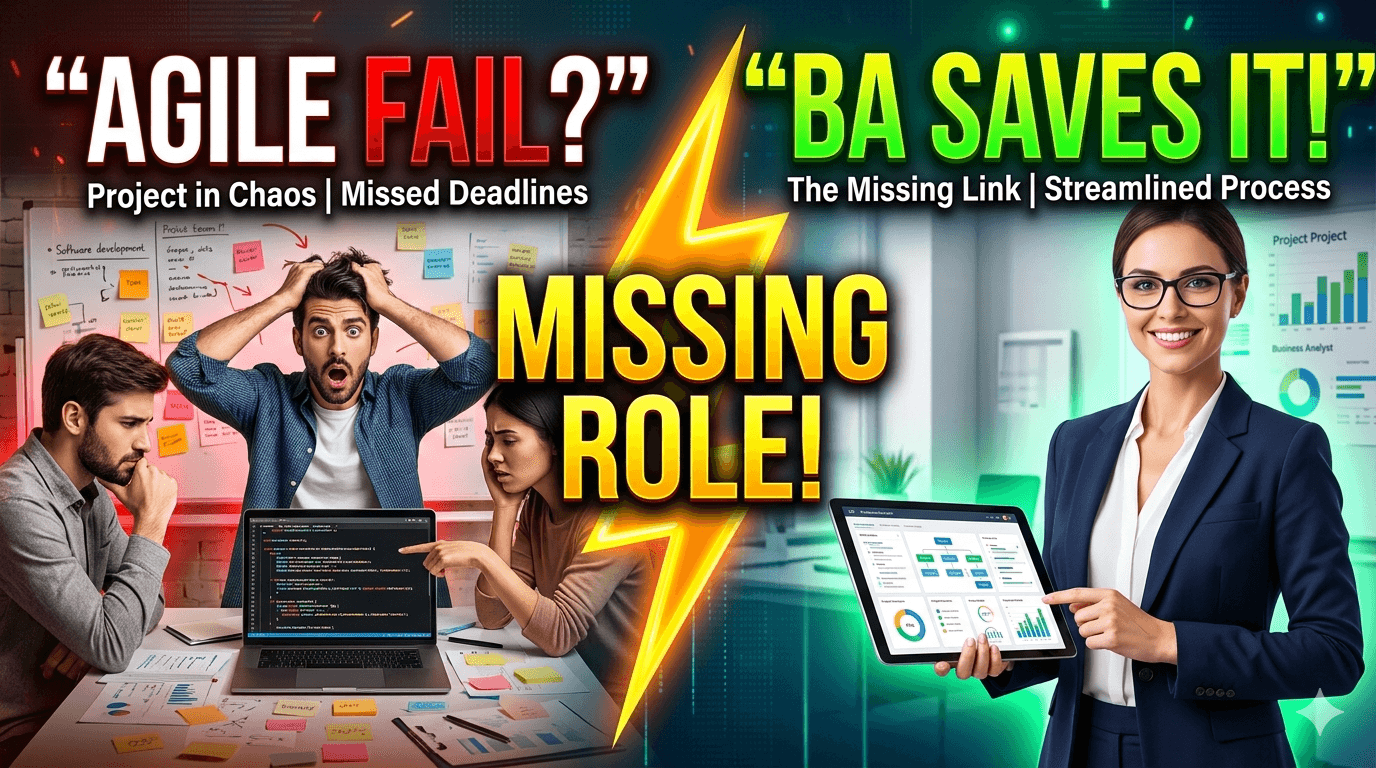
The growth and acceptance of Agile, namely Scrum, has led many to ponder, “Where does the BA fit into Agile Scrum?”.
Since only three roles – PO, SM and Developers are defined in the Scrum Guide, many erroneously assume that there is no room for the BA and the role is eliminated.
This couldn’t be farther from the truth – Agile Business Analysts (Agile BA) are critical members of the modern enterprise software development team.
While the PO is responsible for the product vision, market strategy, and ROI, they don’t have the time and bandwith to meticulously write each User Story, diagram all the end-to-end data flows and make technical logic decisions about edge cases during development in a sprint.
This comprehensive article will explore exactly how and where a BA should engage with the team to support the Agile Scrum team throughout the sprint delivery life cycle.
Product Owner vs. Agile Business Analyst
A BA working within an Agile Scrum environment needs to have a strong understanding of their role in relation to the Product Owner.
STRATEGIC LEVEL (Product Owner) ──► Focus: “WHAT to build & WHY” (ROI, Market, Vision)
│
▼
TACTICAL LEVEL (Agile BA) ──► Focus: “HOW it works in detail” (Stories, Logic, Rules)
| Dimension | Product Owner (PO) | Agile Business Analyst (BA) |
| Primary Focus | Strategic Vision, ROI, Commercial Value. | Detailed Functional Logic, Execution, Quality. |
| Backlog Management | Owns and prioritizes the Product Backlog. | Refines and details Product Backlog Items. |
| Requirements Format | High-level Epics & Feature Ideas. | Granular User Stories & Acceptance Criteria. |
| Stakeholder Interaction | Executive Leadership, Board, Customers. | Department Leads, Subject Matter Experts, Devs, QA. |
| Daily Engagement | High-level roadmap planning & trade-offs. | Daily standups, grooming sessions, dev clarifications. |
BA vs Product Owner
| Product Owner | Business Analyst |
|---|---|
| Owns product vision | Clarifies requirements |
| Prioritizes backlog | Writes detailed user stories |
| Stakeholder decisions | Requirement analysis |
The Agile BA at All Scrum Ceremonies
Working throughout all the core Scrum Ceremonies is where you will see the BA’s impact felt most heavily:
[ Sprint Planning ] ──► [ Daily Standups ] ──► [ Backlog Refinement ] ──► [ Sprint Review ]
1. Backlog Refinement (Grooming)
Objective – Prior to future sprint planning, get user stories into a state where they are ready to be selected by the PO and pulled into the sprint.
BA Responsibilities
- Breakdown large user stories (Epics) into smaller, manageable, and independent user stories.
- Develop granular and precise Acceptance Criteria – many BA’s are utilizing Given-When-Then syntax (Gherkin format).
- Document auxiliary artifacts like Process Flow Diagrams and Screen Mockups to assist in conveying the meaning and intent behind the user story.
- Lead and facilitate team discussions around the user stories to explain the functionality to the developers. Walk-through each story and its acceptance criteria prior to estimation.
2.Sprint Planning
Objective – To select and plan the user stories to be developed in the upcoming 2-week sprint.
BA Responsibilities
- Explain the functionality behind the user stories, answer questions about the business rules and intent.
- Act as a point of clarity regarding scope and business rules during Planning Poker discussions.
- Call out and clearly articulate dependencies between stories.
3. Daily Stand-Up
Objective – To synchronize the team, share progress, and identify impediments to movement.
BA Responsibilities
- Listen attentively for any functional impediments or challenges that developers and/or testers may face.
- Provide immediate clarifications on any quick functional or business logic questions that may arise.
- Serve as a quick point of contact to the business stakeholders if necessary.
4. Sprint Review & Demonstration
Objective – To review the work done in the sprint and demonstrate it to the stakeholders, then gather their feedback.
BA Responsibilities
- Work closely with the PO to demonstrate completed user stories to the business stakeholders.
- Collect and consolidate the feedback provided by the business stakeholders and convert it into new user stories for future sprints.
A Day in the Life of an Agile BA
9:00 AM – 9:30 AM Review emails and Jira for outstanding questions from the development team on the stories from the current sprint.
- 9:30 AM – 9:45 AM Participate in the Daily Stand-Up meeting and bring up any functional roadblocks.
- 10:00 AM – 11:30 AM Facilitate the Backlog Refinement session with the team for user stories upcoming in the sprint pipeline.
- 11:30 AM – 1:00 PM Spend time writing new user stories and acceptance criteria in Jira for an upcoming payment feature.
- 2:00 PM – 3:00 PM Meet with the Compliance SME to gather the requirements around data retention policies.
- 3:00 PM – 4:30 PM Design mockups for the UI/UX of the new checkout process using Figma.
Artifacts Created By an Agile BA
The most commonly created artifacts of an Agile BA include:
User Stories A user story is an informal, natural language description of a feature, from the perspective of the end-user.
It usually follows the pattern: “As a [type of user], I want [some goal] so that [some reason/benefit].”
Acceptance Criteria Specific, measurable, achievable, relevant, and time-bound (SMART) statements which detail the criteria that must be met for the user story to be considered complete. This may take the form of a Given-When-Then(GWT) style of documentation. Given [initial state/context], When [an action is performed], Then [the expected outcome is achieved].
Process Flowcharts Visual diagrams which demonstrate the sequential steps and actions within a business process, a computer system, or a computer-generated workflow.
Process flows can use BPMN or a simpler diagramming method.
Data Dictionary A documentation that describes a collection of data and provides a detailed explanation of its components and characteristics. This typically involves a description of each attribute or field name, its type, meaning, relationship to other data items, and its usage.
Conclusion
So next time someone says…
👉 ‘BA is not needed in Agile’
You know the truth…
👉 BA is the backbone of successful Scrum projects.
Related Articles
- Business Analyst Career Path
- Agile Methodology for Business Analysts
- How to Write User Stories
- BA Interview Questions
Frequently Asked Questions (FAQs)
A Business Analyst in Agile Scrum acts as a bridge between stakeholders, Product Owner, and the development team. They ensure requirements are clear, write user stories, and help deliver the right product.
A Business Analyst is important because they prevent misunderstandings in requirements. Without a BA, Agile teams may deliver quickly but build the wrong product.
Yes, a Business Analyst is often required in Scrum teams, especially in complex projects, to ensure clarity in requirements and smooth communication between stakeholders and developers.
A Business Analyst participates in Sprint Planning, Daily Standups, Sprint Review, and Retrospective to clarify requirements, resolve issues, and validate deliverables.
The Product Owner focuses on product vision and backlog prioritization, while the Business Analyst focuses on detailed requirements, user stories, and requirement clarity.
Scrum projects fail without a Business Analyst due to unclear requirements, miscommunication, and lack of proper requirement analysis.
🎁 Become a Better Business Analyst
Join 1,200+ Business Analysts learning every week.
Get instant access to:
📘 FREE Business Analyst Templates
🎯 Interview Preparation Guides
🚀 Agile & Scrum Tutorials
🤖 AI for Business Analysts
📈 Career Growth Tips
100% Free • No Spam • Unsubscribe Anytime
