


FREE DOWNLOAD: Business Analyst Documentation Toolkit
Get instant access to real-world BRD, FRD, and project story templates used by senior BAs.
Download Free Templates PDF
Introduction :
Tell an experienced Business Analyst and he will undoubtedly mention that the hardest part of requirement gathering, is to manage a room with strong individual viewpoints where every one of them thinks that their opinion matters most. The operations person wants the feature fully automated, the compliance person wants it completely illegal for corporate policy reasons and the technical architect want you to know there is no budget for it anyway. When a requirement is dropped into this sort of organisational gridlock, your usual one-on-one interview approach will just fall short.
To succeed here, a Business Analyst need to ditch the interviewer and become a master facilitator using Joint Application Design (JAD) sessions.
This however is not only about booking a conference room and ordering white-board pens. A high quality JAD session requires rigorous structural management, strong people-skills to manage even the most difficult character types, and a solid execution blueprint. This is your blueprint to prepare, run, and successfully close a high-impact JAD workshop.
What is a JAD session?
A Joint Application Design (JAD) session is a facilitated, highly structured requirements elicitation workshop which brings business stakeholders, system users, system developers, executive sponsors, and domain experts together in a single environment to elicit information from multiple stakeholders, clarify business needs, reconcile differing views, and identify technical and design specifications in a real-time, highly focused session. Instead of weeks or months passing back and forth between business users and IT developers via documentation, JAD sessions compress the entire requirements process into an effective, one-time, hands-on workshop that results in more comprehensive requirements.
The End-to-End JAD Session Timeline
A successful JAD session is won or lost before the meeting even starts. Use this operational checklist to manage the entire lifecycle of your workshop:
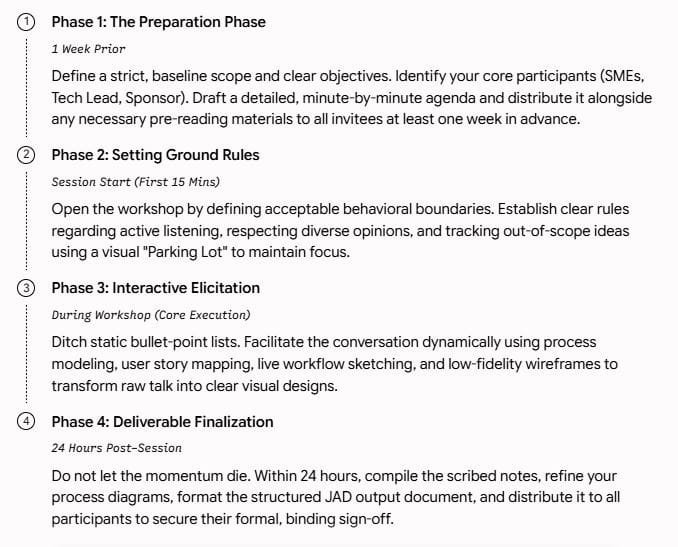
Sample JAD Session Agenda Template
A structured time block keeps your participants focused and professional. Below is a copy-pasteable framework you can use for your next half-day JAD session:
| Time Block | Session Component | Primary Facilitation Objective | Key Deliverable / Output |
| 09:00 AM – 09:15 AM | Kickoff & Boundary Setting | Welcome the team, state the session goal, and agree on ground rules. | Signed-off Ground Rules & Final Agenda |
| 09:15 AM – 10:30 AM | Current State vs. Future State | Map out the existing bottlenecks and define high-level system needs. | As-Is / To-Be Process Diagrams |
| 10:30 AM – 10:45 AM | Morning Refreshment Break | Give participants time to recharge and build informal connections. | N/A |
| 10:45 AM – 12:00 PM | Interactive Requirements Modeling | Run live wireframing, data element definitions, and rule processing. | Draft Functional Requirements & Mockups |
| 12:00 PM – 12:30 PM | Parking Lot Review & Next Steps | Review all parked ideas, assign clear action items, and establish review dates. | Action Item Matrix & Sign-off Timeline |
The 5 Core Elements of a JAD Execution Playbook
A JAD session requires careful planning and disciplined execution to ensure that it is a successful event. A well-executed JAD session will result in clear project goals, reduced conflict, more efficient project timelines, and a greater consensus among project stakeholders. To ensure maximum productivity from a JAD session, a facilitator should follow a structured 5-step lifecycle:
1. Preparation Before the workshop begins, clearly define the overall goals and objectives of the JAD session, establish scope, and outline the session’s agenda.
Identify the key cross-functional stakeholders who must participate in the session and send them necessary information, documents or background reading well in advance.
2. Facilitation The facilitator plays a crucial role in ensuring the session’s success. Their responsibilities include managing the agenda, keeping discussions focused, encouraging participation, addressing and resolving conflicts among stakeholders, and keeping the session on schedule and within its objectives.
The facilitator must remain neutral to facilitate discussion and resolution.
3. Structured Activities A JAD session relies heavily on interactive and collaborative activities to stimulate requirements and facilitate the process of designing the system. Activities such as brainstorming, group discussions, user story mapping, process modeling, and rapid prototyping exercises help to elicit detailed requirements and solutions in a concise, interactive way.
4. Documentation (The Scribe Role) Detailed notes, decisions, action items and any designs created during the workshop need to be documented during the session itself. A dedicated Scribe takes notes to capture the information which can be used to develop future design documents, specifications and reports.
This role is critical for freeing up the BA to facilitate the meeting and the team to participate effectively.
5. Follow-up Once the session is concluded, the facilitator will need to review the meeting notes, validate decisions with participants and address any remaining questions or outstanding items.
The facilitator will also communicate to participants any follow-up actions and steps, such as refining requirements, creating design documents or proceeding to the next project phase.
The Business Benefits of Driving JAD Consensus Successfully facilitating a JAD session brings many tangible benefits to your organisation including:
Improved Communication by bringing people together from all parts of the organisation, it will break down departmental silos and facilitate a clear understanding of project requirements.
Faster decision making when disparate groups of people sit in a room together to hammer out the details and negotiate compromise solutions in real-time, decision making occurs much faster.
Reduced conflict through structured facilitation of JAD workshops, you will be able to address concerns from each stakeholder group and identify potential rule conflicts before they become an issue in a project.
Greater buy-in from stakeholders as everyone participates in defining the scope and design of the new system, stakeholders will develop a stronger sense of ownership of the outcome, which leads to increased user acceptance during implementation.
Lower project costs identifying potential issues or technical constraints early on in the process will save your project a lot of rework and avoid scope creep.
Survival Tactics for Managing Difficult Stakeholders If the participants do not behave and interact, your JAD will become chaos. Some common behaviour challenges include:
1. The Dominant Speaker (The “HiPPO”)
The high-ranking stakeholder, SME or dominant personality will talk too much.
Other quieter team members will sit and let the HiPPO dominate the discussion for obvious fear.
Solution: Introduce a process of elicitation for every team member – e.g. To go around the room each time the issue comes up. The facilitator might say: “John, it was helpful to hear your opinion again. To ensure we hear from the rest of the room please, let’s go to Anna now on the operation side, Anna, what impact would the suggestion have on you team’s daily operations?”
2.The Scope Drifter
The participant has the habit of continuously referring to previous projects, and other projects currently in flight. All of their suggestions and ideas might be really interesting and valuable but outside the scope of the current project. Solution: Have a physical space for a ‘Parking Lot’.
This could be a separate board or whiteboard dedicated to non-project items or issues not in scope for now. Address this issue by stating: “That is a very interesting discussion, and certainly something we can look at as a future initiative or in Phas
2. To keep us focused on our project objectives for today, however, I’m going to capture that idea in our Parking Lot.”
3.The Unresolved Technical Conflict If two key participants or departments absolutely do not agree and cannot reach a compromise, it will drag the meeting to a halt, turning it into an argument. Solution: Introduce timeboxing. For every difficult item, set a timer and state at the beginning that it will take no longer than five minutes to resolve, or an action will be assigned. “We can discuss this for the next five minutes, if we haven’t agreed on a path forward by then, we will escalate to the sponsor or technical architect for a decision, and assign an action item for them.”
This is one of the ultimate badges of honor for a Business Analyst, to be able to replace weeks of work for individual requirements gathering, with an intensive time-boxed workshop, to cut through corporate politics, and reduce the time to build value by hundreds of hours.
Frequently Asked Questions (FAQs)
Q: What is the ideal number of participants for a JAD session?
A: Generally, the ideal size for a JAD session is 8 to 15 participants. If the group is too small, it might not have adequate representation of different stakeholder perspectives.
If the group is too large, the facilitator may have difficulty managing the group and ensuring everyone has a chance to participate.
Q: Can a JAD session be conducted completely online?
A: Yes, JAD sessions can be conducted remotely using video conferencing tools (e.g., Zoom, Microsoft Teams) and online collaborative tools (e.g., Miro, Mural, Lucidspark) for interactive activities like whiteboarding, dot-voting, and brainstorming.
Q: What is the role of the Scribe in a JAD session?
A: The Scribe is responsible for meticulously documenting all decisions, action items, open questions, proposed solutions, and requirements identified during the JAD session. Their role is critical in freeing up the facilitator and other participants to focus on the discussion and content of the meeting, ensuring that valuable information is captured accurately and thoroughly.
🎁 Become a Better Business Analyst
Join 1,200+ Business Analysts learning every week.
Get instant access to:
📘 FREE Business Analyst Templates
🎯 Interview Preparation Guides
🚀 Agile & Scrum Tutorials
🤖 AI for Business Analysts
📈 Career Growth Tips
100% Free • No Spam • Unsubscribe Anytime

Thank You