

FREE DOWNLOAD: Business Analyst Documentation Toolkit
Get instant access to real-world BRD, FRD, and project story templates used by senior BAs.
Download Free Templates PDFBug, Defect, Error, and Failure during software testing phase is one of the most frequently used phrases within a team of engineers and testers. Although all of these terms point to a fault with the software, they each have specific meaning. It’s crucial for an aspiring Business Analyst to know this terminology, so they can effectively communicate with both the developers and quality assurance teams.
In this article we’ll explore the defect meaning, and see how this definition differs from a traditional bug, and we’ll cover how to leverage your domain knowledge to prevent these issues from getting into production.
What is a Bug in Software Development?
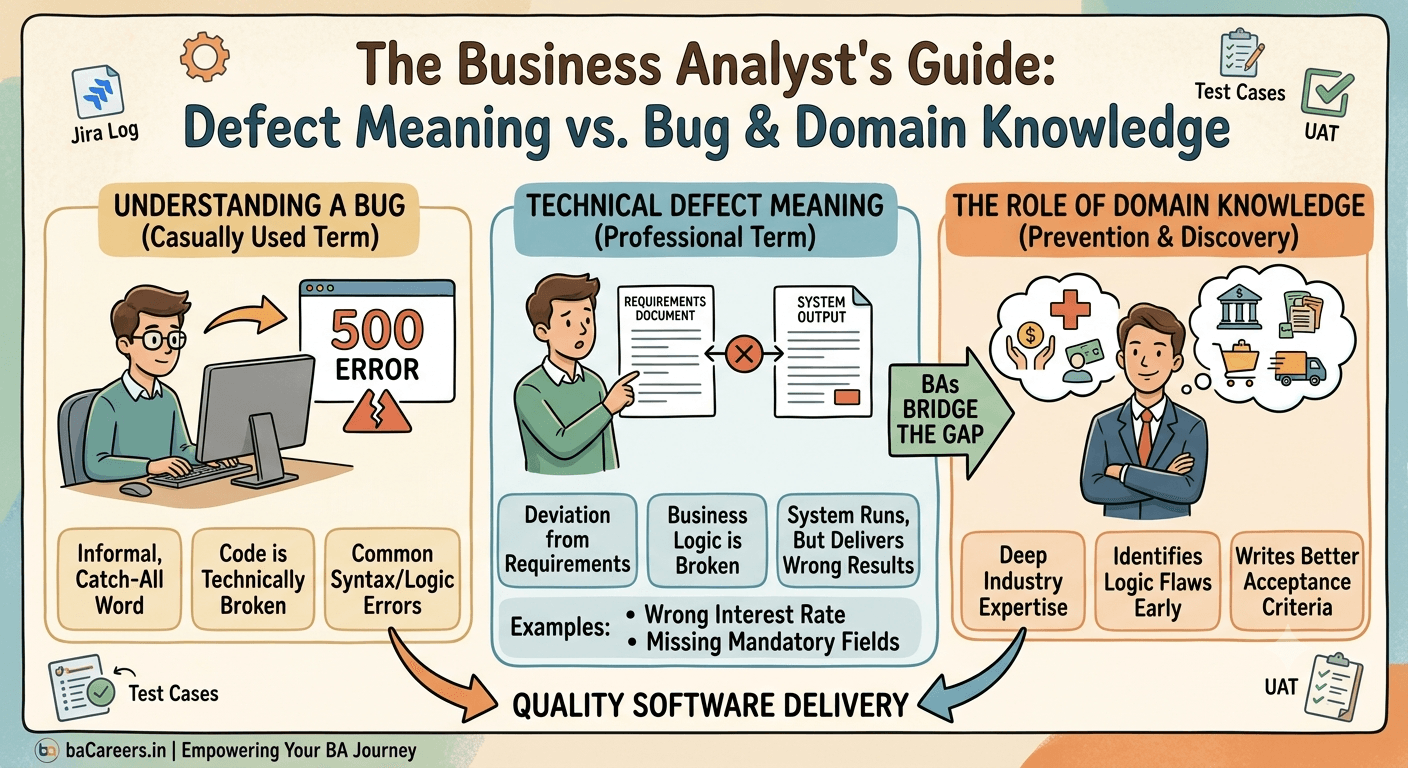
The simplest definition for a bug in software development is that it’s any sort of mistake, flaw or imperfection within the computer program that results in a wrong, unexpected output.
Bugs are often found during the development stages by the programmers and developers themselves, or by the software engineers performing the preliminary code execution check ups. An example of such is a syntax mistake in the program which might make a button non-clickable or, in the worst case, crash the entire website when opened. Usually, “bug” can be used as a more informal, overarching term used for anything technical that appears to be out of order.
Defect Meaning: How it Differs From a Standard Bug.
Unlike a “bug,” the defect meaning highlights a deviation from what was previously documented. The term “defect” refers to a software application that isn’t behaving as described in the Business Requirements Document (BRD) and Functional Requirements Specification (FRS).
Think of it as this:
Bug: Broken technically (e.g. A script button which crashes the entire website)
Defect: Broken from the business standpoint (e.g. Your Banking app, designed for all to save money and get 5% interests as a Senior citizen, however, due to some mistake, it only shows 4%)
The Role of Domain Knowledge in Catching Functional Defects
Catching a technical bug is usually simple, the code breaks down and it show errors messages. But a functional defect needs to be caught using one’s specific domain knowledge. Your domain knowledge implies knowing a particular industry thoroughly, like healthcare, finance or e-commerce.
A BA, having enough domain knowledge, can provide very valuable input while testing because he can catch the business logic bugs which might go unnoticed in a technical check:
– Knowing the business domain – If you have banking domain knowledge you know what would be the calculation logic of interest or tax and can easily catch discrepancies.
– Catching workflows that are not built-in. Even if the system is working as code, you might realize while seeing it that something the business users would use is missing out entirely from the design.
– Writing good acceptance criteria. The documentation for any feature is prepared by the Business Analyst, if they are well versed in the domain then they are more likely to prepare accurate criteria and documentation.
Frequently Asked Questions (FAQs) –
Who usually reports the defect?
Although testers log most of the bugs that occur, it’s often BAs that spot defects during their review sessions while UAT-testing. The teams using tools like Jira assign defects back to the developers.
– Difference between a defect and a software failure?
While a defect lies inside the code of a software, a failure happens in a production environment, and the end user experiences the faulty behaviour.
– How can defects be reduced in a Sprint?
Through the grooming of the stories where BA, developers and QA discuss, clarify, and document everything before development begins.
Conclusion:
Elevated Software Quality By knowing the defect meaning, and how it’s distinct from the simple coding bugs, you can engage into sophisticated conversations with your developers and testers as if you were one of them. Using your domain knowledge can ensure that you not only create a smoothly functioning system, but you are building the right system!
Related Articles:
- Defect Meaning: Definition and Examples
- Different types of defects in software development
- What is defect in software development
- The Defect Life Cycle Explained
- Bug Life Cycle / What is Defect Life Cycle ?
🎁 Become a Better Business Analyst
Join 1,200+ Business Analysts learning every week.
Get instant access to:
📘 FREE Business Analyst Templates
🎯 Interview Preparation Guides
🚀 Agile & Scrum Tutorials
🤖 AI for Business Analysts
📈 Career Growth Tips
100% Free • No Spam • Unsubscribe Anytime
