

FREE DOWNLOAD: Business Analyst Documentation Toolkit
Get instant access to real-world BRD, FRD, and project story templates used by senior BAs.
Download Free Templates PDFIntroduction: Data Doesn’t Make Decisions—People Do
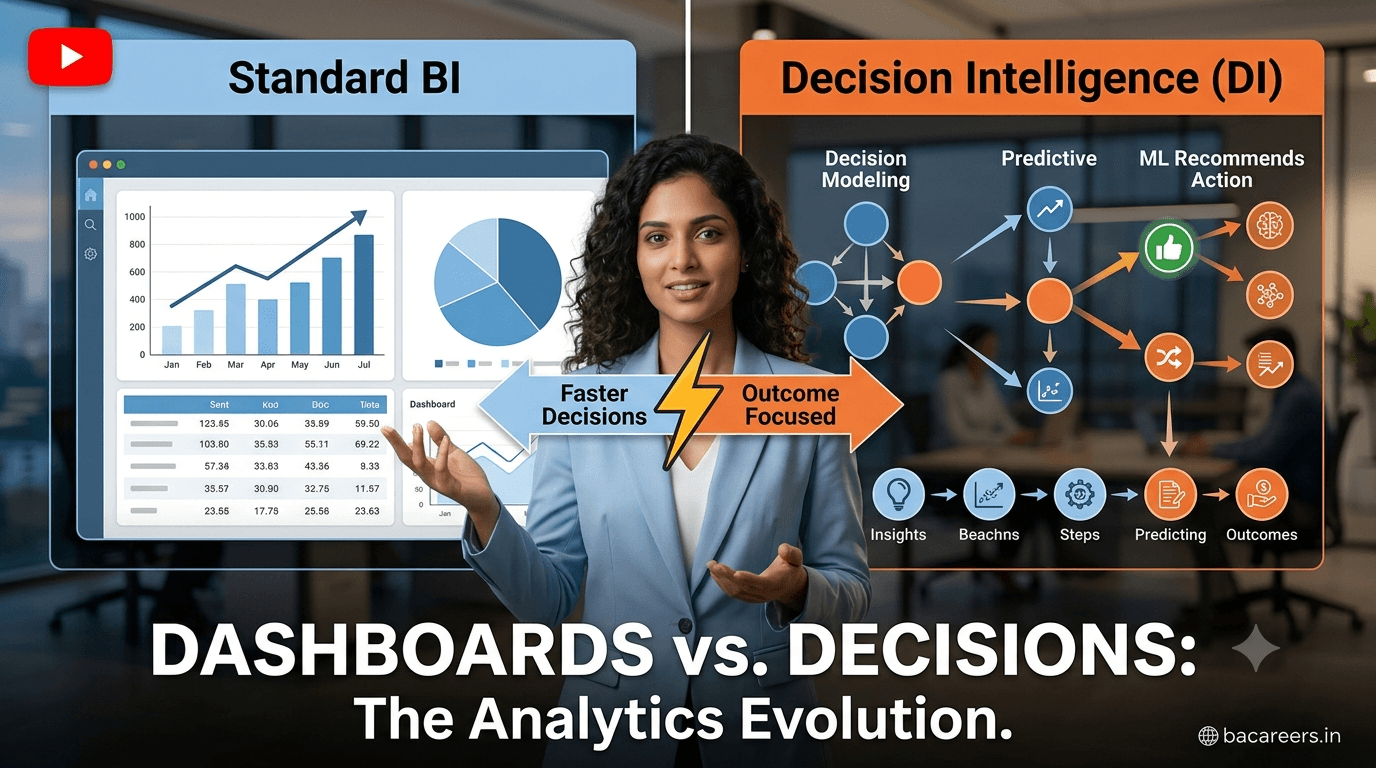
Imagine you’re a Business Analyst working for a global retail company.
It’s Monday morning, and you’ve just opened your executive dashboard. Sales have dropped by 12% in the southern region, customer complaints have increased by 18%, and inventory for one of your best-selling products is running dangerously low.
The dashboard clearly shows what happened. It even highlights trends using colorful charts and KPIs.
Now the executive team turns to you.
“Why did this happen?”
“Which issue should we solve first?”
“What action should we take today?”
Suddenly, the dashboard becomes silent.
For years, organizations have invested millions of dollars in Business Intelligence (BI) platforms capable of collecting, cleaning, analyzing, and visualizing enormous amounts of business data. These systems have transformed reporting, improved transparency, and helped executives monitor organizational performance.
Yet one fundamental challenge has remained.
Dashboards don’t make decisions. People do.
And people—regardless of experience—are influenced by limited information, time pressure, assumptions, confirmation bias, and conflicting priorities.
This gap between insight and action has become one of the biggest challenges facing modern organizations.
That is precisely why Decision Intelligence (DI) is rapidly emerging as the next evolution of enterprise analytics.
Instead of simply presenting historical information, Decision Intelligence combines Business Intelligence, Artificial Intelligence (AI), Machine Learning (ML), predictive analytics, automation, and behavioral science to recommend the best possible action—or in some cases, execute that action automatically.
For Business Analysts, this shift represents far more than another technology trend.
It represents a transformation in how business problems are solved.
Instead of acting as report creators, Business Analysts are increasingly becoming decision architects who help organizations design smarter, faster, and more consistent decision-making processes.
In this comprehensive guide, we’ll explore:
- What Business Intelligence really is
- What Decision Intelligence means
- The key differences between BI and DI
- Real-world business scenarios
- The evolving role of the Business Analyst
- Why Decision Intelligence is becoming one of the most valuable skills for 2026 and beyond
Whether you’re an aspiring Business Analyst, an experienced professional, or a business leader driving digital transformation, understanding this evolution will help you stay ahead in a world where competitive advantage increasingly depends on making better decisions—not simply collecting more data.
Understanding Business Intelligence (BI)
Before exploring Decision Intelligence, it’s important to understand why Business Intelligence became one of the most valuable business technologies over the past three decades.
Business Intelligence is the process of collecting, organizing, analyzing, and presenting business data so organizations can understand past and current performance.
Its primary objective is simple:
Transform raw business data into meaningful information that supports decision-making.
Most organizations generate enormous volumes of data every single day.
For example:
- Sales transactions
- Customer purchases
- Website visits
- Inventory movements
- Employee productivity
- Marketing campaigns
- Financial transactions
- Supply chain operations
Without Business Intelligence, this data remains scattered across multiple systems and provides very little value.
BI platforms consolidate this information into centralized dashboards and reports, allowing decision-makers to monitor business performance from a single location.
What Does Business Intelligence Actually Do?
Business Intelligence answers questions such as:
- What happened last month?
- Which products generated the highest revenue?
- Which region achieved the best sales performance?
- Why did customer satisfaction decline?
- How many orders were delayed?
- Which department exceeded its budget?
Notice something interesting.
Every question focuses on understanding existing or historical information.
Business Intelligence is exceptionally good at explaining the past and monitoring the present.
However, it rarely tells organizations what they should do next.
Real-World Example: Business Intelligence in Retail
Imagine a nationwide supermarket chain operating 500 stores.
Every morning, executives review a dashboard showing:
- Daily revenue
- Product sales
- Customer footfall
- Inventory levels
- Supplier performance
- Employee productivity
The dashboard indicates that:
- Revenue dropped by 9%
- Fresh produce waste increased by 15%
- Inventory shortages affected 40 stores
- Customer complaints doubled over the weekend
The BI dashboard has done its job perfectly.
It has identified the problems.
But executives still need to answer critical questions:
- Which issue should be addressed first?
- Which stores require immediate inventory transfers?
- Should pricing be adjusted?
- Should additional suppliers be contacted?
- Will these actions improve profitability?
These decisions still depend entirely on human judgment.
This is where Business Intelligence reaches its natural limit.
The Evolution Toward Decision Intelligence
Modern businesses no longer compete solely on products or pricing.
They compete on how quickly they can make intelligent decisions.
Consider industries like:
- Banking
- Healthcare
- Insurance
- E-commerce
- Manufacturing
- Logistics
- Telecommunications
Thousands of business decisions happen every minute.
Examples include:
- Should a loan application be approved?
- Which delivery truck should be rerouted?
- Should an insurance claim be flagged as suspicious?
- Which customer is likely to cancel a subscription?
- Which supplier should receive the next purchase order?
- Which marketing campaign should receive additional funding?
Waiting for humans to manually interpret reports creates delays.
These delays often translate into:
- Lost revenue
- Poor customer experience
- Higher operational costs
- Missed business opportunities
Organizations therefore need systems capable of supporting—not replacing—human decision-making.
This need has led to the rapid adoption of Decision Intelligence.
What Is Decision Intelligence?
Decision Intelligence is a discipline that combines:
- Business Intelligence
- Artificial Intelligence
- Machine Learning
- Predictive Analytics
- Automation
- Business Rules
- Behavioral Science
Its objective is not merely to display information.
Its objective is to improve business decisions.
Instead of asking:
“What happened?”
Decision Intelligence asks:
- What should we do now?
- Which option creates the highest business value?
- What are the risks?
- What is the expected outcome of each decision?
- Which recommendation should be implemented automatically?
Decision Intelligence transforms data into actionable recommendations.
Rather than overwhelming managers with dozens of charts, it helps them focus on the best possible decision.
Business Intelligence vs Decision Intelligence
The easiest way to understand the difference is to identify where the technology stops working.
Business Intelligence
The system:
- Collects data
- Cleans data
- Creates reports
- Displays dashboards
Human beings:
- Interpret reports
- Compare alternatives
- Decide actions
- Execute decisions
Decision Intelligence
The system:
- Collects data
- Learns patterns
- Predicts outcomes
- Evaluates alternatives
- Estimates business impact
- Recommends actions
- Automates selected decisions
Humans:
- Review recommendations
- Approve strategic decisions
- Monitor results
- Improve decision models
Instead of replacing people, Decision Intelligence augments human intelligence.
It helps decision-makers move from data interpretation to decision optimization.
Business Intelligence vs Decision Intelligence Comparison
| Feature | Business Intelligence (BI) | Decision Intelligence (DI) |
|---|---|---|
| Primary Goal | Understand business performance | Improve business decisions |
| Main Question | What happened? | What should we do next? |
| Data Focus | Historical and descriptive | Predictive, prescriptive, and causal |
| Output | Reports and dashboards | Recommended actions and decision options |
| User Interaction | Manual analysis | AI-assisted decision support |
| Automation | Limited | Extensive |
| Success Metric | Report accuracy | Decision quality and business outcomes |
| Business Analyst Role | Requirements gathering, reporting, KPI analysis | Decision modeling, AI collaboration, business rule definition, outcome optimization |
Why This Difference Matters to Business Analysts
For many years, Business Analysts primarily focused on:
- Gathering requirements
- Documenting business processes
- Creating BRDs and FRDs
- Preparing dashboards
- Supporting reporting initiatives
These responsibilities remain important.
However, modern organizations increasingly expect Business Analysts to answer a different question:
“How can we improve the quality and speed of business decisions?”
That shift changes the BA’s role from an analyst of information to a designer of decision-making processes.
Instead of only documenting requirements, Business Analysts now collaborate with data scientists, AI engineers, product managers, and business leaders to define:
- Decision rules
- Success criteria
- Business constraints
- Risk thresholds
- Automation opportunities
- Governance policies
The Business Analyst becomes the crucial link between technology and business strategy, ensuring that AI-driven recommendations align with organizational goals, compliance requirements, and customer expectations.
Conclusion
Business Intelligence has played a vital role in helping organizations transform raw data into meaningful insights. Dashboards, reports, and data visualizations have enabled businesses to monitor performance, identify trends, and make informed decisions based on historical and real-time information. However, in today’s fast-paced digital landscape, simply knowing what happened is no longer enough.
This is where Decision Intelligence (DI) marks the next stage in the evolution of data-driven organizations. By combining Business Intelligence with Artificial Intelligence (AI), Machine Learning (ML), predictive analytics, automation, and behavioral science, Decision Intelligence goes beyond reporting to recommend the best possible actions and predict their outcomes. Instead of waiting for decision-makers to interpret dashboards manually, DI empowers organizations to make faster, smarter, and more consistent decisions.
For Business Analysts, this shift presents an exciting opportunity rather than a challenge. The role of a BA is evolving from gathering requirements and building reports to becoming a strategic decision enabler. Modern Business Analysts are expected to understand business objectives, model decision workflows, collaborate with data scientists, define business rules, validate AI-driven recommendations, and ensure that technology delivers measurable business value.
It’s important to remember that Decision Intelligence is not replacing Business Intelligence—it is building upon it. BI remains the foundation for data collection, reporting, and performance monitoring, while DI leverages that trusted data to drive intelligent, outcome-focused decision-making. Organizations that successfully combine both approaches will gain a significant competitive advantage through improved operational efficiency, reduced decision latency, and enhanced customer experiences.
As businesses continue to embrace AI-powered transformation, the demand for Business Analysts who can bridge the gap between data, technology, and strategic decision-making will continue to grow. By developing skills in Decision Intelligence, predictive analytics, AI fundamentals, and business process optimization, you can future-proof your career and position yourself as a trusted advisor capable of driving meaningful organizational change.
The future of Business Analysis is no longer about creating better dashboards—it’s about designing better decisions. The professionals who master this transition won’t just analyze data; they’ll shape the strategies that define tomorrow’s successful organizations.
Related Articles:
Business Intelligence (BI) Analystorrole of a Business Intelligence AnalyBusiness Intelligence for Business AnalystsUsing AI Tools in Business AnalysisorAI-powered analytics
🎁 Become a Better Business Analyst
Join 1,200+ Business Analysts learning every week.
Get instant access to:
📘 FREE Business Analyst Templates
🎯 Interview Preparation Guides
🚀 Agile & Scrum Tutorials
🤖 AI for Business Analysts
📈 Career Growth Tips
100% Free • No Spam • Unsubscribe Anytime

Industrial Engineering students at Telkom University Surabaya learn that Business Intelligence (BI) focuses on organizing and visualizing historical data through dashboards and reports to help people understand past performance. Meanwhile, Decision Intelligence (DI) is a next-generation framework that integrates data, advanced analytics, artificial intelligence, and human expertise to focus on the actions and recommendations that should be taken next.