

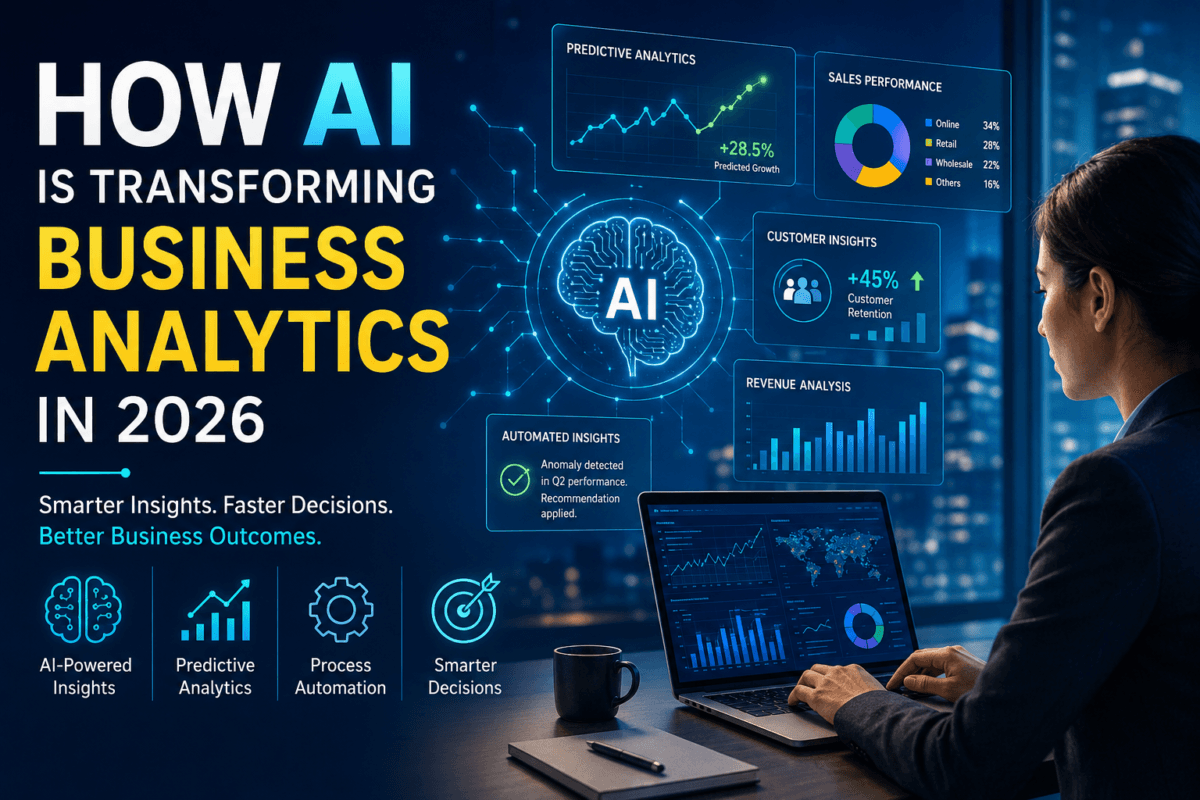
FREE DOWNLOAD: Business Analyst Documentation Toolkit
Get instant access to real-world BRD, FRD, and project story templates used by senior BAs.
Download Free Templates PDFIntroduction
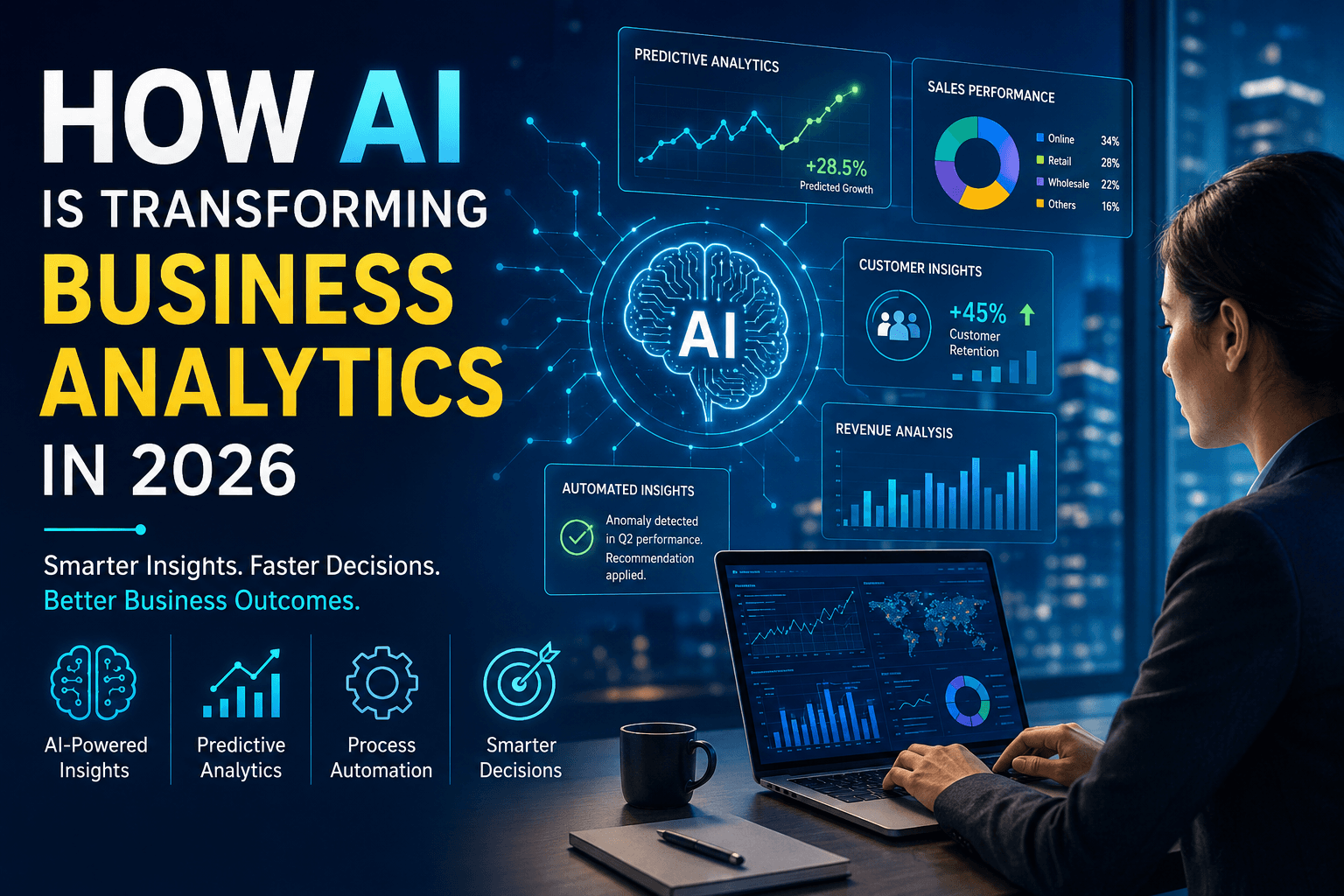
Business Analytics Has Entered the AI Era
Imagine you are a Business Analyst who works for a retail company in 2026.
Every second the company gets a lot of data from customer transactions, website clicks, mobile app interactions, social media comments, supplier updates and logistics events.
By the time you finish looking at yesterdays sales report the company has already gotten thousands of data points. A years ago your job would have been very different. You would have spent hours getting data from systems cleaning up spreadsheets making pivot tables writing SQL queries and building dashboards before showing your findings to the people in charge.
Most of your time was spent getting the data ready of solving Business Analytics problems. Now it is 2026. Things have changed a lot.
Artificial Intelligence or Business Analytics AI now does a lot of the work that used to take up much of a Business Analysts time. Of finding trends by hand Business Analytics AI finds patterns in real time.Of waiting for reports smart systems always watch how the business is doing predict what will happen next and tell you what to do.
This change is really changing Business Analytics. Companies do not just want to know what happened yesterday. They want to know what will happen tomorrow, why it is happening and what they should do now.
Business Analytics AI is making this possible by putting together analytics, machine learning, natural language processing, automation and predictive modeling into a strong system that helps make decisions.
For Business Analysts this change is an opportunity. Of just making reports or dashboards Business Analysts are now advisors who work with Business Analytics AI systems to give advice that can be used make business processes better and help with digital transformation.
In this guide you will learn how Business Analytics AI is changing Business Analytics in 2026 learn about the technologies that are driving this change see how companies are really using Business Analytics AI and understand how Business Analysts can get ready, for the future in a business world that uses more Business Analytics AI.
What Is Business Analytics?
Business Analytics is the process of collecting and organizing Business Analytics data and then analyzing and interpreting Business Analytics information to help make decisions. It assists organizations in understanding how they are performing with Business Analytics finding opportunities to improve with Business Analytics reducing risks and achieving objectives with Business Analytics.
Unlike reporting Business Analytics goes beyond just presenting numbers. It tries to answer Business Analytics questions such as:
* Why are sales declining in a region for our Business Analytics?
* Which customers are most likely to stop using our services for Business Analytics?
* How can operational costs be reduced with Business Analytics?
* Which marketing campaign delivers the return on investment for our Business Analytics?
* How can inventory be optimized to reduce waste with Business Analytics?
* Which business processes should be automated for our Business Analytics?
To answer these Business Analytics questions Business Analytics combines data from sources, including enterprise applications, customer relationship management systems, enterprise resource planning platforms, financial systems, websites, mobile applications, IoT devices and social media channels for our Business Analytics.
The insights generated enable business leaders to make strategic and operational decisions with Business Analytics.
The Four Types of Business Analytics
Business Analytics is commonly divided into four categories:
Descriptive Analytics
Descriptive Analytics focuses on understanding performance with Business Analytics. It answers questions such as:
* What happened with our Business Analytics?
* How many products were sold for our Business Analytics?
* What was months revenue for our Business Analytics?
* Which department exceeded its budget for our Business Analytics?
Business Intelligence dashboards and reports are examples of descriptive analytics for Business Analytics.
Diagnostic Analytics
Diagnostic Analytics investigates why something happened with Business Analytics.
For example:
* Why did website traffic decline for our Business Analytics?
* Why are customer complaints increasing for our Business Analytics?
* Why did production costs rise for our Business Analytics?
Business Analysts use techniques such as root cause analysis, data visualization and statistical analysis to uncover the reasons behind business problems with Business Analytics.
Predictive Analytics
Predictive Analytics uses data, machine learning algorithms and statistical models to forecast future events with Business Analytics.
Examples include:
* Predicting customer churn for our Business Analytics
* Forecasting product demand for our Business Analytics
* Estimating equipment failures for our Business Analytics
* Predicting sales performance for our Business Analytics
* Forecasting risks for our Business Analytics
Prescriptive Analytics
Prescriptive Analytics recommends the action based on predicted outcomes with Business Analytics.
Of simply forecasting future demand it answers:
* How should inventory levels be adjusted for our Business Analytics?
* Which customers should receive offers for our Business Analytics?
* Which supplier should be selected for our Business Analytics?
* How should delivery routes be optimized for our Business Analytics?
Artificial Intelligence plays a role in enabling prescriptive analytics by evaluating multiple scenarios and recommending the most effective solution, for our Business Analytics.
Why AI Is Changing Business Analytics in 2026
The amount of business data created today is huge. Organizations make a lot of data every day from customer interactions, online transactions, sensors, devices and cloud apps.
Old ways of analyzing data can’t handle this information fast enough to help make quick decisions.
Artificial Intelligence helps by letting systems learn from data find patterns predict what will happen and do analysis automatically.
AI doesn’t replace Business Analytics it makes it better by making it faster more accurate and more useful.
Some key reasons AI is changing Business Analytics are:
Real-Time Decision Making
Companies can’t wait for reports at the end of the day or month. AI watches data all the time. Finds problems as they happen. For example an AI system that detects fraud can spot credit card transactions in seconds stopping financial losses before they happen.
Faster Data Processing
A Business Analyst might spend hours getting data ready from systems. AI tools for data preparation can automate tasks, like:
* Cleaning data
* Removing duplicates
* Handling missing values
* Integrating data
* Finding patterns
This lets Business Analysts spend time understanding results and working with stakeholders.
Why Better Prediction Accuracy
Machine learning models get better as they handle data. This helps organizations make reliable predictions about:
* Customer behavior
* Market demand
* Equipment maintenance
* Employee attrition
* Financial performance
* Personalized Customer Experiences
AI helps businesses understand what customers like and how they behave to give them personalized experiences.
Examples include:
* Product recommendations on shopping sites
* Personalized banking offers
* Healthcare treatment suggestions
* Customized learning paths on platforms
The Business Analysts Role in the Age of AI
One big misconception about AI is that it will replace Business Analysts. In reality AI is changing how Business Analysts work, not whether they are needed. Modern Business Analysts spend time gathering data and more time adding strategic value to the business.
Their jobs now include:
* Defining business problems that AI should solve
* Working with data scientists and AI engineers
* Translating business needs into AI projects
* Checking AI recommendations
* Identifying regulatory issues
* Designing decision processes
* Monitoring AI performance and business results
* Communicating insights to stakeholders in a way
In other words Business Analysts are moving from just interpreting data to helping make decisions.
Real-World Scenario
Think of an insurance company that gets thousands of claims daily.
Traditional Approach
A Business Analyst reviews reports to spot fake claim patterns and suggests actions for the fraud team.
AI-Powered Approach
An AI model analyzes each claim in time giving a fraud risk score based on past patterns, customer behavior claim history and external data.
The Business Analyst no longer spends days finding claims. Instead they check the AIs suggestions refine business rules investigate positives and ensure the system follows regulations.
This change lets the Business Analyst focus on important tasks while AI handles repetitive analysis.
Why This Matters for Your Career
The future of Business Analytics is not about replacing expertise with machines. It’s about combining both.
AI is great, at handling data finding hidden patterns and making fast predictions. Business Analysts add something AI can’t: business context, working with stakeholders, strategic thinking, ethical judgment and translating insights into actions.
Those who adapt to AI will not stay relevant but become crucial in helping organizations navigate complex business environments.
Conclusion :
Artificial Intelligence is not something new anymore. It is the reason why Business Analytics is moving forward. In 2026 companies are going beyond just looking at reports and static dashboards. They are using systems that can look at a lot of data guess what will happen next do routine work automatically and tell them what to do at the right time.
For Business Analysts this change is a chance to make their work more valuable. Artificial Intelligence can look at data quickly. Find patterns that people might miss. It still needs people to say what the company wants to achieve understand what the results mean check if the recommendations are good and make sure every decision is good, for the company, its customers and is fair. Artificial Intelligence is not taking the place of Business Analysts.
It is helping them focus on thinking about the picture working with others coming up with new ideas and solving problems. Artificial Intelligence is helping Business Analysts do their job better.
Related Articles:
External References
| Resource | URL |
|---|---|
| Gartner – Artificial Intelligence Research | https://www.gartner.com/en/topics/artificial-intelligence |
| Gartner – Decision Intelligence | https://www.gartner.com/en/information-technology/glossary/decision-intelligence |
🎁 Become a Better Business Analyst
Join 1,200+ Business Analysts learning every week.
Get instant access to:
📘 FREE Business Analyst Templates
🎯 Interview Preparation Guides
🚀 Agile & Scrum Tutorials
🤖 AI for Business Analysts
📈 Career Growth Tips
100% Free • No Spam • Unsubscribe Anytime
