

FREE DOWNLOAD: Business Analyst Documentation Toolkit
Get instant access to real-world BRD, FRD, and project story templates used by senior BAs.
Download Free Templates PDFIntroduction:
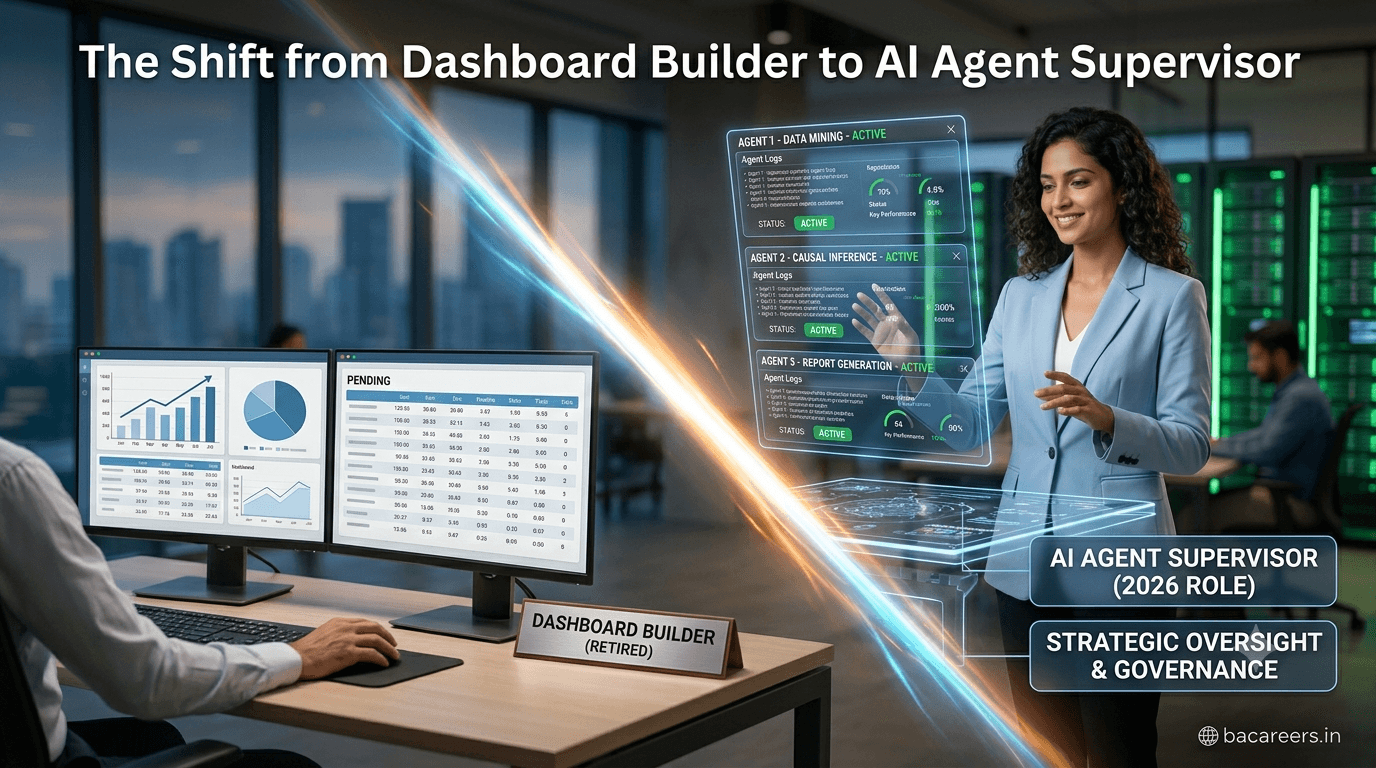
For many years, the primary responsibility of a Business Analyst (BA) was to gather business requirements, analyze data, and build dashboards that helped stakeholders understand business performance. Success was often measured by delivering visually appealing reports, KPI dashboards, and trend analysis that supported decision-making.
However, the business landscape has changed dramatically.
With rapid advances in Artificial Intelligence (AI), Machine Learning (ML), Generative AI, and autonomous AI agents, organizations are no longer satisfied with simply viewing data. They want intelligent systems that can analyze information, recommend actions, and even make operational decisions in real time.
This shift is transforming the role of the Business Analyst.
Instead of spending most of their time creating dashboards, modern Business Analysts are becoming AI Agent Supervisors—professionals who ensure AI systems make accurate, ethical, and business-aligned decisions.
In this article, you’ll learn:
- Why traditional dashboards are no longer enough
- How AI Agents are transforming business operations
- What an AI Agent Supervisor actually does
- Real-world examples from the banking industry
- Essential skills every Business Analyst needs for the AI era
- Why decision intelligence is becoming the future of Business Analysis
Why Traditional Dashboards Are No Longer Enough
Dashboards continue to play an important role in Business Intelligence by helping organizations monitor Key Performance Indicators (KPIs), identify trends, and measure business performance.
However, dashboards have one significant limitation:
They provide information—but they don’t make decisions.
Consider a sales dashboard that shows:
- Revenue has decreased by 15%
- Customer churn has increased by 10%
- Inventory costs continue to rise
While these insights are valuable, they still leave critical business questions unanswered.
Important Business Questions Dashboards Cannot Answer
- Which customers are most likely to leave next month?
- Which marketing campaign deserves additional investment?
- Should product pricing be adjusted immediately?
- Which supplier offers the lowest cost with the highest reliability?
- Which business decision will generate the highest Return on Investment (ROI)?
Traditionally, Business Analysts would:
- Analyze reports
- Meet stakeholders
- Compare possible solutions
- Recommend the best course of action
Although this process worked well for many years, today’s markets move much faster.
By the time decisions are approved, business opportunities may already be lost.
The Rise of AI Agents
Organizations are now moving beyond traditional analytics by adopting AI Agents that can continuously monitor business events and recommend—or even execute—actions automatically.
Unlike dashboards that describe what has already happened, AI Agents analyze data as events occur and support real-time decision-making.
What Can an AI Agent Do?
Modern AI Agents can:
- Detect unusual sales patterns
- Predict customer churn
- Identify potentially fraudulent financial transactions
- Recommend optimal inventory replenishment
- Prioritize customer support tickets
- Suggest business process improvements based on live operational data
Instead of waiting for someone to interpret reports, businesses can respond immediately to changing conditions.
This is one of the biggest shifts in modern Business Analysis.
From Business Analyst to AI Agent Supervisor
As AI systems become more intelligent, the Business Analyst’s role is evolving beyond requirements gathering and dashboard creation.
Rather than manually reviewing every business event, Business Analysts now supervise AI-driven decisions to ensure they are accurate, ethical, compliant, and aligned with business objectives.
Responsibilities of an AI Agent Supervisor
An AI Agent Supervisor is responsible for:
- Defining business rules that govern AI decision-making
- Reviewing AI-generated recommendations before implementation
- Monitoring AI performance and decision quality
- Identifying situations requiring human intervention
- Ensuring regulatory and organizational compliance
- Collaborating with AI Engineers, Data Scientists, and business stakeholders
- Evaluating the long-term business impact of AI-driven decisions
- Continuously refining business rules to improve AI outcomes
Instead of interpreting dashboards, Business Analysts now evaluate how AI makes decisions and identify opportunities for continuous improvement.
Real-World Example: AI in Retail Banking
The banking industry provides an excellent example of this transformation.
Traditional Business Intelligence Approach
A Business Analyst reviews reports covering:
- Loan approval rates
- Customer repayment trends
- Default statistics
Credit officers then analyze these reports before making lending decisions.
Although effective, this process is time-consuming.
AI Agent Approach
An AI Agent evaluates each loan application using:
- Credit history
- Income
- Employment details
- Spending behavior
- Fraud indicators
The AI system then recommends whether to:
- Approve the loan
- Reject the application
- Escalate the case for manual review
The Business Analyst no longer evaluates every individual application.
Instead, they supervise the AI system.
The Business Analyst’s New Responsibilities
- Ensure approval decisions comply with lending policies
- Monitor incorrect approvals and rejections
- Investigate unusual AI decisions
- Update business rules when regulations change
- Measure business outcomes generated by AI recommendations
This represents a major shift—from operational analysis to strategic AI governance.
Essential Skills Every Future Business Analyst Must Learn
Business Analysts who want to stay competitive must develop new capabilities beyond reporting and dashboard development.
Decision Intelligence
Learn how organizations combine analytics, AI, and business rules to make smarter decisions.
Artificial Intelligence and Machine Learning Fundamentals
Understand:
- How AI models work
- Model limitations
- Business applications of Machine Learning
Prompt Engineering
Learn how to create effective prompts for AI assistants that generate reliable business outcomes.
Business Process Automation
Understand automation platforms that streamline repetitive business processes.
Decision Modeling
Learn how organizations represent complex business decisions using structured models.
Business Rules Management
Develop business rules that AI systems can consistently follow.
Process Mining
Discover hidden process inefficiencies using event logs and operational data.
Predictive and Prescriptive Analytics
Move beyond descriptive reporting by learning:
- Future forecasting
- Recommendation modeling
Data Governance
Understand:
- Data quality
- Privacy
- Security
- Regulatory compliance
AI Ethics and Responsible AI
Ensure AI systems remain:
- Fair
- Transparent
- Explainable
- Unbiased
Stakeholder Management for AI Projects
Business Analysts must bridge communication between:
- Business leaders
- AI Engineers
- Data Scientists
- Compliance teams
- End users
Strong stakeholder management remains one of the most valuable BA skills.
The Future of Business Analysis
The future belongs to Business Analysts who can combine:
- Business process expertise
- Analytical thinking
- Strategic decision-making
- Artificial Intelligence
- Human judgment
Dashboards will continue to provide valuable insights.
However, AI Agents will increasingly perform operational analysis and recommend actions automatically.
As a result, Business Analysts will focus on:
- Designing intelligent decision frameworks
- Supervising AI systems
- Managing business risk
- Ensuring ethical AI usage
- Aligning AI decisions with organizational objectives
conclusion:
Business Analysis is entering a new era.
The most successful Business Analysts will no longer be defined by the number of dashboards they build. Instead, they will be recognized for their ability to guide AI systems toward making smarter, faster, and more responsible business decisions.
The transition from Dashboard Builder to AI Agent Supervisor is not simply another career trend—it represents the future direction of Business Analysis itself.
Business Analysts who embrace AI, Decision Intelligence, and strategic thinking today will become the leaders of tomorrow.
Related Articles:
Using AI Tools in Business Analysis
: Business Analyst Roadmap 2026
BRD vs FRD Difference with Examples or Unlocking Insights: A Comprehensive Guide to Business Analytics
External Links:
“What is an AI Agent Supervisor Pattern?” :
The technical architecture where a central supervisor engine coordinates specialized worker agents.
“AI agent supervisor architecture pattern”
🎁 Become a Better Business Analyst
Join 1,200+ Business Analysts learning every week.
Get instant access to:
📘 FREE Business Analyst Templates
🎯 Interview Preparation Guides
🚀 Agile & Scrum Tutorials
🤖 AI for Business Analysts
📈 Career Growth Tips
100% Free • No Spam • Unsubscribe Anytime
